


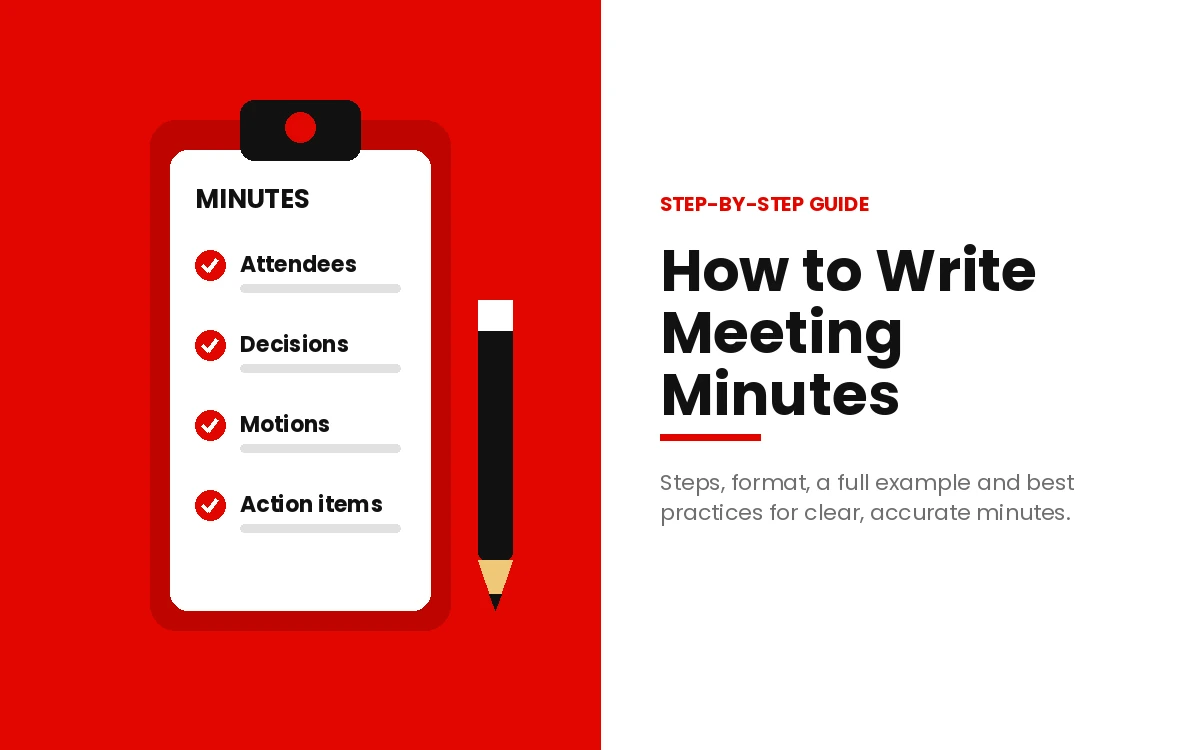
To learn how to write meeting minutes, start with the agenda and record each decision, motion and action item while the meeting runs. Afterward, turn your notes into a short, neutral summary, ideally within 24 to 48 hours. Meeting minutes are the written record of what a group decided at a meeting, and formal bodies such as boards approve them as their official record. Someone who missed the session should be able to read them and see who owns each follow-up task, along with its due date.
Good minutes give an organization four practical benefits: a historical record, legal documentation for audits or disputes, clear accountability for action items, plus transparency for absent stakeholders. Corporate boards, school boards, nonprofits and governmental bodies depend on minutes for exactly those reasons, while project teams use them to keep follow-ups from slipping between meetings.
A basic set of minutes covers 7 core parts: a header, an attendees list, approval of the previous minutes, a discussion summary, decisions and motions, action items, plus the next meeting date. Formal boards and committees add further detail, such as quorum status, reports and signatures. The sections below follow the order a minute taker works in, from preparation through approval. Later sections add a standard minutes of meeting format, a completed sample, board-specific rules and the habits behind consistently useful minutes.
Key Takeaways
- Minutes record what was done, not what was said.
- Read the agenda and papers before the meeting starts.
- Capture every decision, motion, vote and action item live.
- Give each action one named owner and a deadline.
- Aim to type up the draft within 24 to 48 hours.
- Write in past tense with a neutral tone.
- Send the draft to the chair before wider distribution.
- Board minutes can carry legal weight, so keep them precise.
What Are Meeting Minutes?
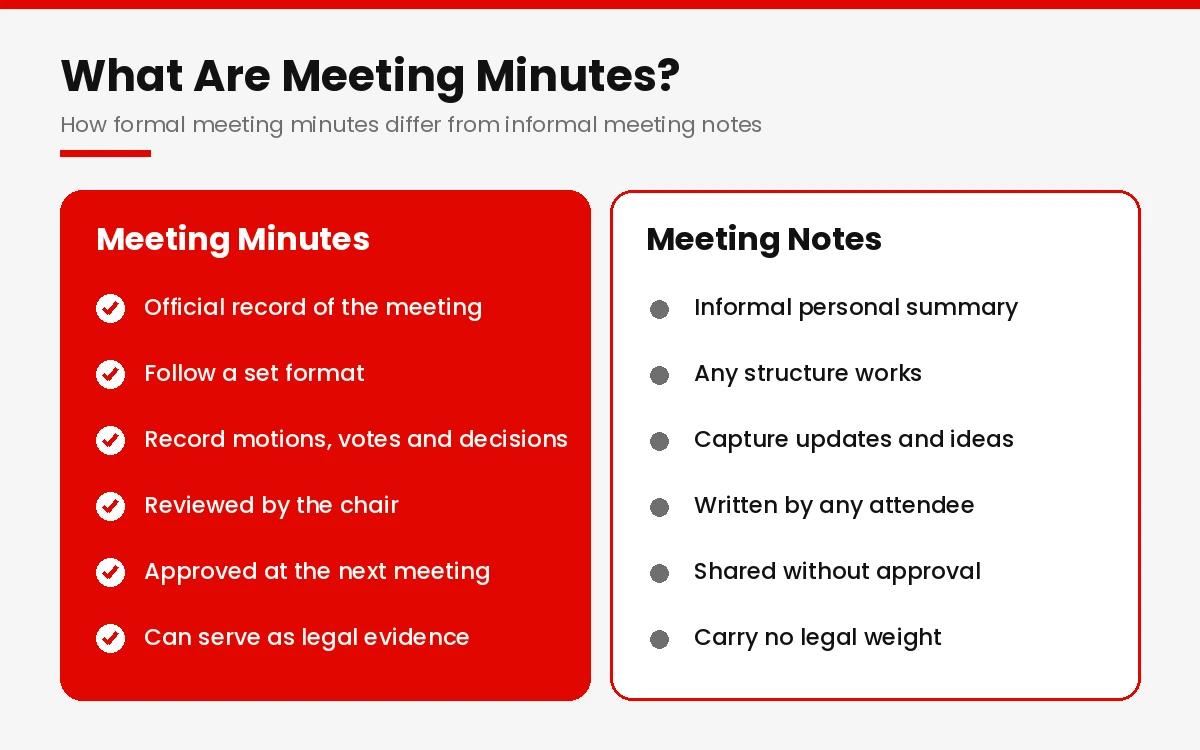
Meeting minutes are the written record of a meeting, covering who attended, which topics came up, what the group decided and which actions people agreed to take. Minutes summarize outcomes instead of transcribing every word, so a reader can get through a one-hour meeting in a few minutes.
The parliamentary guide Robert's Rules of Order sets the principle most organizations follow: minutes should hold mainly a record of what was done at the meeting, not what each member said. City councils, corporate boards and student clubs apply the same rule, even when their own bylaws ask for extra detail on certain items.
A secretary, clerk or designated minute taker usually prepares the document, though some teams rotate the role every week. In formal bodies, the chair reviews the draft and the group usually approves it at the following session, which turns a draft into the official record. Approval rules depend on your bylaws, governing law and meeting type.
Meeting Minutes vs Meeting Notes
Meeting minutes are formal, follow a fixed structure and need group approval, while meeting notes are informal summaries any attendee can write for personal use. Board and committee minutes can serve as evidence in legal or regulatory reviews, whereas notes simply help a team remember updates.
Writing meeting notes suits a weekly stand-up or a client call where nobody votes on anything. Formal minutes become the better choice as soon as a meeting involves motions, budgets, policy changes or any decision someone could dispute later.
Why Are Meeting Minutes Important?
Meeting minutes matter for 6 reasons: they preserve history, provide legal documentation, create accountability, support communication, act as reference material and promote transparency. Each reason ties to a practical outcome for the people who rely on the record.
- Historical record. Minutes show how past decisions came about, which helps new members understand why a policy exists in its current form.
- Legal documentation. Auditors, regulators or courts can review minutes during an audit or dispute to check whether a board met its statutory requirements and fiduciary responsibilities.
- Accountability. A named owner beside each task turns a vague promise into work someone has to finish before the next meeting.
- Communication. Absent members, investors or department heads catch up on key developments without needing a separate briefing.
- Reference material. Attendees check the minutes to recall exactly what the group agreed, instead of relying on memory weeks later.
- Transparency. Public bodies and charities publish minutes so members of the public can see how each decision was reached.
Several laws turn good practice into a requirement. The Delaware General Corporation Law assigns one corporate officer the duty to record the proceedings of stockholder and director meetings in a book kept for that purpose. The Texas Open Meetings Act requires governmental bodies to keep minutes or a recording of each open meeting.
Outside the US, the UK Companies Act 2006 obliges every company to keep minutes of directors' meetings for at least 10 years. Under section 249 of the same Act, minutes authenticated by the meeting's chair count as evidence of the proceedings. Requirements differ by organization type and jurisdiction, so check your bylaws and the statute that covers your organization before deciding how much detail your minutes need.
What Should Meeting Minutes Include?
Meeting minutes should include 12 items, from the organization name and attendance list through decisions, action items, the next meeting date and a signature. The detailed checklist expands the 7 core parts into the items formal bodies usually record, while a short team meeting can skip the formal entries such as quorum and motions.
- Organization name and meeting type, such as "Board of Directors Regular Meeting" or "Marketing Team Weekly Sync."
- Date, start time and end time, which support timekeeping and show how long each session ran.
- Physical or virtual location, including the room name or the video platform for online meetings.
- Attendees and absentees, with late arrivals, early departures, guest speakers and observers noted separately.
- Quorum status, stating whether enough voting members attended to make binding decisions.
- Approval of previous minutes, recording whether the group accepted them as written or with corrections.
- Discussion summary for each agenda item, covering key points, supporting data, questions and concerns.
- Motions and resolutions, with the wording, mover, seconder and vote outcome.
- Decisions, stated plainly, along with any conditions or deadlines attached to them.
- Action items, each with a task description, one named owner and a due date.
- Next meeting date, time and location, plus any preparation members need to complete.
- Adjournment time and signature of the secretary, with the chair's signature where bylaws require it.
Leave out personal opinions, side conversations and jokes. Keep sensitive personal details, such as an employee's medical information, in a separate restricted record, while still recording every decision your bylaws or the law require.
How Do You Prepare Before the Meeting?
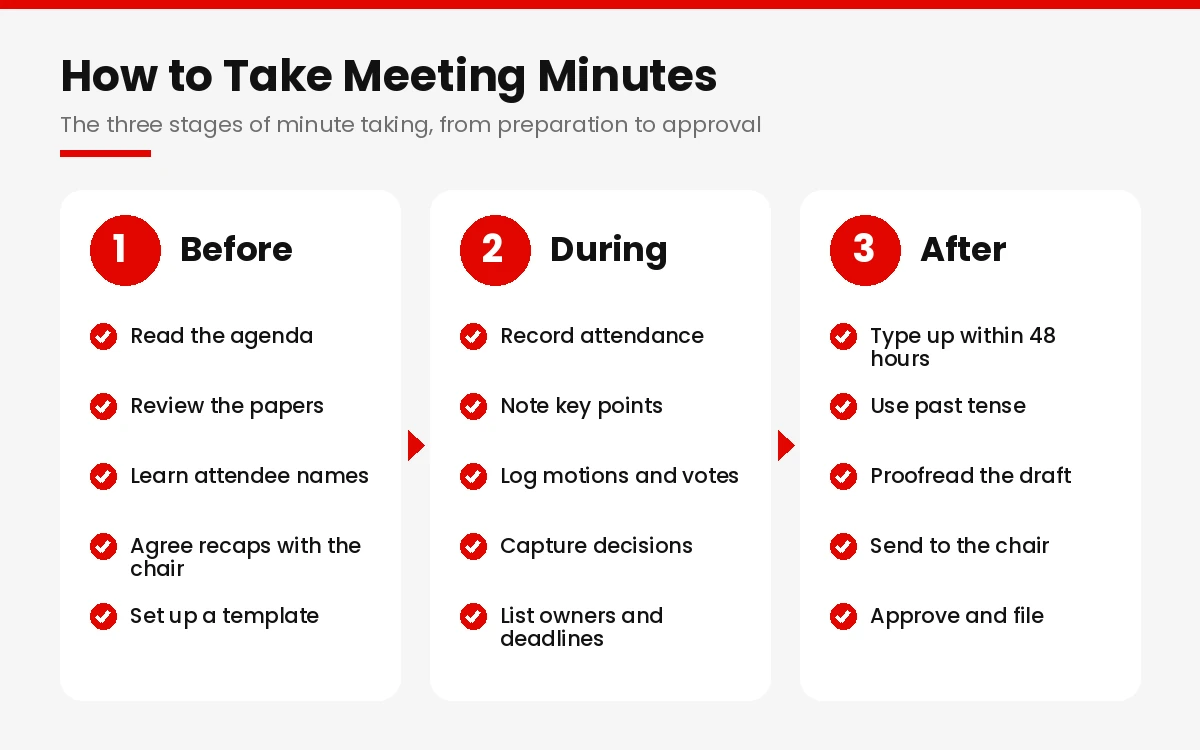
To prepare for minute taking, read the agenda, review the meeting papers, learn attendees' names, agree on a recap routine with the chair and set up a template. Preparation gives you context, which makes a fast discussion far easier to follow.
- Review the agenda. The agenda sets the order of topics, the presenters and the decisions the group needs to make, which tells you where to listen hardest.
- Read the papers. Reports and proposals attached to the agenda reveal the figures, acronyms and jargon likely to come up during discussion.
- Learn the names. Check the spelling and role of every board member, guest speaker and observer, so each motion lands on the right person.
- Check open actions. Items still pending from the previous minutes usually return under old business or matters arising.
- Agree on a recap routine with the chair. Ask the chair to restate each decision aloud before moving on, which hands you a clean line to record.
- Set up a template. Create a heading for each agenda item with space for discussion, decisions and actions, then pre-fill the expected attendees list so you can tick names as people arrive.
How to Take Meeting Minutes During the Meeting
To take meeting minutes during a session, record attendance first, then capture each agenda item's key points, motions, decisions and action items as they happen. Listen for outcomes rather than dialogue, since a good minute taker writes down results, not speeches.
- Attendance and quorum. Note who is present, who sent apologies, who arrived late and whether the group reached a quorum.
- Call to order. Write the exact start time along with the name of the person who opened the meeting.
- Key points. Summarize the main arguments for each item in one or two sentences, including real points of disagreement.
- Supporting data. Record the figures or documents presented, then reference them instead of copying their contents.
- Questions and concerns. Capture significant questions from members together with the answers they received.
- Motions. Write the exact wording of each motion, the mover, the seconder and the result of the vote.
- Decisions. State what the group decided, plus any conditions attached to the decision.
- Action items. List the task, the owner and the deadline for every follow-up the group agrees.
Formal groups often number motions consecutively through the year, so motion 15 at one meeting picks up where motion 14 ended at the last. A complete motion answers who, what, where, when, why and how, for example who receives a payment, the amount, the budget account, the event date, the reason and the payment method.
Shorthand keeps notes readable when the pace picks up. Writing "D:" before a decision and "A:" before an action, with initials for owners, lets you rebuild the full record later without hunting through paragraphs.
How to Take Good Minutes of Meeting When the Discussion Moves Fast
To take good minutes of meeting when talk moves fast, focus on outcomes, flag anything unclear and ask the chair to confirm each decision before the next item begins. A quick question such as "Can I confirm what we agreed for the minutes?" prevents arguments weeks later.
Off-agenda ideas belong in a short parking-lot list at the end of your notes, which keeps the main record tidy while still capturing suggestions for future meetings. Check the recording laws for your location before recording audio, since consent rules vary by state and circumstance, as the Reporters Committee for Freedom of the Press recording guide shows. Workplace policies can add further restrictions.
Minute takers who also present should ask a colleague to cover the notes during their own agenda item. Presenting a proposal while typing an accurate record of the reaction to it rarely works for anyone.
How to Type Up Meeting Minutes After the Meeting
To type up meeting minutes, turn your notes into a clean draft within 24 to 48 hours, write in past tense with a neutral tone, then send it to the chair. No universal legal deadline applies to most meetings, yet details fade quickly, so the same day gives the most accurate result.
- Transcribe your notes. Move handwritten notes into a digital document in Microsoft Word, Google Docs or OneNote, using the same template every time.
- Write in past tense with reported speech. "The treasurer reported that spending stayed within budget" reads better than "We're on budget."
- Choose neutral words. Replace "a heated argument" with "members discussed the proposal at length and views differed."
- Use action verbs. "The committee approved the proposal" tells readers far more than "the committee discussed the proposal."
- Explain major decisions. One sentence on why the group chose an option gives absent members the context they need.
- Spell out acronyms. Write the full term on first use, with the abbreviation in parentheses after it.
- Attach supporting documents. Reference reports and slides as appendices instead of summarizing them line by line.
- Proofread. Check names, figures, dates, spelling and grammatical errors before anyone else sees the draft, then save a PDF copy for distribution so the formatting stays fixed.
How Do You Approve, Distribute and Store Minutes?
Send the draft minutes to the chair first, circulate the corrected version to attendees and absentees, then present it for formal approval, usually at the next meeting. After approval, the secretary signs the minutes and files them as the official record.
Store approved minutes in one shared location with controlled access, such as a board portal or a restricted folder in your cloud drive. Teams comparing shared workspaces can find options in our guide to team collaboration tools. Minutes from human resources (HR) disciplinary hearings, grievances or safeguarding reviews need tighter access, plus a fuller record of questions and answers. Those records face closer scrutiny whenever someone challenges the outcome.
How to Structure Meeting Minutes: The Standard Format
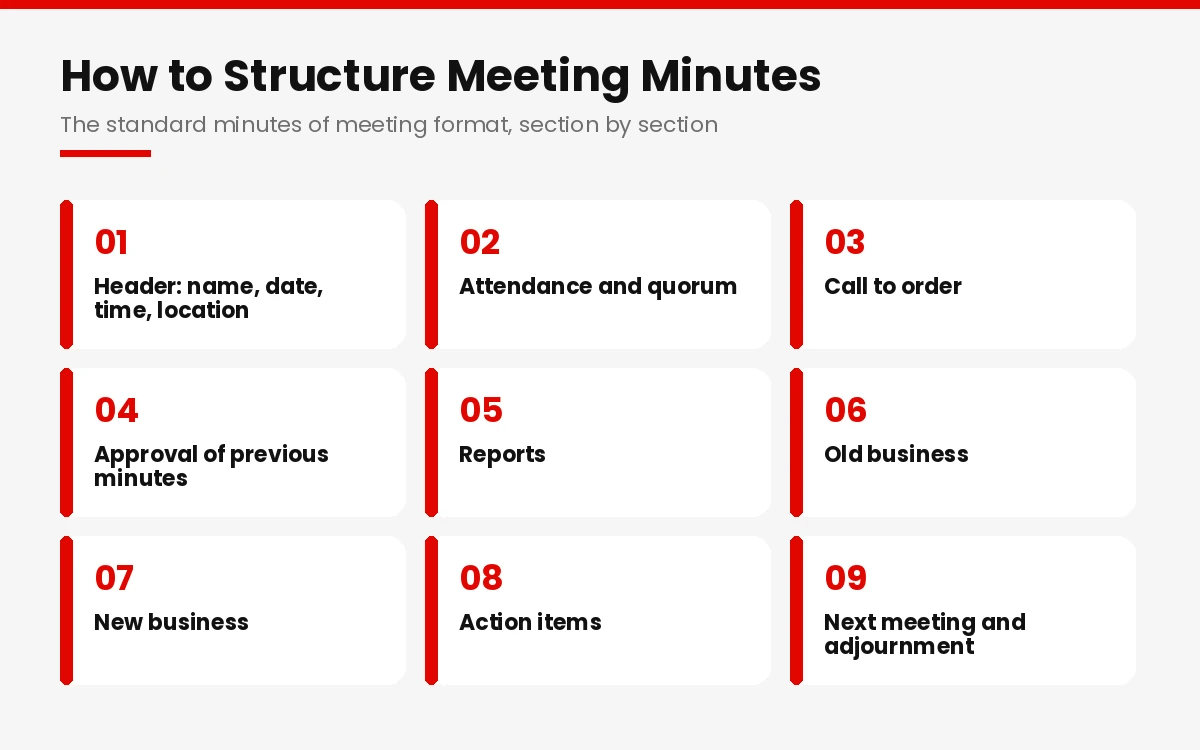
The standard minutes of meeting format follows the agenda in 9 sections, starting with the header and attendance, then moving through reports and business items to action items and adjournment. Keeping the same order every time lets readers find information in the same place across years of records.
- Header: organization name, meeting type, date, time and location.
- Attendance: members present, apologies, guests and quorum status.
- Call to order: start time and the name of the person presiding.
- Approval of previous minutes: accepted as written or with corrections.
- Reports: short summaries from officers, committees or project leads.
- Old business: progress on items carried over from earlier meetings.
- New business: fresh proposals, discussion summaries, motions and votes.
- Action items: task, owner and deadline for each follow-up.
- Next meeting and adjournment: the next date, the closing time and the secretary's signature.
Informal team meetings can drop the reports and motions sections, keeping only the header, attendees, a discussion summary, decisions and actions. The free fill-in template below follows the same 9 sections, so copy it into your document editor and reuse it for every meeting:
1. Header: [Organization name] | [Meeting type] Minutes
Date: [date] | Time: [start] to [end] | Location: [room or video link]
2. Attendance: Present: [names, roles] | Apologies: [names] | Guests: [names] | Quorum: [yes/no]
3. Call to order: [time], [chair's name]
4. Approval of previous minutes: [approved / approved with corrections]
5. Reports: [summary of each report]
6. Old business: [item, status, decision]
7. New business: [item, discussion summary, motion, vote, decision]
8. Action items: [task] | [owner] | [deadline]
9. Next meeting and adjournment: [next date, time, location] | Adjourned at [time]
Minutes prepared by: [name, title] | Signature: [____]
Meeting Minutes Example
The meeting minutes example below shows a completed record for a fictional software company's monthly product meeting. Use this example of minutes of meeting sample as a starting point, then adjust the sections to match your own bylaws or team habits. The sample only demonstrates a format, so real minutes must reflect what actually happened at your meeting.
Brightline Software, Product Team Monthly Meeting
Date: Tuesday, October 6, 2026. Time: 10:00 a.m. to 10:48 a.m. Location: Conference Room B and video call.
Present: Maria Chen (Chair, Head of Product), James Okafor (Engineering Lead), Priya Raman (Design Lead), Tom Becker (Quality Assurance Lead). Apologies: Sara Lind (Marketing). Minute taker: Daniel Ruiz.
1. Call to order. Maria Chen opened the meeting at 10:00 a.m. All 4 voting members attended, so the meeting reached quorum.
2. Previous minutes. The team approved the September 1 minutes with one correction to the release date in item 3.
3. Mobile release update. James Okafor reported that 18 of 22 planned features had passed testing. Tom Becker raised a concern about login failures on older Android devices. Decision: the team agreed to move the release from October 20 to October 27 to fix the login issue.
4. Onboarding redesign. Priya Raman presented 2 design options for the new onboarding flow. Members preferred option B for its shorter sign-up. Motion: approve option B for development. Moved by Priya Raman, seconded by James Okafor. Vote: 4 for, 0 against, 0 abstaining. Motion carried.
5. Next meeting. Tuesday, November 3, 2026, at 10:00 a.m. in Conference Room B. The meeting adjourned at 10:48 a.m.
| Item | Action | Owner | Deadline | Status |
|---|---|---|---|---|
| 3 | Fix Android login failures | James Okafor | Oct 22 | Open |
| 3 | Confirm new release date with marketing | Maria Chen | Oct 9 | Open |
| 4 | Hand over option B design files | Priya Raman | Oct 13 | Open |
| 4 | Write test plan for new onboarding | Tom Becker | Oct 16 | Open |
How to Write the Minutes of a Board Meeting
To write the minutes of a board meeting, record the quorum, each motion with its mover and result, conflicts of interest and the reasoning behind major decisions. Board minutes use more formal language than team minutes. Board meeting minutes can become evidence in shareholder disputes or regulatory reviews, which raises the standard for accuracy.
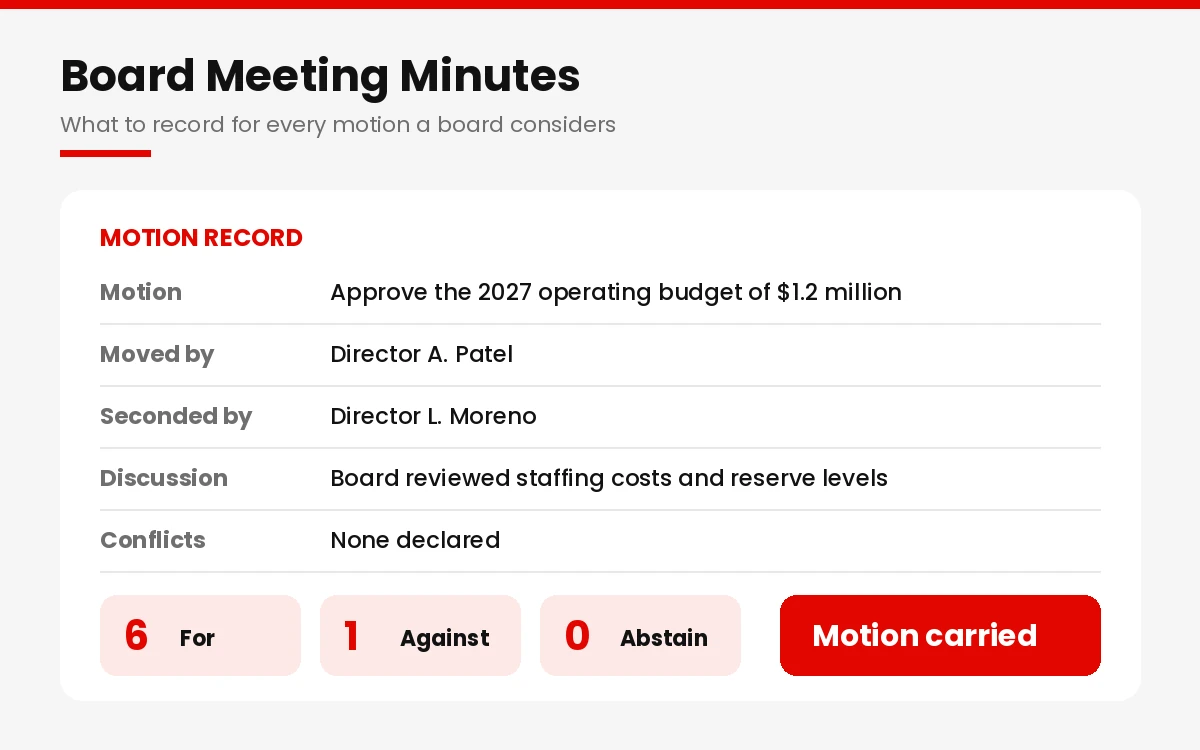
- Confirm the quorum at the start, and again after any director leaves early.
- Record conflicts of interest, including which director declared one and whether that director left the room for the vote.
- Show the challenge. A short summary of the questions directors asked proves the board weighed risks before deciding.
- Note dissent on request. Record a director's opposition by name when that director asks for it to appear in the minutes.
- Name individuals sparingly. Most boards act as one body, so minutes usually say "the board noted" unless bylaws or regulators expect attribution.
- Handle executive sessions carefully. Record that a closed session took place, its general topic and the time, following your counsel's guidance on privileged content.
Minutes of directors' meetings frequently surface in shareholder lawsuits. A guide from the Association of Corporate Counsel explains that Delaware courts examined board minutes in the Disney executive-pay litigation when judging whether directors met their fiduciary duties.
Boards approving artificial intelligence (AI) investments face the same scrutiny, a point our article on AI governance covers in more depth. A board secretary who records the options considered, the risks discussed and the final vote gives directors a defensible record. Capture the relevant reasoning without exposing sensitive personal or legally privileged information beyond what the record needs.
How to Take Effective Meeting Minutes: 8 Best Practices
Best practices for meeting minutes come down to 8 habits, each aimed at making the record accurate, neutral and easy to act on. Experienced secretaries apply them at every meeting, whether a two-person check-in or an annual general meeting.
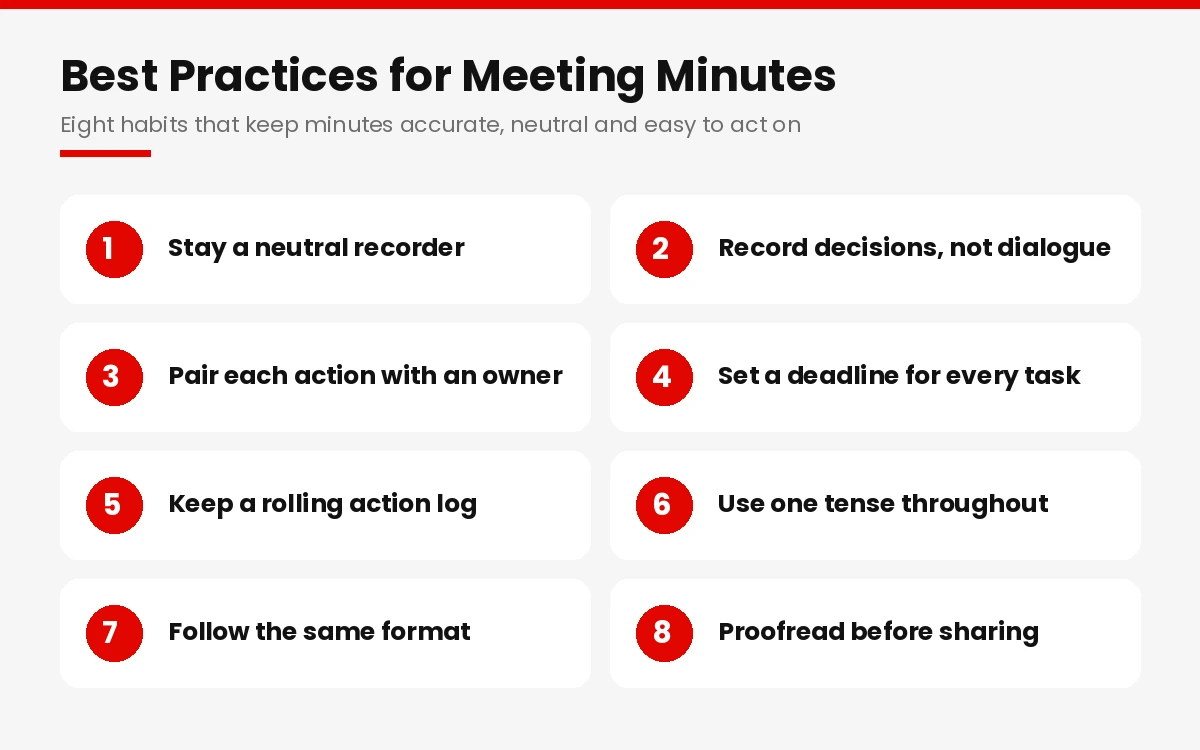
- Stay a neutral recorder. Keep your own opinions, adjectives and judgments out of the minutes entirely.
- Record decisions, not dialogue. Distill each discussion into its outcome, the main reason behind it and any dissent.
- Pair every action with one owner. Assigning one named owner makes follow-up responsibility clearer than a task left to the whole team.
- Set a deadline for every task. "JB to book training for 6 new starters by November 30" can be checked, unlike "training to be arranged soon."
- Keep a rolling action log. Review open actions at the start of each meeting, then close, update or carry them forward.
- Use one tense throughout. Past tense with reported speech keeps the record consistent from first item to last.
- Follow the same format. A fixed layout helps readers compare meetings over months or years.
- Proofread before sharing. Check every name, number and date against your notes before the chair sees the draft.
Action completion rate makes a useful measure of whether meetings produce results. Teams that already track performance through KPI examples can add the share of actions closed by their deadline to the same dashboard.
What Mistakes Should You Avoid When Writing Minutes?
The 5 most common minute-taking mistakes are writing a transcript, using vague action wording, adding personal opinions, delaying the write-up and skipping chair review. Each one weakens the record in a different way.
- Transcripts bury decisions under pages of dialogue nobody will read.
- Vague wording such as "to be discussed" leaves no owner and no deadline.
- Opinions make minutes unfair to participants and risky to share.
- Late write-ups lose detail, especially on numbers and motion wording.
- Skipping chair review lets errors reach the official record unchecked.
Follow your retention policy for raw notes as well. An old notebook kept long after approval can contradict the official minutes if a dispute reaches court.
Can AI Help You Write Meeting Minutes?
AI tools can transcribe a meeting, draft a summary and pull out action items, but a person still needs to check every decision, name and figure before the minutes go out. Speech recognition still mishears names, while summarizers sometimes record a suggestion as a decision.
ChatGPT turns rough notes into a formatted first draft in a few steps:
- Remove sensitive details from your notes, or use an account your organization has approved.
- Paste your template and ask the tool to keep its section order.
- Paste your notes with an instruction such as "Write formal minutes in past tense, listing each decision and each action with its owner and deadline."
- Check the draft against your notes for names, figures, motions and vote counts.
- Send the corrected draft to the chair, as you would with handwritten minutes.
Outlook users can keep the whole process inside the calendar invite. Attach your template to the meeting before it starts, then send the finished minutes with Reply All from the same invite, so every attendee receives them. Microsoft 365 adds transcripts and AI recaps to Teams meetings, though availability depends on your license and organization settings. Our guide to AI assistants for productivity compares meeting assistants in detail, and our explainer on tasks for generative AI shows where drafting tools fit best.
Upload confidential board material to an AI tool only after your organization approves that use. Personal ChatGPT accounts can use conversations to improve models, depending on each user's data controls. Business plans follow different default policies, so review the terms before sharing sensitive records. Organizations that want minutes drafted inside their own approved systems can explore AI agent development with O2SOFT.
Conclusion
Knowing how to write meeting minutes comes down to a repeatable routine. Prepare from the agenda, capture decisions, motions and action items while the meeting runs, then type up a neutral draft while details are fresh. A consistent minutes of meeting format keeps every record easy to scan, while named owners and deadlines turn discussion into finished work.
Board meeting minutes raise the stakes, since they can show auditors, regulators or courts how directors reached each decision. Apply the 8 best practices above, keep the chair involved in review, and use AI tools for first drafts only, with a person checking every detail before approval.
Frequently Asked Questions
Who should take meeting minutes?
A secretary, clerk or designated minute taker who is not leading the discussion should take meeting minutes. The chair runs the meeting, so a separate person can focus on recording decisions accurately.
Should meeting minutes be written word for word?
Meeting minutes should summarize decisions, motions and actions rather than record every word. Verbatim records suit court hearings or legislative sessions, while sensitive HR meetings often call for a fuller record of questions and answers.
What tense are meeting minutes written in?
Most style guides recommend past tense, third person and reported speech for meeting minutes. Write "The director reported that sales rose 4%" rather than "Sales are up 4%," keeping the same tense throughout.
How soon should meeting minutes be sent out?
Send a draft to the chair within 24 to 48 hours of the meeting, then circulate the corrected version to attendees. Most groups formally approve the minutes at their next meeting, depending on their bylaws.
How long should you keep meeting minutes?
Keep meeting minutes for as long as your bylaws and local law require, which is at least 10 years for UK directors' meetings. Many corporations keep board minutes permanently as part of their corporate records.
Can meeting minutes be written in bullet points?
Team meeting minutes work well in bullet points, while formal board minutes usually use full sentences for motions and resolutions. Your governing rules and the purpose of the minutes decide the detail required.
What is the difference between action minutes and discussion minutes?
Action minutes record only decisions and tasks, while discussion minutes add a short summary of the debate behind each decision. Most boards use discussion minutes, since the reasoning shows directors considered the issue carefully.
What should minutes of directors meeting include?
Minutes of directors meeting should include the quorum, conflicts of interest, each motion with its mover and vote, the resolutions passed and the main reasoning behind major decisions. Add the chair's signature once the board approves the record.
How does a secretary write minutes step by step?
A secretary prepares a template from the agenda, records attendance and outcomes during the meeting, types up a draft, sends it to the chair and files the approved version. The secretary also tracks open actions and brings them back at the next meeting.
What English writing rules apply to meeting minutes?
Clear minutes in English use past tense, reported speech, full names on first mention and plain words instead of jargon. Spell out each acronym once, keep sentences short and avoid adjectives that signal opinion.
How do student councils and school boards keep minutes?
Student councils and school boards follow the same format, usually under Robert's Rules, with numbered motions, vote counts and a record of budget decisions. Public school boards often fall under state open meetings laws, which can require them to keep minutes available to the public.