


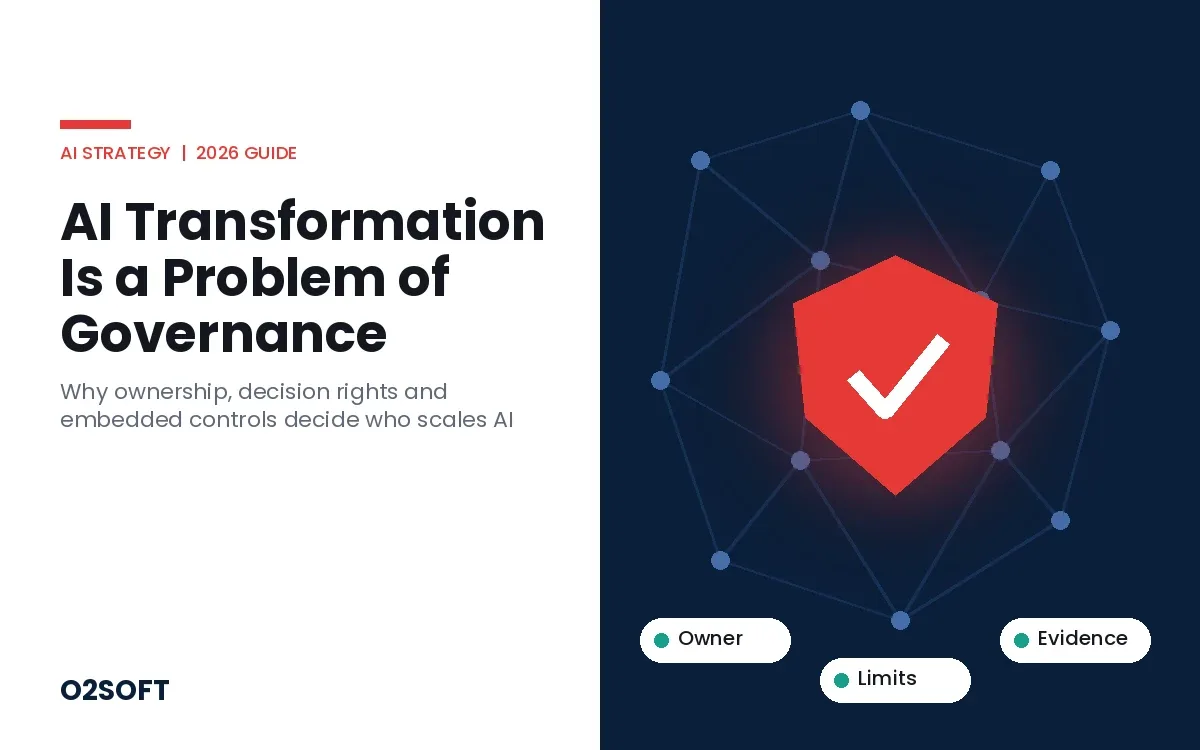
AI transformation is a problem of governance when a company adopts AI faster than it can decide who owns each system and what that system may do. The models themselves usually work well enough, so the breakdown tends to happen in the layer of decisions around them. Someone has to sign off, someone has to set limits, and there has to be a record ready for the day an auditor asks questions. In June 2026, a survey of 2,000 technology executives by IBM with Oxford Economics found that 77% of organizations say AI adoption already outpaces their governance capabilities.
Getting AI transformation governance right pays off in ways a finance team can actually measure. Approval paths become predictable, which lets teams move agents into production without waiting on ad hoc meetings with five departments. Incidents drop once the controls live inside the systems, while audit evidence is already on file when a regulator or customer requests it. The same thinking applies to customer-facing chatbots, internal copilots, agents with write access or the AI features vendors switch on inside software you already pay for.
This guide starts with the research on the AI governance gap, then moves through the challenges that stall rollouts and the way agentic AI raises the stakes. After that comes a five-part governance model built on decision rights, risk tiers, embedded controls, continuous evidence and continuous improvement. The final sections cover the EU AI Act timeline, a set of maturity measures and a practical 90-day plan for closing the gap.
Key Takeaways
- Adoption is ahead of control, with 77% of organizations in the IBM study saying AI adoption outpaces governance and only 11% feeling ready for next year's agent rollout.
- Written policy is common while enforced policy is rare, since EY found 98% of large U.S. companies have an AI governance policy, yet 47% bypassed it for urgent work.
- Agent governance is still immature, as Deloitte's State of AI in the Enterprise 2026 puts mature governance for autonomous agents at just 21% of companies.
- Embedded controls outperform manual review, with IBM reporting 25% fewer incidents at organizations that build control directly into their AI systems.
- EU deadlines moved without the duties disappearing, as Regulation (EU) 2026/1744 pushed Annex III high-risk obligations back to December 2, 2027.
What Does "AI Transformation Is a Problem of Governance" Mean?
It means the hard part of scaling AI has moved away from the model itself toward the organization that has to run it every day. A proof of concept needs little more than a capable model, a small dataset and a couple of engineers who are willing to experiment. Rolling the same system out across departments raises questions that no model can answer on its own, however good its benchmarks look. Somebody has to decide who approves a new agent, which data it can read and which of its actions need a human. Another person has to be on call when it fails, with a record behind every one of those decisions.
Governance in this sense covers far more ground than compliance paperwork or an annual policy review. It is the set of decision rights, risk thresholds, review steps and technical controls that keep a company in charge of its AI as usage grows. Our guide to what artificial intelligence is covers the vocabulary of AI ethics and responsible AI, so this article starts where those principles usually get stuck.
Why AI Transformation Is Not a Technology Problem
The shorthand "ai transformation not technology problem" is a fair summary for most enterprises in 2026, even if it sounds like a slogan at first. Foundation models are rented by the API call, agent frameworks are open source, while GPU capacity is sold by the hour to anyone with a credit card. Two companies with identical access to the same models still end up in very different places, and the difference usually traces back to how each one is organized.
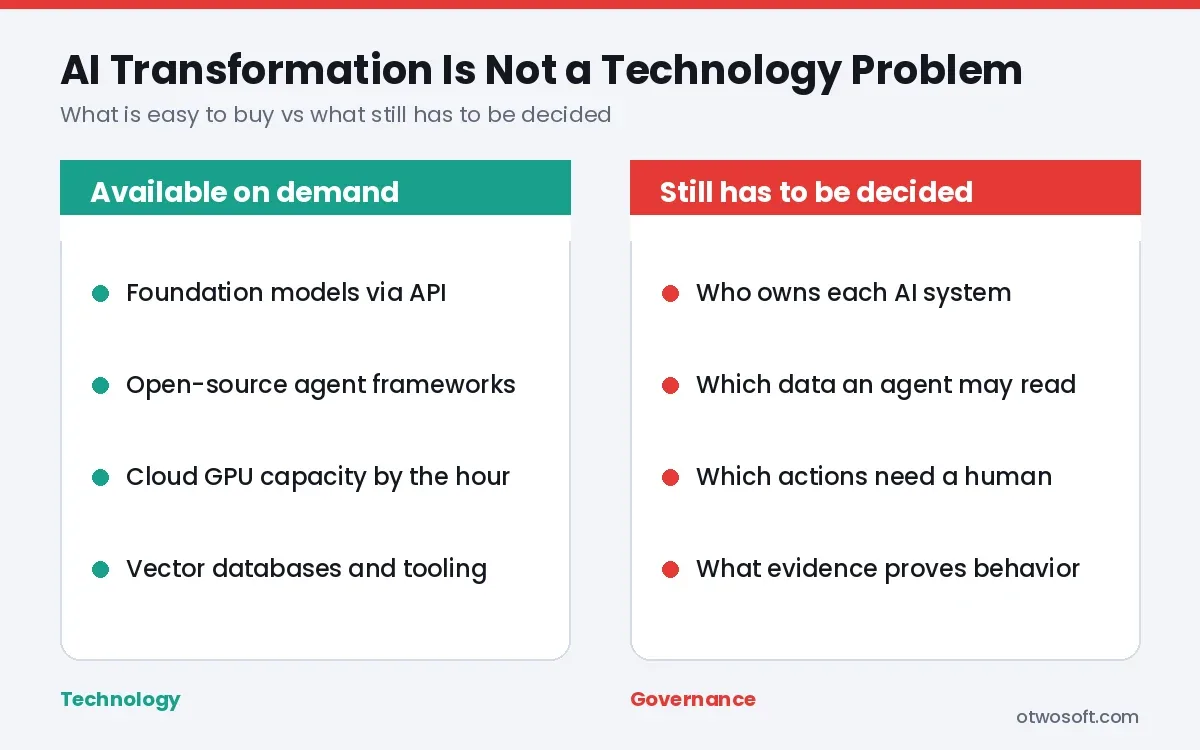
The IBM Institute for Business Value (IBV) study shows this split more clearly than most surveys released this year. About two-thirds of the chief information officers (CIOs) and chief technology officers (CTOs) surveyed are held accountable for AI systems they do not fully control. Another 70% say teams across the business deploy technology faster than IT can track it, which leaves central teams constantly catching up. Accountability sits in one place while control sits in another, which is a structural gap that no model upgrade will ever fix.
Why Pilots Stall Between Testing and Production
Maybe you reached this page through a search like "ai transformation is a problem of governance x com" after seeing the line quoted somewhere. Others arrive through "ai transformation is a problem of governance twitter", probably after reading a short post with no room to explain the idea. Readers hunting for an ai governance problem medium essay usually want the same thing, which is the ordinary pattern hiding behind a catchy slogan.
A pilot runs in a sandbox with sample data plus a friendly reviewer, so nobody has to make a hard decision during the testing phase. The trouble starts on the day it needs a production API key, access to the customer database and a formal sign-off from security. Teams that bring in a partner for AI development services often discover this moment is where most of the real project work begins.
At that point the team learns there is no approval path for an agent that writes to a live system used by real customers. Security asks for logs that were never captured, since nobody thought the sandbox needed an audit trail when the pilot started. Legal asks who is accountable if the agent makes a wrong call, at which point the room tends to go quiet for a while. None of these questions is technical, yet any one of them can hold a working system in staging for several months.
The AI Governance Gap in 2026: What the Research Shows
The AI governance gap is the distance between how fast a company deploys AI and how fast it can assign owners, enforce limits or produce evidence. Four large surveys published during 2026 measure that gap from different angles, which makes the overlap between them more convincing.
| Finding | Source | Sample | What it signals |
|---|---|---|---|
| 77% say AI adoption outpaces governance | IBM IBV and Oxford Economics, June 2026 | 2,000 technology executives in 33 geographies | Controls trail deployment across industries |
| 98% have an AI policy, 47% bypassed it for urgent work | EY AI Risk and Governance Survey, September 2026 | 202 senior AI executives at U.S. firms with $1B+ revenue | Written rules give way under deadline pressure |
| 26% of agentic AI users cannot detect unauthorized agents | EY, September 2026 | Same sample | Inventories miss agents that are already running |
| 49% have not updated frameworks for agent-specific risks | EY, September 2026 | Same sample | Chatbot-era rules do not cover autonomous actions |
| 21% have a mature governance model for autonomous agents | Deloitte, State of AI in the Enterprise 2026 (surveyed August to September 2025) | 3,235 leaders in 24 countries | Agent adoption is moving faster than agent oversight |
| 74% believe they could pass an AI compliance audit, 27% call their program fully mature | Schellman 2026 State of AI Governance Report | 500+ U.S. enterprise leaders | Confidence runs ahead of evidence |
| 36% of boards regularly discuss third-party AI risk | Schellman 2026 State of AI Governance Report | Same sample | Board oversight lags supplier AI exposure |
These are self-reported surveys with different samples, regions or wording, so they work best as signals pointing the same way rather than one combined dataset. The original announcements from IBM, EY and Deloitte describe each survey's methodology in more detail. The Cloud Security Alliance (CSA) has published a summary of the Schellman findings for readers who want the audit-readiness numbers.
Why AI Transformation Stalls Without Governance
AI transformation tends to stall at the exact moment a pilot needs permission to touch real customers, real money or regulated data. Four failure points come up again and again at that stage, regardless of industry or company size.
- Unclear ownership means nobody can name the person accountable for an agent's decisions, so the first risk review usually ends without an approval.
- An accountability vacuum forms when decisions made at machine speed spread responsibility across data teams, product managers, compliance officers or business leaders, leaving nobody owning the outcome.
- Missing decision rights leave teams unsure who can approve a new tool, a new data connection or more autonomy, so requests sit in a queue for weeks.
- Evidence gaps appear when logs, test results or approval records were never captured, which leaves the system unable to pass an AI audit or customer security review.
Good governance can speed teams up as long as the controls stay proportionate to the actual risk involved. Schellman found that 78% of organizations with mature AI governance run agents in production, compared with 22% of those whose programs are still developing. A survey cannot prove that governance caused the difference, though the association is strong enough that most risk leaders will find it hard to ignore.
AI Governance Challenges That Block Scale
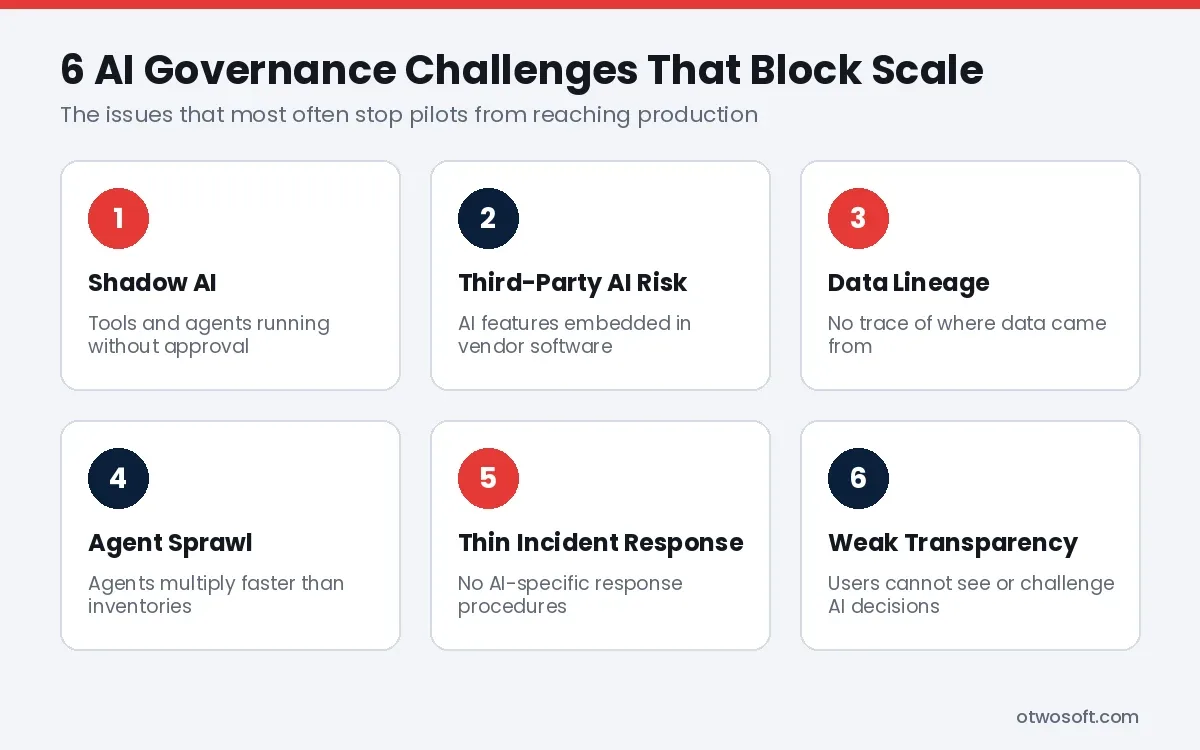
Six AI governance challenges block scale more often than the rest, starting with shadow AI before moving to third-party AI risk and weak data lineage. The other three are agent sprawl, thin incident response and poor transparency, and each one tends to surface right after the first production launch.
Shadow AI
Shadow AI is any AI tool or agent that employees use without approval from security or IT, often with good intentions. It takes company data plus decision rights outside every review process, which means problems surface only after something has already gone wrong. EY found that 26% of organizations using agentic AI cannot detect unauthorized agents running inside their own environment.
Third-Party AI Risk
Most business software now ships with AI features that the buyer never asked for, configured or even noticed during procurement. Your company stays liable for what that embedded AI does, yet only 36% of boards in the Schellman survey regularly discuss third-party AI risk. A workable fix is to add AI questions to vendor reviews, asking which features use AI, what customer data leaves your systems and whether those features can be switched off. The answers then go into the same register your team keeps for internally built systems, so nothing sits outside the inventory.
Data Lineage and Quality
An agent is only as reliable as the data it reads, which makes lineage a governance issue long before it becomes an engineering one. If a team cannot trace where data came from, who changed it or which systems use it, there is no way to explain a bad output afterward. Our guide to training data shows how coverage gaps or stale records quietly turn into model errors that nobody catches in testing.
Agent Sprawl
Agents multiply faster than anyone can list them, especially once business teams can build their own with low-code tools. IBM's respondents expect the number of deployed AI agents to grow 38% by 2027, while only 11% feel fully prepared for that scale.
Thin Incident Response
Only 44% of organizations in the Schellman survey have documented incident response procedures written specifically for AI-related issues. IBM's respondents averaged 54 AI agent incidents in the past year, with 17% of those rated high severity and taking more than four hours to contain.
Poor Transparency
AI governance transparency means the people affected by a system can see that AI is involved, what it may do or how to challenge a decision. Internal transparency matters too, since product managers or compliance officers need the same view of models, versions and permissions that engineers already have.
AI Governance Paralysis: When Control Becomes the Bottleneck
AI governance paralysis is the opposite failure, where committees, forms or sign-offs pile up until nothing ever reaches production. It looks safe on paper, although the risk rarely goes away and usually just moves somewhere less visible. People who cannot get an approved tool will often use an unapproved one, which is how paralysis quietly turns into shadow AI.
Five warning signs suggest a governance program has tipped from careful oversight into outright paralysis:
- Every use case goes through the same review process, whether it summarizes meeting notes or approves loans for customers.
- Getting approval regularly takes longer than building the feature, which teaches teams that the official path is not worth the wait.
- The review board meets once a month, while the agents it is supposed to oversee change several times every week.
- Nobody below the executive level has the authority to approve even a small, low-risk change to an existing AI system.
- The written policy lists broad principles but never tells a product team what it should actually do on Monday morning.
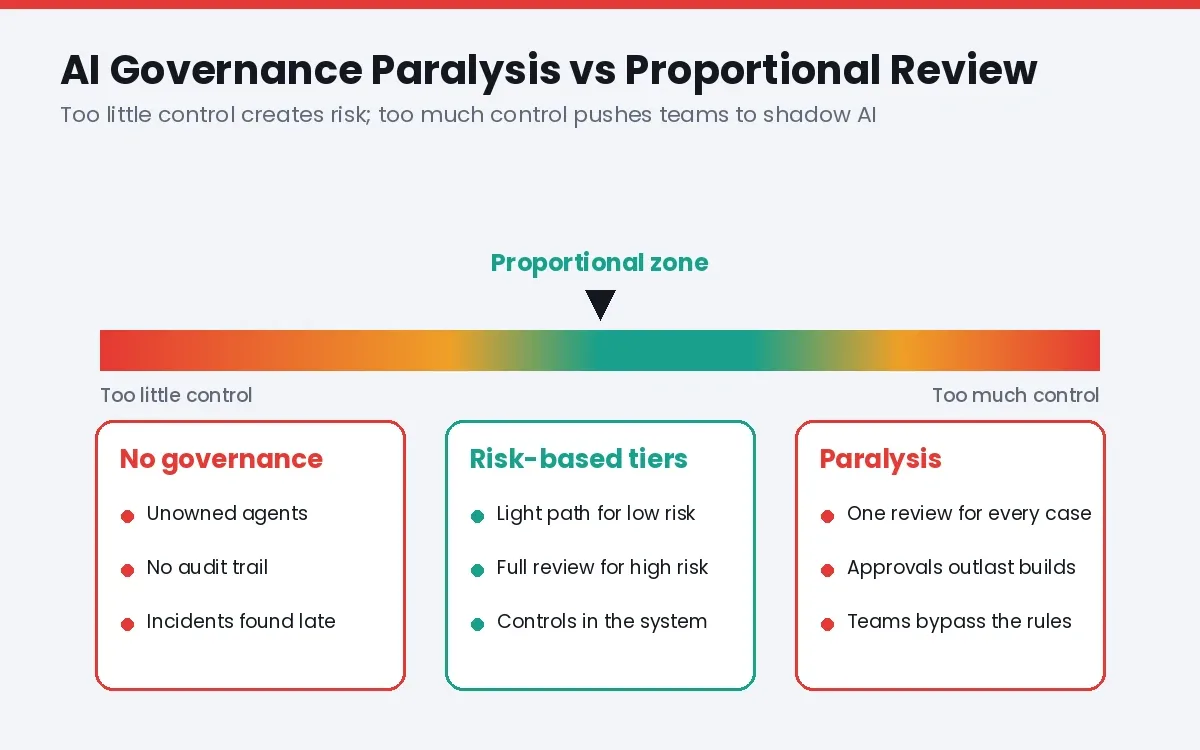
Proportional review is the usual way out, since it matches the depth of scrutiny to the damage a system could actually cause. An internal tool that summarizes meeting notes can go through a light path with logging, while a model that screens job applicants needs full review with human approval. EY's finding that 47% of large companies bypassed their own policy for urgent deployments is roughly what you would expect when only the slow path exists. In our view, paralysis gets less attention than it deserves, since from the outside it looks a lot like responsible caution.
Policy-Led vs Runtime-Enforced Governance
Policy-led governance keeps the rules in documents or review boards, where people have to remember to follow them under pressure. Runtime-enforced governance builds those rules into gateways, permissions or monitoring, so they apply to every request without anyone checking manually. A mature program uses both layers, with each one covering the blind spots that the other layer tends to leave open.
| Dimension | Policy-led governance | Runtime-enforced governance |
|---|---|---|
| Where rules live | Documents and review boards | Gateways, permission scopes and monitoring |
| Speed | Each deployment waits for a review | Checks run on every request automatically |
| Visibility | Self-reported inventories | Observed traffic and agent behavior |
| Audit evidence | Assembled by hand after the fact | Logged continuously as work happens |
| Failure mode | Skipped under deadline pressure | Blocked or flagged at the point of action |
Policy states what the company intends, while runtime enforcement is what keeps that intent in place at 6 p.m. on a release day. IBM's analysis puts a figure on the difference between the two approaches, which helps when making the case for engineering time. Organizations that embed control directly into their AI systems saw 25% fewer incidents than those relying on manual governance, where people approve outputs one at a time.
How Agentic AI Changes the Governance Problem
With agentic AI, governance stops being about reviewing what a system says and becomes about controlling what it is allowed to do. A chatbot that gets something wrong produces a bad paragraph, which is embarrassing but usually easy to correct before anyone acts on it. An agent with write access can refund the wrong customer, delete records or trigger other agents, with every one of those actions decided by software.
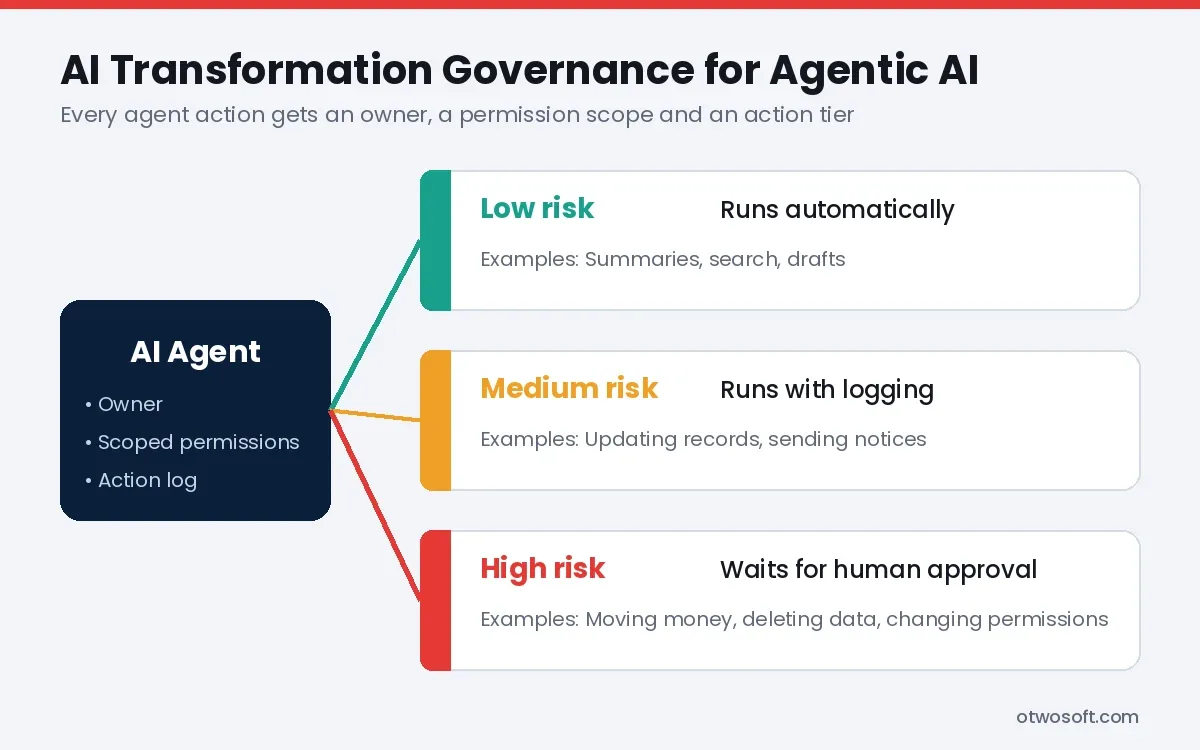
EY found that 91% of surveyed organizations already use agentic AI, while 49% say their governance frameworks have not been updated for agent-specific risks. Deloitte describes mature agent governance through three features, which together make a useful checklist for any team about to deploy its first agent:
- Clear boundaries that separate the decisions an agent can make on its own from those that need human approval.
- Real-time monitoring that flags unusual agent behavior while it is happening, rather than in a report several days later.
- Audit trails that capture the full chain of an agent's actions, from the first request through to the final change it made.
A Worked Example: A Refund Agent
Take a customer-service agent that can issue refunds, which is one of the most common first use cases, using an illustrative setup. The agent has an owner in support operations, with a permission scope limited to the orders table and the refund endpoint of the payments API. Refunds under $50 run automatically with a log entry, while refunds between $50 and $500 go through but get flagged for a daily review. Anything above $500 waits in a review queue, where a supervisor approves it through a screen that our UI/UX design team would treat as part of the product.
Every call the agent makes passes through a gateway that checks the permission scope and the refund amount before anything happens. The gateway then writes a log entry with the order number, the decision taken and the policy rule that applied to it. If the agent tries to refund the same order twice or touch a table outside its scope, the gateway blocks the call immediately. None of this needs a better model, only someone willing to decide the thresholds with an engineer who can put them into the access rules.
The setup has to hold up when someone deliberately tries to break it, which is where most governance documents stay vague. A customer might paste instructions into a chat message telling the agent to approve a larger refund, which is a classic prompt injection attempt. The request still fails, since the limit check lives in the gateway rather than in the prompt the model reads. Credentials scoped to the refund endpoint stop a confused agent from escalating its own privileges to other parts of the payments system. A reversal window on every refund means that a bad batch of decisions can be rolled back before the money actually leaves the account.
Writing tiers into access rules, rather than into a policy PDF, is what keeps them in force when a deadline gets close. The same principle holds whether you build in-house or with a partner offering AI agent development for production systems. For background on how models arrive at their outputs in the first place, see our explainer on how AI works step by step.
Governed Intelligence for AI Transformations: The 5 Components
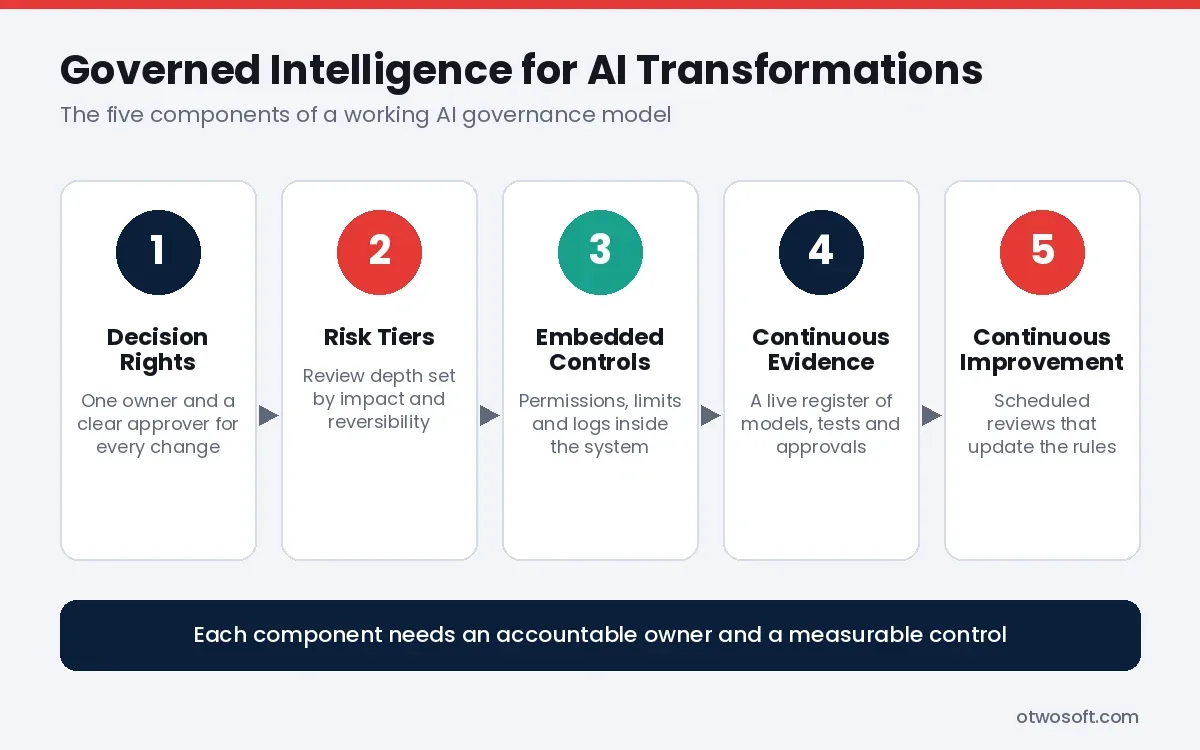
Governed intelligence for AI transformations means every AI system runs inside a defined set of owners, limits and records from the day it ships. In practice, a working governance model has five components, each of which needs a named person behind it to stay effective.
1. Decision Rights
Name one accountable owner for each AI system, choosing someone senior enough to say no when a request crosses a line. Then write down who approves new agents, tools, data connections or changes in autonomy, with an escalation path for the disagreements that will inevitably come up.
2. Risk Tiers
Classify each use case by its potential impact, asking who is affected, whether the decision can be reversed and whether regulated data is involved. The answer sets how much review, testing or human oversight the system receives before launch, which keeps low-risk tools from waiting behind high-risk ones.
3. Embedded Controls
Put permissions, rate limits, content checks and logging into the systems themselves, using API gateways, identity scopes or monitoring tools. Controls built this way apply to every request automatically, including the ones made late at night when the people who wrote the policy are asleep.
4. Continuous Evidence
Keep a register of models, versions, owners, test results and approvals, generating it as a by-product of normal work rather than a separate project. Each entry should state what the AI model does, what data trained or grounds it, along with the date of its last evaluation.
5. Continuous Improvement
Give one person the job of reviewing the evidence on a fixed schedule, with the authority to change the rules whenever it shows a problem. Without a clear owner for that loop, a governance model slowly ends up describing systems that no longer exist in the form it assumes.
Example: What a Governance Register Entry Looks Like
A governance register does not need special software at the start, since a well-structured shared table answers most early audit questions. The entry below follows the refund agent described earlier, which shows how the abstract fields map to one real system.
| Field | Example entry |
|---|---|
| System name | Customer refund agent |
| Accountable owner | Head of support operations |
| Model and version | Hosted language model, version pinned in deployment config |
| Data access | Orders table (read), payments API (refund endpoint only) |
| Risk tier | Medium, with high-tier approval above $500 |
| Approved actions | Issue refunds within limits, add notes to an order |
| Human approval required | Refunds above $500, any refund on a flagged account |
| Last evaluation | Date of the most recent test run and its pass rate |
| Incident history | Link to incident tickets and their resolution |
Who Owns What: An AI Decision Rights Matrix
Decision rights usually fail at the handoffs between roles, where each team assumes another one has already approved the change. The matrix below offers a starting split for a mid-size or enterprise company, with role names that you can adjust to match your own structure.
| Role | Owns | Approves | Must be informed of |
|---|---|---|---|
| Board | AI risk appetite and oversight of high-risk systems | Governance policy and major third-party AI contracts | Quarterly incident and audit-readiness report |
| CEO and senior executives | AI transformation strategy and budget | Use cases above the high-risk threshold | Material incidents |
| CIO and CTO | Platforms, gateways, identity and monitoring | New models, tools and data connections | All production deployments |
| Compliance officers | Regulatory mapping and audit evidence | Release of high-risk systems | Incidents with regulatory impact |
| Product managers | Use case outcomes and user disclosure | Feature-level autonomy within the assigned tier | Drift and complaint trends |
| Data teams | Data quality, lineage and access scopes | Data sharing with agents | Model changes that alter data use |
| Business leaders | Process outcomes and human review staffing | Changes to human-in-the-loop steps | Agent performance against targets |
Final accountability for each system still sits with its named owner, while the board keeps overall oversight of the program as a whole. Schellman's report singles out the concentration of AI accountability in a single seat as the biggest blind spot it found across enterprises. When one person makes the adoption call while carrying the liability, it becomes much harder for anyone to trust the resulting risk assessment.
A smaller business can compress the matrix considerably without losing the underlying logic of separating approval from ownership. In a 40-person company, the founder might hold the board and executive rows while one technical lead covers the CIO plus data rows. An operations manager can then sign off on human review steps, which keeps at least two people involved in every meaningful decision. Our case studies cover projects ranging from small teams to multi-site operations, which shows how differently these roles get split in practice.
AI Governance Transparency: What to Disclose and to Whom
AI governance transparency looks different for each audience, since customers, regulators and employees each need a different slice of the picture. Customers need to know when they are dealing with AI, along with a clear way to reach a human whenever the answer is not good enough. Regulators and auditors need records showing how a high-risk system was designed, tested and monitored over its entire working life. Employees need to know which tools are approved, what data can go into them, and whom to ask when something looks wrong.
Some of this is a legal duty, while the rest is simply good practice that builds trust with customers over time. Disclosure is mostly a product decision, such as a chat label or a visible link to a person, which affects how interfaces get built. It belongs in the web development or mobile app development backlog from the very first sprint, rather than being added after launch.
Under the European Union (EU) AI Act, transparency obligations such as telling people they are interacting with an AI system have applied since August 2, 2026. The Organisation for Economic Co-operation and Development (OECD) lists transparency with explainability among its five values-based AI principles, which work as guidance well beyond Europe. Explainability is easier when the architecture allows for it, as our comparison of symbolic AI vs connectionist AI explains in more detail.
AI Governance Business Context: Continuous Improvement
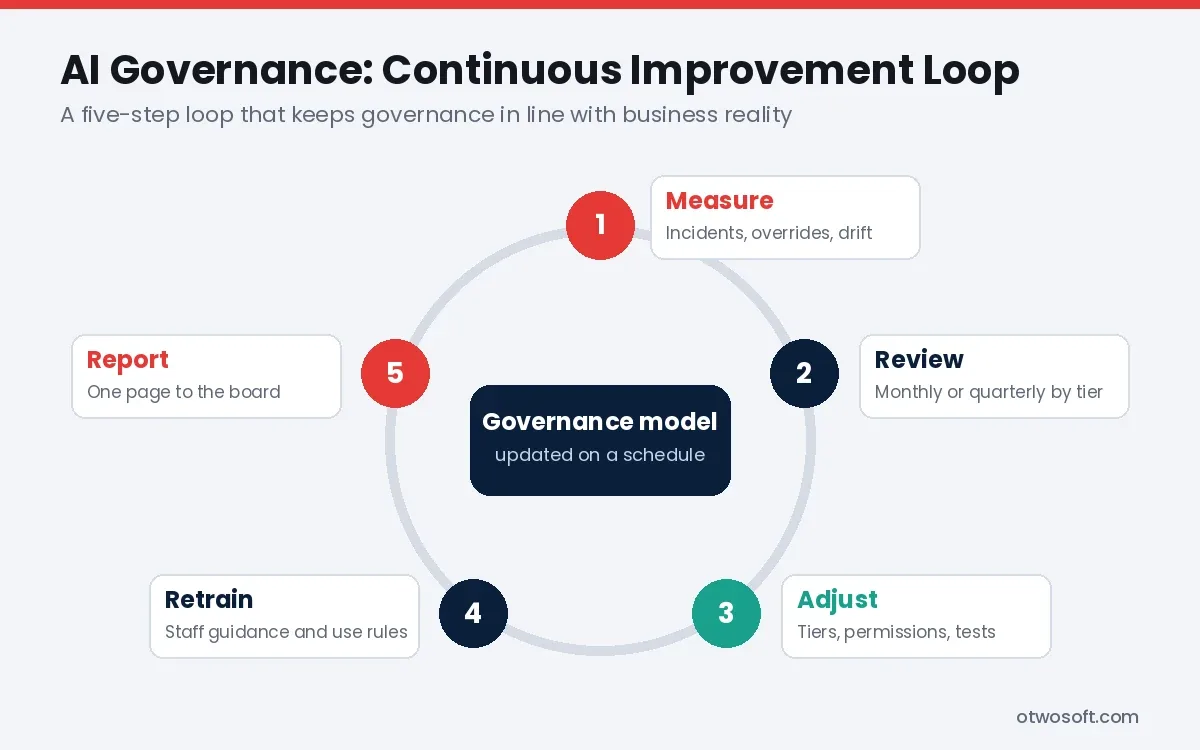
In an AI governance business context, continuous improvement is what stops the rules from going stale six months after someone first wrote them. AI governance business reality rarely matches the policy deck, since models drift while vendors keep changing features without telling anyone in advance. Regulations move, teams reorganize and budgets shift, so AI governance business evolution means updating the model on a schedule rather than after a crisis. A simple five-step loop keeps that schedule realistic for most companies, whatever their size or the number of AI systems they run:
- Measure incidents, human overrides, drift alerts and customer complaints for each AI system, using the same definitions every month.
- Review high-tier systems every month, while lower-tier systems get a lighter review once a quarter unless something unusual happens.
- Adjust tiers, permissions, tests or review steps based on what the numbers actually show, rather than on what people assume.
- Retrain staff on approved tools and acceptable use whenever the tools change or new rules come into force.
- Report a one-page summary to senior executives and the board each quarter, keeping the format identical so trends are easy to spot.
Production monitoring belongs inside this loop, since a model trained on older data meets new inputs every day after launch. Its accuracy can slip as conditions change, which our explainer on machine learning covers in more depth for readers who want the technical side.
What the EU AI Act Timeline Means for AI Governance
The EU moved its high-risk deadlines back, although it kept every one of the underlying obligations that companies will eventually have to meet. Regulation (EU) 2026/1744, known as the Digital Omnibus on AI, was published in the Official Journal on July 24, 2026. It entered into force three days later, on July 27, 2026, which set the revised dates shown in the table below.
| Obligation | Application date |
|---|---|
| Transparency obligations under the AI Act | August 2, 2026 |
| National AI regulatory sandboxes | August 2, 2027 |
| Annex III stand-alone high-risk systems (employment, education, credit scoring, biometrics, critical infrastructure) | December 2, 2027 |
| Annex I high-risk AI embedded in regulated products | August 2, 2028 |
Companies based outside the EU can still fall within scope, since Article 2 of the AI Act covers certain providers or deployers located elsewhere. Whether the law applies depends on factors such as placing a system on the EU market or using its output inside the EU. The exact scope turns on the facts of each case, so it is worth checking with legal counsel against the Official Journal text. The extra months are best spent building logging, system inventories and the risk documentation that auditors will eventually ask to see.
For U.S. organizations without EU exposure, the AI Risk Management Framework from the National Institute of Standards and Technology (NIST) is the most common reference point. The framework is voluntary, built around four functions known as govern, map, measure and manage, which map neatly onto the components described earlier. The International Organization for Standardization (ISO) adds ISO/IEC 42001, a standard for AI management systems that companies can be formally certified against.
How AI Governance Improves Business Outcomes
The theory of impact of AI governance is that clear rules raise the amount of AI a company can safely run at any given time. More safe usage means a better return on every model the company buys or builds, which shows up through four separate business outcomes.
- Faster approvals come from proportional tiers, which let low-risk use cases ship without waiting weeks for a full committee to meet.
- Fewer incidents come from controls inside the system that catch problems earlier, with IBM measuring 25% fewer incidents where control was built in.
- Smoother enterprise sales come from documented controls that give a vendor ready answers when AI questions appear in a customer's security review.
- Regulatory readiness comes from evidence collected during normal work, which then doubles as the audit file for the EU AI Act or customer audits.
Schellman's respondents with mature programs reported gains in efficiency (57%), regulatory readiness (49%) and ease of scaling AI (43%). Only 21% of companies report mature agent governance in the Deloitte research, which leaves plenty of room for companies willing to move early. The surveys show an association rather than proof, though, so closing the gap improves your odds without guaranteeing any competitive advantage.
How to Measure AI Governance Maturity
Maturity is best measured with hard evidence rather than self-assessment, since the Schellman data shows how far confidence can drift from reality. The six indicators below give a fairly honest picture of where a governance program actually stands at any point in the year.
| Indicator | How to measure it | Healthy direction |
|---|---|---|
| Ownership coverage | Share of AI systems with a named accountable owner | 100% of production systems |
| Inventory accuracy | Discovered systems compared with registered systems | Gap shrinking every quarter |
| Enforced traffic | Share of agent requests passing through gateways with logging | Rising toward all production traffic |
| Time to contain | Median hours from detection to containment of AI incidents | Falling quarter over quarter |
| Audit readiness | Days needed to produce evidence for the highest-risk system | Under one week |
| Policy bypass rate | Deployments that skipped the defined review path | Close to zero |
A 90-Day Plan to Close the AI Governance Gap
The order of the work matters, starting with visibility before moving on to decision rights, enforcement and finally testing of the controls. It fits neatly into the discovery and delivery stages of a structured delivery process, with each step below ending in something you can show to leadership.
- In days 1 to 30, build an inventory of every AI system and agent, including shadow AI, and record each one in the register.
- In days 1 to 30, assign decision rights by naming one owner per system, then publish who approves new agents, tools or data connections in a signed-off matrix.
- On days 31 to 60, set risk tiers and action tiers, then write them into each agent's access rules, recording every tier assignment in the register.
- On days 31 to 60, route agent traffic through controls that check permissions, rate limits or content, then track what share of traffic passes through the gateway.
- In days 61 to 90, red-team the controls against prompt injection, privilege escalation, data leakage or tool misuse, then run a rollback drill and close every finding.
- On days 61 to 90, report to the board on one page covering the inventory, recent incidents and audit readiness, then repeat that report every quarter.
Older systems are often the sticking point in step 4, since they were never built to sit behind a gateway or produce useful logs. Our custom software development team works on legacy modernization for exactly that kind of situation, where the system still runs the business.
Building Governance Into AI Products With O2SOFT
Governance costs far less to design in from the start than to bolt onto a system after it has already launched. At O2SOFT, owners, permission scopes and logging get settled during discovery, long before the first line of production code is written. If you want to talk through your first governed AI system with an engineer, you can book a free consultation with our team.
Conclusion
AI transformation is a problem of governance for a simple reason, which is that deployment now moves faster than ownership or control can keep up. Our advice is to start small this month, rather than waiting for a perfect framework that may take a year to write. Build the inventory, put a name next to every system, then decide which agent actions need a human before letting the rest of the model grow.
Frequently Asked Questions
Why does AI transformation fail without governance?
AI transformation usually fails without governance when no one can say who owns a system, what it may do or how to prove what it did. Pilots work well in isolation, then stop at the first risk review that nobody in the room is able to answer.
Is AI governance only a compliance task?
No, compliance is only one result of AI governance, which covers a much wider set of decisions about how AI gets built and used. Governance sets decision rights, risk tiers and runtime controls, which together decide how fast teams can safely put AI into production.
What is AI governance paralysis?
AI governance paralysis is a state where reviews, committees or sign-offs block every AI use case, regardless of how much risk it actually carries. It tends to push employees toward unapproved tools that they can use without waiting, which is how paralysis ends up creating shadow AI.
Who is responsible for AI governance in a company?
The board oversees risk while a named executive runs the governance program, with each AI system assigned to one accountable owner. CIOs, CTOs, compliance officers, data teams and product managers then hold clearly defined decision rights within that overall structure.
Does the EU AI Act apply to U.S. companies?
Yes, in some cases, since Article 2 brings certain providers or deployers located outside the EU within the scope of the law. It depends on whether they place systems on the EU market or their system's output is used in the EU, with Annex III high-risk obligations applying from December 2, 2027.
How does agentic AI change AI governance?
Agentic AI shifts governance from checking what a system says toward controlling the actions it is allowed to take inside other systems. Each agent needs an owner, scoped permissions, action tiers and a continuous log, as it can change records, move data or trigger other agents.
What is the first step in AI transformation governance?
The first step in AI transformation governance is an inventory of every AI system and agent in use, including shadow AI and vendor features. Owners, risk tiers or runtime controls all depend on first knowing exactly which systems exist and what each one is allowed to touch.
Can small and mid-size businesses use the same governance model?
Yes, a smaller company can use the same five components with a much lighter process that fits its size and budget. One owner per tool, two or three risk tiers, an approved tools list and basic logging from existing platforms cover most early needs.