


Picture a hypothetical model that scores 99% on its training data but only 70% on real customers. It has not learned your problem; it has learned your dataset. That gap is overfitting in machine learning, one of the most common reasons a promising AI pilot fails once it meets production data.
This guide explains what overfitting is, why it happens, how to detect it early, and which techniques prevent it. It also covers the areas most guides skip, such as overfitting in large language models and the privacy risk of memorized training data. The final sections explain benign overfitting, a line of research that changed how engineers think about model size.
Key takeaways
- Overfitting happens when a model learns the noise in its training data along with the real pattern, so it fails to generalize to unseen data.
- The clearest warning sign is a growing gap between training loss and validation loss, or between training accuracy and test accuracy.
- Overfitting sits at the high variance, low bias end of the bias-variance tradeoff, while underfitting sits at the opposite end.
- Regularization, early stopping, dropout, more training data, data augmentation, feature selection and cross validation are the most reliable fixes.
- In large models, overfitting can also become a privacy problem, because memorized training data can sometimes be extracted from the model.
What Is Overfitting in Machine Learning?
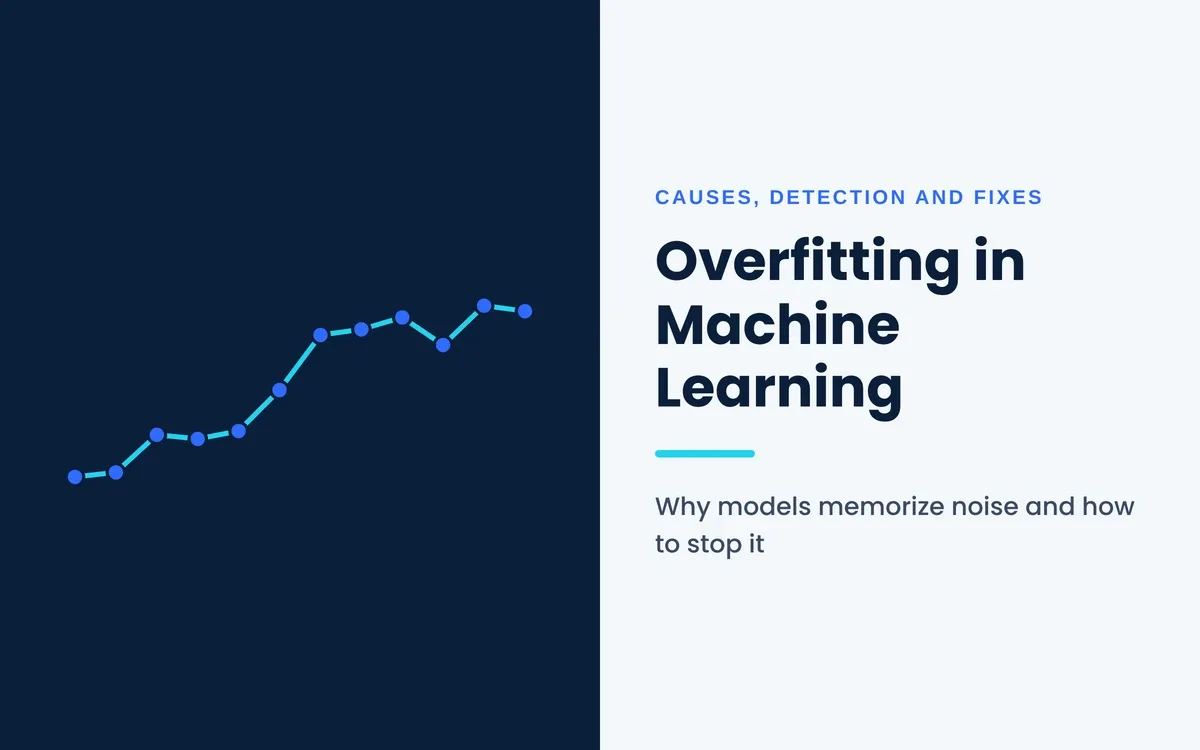
Overfitting in machine learning happens when a model fits its training data so closely that it learns the noise along with the real pattern. The overfit model posts excellent scores on examples it has already seen. Yet it makes poor predictions on unseen data, which is the only data that matters after deployment.
In supervised machine learning, every model is trained on a sample of the world rather than the world itself. That sample, known as the training data, contains a dominant trend you want the model to learn. It also carries statistical noise such as measurement errors, outliers, mislabeled rows and coincidences that will never repeat. A well-fitted model captures the trend while ignoring the noise. An overfitted model treats both as equally important, so it ends up memorizing instead of learning.
Overfitting Meaning in Plain Words
Think of a student who prepares for an exam by memorizing the answers to last year's practice test. The student aces that practice test every time, but a new exam with reworded questions exposes the gap immediately. A model that aces the practice test in this way has high training accuracy with low real-world accuracy, which is the simplest description of overfitting you will find.
The idea is older than machine learning itself. In statistics and mathematical modeling, a statistical model with more parameters than the data can justify reproduces its sample precisely, yet its predictions on fresh data fall apart. The difference between performance on the training sample and on new data is called the generalization gap. To keep that gap small, statisticians have long recommended the principle of parsimony, often linked to Occam's razor: prefer the simplest model that explains the data well.
What an Overfit Model Looks Like
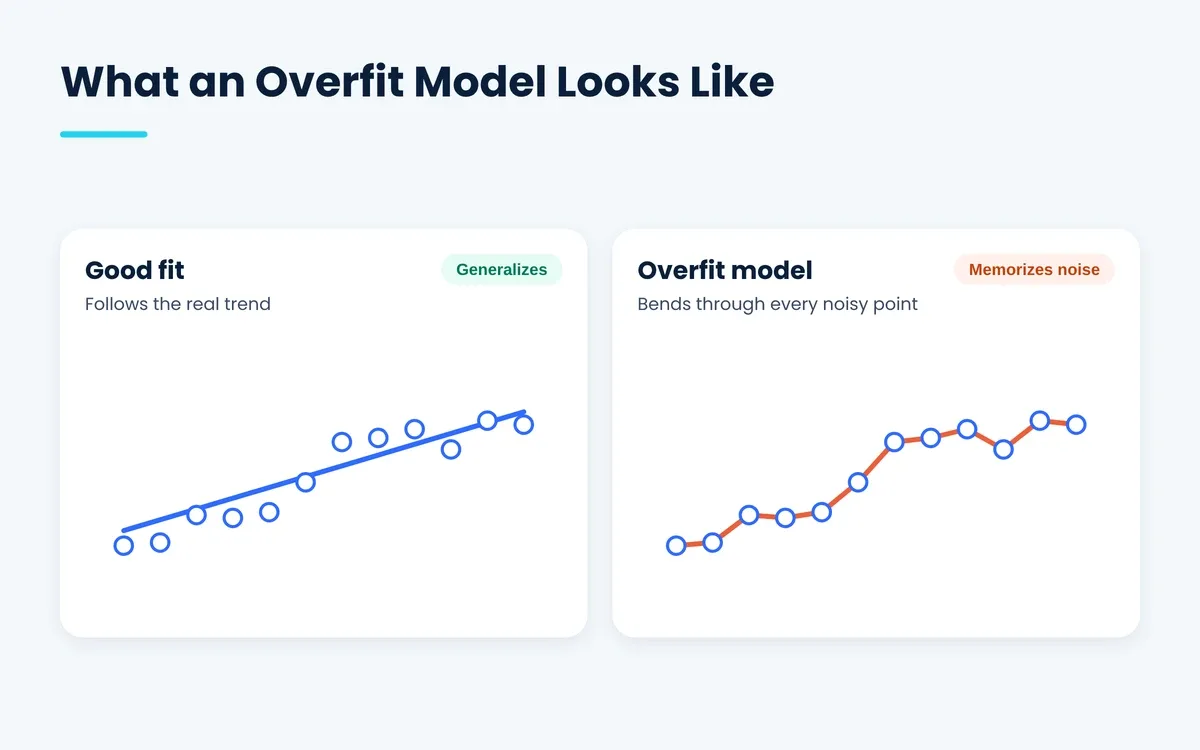
Picture twenty data points that follow a gentle curve with some random scatter. A straight line misses the curve entirely, which is underfitting. A smooth second-degree curve follows the dominant trend, which is a good fit. A fifteenth-degree polynomial snakes through every point, including the noisy ones, so its training error is almost zero while its predictions between points swing wildly. That wiggly curve is what an overfitted model looks like on a chart.
Overfitting vs Underfitting
When comparing overfitting vs underfitting, think of them as opposite failures on the same spectrum of model fit. An overfit model is too flexible, so it scores well on training data but poorly on test data. An underfit model is too rigid, so it scores poorly on both. The goal is the sweet spot between them, where model generalization is strongest because the model captures the real signal without memorizing noise.
| Aspect | Underfitting | Good fit | Overfitting |
|---|---|---|---|
| Training error | High | Low | Very low, often near zero |
| Validation or test error | High | Low, close to training error | High, far above training error |
| Bias | High | Balanced | Low |
| Variance | Low | Balanced | High |
| Typical cause | Model too simple, weak features or too little training | Model capacity matches the data | Model too complex, too little data or too many epochs |
| First fix to try | Add features, use a more flexible model or train longer | Keep monitoring after launch | Regularize, add data, simplify or stop training earlier |
Underfitting and Overfitting in Machine Learning
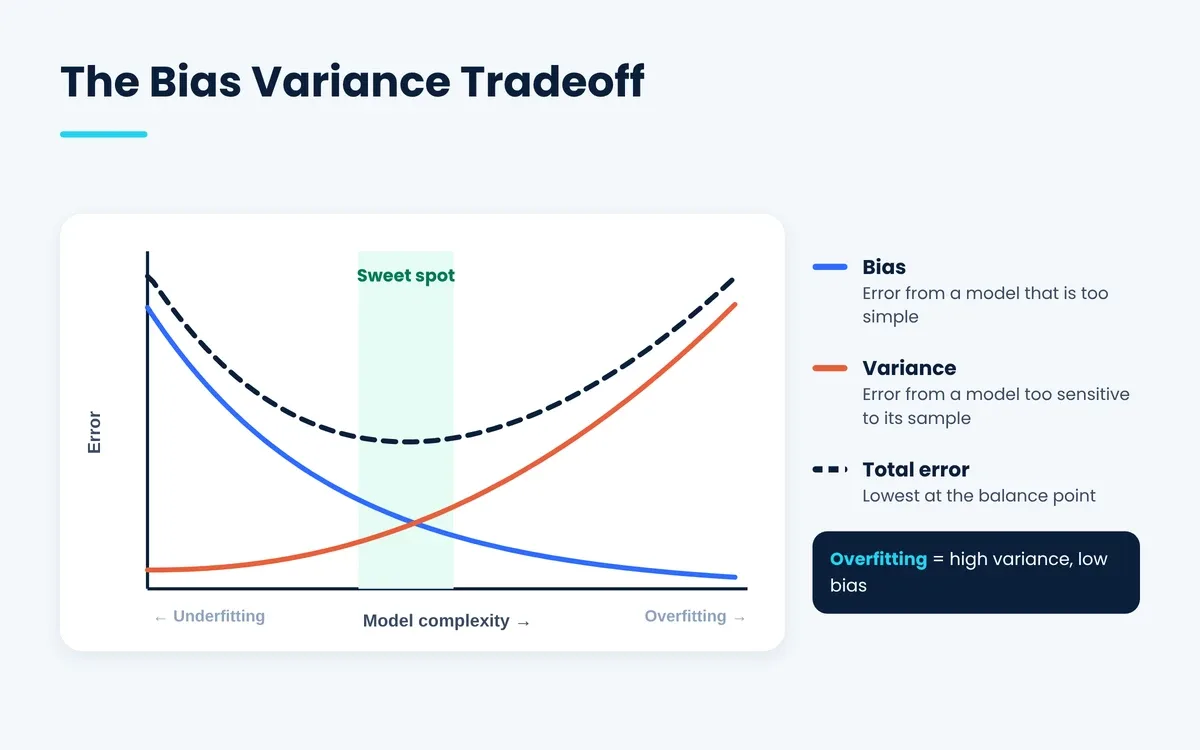
Most real projects move from one failure toward the other during development. Early versions underfit because the model is small or the features are weak. As engineers add layers, features and training epochs, training loss keeps falling, and at some point validation loss stops following it. The level of model complexity where those two curves separate marks the sweet spot, so every fix discussed later is really a way of staying near it.
The Bias-Variance Tradeoff Behind Overfitting
The bias variance tradeoff explains why overfitting happens in practice. Bias is error caused by overly simple assumptions, while variance is error caused by sensitivity to the specific training sample. Raising model complexity lowers bias but raises variance. Overfitting is the high variance low bias end of that tradeoff, where small changes in the training data produce very different models.
Under the usual squared-error assumptions, where a model is judged by mean squared error (MSE), expected prediction error on new data can be decomposed into three parts:
Expected error = Bias² + Variance + Irreducible error
As model capacity grows, the bias term shrinks while the variance term grows. In this classical picture, total error follows a U-shaped curve, and the bottom of that curve is the best balance for a given dataset. Other loss functions and metrics do not always split this cleanly, so treat the formula as a guide rather than a universal law.
High Variance, Low Bias Explained
A high variance model changes its mind easily. Train it twice on two random samples from the same population, and you get two noticeably different models. Each one has latched onto the quirks of its own sample. Its low bias means it can represent the true relationship in principle, yet it cannot tell that relationship apart from the noise. Fully grown decision trees, high-degree polynomial regression and very large neural networks trained on small datasets are classic high variance models.
Irreducible Error and Why Perfect Training Scores Need a Second Look
Irreducible error is the noise that no model can remove, such as sensor jitter, human labeling mistakes or truly random outcomes. Because that noise exists in every real dataset, a training error of zero can indicate that a model has fitted the noise as well as the underlying pattern. It does not prove harmful overfitting on its own, so check validation performance before concluding that the model generalizes well.
Causes of Overfitting
Overfitting is caused by an imbalance between model capacity and the information available in the data. The most common causes of overfitting are too many parameters, too little training data, noisy data, irrelevant features, too many epochs and data leakage.
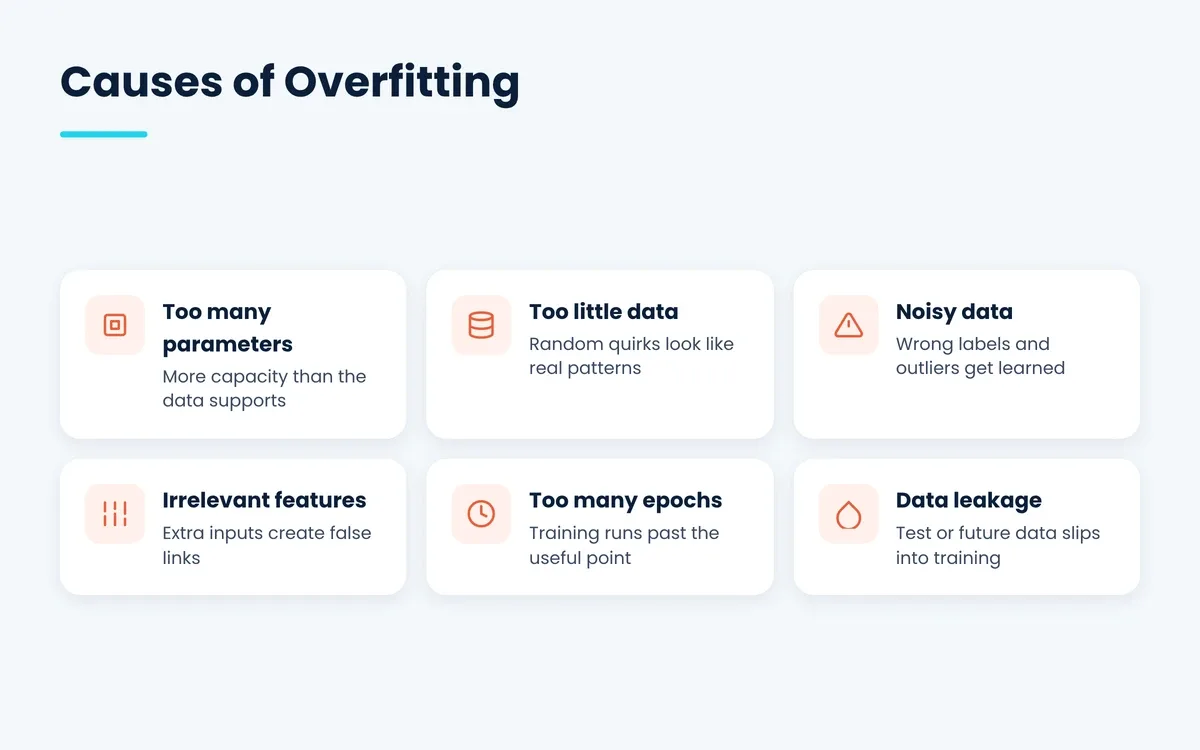
- Too many parameters for the data. An AI model with more adjustable parameters than the data can support uses its spare capacity to memorize individual examples. Model capacity, which theorists measure with tools such as the Vapnik-Chervonenkis (VC) dimension, should match the size and difficulty of the dataset.
- Too little training data. A small dataset cannot represent the full range of inputs a model will meet after launch. In regression analysis, the long-standing one in ten rule suggests about ten outcome events per predictor in logistic regression or a Cox proportional hazards model. A study by Vittinghoff and McCulloch in the American Journal of Epidemiology showed the rule can sometimes be relaxed, although small samples remain risky.
- Noisy data and outliers. Mislabeled rows, sensor glitches and extreme outliers look like signals to a flexible model. The more noise a dataset carries, the easier it becomes for the model to fit patterns that will never repeat.
- Irrelevant or redundant features. With enough unrelated input variables, some will appear statistically significant purely by chance, a trap known as Freedman's paradox. A model that keeps those variables is fitting coincidences instead of causes.
- Training for too many epochs. Neural networks and gradient boosting models keep improving on training data long after they stop improving on new data. This overtraining is one of the most common sources of overfitting in deep learning.
- Data leakage. When information from the validation or test set slips into training, the evaluation becomes optimistic, which hides overfitting until production. The scikit-learn documentation warns that preprocessing steps such as scaling or feature selection should be learned from the training set only.
- Tuning against the test set. Adjusting hyperparameters again and again until the test score improves slowly overfits the test set itself. This is often called test set overfitting or validation set overfitting, and a close cousin of data dredging. It is why a final holdout set should be used only once.
Overfitting Examples From Real Projects
The pattern looks different depending on the model type, so a few concrete overfitting examples make it easier to recognize in your own work. Each overfitting example below is illustrative rather than a measured case, apart from the computer vision study, which comes from published research.
Overfitting in Regression
Imagine a housing price model with only 30 sales records but 25 input variables. With nearly as many parameters as observations, linear or polynomial regression can pass through almost every point, pushing the coefficient of determination (R-squared) close to 1.0. On next month's listings, that same model may produce worse estimates than a simple model built on floor area, location and age.
Overfitting in Decision Trees
An unpruned decision tree keeps splitting until each leaf holds a single training example, which guarantees perfect training accuracy. A churn model built this way might learn a very narrow rule. One example would be "Tuesday sign-ups in March with three support tickets will cancel." That rule is true for one customer in the training set while meaning nothing for everyone else.
Overfitting in Image Classification and Computer Vision
In a well-known experiment, researchers Ribeiro, Singh and Guestrin deliberately trained a classifier to separate wolves from huskies using photos where every wolf stood on snow. The model performed well on similar photos, yet explanation tools revealed it was detecting snow rather than animals. Spurious background cues like this are a frequent form of overfitting in computer vision, especially when training images come from a narrow set of cameras or locations.
Overfitting in Time Series, Fraud Detection and Recommendation Systems
A fraud detection model trained on a single quarter of transactions can memorize the habits of one fraud ring that has since moved on. A recommendation system trained on a small group of early adopters can learn their niche tastes, which leads to poor suggestions for mainstream users. In time series forecasting, shuffling data before a train-test split lets the model peek at the future, so its offline scores collapse once it faces real forecasts.
How to Detect Overfitting
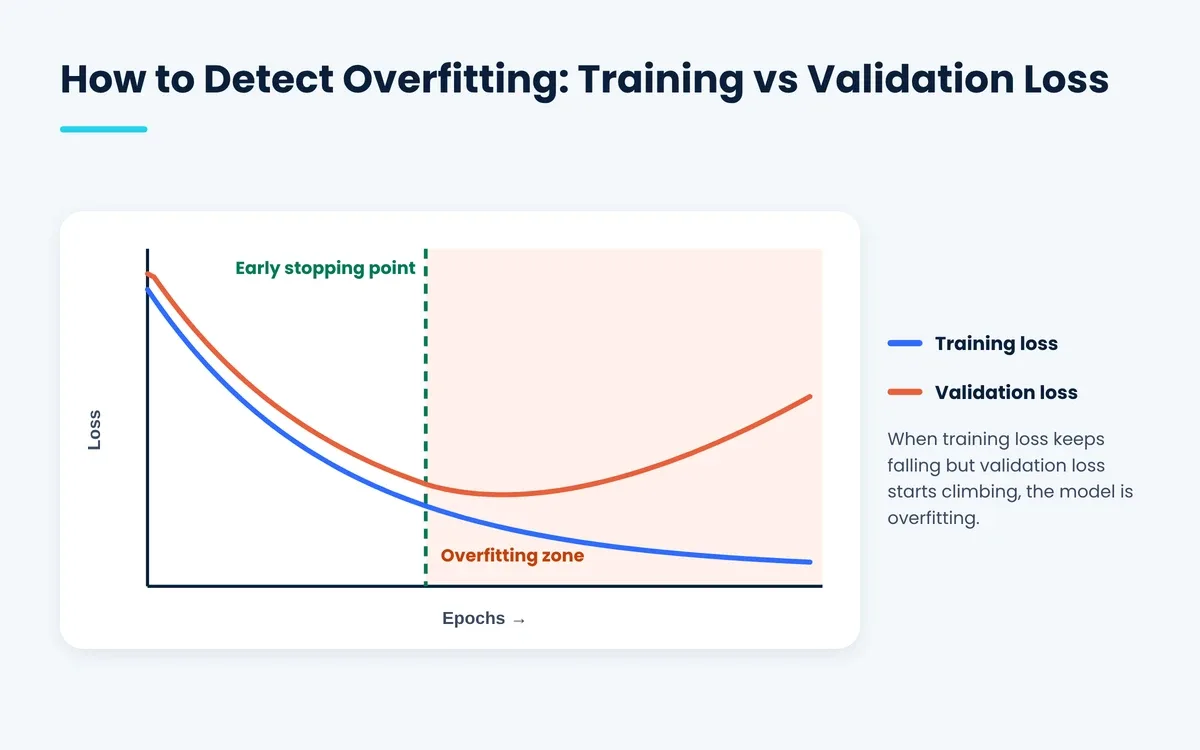
The simplest answer to how to detect overfitting is comparing performance on data the model trained on with performance on data it has never seen. A large gap is the clearest sign, for example a hypothetical model with 98% training accuracy against 80% validation accuracy. Training loss that keeps decreasing while validation loss starts increasing tells the same story over time.
Split Data Into Training, Validation and Test Sets
Before training starts, divide the data into three parts. The training set teaches the model, while the validation set guides decisions such as hyperparameter tuning and early stopping. The test set, also called the holdout set, gives a final unbiased score on unseen data. A 70/15/15 split is a common starting point, although the right ratio depends on how much data you have.
Keep the test set completely out of every training decision. Scalers, encoders, feature selection and hyperparameter choices should all be learned from the training data, with the validation set used for tuning. The scikit-learn documentation notes that fitting preprocessing on held-out data lets test information leak into the model, which produces overly optimistic results.
Compare Training Loss and Validation Loss on a Learning Curve
A learning curve plots the loss function for both sets across training iterations or epochs, which makes training vs validation loss easy to compare at a glance. In a healthy run, both curves fall together before leveling off close to each other. When overfitting begins, training loss decreases steadily while validation loss flattens before it starts climbing. The point where validation loss is lowest is usually the best checkpoint to keep.
Use K-Fold Cross-Validation
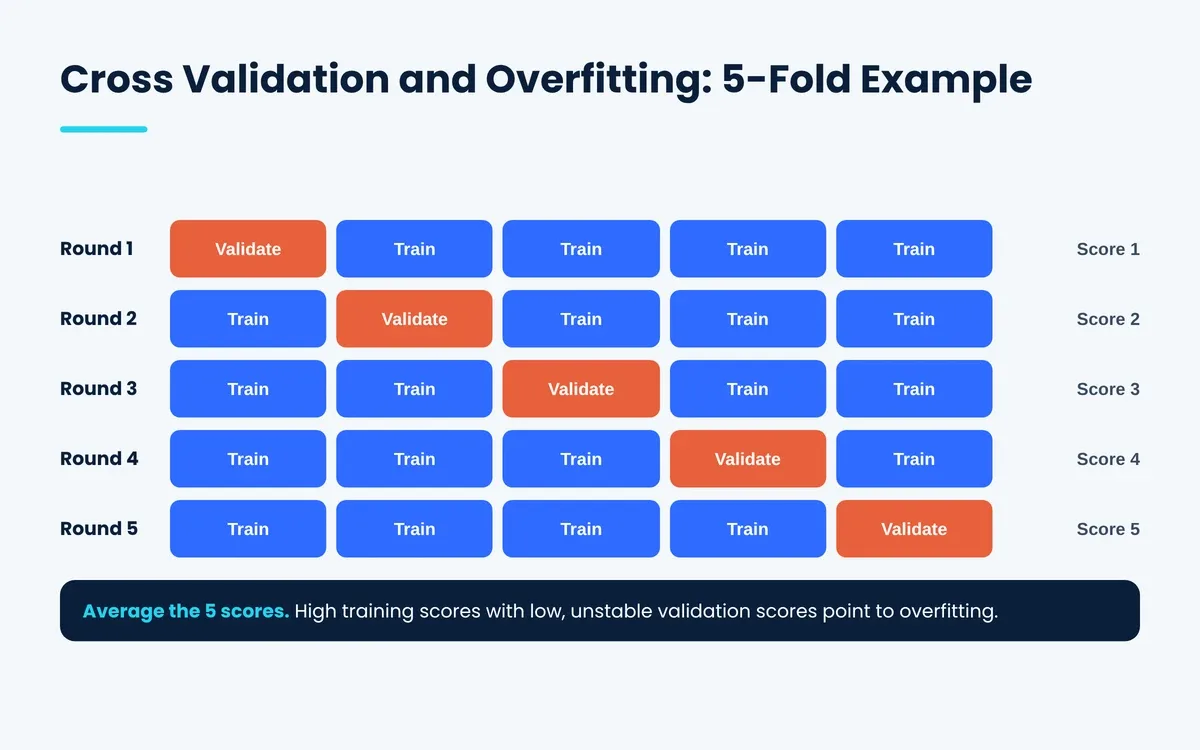
K-fold cross validation gives a more reliable estimate than a single train-test split, especially on small datasets. The data is divided into k equal folds, usually five or ten. The model trains on all folds except one before it is evaluated on the fold it skipped. The process repeats until every fold has served as validation data once. A wide spread between fold scores, or a large gap between average training and validation scores, points to high variance.
from sklearn.model_selection import cross_validate
from sklearn.tree import DecisionTreeClassifier
model = DecisionTreeClassifier(max_depth=None, random_state=42)
scores = cross_validate(model, X, y, cv=5, return_train_score=True)
print("Train accuracy:", scores["train_score"].mean())
print("Validation accuracy:", scores["test_score"].mean())
If the training average sits near 1.0 while the validation average lags well behind, the unpruned tree is overfitting. Setting max_depth to a smaller value and running the same check again shows whether the gap closes.
Overfit a Small Batch to Debug Your Pipeline
Deliberate overfitting has one useful job in model development. Before a full training run, experienced engineers train the model on a tiny batch of around twenty examples. They then confirm it can drive the training loss close to zero. The Stanford CS231n course notes recommend this sanity check with regularization switched off. If the model cannot memorize even that small batch, the problem is a bug in the data pipeline, labels or loss function rather than a lack of regularization.
How to Prevent Overfitting: 10 Techniques That Work
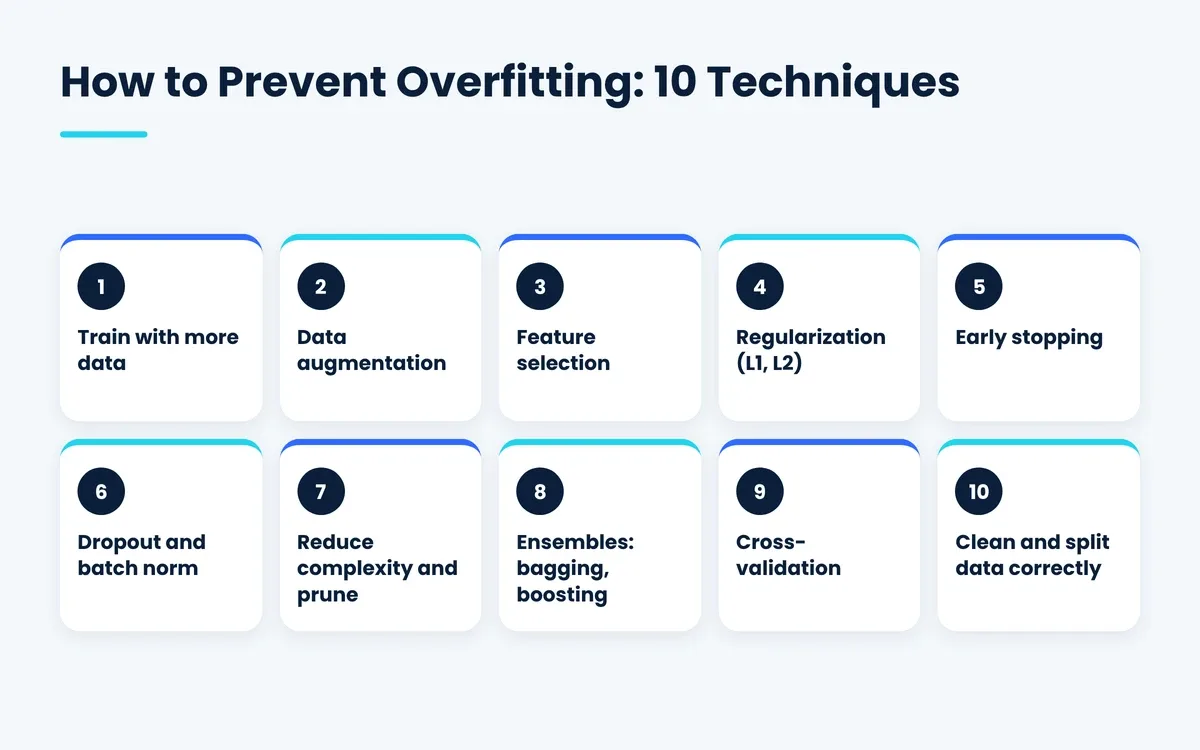
If you are wondering how to avoid overfitting, the answer is to reduce the model's freedom to memorize or give it more varied evidence to learn from. The most effective techniques are adding training data, data augmentation, feature selection, regularization, early stopping, dropout, simpler architectures, ensemble methods and cross validation. Most production teams combine several of them rather than relying on one.
1. Train With More Data
More examples make it harder for a model to memorize individual rows while making the dominant trend easier to see. The new data must be clean, relevant and representative of the conditions the model will face after launch. Adding more of the same narrow sample rarely helps, because the model simply memorizes a larger version of the same blind spot.
2. Use Data Augmentation
When collecting new data is expensive, data augmentation creates realistic variations of the examples you already have. In image classification, that means flips, crops, rotations, color shifts and added noise. Text and audio models use paraphrasing, synonym swaps, time shifts or background sound. Augmentation should mimic variation the model will actually see, because unrealistic transformations teach it the wrong lessons.
3. Apply Feature Selection and Dimensionality Reduction
Removing irrelevant or redundant features takes away the raw material the model uses to fit coincidences. Feature selection keeps only the inputs that carry real predictive signal. Dimensionality reduction methods such as principal component analysis (PCA) compress many correlated inputs into fewer, more informative ones. Careful feature engineering, which builds inputs that carry real signal, reduces how much regularization the model needs later.
4. Add Regularization to Prevent Overfitting
Regularization adds a penalty to the loss function that discourages large or unnecessary model weights. L1 regularization, used in Lasso, pushes weak coefficients to exactly zero, which doubles as automatic feature selection. L2 regularization, used in ridge regression and known as weight decay in deep learning, shrinks all weights toward zero without removing them. Elastic Net combines both penalties, which works well when many features are correlated.
The strength of the penalty is a hyperparameter. Too little regularization leaves the overfit model unchanged, while too much pushes it into underfitting, so tune it with cross validation instead of guessing.
5. Use Early Stopping
Early stopping prevents overfitting by ending training when validation loss stops improving, before the model starts memorizing noise. Among regularization techniques, it is one of the cheapest to apply because it needs no change to the model itself. Most frameworks provide an early stopping callback with a patience setting, which waits a few epochs to make sure the improvement has really stalled. The callback can also restore the weights from the best epoch. That way you keep the model from the bottom of the validation curve rather than the end of training.
6. Add Dropout and Batch Normalization
Dropout randomly switches off a fraction of neurons during each training step, which prevents the network from relying on any single pathway. In their paper in the Journal of Machine Learning Research, Srivastava, Hinton and colleagues showed that dropout significantly reduces overfitting across vision, speech and text tasks. Batch normalization mainly stabilizes training, though it often adds a mild regularizing effect as well.
7. Reduce Model Complexity and Prune
Sometimes the simplest fix is a smaller model with fewer layers, fewer neurons, shallower trees or a lower polynomial degree. Pruning removes parts of a trained model that contribute little to its predictions. The idea dates back to the Optimal Brain Damage method that Yann LeCun, John Denker and Sara Solla presented at NeurIPS in 1989. A pruned model is usually cheaper to run as well, which helps when it ships inside mobile or edge products.
8. Use Ensemble Learning: Bagging and Boosting
Ensemble methods combine several models so that their individual mistakes cancel out. Bagging trains many models on random resamples of the data before averaging them. This is how a random forest turns a set of overfit decision trees into a stable predictor. Boosting trains weak learners one after another, with each new model correcting the errors of the previous ones. Boosting can still overfit, so it needs early stopping or a limit on the number of trees.
9. Choose Models With Cross-Validation
Use k-fold cross validation to compare model types, feature sets and hyperparameters, rather than a single validation split that may be lucky or unlucky. For small datasets with heavy tuning, nested cross validation keeps the tuning loop separate from the final evaluation. That separation prevents cross validation overfitting, where the selection process itself starts fitting the noise in your folds.
10. Clean, Standardize and Split the Data Correctly
Remove duplicate rows, fix label errors and investigate outliers before training. Standardization and normalization keep features on comparable scales, which helps regularization penalize them fairly. Split time series by date and grouped data by customer, patient or device, so the model never sees near-copies of its evaluation examples during training.
Which Overfitting Fix Should You Use?
The right fix depends on the symptom you observe. This table maps the most common warning signs to their likely cause and the first remedy worth testing.
| Symptom | Likely cause | First fix to try |
|---|---|---|
| Training accuracy near 100% while validation accuracy is much lower | Model too complex for the data | L2 regularization or a smaller model |
| Validation loss rises after a certain epoch | Too many epochs | Early stopping with patience |
| Large spread between cross-validation fold scores | Small or unrepresentative dataset | More training data or data augmentation |
| Strong training fit on many weak features | Irrelevant features | Feature selection or L1 regularization |
| Excellent offline score but poor live performance | Data leakage or distribution shift | Re-split by time or group and rebuild preprocessing inside the pipeline |
| Large neural network on a small dataset | Too much capacity for the data | Dropout, weight decay or transfer learning |
Overfitting in Deep Learning and Neural Networks
Deep learning, a subset of machine learning, relies on neural networks that often have millions or billions of parameters, far more than the number of training examples. That capacity makes overfitting in neural networks easy to trigger, especially on small datasets or after too many epochs. Deep learning teams therefore rely on validation monitoring, dropout, weight decay, data augmentation and early stopping as standard parts of every training run.
Why Deep Networks Can Memorize Random Labels
In a widely cited study, Zhang, Bengio, Hardt, Recht and Vinyals showed that standard image classification networks can perfectly fit training data whose labels were assigned at random. They could even fit pure random noise in place of images. Since random labels contain no pattern at all, the networks were memorizing, which shows that a modern network has enough capacity to overfit almost any training set.
The same networks still generalize well when trained on real labels. That surprising result is why training accuracy alone says little about model quality, and why validation data remains essential.
Practical Defaults in PyTorch, TensorFlow and Keras
Every major framework, including PyTorch, TensorFlow and Keras, ships with the building blocks to control overfitting in deep learning. A typical Keras setup combines dropout layers, L2 weight decay and an early stopping callback in a few lines of Python.
from tensorflow import keras
from tensorflow.keras import layers, regularizers
model = keras. Sequential([
layers.Dense(128, activation="relu",
kernel_regularizer=regularizers.l2(1e-4)),
layers. Dropout(0.3),
layers. Dense(64, activation="relu",
kernel_regularizer=regularizers.l2(1e-4)),
layers.Dropout(0.3),
layers.Dense(1, activation="sigmoid"),
])
early_stop = keras.callbacks.EarlyStopping(
monitor="val_loss", patience=10, restore_best_weights=True)
model.compile(optimizer="adam", loss="binary_crossentropy", metrics=["accuracy"])
model.fit(X_train, y_train, validation_split=0.2, epochs=200, callbacks=[early_stop])
In PyTorch, the same ideas map to nn.Dropout layers, the weight_decay argument on the optimizer and a short loop that saves the checkpoint with the lowest validation loss. Our AI development team uses this pattern across the Python, PyTorch and FastAPI stack behind our production models.
Overfitting in LLMs and Generative Models
Large language models and image generators learn statistical patterns from vast training sets before using them to produce new output. When these systems overfit, that learning turns into memorization. Instead of producing new text or images that follow learned patterns, an overfitted generative model can reproduce near-exact copies of its training data. That creates two risks beyond poor accuracy: leaking private information and reproducing copyrighted material.
Memorization as a Privacy Risk
Research by Nicholas Carlini and colleagues, presented at the USENIX Security Symposium, showed how memorization becomes a privacy risk. The team demonstrated that an attacker could extract hundreds of verbatim text sequences from a public language model by querying it. The extracted examples included names, phone numbers and email addresses, which counts as personally identifiable information (PII). Some sequences appeared in only one training document, yet the model still memorized them. The researchers also found that larger models were more vulnerable than smaller ones.
When Image Generators Reproduce Their Training Data
A follow-up study posted on arXiv by Carlini and colleagues extracted more than a thousand training images from diffusion models, including Stable Diffusion. The recovered images ranged from photos of real people to trademarked logos. Their analysis suggested that diffusion models are considerably less private than earlier generative approaches.
How Teams Reduce Memorization in Generative AI
Deduplicating the training data is one of the most effective steps. Research by Lee, Ippolito and colleagues found that models trained on deduplicated datasets emitted memorized text about ten times less often. Other safeguards include PII redaction before training, differential privacy during training, output filters and evaluation sets that probe for verbatim recall. When we build assistants and AI agents, guardrails and PII redaction are part of the default build rather than an optional extra.
Benign Overfitting and Double Descent: When Overfitting Is Not the Enemy
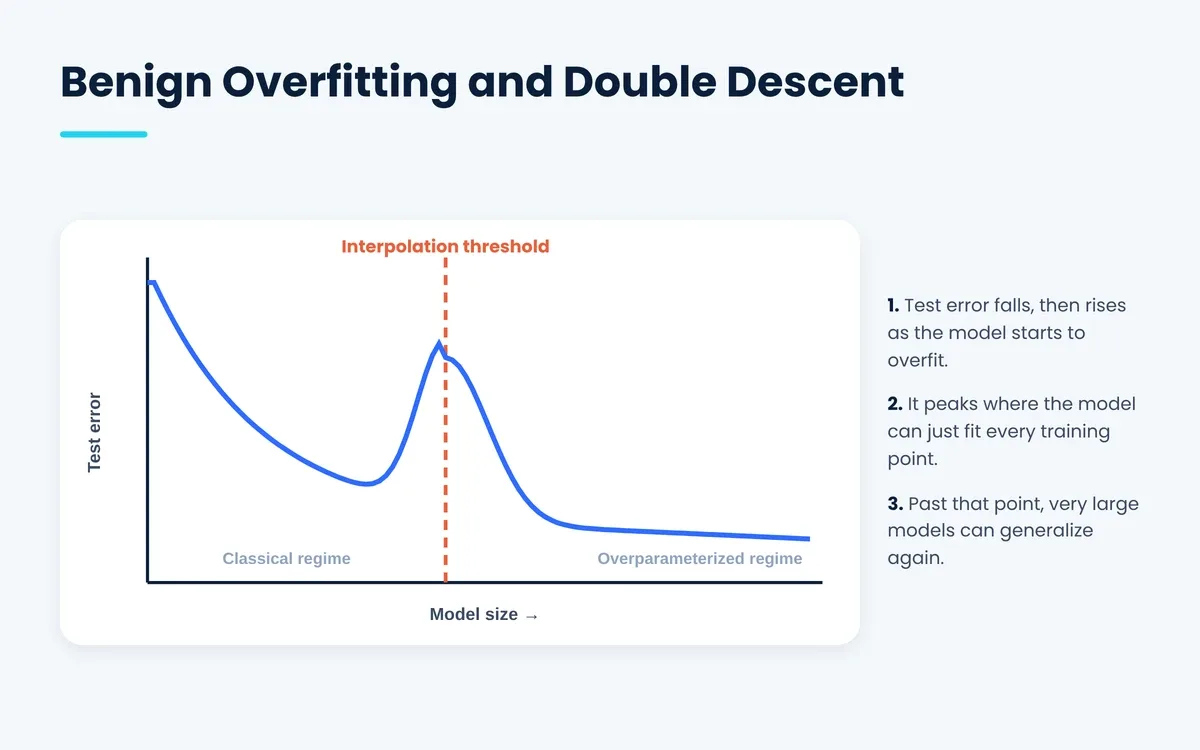
Benign overfitting describes models that fit noisy training data perfectly yet still predict well on new data. It appears mostly in heavily overparameterized models such as large neural networks. Research on double descent shows that test error can fall again once model size passes the interpolation threshold, which challenges the classic U-shaped bias-variance curve.
Double Descent and the Interpolation Threshold
Belkin, Hsu, Ma and Mandal reported a "double descent" risk curve across neural networks, random forests and other models. Test error first follows the familiar U shape, then peaks around the interpolation threshold, where the model has just enough capacity to fit every training point. Past that peak, adding even more capacity makes test error fall again, sometimes below the best classical result. Follow-up work by Nakkiran and colleagues observed a similar pattern across training epochs, not just model size.
Benign Overfitting in Theory
Bartlett, Long, Lugosi and Tsigler studied when a perfect fit to noisy data can coexist with accurate prediction, starting with linear regression. Their analysis showed that overparameterization is essential for benign overfitting. The model needs far more unimportant directions in its parameter space than there are training samples, so the noise gets spread thinly instead of distorting predictions.
Grokking: Generalization Long After Overfitting
Researchers Power, Burda, Edwards, Babuschkin and Misra found that small networks trained on algorithmic tasks can memorize their training set early, then suddenly generalize much later in training. The researchers called this delayed jump in accuracy grokking. It shows that early stopping, while usually wise, can occasionally end a run just before a model would have generalized.
What This Means for Your Project
These findings do not mean overfitting has stopped mattering. They describe specific conditions involving very large models, particular training dynamics and, often, huge datasets. For the tabular models, forecasting systems and fine-tuned smaller models that most businesses build, the classical rules still apply. Watch the validation curve, regularize sensibly, keep a clean holdout set and treat a perfect training score as a question rather than an answer.
A Pre-Launch Checklist for Avoiding Overfitting
Run through this checklist before any model reaches real users, because it is the fastest way to prevent overfitting from slipping into production.
- Split data into training, validation and test sets before any preprocessing, using time-based or group-based splits where the data requires them.
- Fit scalers, encoders and feature selection steps on the training set only, ideally inside a single pipeline.
- Plot training and validation learning curves, then confirm the gap between them is small and stable.
- Run k-fold cross validation, then check that the scores stay consistent across folds.
- Tune regularization strength, dropout rate and model size against validation data rather than the test set.
- Use early stopping with a patience setting that matches how noisy your validation loss is.
- Evaluate on the untouched test set once, then record that score as the realistic expectation for production.
- For generative models, test for verbatim memorization and PII leakage before release.
- Monitor live accuracy and data drift after launch, because a model that generalized last quarter can overfit to a world that has since changed.
How O2SOFT Builds Models That Generalize
At O2SOFT, we treat overfitting as a delivery risk rather than a research footnote. Our AI development services begin with a proof of concept measured against accuracy criteria agreed before training starts. The result is a number of held-out data rather than an impressive demo. Evaluation suites, drift alerts and human-in-the-loop review stay in place after launch, which keeps a model honest as real-world data changes.
That discipline carries into everything we ship, from custom software development with predictive features to AI inside mobile app development and web development projects. You can see how we work stage by stage on our delivery process page or browse shipped work in our case studies. If a model performs well in testing but struggles with real users, book a free consultation and our engineers will review it with you.
Frequently Asked Questions About Overfitting
What is overfitting in simple terms?
Overfitting is when a machine learning model memorizes its training examples instead of learning the general pattern behind them. It looks excellent on the data it was trained on but makes poor predictions on new data. Think of a student who memorized last year's answers, then fails a new exam.
What is the difference between overfitting and underfitting?
An overfit model is too complex, so it captures noise and performs well on training data but poorly on test data. An underfit model is too simple, so it misses the real pattern and performs poorly on both. Overfitting means high variance with low bias, while underfitting means high bias with low variance.
How do I know if my model is overfitting?
Start by comparing training and validation performance side by side. If training accuracy is much higher than validation accuracy, or if training loss keeps decreasing while validation loss increases, the model is overfitting. K-fold cross validation confirms the diagnosis, especially when fold scores vary widely or average validation scores trail training scores.
Can overfitting ever be useful?
Yes, overfitting is useful in a few limited cases. Engineers deliberately overfit a tiny batch of data to check that a training pipeline works. Research on benign overfitting and double descent also shows that very large models can fit training data perfectly while still generalizing well. For most business models, though, overfitting remains a problem to prevent.
Does more data always fix overfitting?
More data usually helps, but only when it is clean, relevant and representative of real-world conditions. Adding more of the same narrow or noisy data can leave overfitting in place. If the cause is data leakage, an oversized model or too many epochs, you also need regularization, early stopping or a better train-test split.
Is overfitting a problem in large language models?
Yes. In large language models, overfitting appears as memorization of training text. Research has shown that attackers can extract verbatim passages, including personal details, from language models. Deduplicating training data, redacting PII and testing for verbatim recall are the main defenses used by careful teams.
How does regularization prevent overfitting?
Regularization adds a penalty for large model weights to the loss function, which pushes the model toward simpler solutions. L1 regularization can remove weak features entirely, while L2 regularization shrinks all weights evenly. Both reduce variance, helping the model focus on the dominant trend rather than the noise in its training data.