


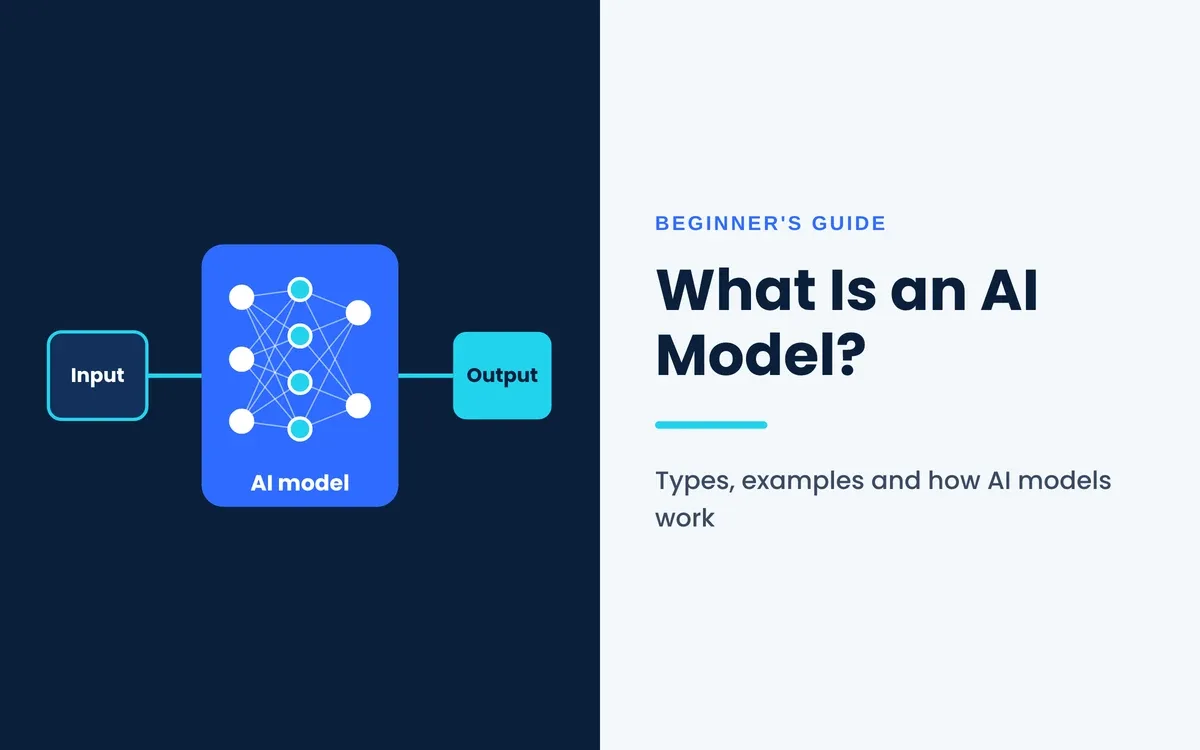
An artificial intelligence model, or AI model, is a computer program that learns patterns from data and generates content, predictions or decisions based on those patterns. For example, a spam filter can learn to recognize spam messages from examples, as opposed to having one specific rule for each kind of spam.
The same basic idea applies to wildly different artificial intelligence models. A model can accept an email, an image, a number or some text and send out a label, a prediction or a generated response.
In this article, you'll find out what an AI model is, how it works and how it learns, along with the different types you'll come across and where they're applied. It also covers the limitations of AI models and how to select a model for a specific task.
Key Takeaways
- An AI model converts inputs into predictions, decisions or content.
- An algorithm trains or runs the model; the model is the learned system.
- In training, a model predicts, checks for errors and adapts its parameters.
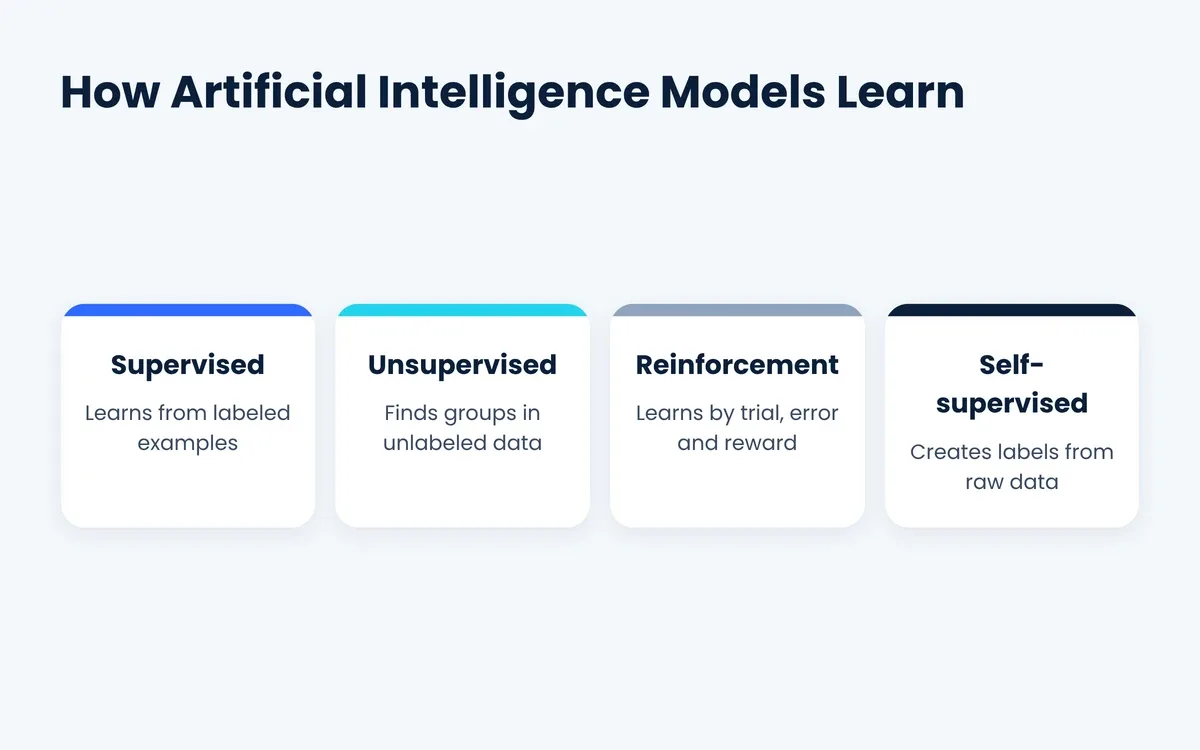
- Learning can be supervised, unsupervised, reinforcement learning or self-supervised.
- Model "types" depend on sorting by task, approach or learning style.
- More than 3 million public models exist on Hugging Face.
- Bias enters through data; drift comes from changing real-world data.
What Is an AI Model?
An AI model is a piece of software designed to transform an input into an output using learned patterns. In a machine learning model, those patterns are stored as values the system tunes during training. Depending on the task, the output might be a category, a number, a probability or generated content.
For the purpose of this article, the term "AI model" denotes a machine learning model that learns from data. Other types of AI systems exist too, such as rule-based systems, which run on rules programmed by humans rather than learned from examples.
A little visualization helps here. Picture a new claims assessor at an insurance agency. In her first few weeks, she reads thousands of old claims that have already been approved or rejected. Once she has seen enough examples, she begins to detect patterns that can't be formulated as a single rule.
The same is true of an AI model, except that its "judgment" takes the form of numbers. Training alters those numbers in response to the errors the model makes. After training, running the model on new data is known as inference.
Inputs and outputs differ significantly between models. A language model can accept a question as input and output a response. A forecasting model, on the other hand, can use last year's sales to predict next quarter's revenue.
The fundamental concept has existed for decades. In the 1950s, Arthur Samuel created a checkers program that improved over time through play. His 1959 paper, Some Studies in Machine Learning Using the Game of Checkers, helped spread the phrase "machine learning."
AI Model vs Algorithm
An algorithm is a sequence of instructions or procedures for solving a problem or training a model. An AI model is the learned system that results after training on data. People in the field swap the two terms all the time, yet they're related rather than interchangeable.
Linear regression shows the difference. As an algorithm, it's simply a procedure for fitting a straight line through points on a chart. Execute it on 5,000 homes sold in a single city and you'll have a model. In this example, the model holds only two numbers (a slope and an intercept) that convert square footage into a price estimate.
Repeat the same process with sales from another city and you'll obtain a different slope, a different intercept and a different model. As a result, two companies may use the same code and still end up with models that act quite differently.
AI Models vs Machine Learning vs Deep Learning
AI is the large area, machine learning is one of the methods used in AI, and deep learning is a method within machine learning that uses multilayered neural networks. Most current generative AI systems are based on deep learning, which they use to generate text, images, sounds or other content.
| Field | What it covers | Learn from data? | Example |
|---|---|---|---|
| Artificial intelligence | Any system that handles tasks needing human-like judgment | Not always | A rule-based medical expert system |
| Machine learning | Statistical models that improve with more data | Yes | A credit risk scoring model |
| Deep learning | Machine learning built on many-layered neural networks | Yes | A speech recognition model |
| Generative AI | Systems, mostly built on deep learning, that create text, images or audio | Yes | A large language model writing an email |
As early as 1950, Alan Turing asked the question behind all of this. His paper Computing Machinery and Intelligence opens with it: can machines think?
In everyday use, "AI ML models" usually means machine learning models that improve as they see more data. Not every system labeled AI operates in that manner, however. Rule-based expert systems, also known as symbolic AI, run on if-then rules that experts program by hand, and they don't learn for themselves.
One slip-up occurs frequently and is worth fixing. Deep learning is sometimes considered a form of unsupervised learning, but that isn't true. The term "deep" relates to the architecture, meaning many stacked layers of artificial neurons, while supervised, unsupervised and self-supervised relate to the origin of the training signal. A photo classifier trained on labeled photos is supervised deep learning. A language model trained by predicting the next word is self-supervised deep learning.
How Do AI Models Work?
The procedure differs from one model to the next, but the concept is simple. An input arrives in a format the model can read, the model applies its learned parameters and an output is returned. A spam filter and a large language model operate at very different scales, yet they share the same input-to-output idea.
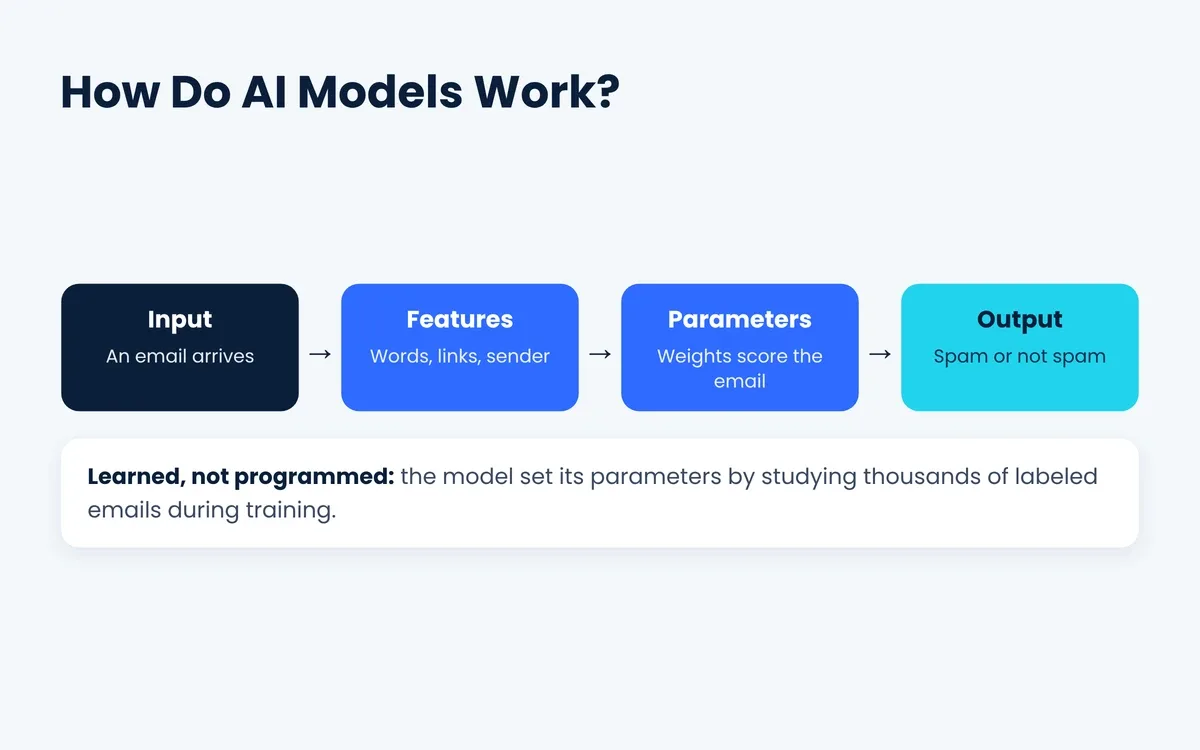
- Input: an email, a photograph or a row from a spreadsheet arrives.
- Processing: the model converts it to numbers and feeds them through its layers.
- Output: out comes a prediction, maybe "spam," "fracture likely" or a price of $412,000.
- Feedback: only during training, the difference between the answer and the correct answer is used to modify the parameters.
The Core Parts of an AI Model
Most machine learning models have a few core pieces in common, although the exact components depend on the model and training method:
- Algorithm: the process used to train or optimize the model, such as gradient descent in many neural networks.
- Architecture: the number of layers, how they're arranged and how they connect.
- Training data: the examples the model learns from, which could be labeled emails or billions of sentences.
- Parameters: the weights and biases that training adjusts. According to the GPT-3 paper, GPT-3 was built with 175 billion parameters.
- Hyperparameters: settings fixed before training starts, like the learning rate.
- Loss function: the formula or objective that measures how far the model's output is from the target or desired learning signal.
Deep learning models add a few structural pieces. Information moves through input, hidden and output layers, and activation functions determine the strength of each neuron's response. Language models also use tokenization, which segments text into smaller parts for processing. Depending on the architecture, they may use an encoder, a decoder or both.
A Simple Example: How a Spam Filter Model Works
Spam filtering is a good place to watch all of this happen, since the whole lifecycle fits into five steps.
- Collect examples. The initial set could be 100,000 emails that users have already reported as spam or marked as legitimate.
- Turn emails into features. Word counts, the number of links and the age of the sender's domain all become numbers the model can operate on.
- Train. An algorithm like Naive Bayes determines which combinations of features are common in spam.
- Test on fresh mail. The model runs on 20,000 emails it has never encountered. Engineers check how much spam it catches and how many legitimate emails it mistakenly flags as spam.
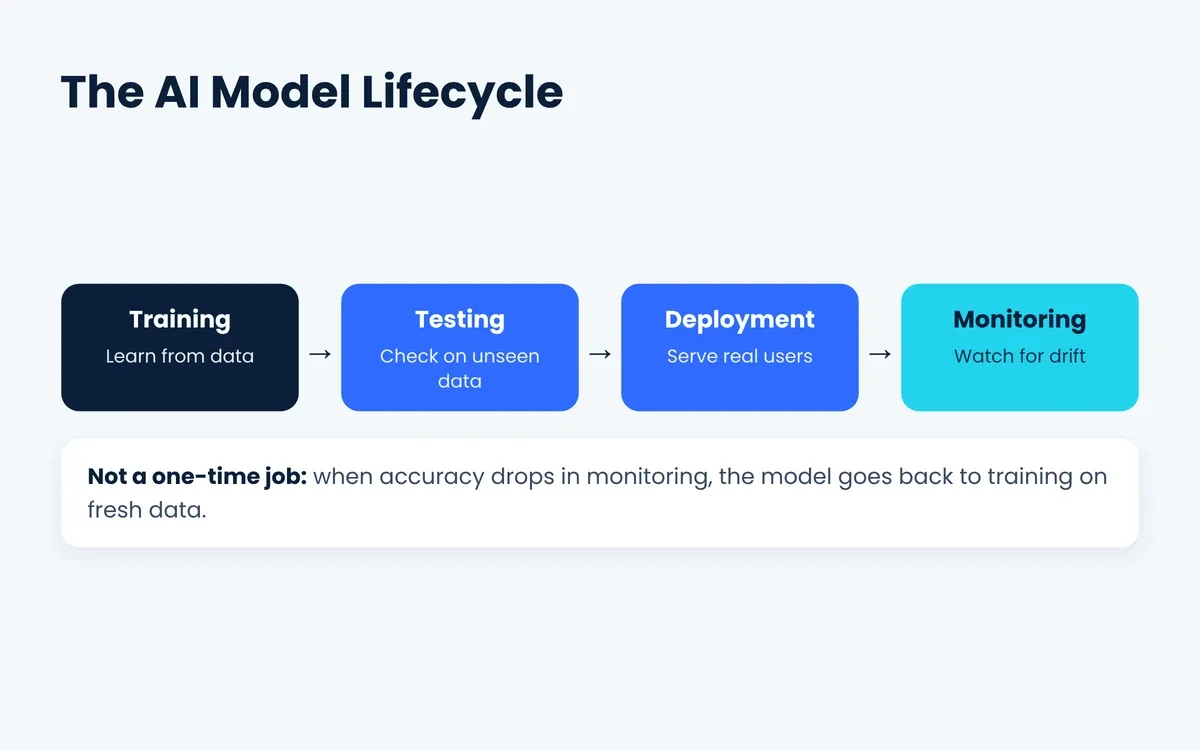
- Roll out and monitor. Every incoming email gets a score in milliseconds. Spammers keep evolving, so new user reports feed continual retraining.
How Do AI Models Learn?
A model makes a prediction, checks whether it's correct and adjusts its parameters if it isn't. AI model training repeats this process over the training data many times, aiming to bring the error down to a level acceptable for the task.
Inside a neural network, the prediction travels forward through the layers in a pass known as forward propagation. Backpropagation then sends the error backward and determines how much each weight contributed to it, which tells the training algorithm how far to move each weight. Geoffrey Hinton was one of the researchers who popularized backpropagation in a 1986 Nature paper, along with David Rumelhart and Ronald Williams. Backpropagation is still a standard method for training many neural networks. Our history of artificial intelligence covers how these ideas developed. Machine learning models generally learn in one of four ways, though plenty of modern systems combine them.
Supervised Learning
Supervised learning requires labeled data, which means every training example is accompanied by its correct answer. Spam filters are the classic case. A house-price model trained on past sales, each with its final price attached, works the same way.
The catch is the labeling itself, which takes people and time. On many projects, preparing the labeled dataset eats up more effort than the training does.
Unsupervised Learning
Unsupervised learning applies when the data has no labels, and the model tries to discover structure on its own. Suppose a retailer passes a k-means clustering model to the purchase histories of its 200,000 customers. The model may come back with a few groups, perhaps one that buys mostly during sales and one that shows up mainly before the holiday season.
What the model can't do is explain those groups. Someone still has to look at each cluster and decide what it represents.
Reinforcement Learning
Reinforcement learning is a method in which a model develops a strategy over time through trial and error: actions that work are rewarded, and actions that don't are penalized. Game-playing systems are trained this way, as are robots that practice picking up objects thousands of times in simulation before trying it in the real world.
Chatbots can rely on a variant too. In some post-training pipelines, human or model-generated preferences provide feedback that trains a reward model or optimizes the model toward preferred responses.
Self-Supervised Learning
Self-supervised learning generates its own labels from raw data, avoiding the need for manual labeling. Large language models are the best-known case. Give one the sentence "The river flooded after three days of rain" and hide the final word. The model now has a ready-made test: guess the word, then check it against the original. The text serves as its own answer key.
Do that across a vast amount of text, and the model learns statistical patterns in language, such as grammar, along with factual associations and the relations between concepts. Many foundation models undergo this type of training before fine-tuning and other later stages.
Training, Testing, Deployment and Monitoring
A trained model is not yet complete. It still needs to work on data it hasn't encountered and keep working once real users rely on it, so teams typically look for these issues:
- Overfitting: the model learns the training examples well, noise included, but struggles to make predictions on new examples.
- Underfitting: the model is too simple to capture the pattern in the first place.
- Cross-validation: a method of getting a more reliable estimate of performance. It partitions the data into segments, typically five for k-fold, and evaluates each segment one by one.
- Holdout set: data kept out of training and earlier tests until the final test.
- Data drift: new data starts to look different from the training data, such as new slang in customer messages.
- Model decay: performance degrades over time as data or real-world conditions change. The fix can be retraining, recalibration or another update, depending on the cause.
Scoring a classification model starts with a confusion matrix, a table that summarizes correct and incorrect predictions for each class. Accuracy is the proportion of all predictions that are correct, but it can mislead when the classes in the data are imbalanced. Precision examines only the items the model flagged and asks how many were correct. Recall turns the question around and asks how many real positives the model managed to catch, and the F1 score combines the two into a single number.
Regression models give numbers as answers, so they're judged by error instead. Mean absolute error (MAE) measures the average size of a miss, while root mean square error (RMSE) penalizes big misses more heavily.
For deployment, open frameworks like PyTorch and scikit-learn handle the training side. The ONNX format and Docker containers help transfer a model from a laptop to a server. Large models typically use GPUs or other accelerators because their workloads require significant parallel computation. Some smaller models can run on CPUs, phones or other edge devices. Applications then send requests to the model through an API, and each request has an inference cost.
What Are the Different Types of AI Models?
No official taxonomy of AI model types exists. The answer depends on the kind of classification you want to make: the job the model performs, the way it produces its output or the way it learns.
Classification, regression and clustering are examples of tasks. Generative and discriminative are modeling strategies, while supervised, unsupervised, reinforcement and self-supervised are learning setups. Rule-based and ensemble systems are another useful way to group models. The sections below go through the different AI models people run into most, from older types of machine learning models up to today's foundation models.
Classification, Regression and Clustering Models
One easy way to tell these three apart is to look at the results. Classification selects a category, regression makes a numerical estimate, and clustering finds groups that aren't specified beforehand.
| Model type | What it outputs | Real example |
|---|---|---|
| Classification | A category | Flagging a card payment as fraud or legitimate |
| Regression | A number | Predicting a home's sale price |
| Clustering | Groups with no preset labels | Segmenting customers by buying habits |
Despite the word "regression" in its name, logistic regression is a classification method. It estimates a probability between 0 and 1 and then converts that into a yes or no.
Generative vs Discriminative Models
A generative model learns the distribution of the data, which allows it to create new instances. A discriminative model learns only where the boundary between the classes is. Formally, generative models learn the joint probability of inputs and labels, while discriminative models learn the conditional probability of a label given the input.
A practical example helps make the difference more apparent. In a picture, a discriminative model is able to distinguish between a car and a truck, while a generative model can produce a new picture of a car.
In real systems the distinction between the two is rather hazy. Naive Bayes is a generative model, but it's mostly used as a classifier, since it simply picks the most probable class using Bayes' theorem. Generative adversarial networks (GANs) take that one step further and pair the two. A generator creates fake samples and a discriminator attempts to catch them, and both improve as they compete with one another.
Types of Machine Learning Models
Deep learning receives most of the attention these days, but traditional machine learning still fits many business problems. These models tend to be easier to train and easier to examine than large-scale neural networks. The following are just a few examples:
- Linear regression: used when the output is numeric, such as sales estimated from advertising spend.
- Logistic regression: applies to yes or no outcomes, like the likelihood that a subscriber cancels.
- Decision trees: make a sequence of if-then decisions that people can inspect.
- Random forests: combine many decision trees and merge their predictions.
- Support vector machines (SVMs): locate a boundary that separates classes.
- K-means: groups unlabeled records into a chosen number of clusters.
- Naive Bayes: a very efficient probabilistic classifier, commonly used for spam and text classification.
Multiple models can also work together in an ensemble. Bagging trains many models in parallel on random subsets of the data, which is how random forests work. Boosting trains models one after another so each corrects the previous one, and stacking feeds their predictions into a final model that makes the call.
Deep Learning Models
Deep learning models are neural networks with many layers, which enable them to learn useful features straight from raw images, audio or text. The history traces back to early work on neural networks, such as Frank Rosenblatt's 1958 paper, The Perceptron: A Probabilistic Model for Information Storage and Organization in the Brain. The later development of convolutional networks, along with the AlexNet paper and its 2012 ImageNet result, helped make modern deep learning popular. The primary model families include:
- Convolutional neural networks (CNNs) pass small filters across an image to detect edges, shapes and objects. Real-time detectors such as YOLO work on this principle.
- Recurrent neural networks (RNNs) read a sequence one step at a time and carry a memory forward, which made them a common choice for speech and time series before transformers spread.
- Long short-term memory networks (LSTMs) are RNNs with gates that let them retain information over long sequences.
- Transformers apply self-attention, which lets them efficiently learn how different tokens in a sequence relate to one another. The architecture comes from the 2017 paper Attention Is All You Need.
- Diffusion models learn to remove noise step by step, and Stable Diffusion creates images this way.
- Variational autoencoders (VAEs) compress data into a compact code, then decode it back out as new variations.
Foundation Models and Large Language Models
Foundation models are models trained on a large amount of data and used for various downstream applications. They can be fine-tuned, prompted or otherwise adapted after training. They are also known as base models or pre-trained models.
They're practical because of transfer learning, where the general knowledge acquired during pre-training carries over to new tasks. Fine-tuning makes the model more specific using a smaller, task-relevant dataset, like 5,000 support transcripts. Prompting is different: it guides the model with instructions and doesn't change the model's learned parameters.
Large language models (LLMs) are foundation models trained primarily on text data, and most of today's LLMs use the transformer architecture. According to the GPT-3 paper, GPT-3 has 175 billion parameters, while the open multilingual BLOOM has 176 billion, as its BLOOM paper reports. LLMs take in text as tokens (slices of words), and a context window determines how many tokens they can accept at one time.
Small language models (SLMs) are smaller and usually less capable on broad tasks, but they're faster and cheaper to run, which means they can run on edge devices such as laptops and phones. A multimodal model processes text, images and audio in a single system. Reasoning models perform additional computation to improve performance on complex, multi-step problems before giving an answer.
Narrow vs General-Purpose AI Models
A narrow AI model is used for a specific task, like reading license plates. Most commonly, a general AI model is a general-purpose foundation model that can be adapted for a wide range of tasks. The term is used very broadly, so it helps to be specific. Here, it refers to something like an LLM that can summarize a contract, translate a menu and write code without being retrained for each task.
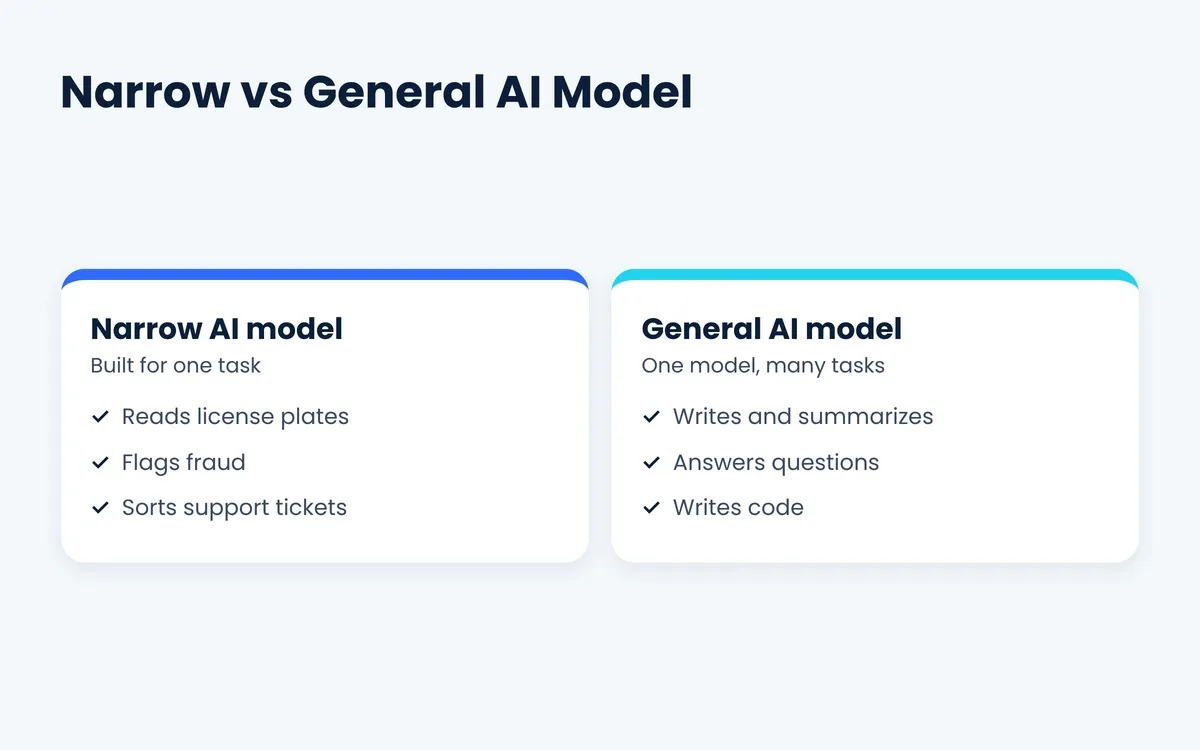
A general-purpose model is not artificial general intelligence (AGI). AGI describes a hypothetical system that could match people on any intellectual task, and no such system exists yet. Even the best chatbots of today are pattern-matching systems with definite limitations. Our guide to the types of artificial intelligence explains how narrow AI differs from general AI.
AI Models Examples (List of AI Models)
AI models examples include the GPT family used in ChatGPT, Claude, Llama, Stable Diffusion, Whisper and YOLO. The less visible models inside spam filters and recommendation systems count too. The artificial intelligence models list below sorts them by what they do:
| AI model | Category | What it does | Access |
|---|---|---|---|
| GPT family | Large language model | Used by ChatGPT for language, conversation and coding | Closed, through products or APIs |
| Claude | Large language model | Writing, analysis and coding help | Closed, through products or APIs |
| Llama | Large language model | Text generation that developers can self-host | Weights available under its own license |
| Mistral | Large language model | Efficient text generation in several sizes | Varies by model |
| BLOOM | Large language model | Multilingual text generation in dozens of languages | Open-access |
| DALL·E | Image generation | Creates images from text prompts | Closed, through products or APIs |
| Stable Diffusion | Diffusion model | Generates and edits images from text | Varies by version and license |
| Whisper | Speech recognition | Transcribes and translates spoken audio | Openly released |
| YOLO | Computer vision (CNN) | Object detection in images and video | Varies by implementation |
| Recommendation engine | Classification and ranking | Suggests products or shows based on behavior | Built in-house by many companies |
| Spam filter | Classification | Sorts email into spam or not spam | Built into most email services |
One thing to note is that ChatGPT is an AI product, not the name of a specific model. It uses GPT models, and the product is the interface and other elements that wrap around them.
How Many AI Models Are There?
No single number represents all AI models, because they're continually being published, updated and retired. In August 2026, Hugging Face, the world's biggest open model hub, passed 3 million public models. The growth has been rapid, since the hub held around 1 million in September 2024.
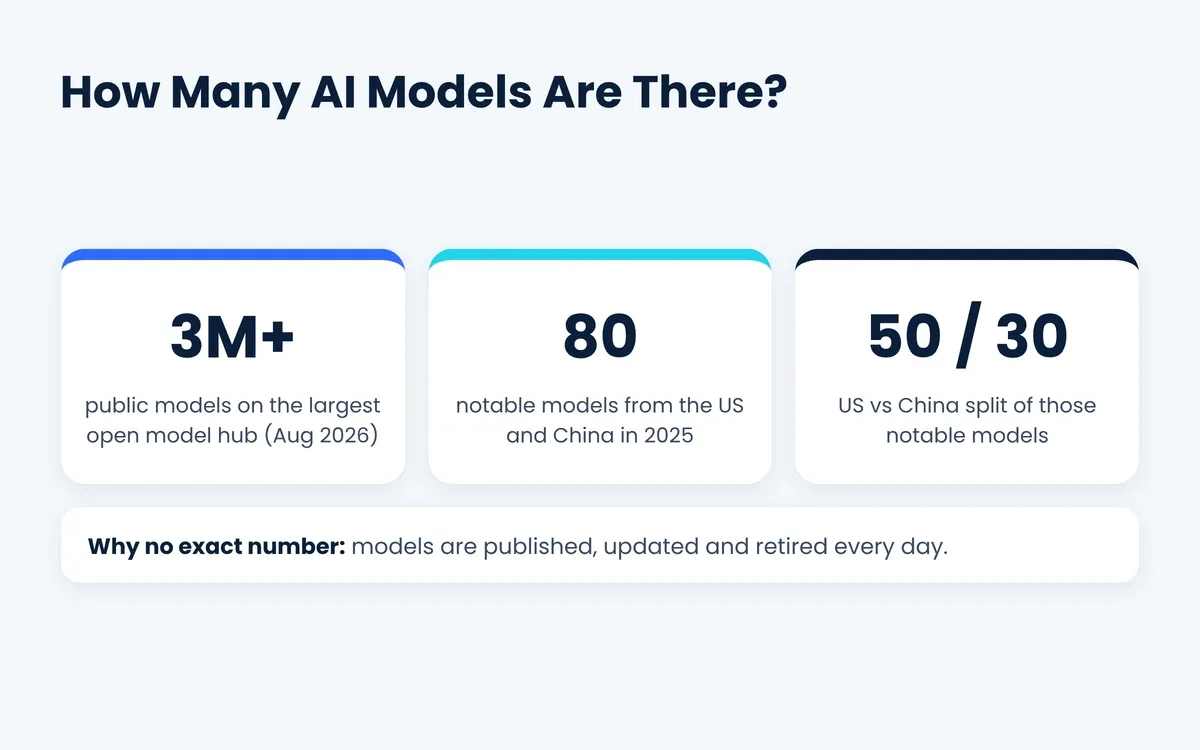
Most of that total is long tail. The Hugging Face spring 2026 report shows that approximately half of hosted models have fewer than 200 downloads, with the top 200 models receiving 49.6% of all downloads.
The list of notable models is much more limited. Stanford HAI's 2026 AI Index counted 50 notable models from the United States and 30 from China in 2025. Industry, not academia, developed more than 90% of the notable models that year.
So, how many AI models are there? Millions, if you count everything public, but only a small number each year if you count the ones that advance the field.
Where Are AI Models Used?
Organizations apply AI models to automate repetitive decisions, identify patterns in vast amounts of data and personalize services at a scale that would be impossible by hand. The value depends heavily on the task, the quality of the data and how well the model suits the current workflow. A few artificial intelligence models examples by industry include:
- Healthcare: computer vision models can detect possible tumors or fractures and alert a radiologist to confirm them.
- Finance: fraud models score card payments in real time, before the transaction is executed.
- Retail: recommendation engines suggest products based on browsing and purchasing behavior.
- Manufacturing: predictive maintenance models analyze sensor data to predict failures and raise an alert in advance.
- Transport: object detection helps driver-assistance systems detect pedestrians, lanes and road signs.
- Customer service: language models respond to simple queries and pass more complex ones on to service staff.
Speech recognition, translation and document search turn up in nearly every industry as well. In most of these cases, the model does the repetitive pattern work, and people remain responsible for decisions that carry real risk.
How Do You Choose the Right AI Model?
The decision on which AI model to use depends on the problem, the data, accuracy and explainability requirements, budget and applicable rules. Different model types work in different scenarios, so it helps to ask some questions first:
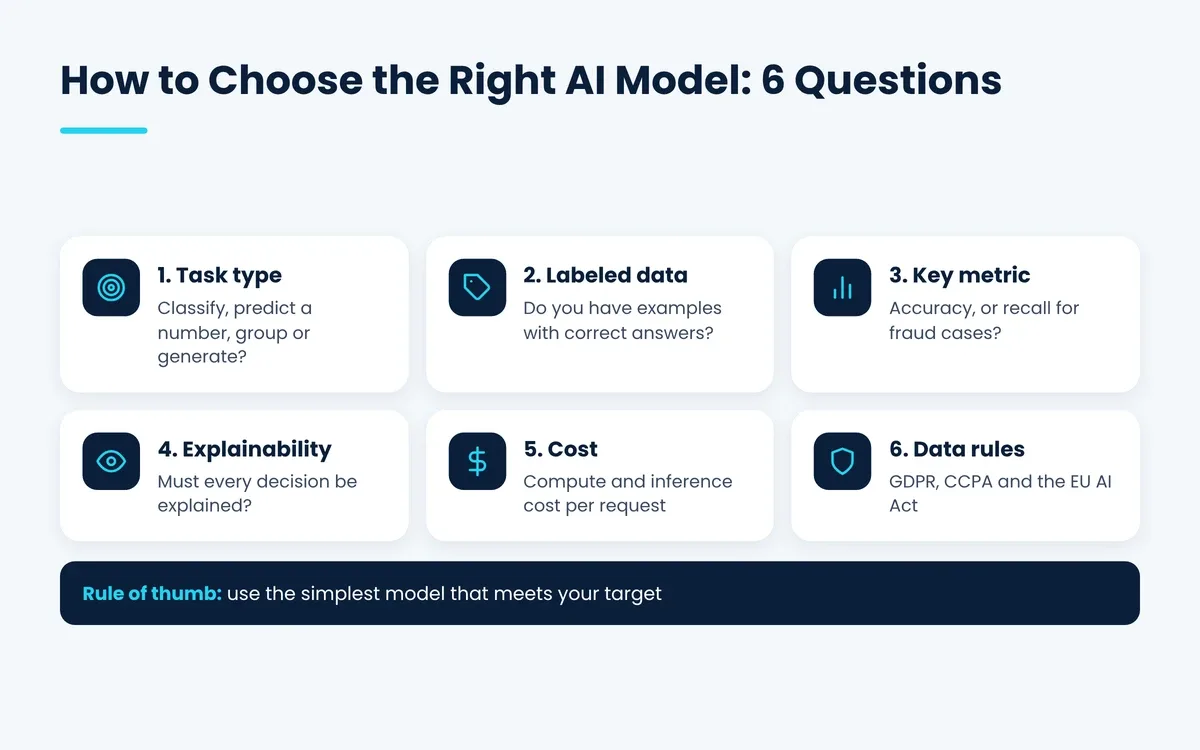
- Is the task classification, regression, clustering or generation?
- Do you have labeled data, and is there enough of it, clean enough to use?
- What is the most important measure? For fraud detection, recall is often more important than precision.
- Will you have to justify individual decisions? In lending or hiring you typically will, which points toward decision trees or logistic regression.
- What will GPU time and per-request inference cost, compared with the value of each prediction?
- Where will the data be stored, and will rules like the GDPR, the CCPA or the EU AI Act apply?
A good default is the simplest model that achieves the desired target. In certain situations, a logistic regression is a better option than a large neural network. That usually holds when the dataset is limited, the problem is fairly simple and the team needs an interpretable model.
What Are the Limitations of AI Models?
AI models can go wrong in a variety of ways. Frequently cited issues are skewed results, wrongly generated answers, lack of explainability, changing data, computing costs and privacy risks. Knowing where these show up helps you decide where a person must stay involved.
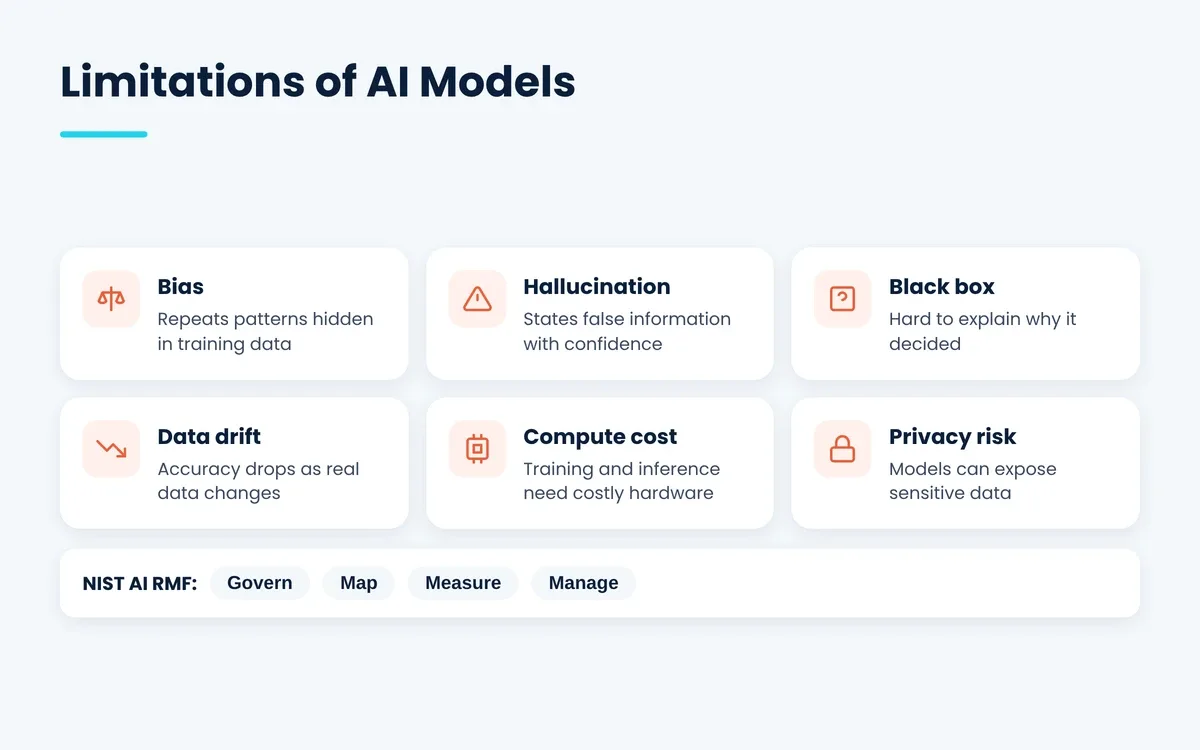
- Bias. If the data used to create a model is biased, the model will be too, so a model based on past hiring decisions can perpetuate old discrimination.
- Hallucination. Generative models sometimes give confident answers that are just plain wrong, such as invented quotes.
- Black-box decisions. Deep networks often don't offer clear reasons for an output, which can make their decisions harder to audit and appeal.
- Data drift. When real-world behavior changes faster than the training data, performance can fall.
- Compute cost. Training and running large models typically requires expensive GPUs or other accelerators and a lot of energy.
- Privacy. Without anonymization and access controls, models trained on personal data can expose sensitive information.
The NIST AI Risk Management Framework, published in January 2023, is a starting point for managing these risks. It's structured around four functions: govern, map, measure and manage. The OECD AI Principles provide guidance on human oversight, accountability and transparency.
Common Misconceptions About AI Models
Most of the misunderstanding around AI models comes from a couple of persistent myths.
- No established evidence shows that current AI models are sentient. Convincing language or behavior from a model isn't evidence of feelings or consciousness.
- People using a model don't normally change the values of its parameters. Changing the model usually requires retraining, fine-tuning or another update.
- No universal model suits every task. A strong language model may not be a good choice for inventory forecasting.
- Size isn't everything either, since a small model trained on your own data can outperform a much larger general model on a specific task.
Conclusion
An AI model is a system that produces an output from an input, based on patterns it learned from data. The output might be a prediction, a classification, a recommendation or newly generated content.
You can group AI models in many ways, and the right category depends on what the model does and how it learns. Large language models and other foundation models are valuable, but simple machine learning is still useful for many business use cases.
When selecting a model, begin with the problem and not the reputation of the model. Take into account the data at hand, the performance required, the cost of running it and how much explanation the result needs. To see the full process from data to prediction, read how AI works.
FAQs About AI Models
What is an AI model in simple words?
An AI model is a computer program that turns inputs into predictions or decisions. Most models learn the patterns they rely on from examples instead of hand-written rules. A spam filter is a typical case, since it studies thousands of labeled emails and then judges new messages without a rule for each one.
What is the difference between an AI model and an algorithm?
An algorithm is a procedure or method, such as the steps used to train a model on data. The AI model is the trained result you get once that algorithm has run on a specific dataset. A single algorithm like linear regression can produce thousands of different models, depending on the data it learns from.
How do AI models learn?
AI models learn by making predictions on training data and measuring how far off each one was, using a loss function. Training then adjusts the parameters to reduce that error. The cycle repeats many times with labeled examples, unlabeled data, rewards or self-made labels, depending on the learning style.
How many AI models are there?
No fixed number exists, because new models are published, updated and removed constantly. Hugging Face alone passed 3 million public models in August 2026. Only a small share counts as notable, though. Stanford HAI counted 80 notable models from the United States and China combined in 2025.
What are the main types of AI models?
Sorted by learning style, the main types are supervised, unsupervised, reinforcement and self-supervised models. By task, they include classification, regression and clustering models. Sorted by approach, they split into generative, discriminative, rule-based and ensemble models, with foundation models and LLMs as the newest major group. Because one model can sit in several groups at once, any list of each different type of AI model depends on the lens you use.
Is ChatGPT an AI model?
ChatGPT is an app rather than a model. The AI models behind it belong to the GPT family of large language models, which read your message and write the reply. The app adds the chat window, conversation memory and safety layers on top of those underlying models.
What is a general AI model?
A general AI model usually means a general-purpose foundation model that can handle many tasks, such as writing, translation and coding, without separate training for each. It isn't the same thing as artificial general intelligence (AGI), a hypothetical system that could match people at any intellectual task.
Are AI models the same as machine learning models?
All machine learning models are AI models, but some AI models don't use machine learning at all. Rule-based expert systems still count as AI because they automate expert judgment. The difference is that they follow if-then rules written by human experts instead of learning from data.