


AI works by turning data into numbers, finding statistical patterns in those numbers with a machine learning algorithm, and then using the learned patterns to predict an output. A neural network stores those patterns as adjustable values called weights. Training adjusts model parameters using many examples. Inference applies the finished weights to your question in under a second.
That split between training and inference explains most of the confusion around artificial intelligence. A model does not look up answers in a database, nor does it follow rules a programmer typed by hand. It ranks probabilities against patterns it absorbed from training data, which is why the same system writes a clean email in one reply, then invents a fake citation in the next.
This guide walks through the pipeline in order: data collection, preprocessing, training, validation, deployment, monitoring. It then traces a single prompt from your keyboard to the answer on your screen, explains large language models, AI agents, plus retrieval grounding, and closes with the measured reasons these systems still get facts wrong.
Key Takeaways
• Many modern AI systems learn patterns from data rather than relying solely on hand-written rules.
• The pipeline has six stages: data collection, preprocessing, training, validation, deployment, monitoring.
• Training changes the model. Inference applies to it and changes nothing.
• Machine learning splits into supervised, unsupervised, and reinforcement learning.
• Large language models predict one token at a time using an attention mechanism.
• Models invent facts because benchmarks reward guessing over admitting doubt.
• Commercial AI systems are generally considered narrow AI, even when they can perform many different tasks. General AI does not exist yet.
What Is Artificial Intelligence?
Artificial intelligence is software that performs tasks normally requiring human intelligence, such as recognizing images, reading language, or forecasting an outcome. It learns those tasks from data instead of from instructions written by a programmer.
The field took its name from a 1955 research proposal written by John McCarthy, Marvin Minsky, Nathaniel Rochester, and Claude Shannon, which set up the Dartmouth Summer Research Project held in 1956. The proposal argued that every feature of intelligence can be described precisely enough for a machine to simulate it.
Five years earlier, Alan Turing published Computing Machinery and Intelligence in the journal Mind, the paper behind what people now call the Turing Test. Turing turned a philosophical argument into a practical one by proposing an imitation game, where a judge reads written answers and decides whether a human or a machine wrote them.
Early systems, now called symbolic AI, answered with hand-written rules. A programmer spelled out every condition, so the system never went beyond what its author imagined. Modern systems flip that arrangement. They work out their own rules from examples, which is why the quality of a dataset now decides performance far more than the amount of code.
Narrow AI vs General AI
Every AI system sold today is narrow AI, meaning it handles one class of task well. ChatGPT generates text, a bank fraud model scores card transactions, a radiology model flags a suspicious lung nodule. None of the three transfers its skill to another job without fresh training data.
Artificial general intelligence, or AGI, describes a system that would match human flexibility across any task. There is no broadly accepted evidence that a system has achieved AGI under commonly used definitions. Stanford’s 2026 AI Index instead calls today’s frontier systems jagged, because one model scores near the human baseline on a coding benchmark while missing a reasoning problem a child solves.
How Does AI Work, Step by Step?
AI works in six stages: data collection, preprocessing, training, validation, deployment, and monitoring. Training adjusts millions of internal parameters to improve predictions against known answers. During ordinary inference, the base model’s weights remain fixed and are applied to inputs the model has not encountered before. Teams refer to this sequence as the AI pipeline, and the order of these stages can be as important as the technology used within each one.
1. Data collection. Engineers gather the raw material: text, images, audio, transaction logs, sensor readings. Volume alone settles nothing, because an AI model trained on biased records learns the bias perfectly.
2. Preprocessing. Raw data rarely arrives usable. This stage removes duplicates, fills gaps, standardizes formats, then converts everything into numbers. Text becomes tokens, images become pixel grids, categories become numeric labels.
3. Training. The model reads batches of examples, predicts an answer for each, measures how far that prediction sits from the correct answer, then adjusts its internal values to shrink the gap. One full pass through the dataset is called an epoch. Training may involve one or more passes over data, depending on the model and training strategy.
4. Validation. Engineers test the trained model on data held back from training. A model that scores far higher on training data than on held-back data has memorized rather than learned, a failure called overfitting.
5. Deployment. The finished model moves to a server, a phone, or an embedded chip, and its values freeze. From here on the system performs inference, meaning it applies fixed knowledge to fresh inputs.
6. Monitoring. Real-world inputs drift away from training conditions over time. Teams track accuracy in production, then retrain once results slip. A fraud model trained in 2023 misses fraud patterns invented in 2026.
Training vs Inference at a Glance
| Aspect | Training | Inference |
|---|---|---|
| What happens | The model adjusts its internal weights | The weights stay frozen and get applied |
| How often | Once per model version | Every single user request |
| Time taken | Days to months | Milliseconds to a few seconds |
| Hardware | Thousands of GPUs running together | A few chips, sometimes a phone |
| Cost shape | One large upfront expense | Small per request, endless in total |
| Does it learn? | Yes, this is the only learning step | No, nothing is remembered afterward |
The split matters commercially. Estimates compiled by Brookings place 80% to 90% of all AI computing on inference rather than training, which is the reason running an AI product costs more over time than building one.
Why Does Training Data Decide Everything?
Training data is the set of examples a model learns from, so it sets the ceiling on what the model can ever do. A model’s ability to recognize a pattern is constrained by the information and structures available during training. Practitioners sort training data into four types, each suited to a different learning method.
• Labeled data. Examples paired with the correct answer, such as chest X-rays each marked pneumonia or clear. Labeling costs money because trained humans have to do it.
• Unlabeled data. Raw examples with no answers attached, such as a collection of web pages. Models find structure inside it without being told what to look for.
• Structured data. Rows and columns with defined fields, such as a sales ledger or a table of patient vitals. Traditional machine learning handles this format efficiently.
• Unstructured data. Free-form content such as emails, photographs, call recordings, or PDFs. Deep learning opened this category, which holds most business information.
Three data defects cause most production failures. Coverage gaps leave a group underrepresented, so accuracy drops for that group. Stale records describe conditions that are no longer held, so the model predicts a world that has moved on. Duplicated entries inflate one pattern, so the model treats a rare case as common.
How Does Machine Learning Work?
Machine learning is the branch of AI where a system gets better at a task by processing examples rather than by following coded instructions. It splits into three families, separated by what the algorithm receives while it learns.
| Family | What it learns from | Typical use |
|---|---|---|
| Supervised learning | Examples with the correct answer attached | Spam filters, credit scoring, medical image triage |
| Unsupervised learning | Examples with no answers attached | Customer segmentation, anomaly detection |
| Reinforcement learning | Reward and penalty signals from trial runs | Robotics control, chatbot alignment, game agents |
Supervised Learning Explained
Supervised learning trains on labeled examples, so the algorithm sees both the input and the right output. It corrects itself until its predictions line up with the known labels, then applies that mapping to cases it has never seen.
Two task types dominate. Classification sorts an input into a category, such as marking an email spam or legitimate. Regression predicts a continuous number, such as the closing price of a house. Spam filters, credit scoring models, along with most cleared diagnostic imaging tools, all belong to this family.
Unsupervised Learning
Unsupervised learning receives no labels at all. The algorithm groups examples by similarity, a process called clustering or compresses them into a smaller set of underlying factors. Retailers use it for customer segmentation, discovering buyer groups nobody defined in advance. Security teams use it for anomaly detection, flagging server behavior that differs from every established pattern.
Reinforcement Learning
Reinforcement learning optimizes behavior using reward signals from interactions or other feedback mechanisms. An agent acts inside an environment, collects a reward for good outcomes or a penalty for bad ones, then updates its strategy to earn more reward over time. Robotics teams rely on it for movement control. Language model labs rely on a variant called reinforcement learning from human feedback to shape how a chatbot responds.
What Is a Neural Network and How Does It Learn?
A neural network is a stack of mathematical layers loosely modeled on brain cells. Each artificial neuron multiplies its inputs by weights, adds a bias, then passes the result through an activation function that decides how strongly the signal continues.
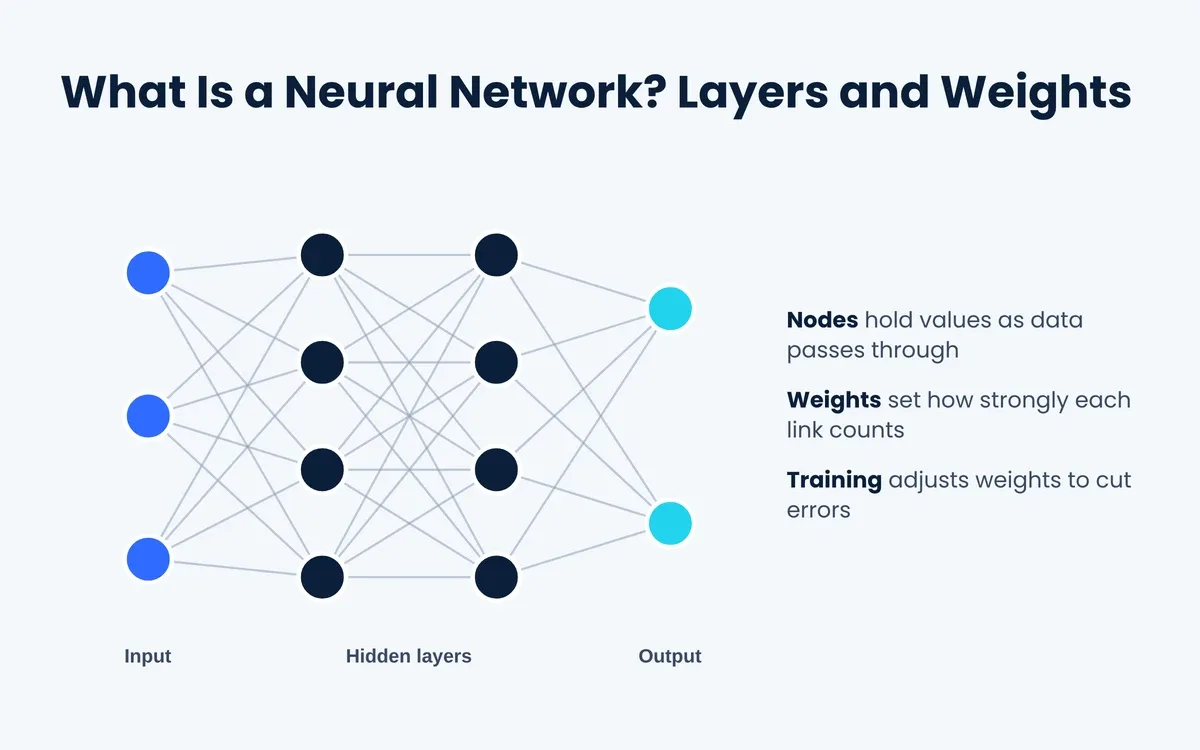
A network holds three kinds of layers. The input layer receives the numbers. Hidden layers transform them, with each layer picking up more abstract features than the one below it. The output layer produces a prediction, such as a probability distribution over image categories.
The Training Loop in Four Steps
1. Forward pass. Data flows from input to output, producing a prediction.
2. Loss calculation. A loss function measures the distance between the prediction and the correct answer, returning one error number.
3. Backpropagation. The error travels backward through the layers. Calculus gives each weight a gradient, meaning the share of the mistake that weight caused.
4. Weight update. An optimizer nudges every weight in the direction that lowers the error. The size of each nudge is the learning rate, a setting that controls how aggressively the model changes.
Backpropagation is the central method used to efficiently calculate gradients in most deep neural networks. Without it, nobody could assign credit or blame across millions of values buried inside hidden layers.
What Is Deep Learning?
Deep learning is a specialized branch of machine learning built on neural networks with many hidden layers. Depth matters because each layer builds features out of the layer beneath it, moving from edges to shapes to whole objects. Three architectures cover nearly every deployed system.
• Convolutional neural networks (CNNs). Built for grid-shaped data such as images. They slide small filters across a picture to spot local features anywhere they appear, which is what powers most medical imaging tools.
• Recurrent neural networks (RNNs). Built for sequences such as speech or sensor readings over time. They carry a memory of earlier steps forward, though that memory fades across long sequences.
• Transformers. Introduced by Google researchers in the 2017 paper "Attention Is All You Need". Transformers can process training sequences in parallel, although autoregressive models generate output tokens sequentially.
Transformers became the standard architecture for language work. Most widely used large language model chatbots are based on transformer or transformer-derived architectures, including ChatGPT, Google Gemini, along with Microsoft Copilot, rely on transformer-based architectures.
How Do Large Language Models Work?
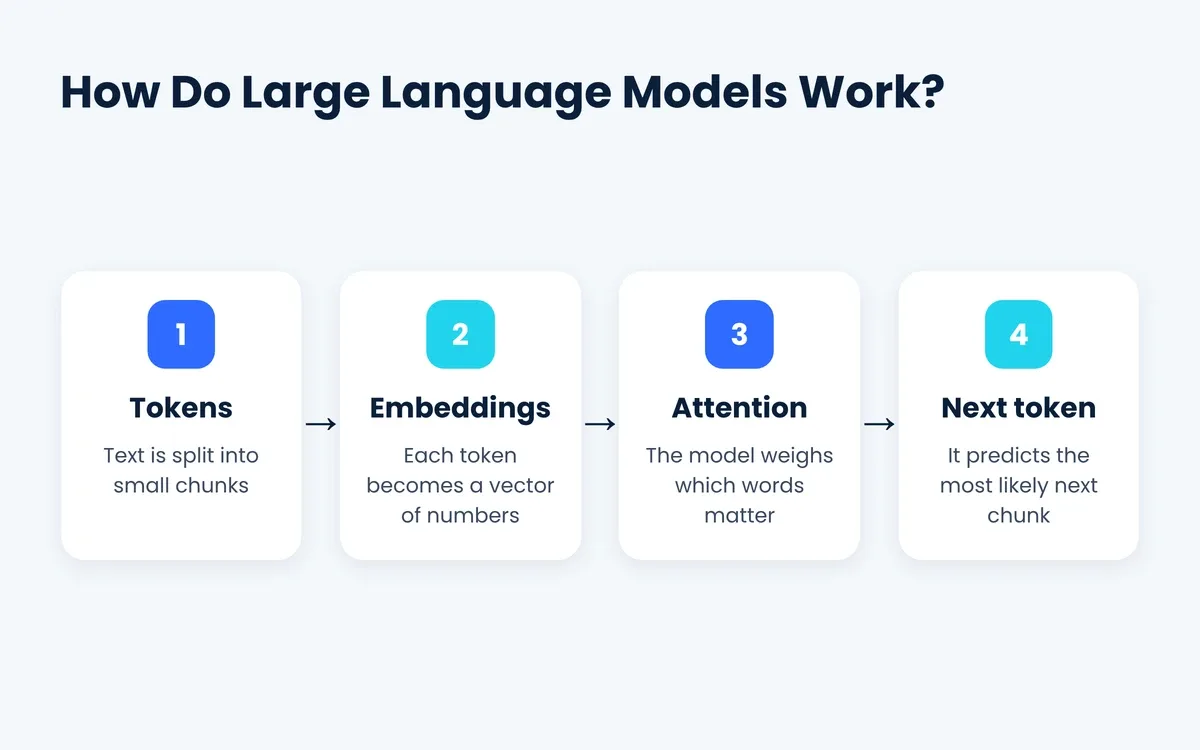
A large language model predicts the next token in a sequence. It splits text into tokens, turns each token into a list of numbers, weighs how strongly every token relates to every other one, then outputs a probability score for every possible next token.
Tokens and Embeddings
A token is a chunk of text, usually a word or a word fragment. The word "unhappiness," for example, splits into several tokens rather than one. Each token maps to an embedding, a list of numbers that records meaning as a position in mathematical space.
Embeddings explain why models handle synonyms without effort. The number lists for "physician" and "doctor" sit close together, so the model treats them as near-equivalent even though nobody wrote a synonym rule.
The Attention Mechanism
Attention lets the model weigh how relevant every token is to every other token in the input. Take the sentence "The trophy did not fit in the suitcase because it was too large." Attention scores connect "it" to "trophy" rather than "suitcase," resolving a reference that stumped earlier systems.
Pretraining, Fine-Tuning, and Alignment
Model creation runs in three phases. Pretraining exposes the network to an enormous body of text, where it picks up grammar, facts, plus reasoning habits purely by guessing hidden words. Fine-tuning then narrows the model on a smaller curated set, teaching it to follow instructions or handle a specialist job such as contract review.
Alignment comes last. Human reviewers rank competing responses, a reward model learns those preferences, then reinforcement learning shifts the base model toward answers people rate as helpful. This phase turns a raw text predictor into a usable assistant.
What Actually Happens When You Send One Prompt?
Most explanations stop at training. The part users experience is inference, so tracing one query makes the difference concrete.
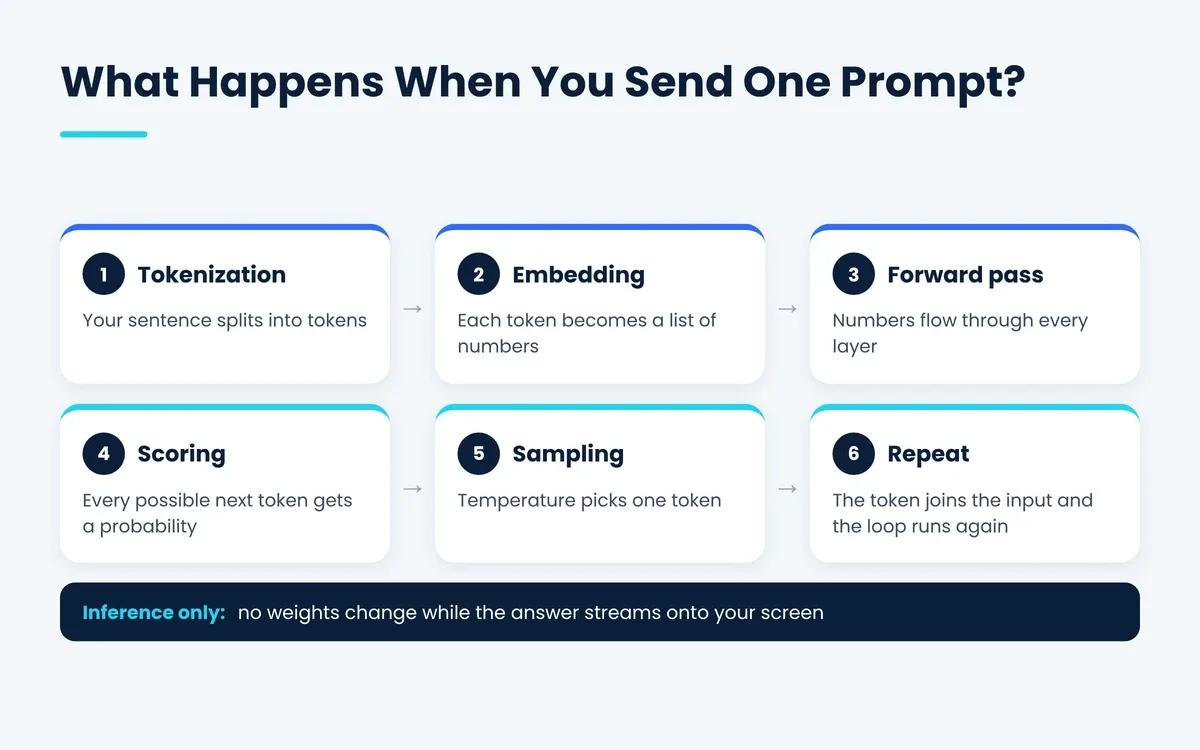
1. Tokenization. Your sentence splits into tokens, each one a word or a word fragment.
2. Embedding lookup. Each token turns into its number list, with position information added so word order survives.
3. Forward pass. Those numbers travel through every transformer layer. Attention runs at each layer, sharpening the model’s representation of the whole sequence.
4. Probability of output. The final layer scores every token in the vocabulary, which runs to tens of thousands of candidates.
5. Sampling. The system picks one token using a temperature setting that controls randomness. Low temperature favors the highest-scoring token, which produces consistent but predictable text.
6. Repeat. The chosen token joins the input, then the whole cycle runs again for the next token. That loop is why answers stream onto your screen word by word.
No weights change during any of these. The model’s base weights normally do not change as a result of an individual question, which is why a chatbot forgets the conversation once the session context ends.
How Does Generative AI Differ from Traditional AI?
Most widely used large language model chatbots are based on transformer or transformer-derived architectures. Generative AI produces new content: text, images, audio, video, or code, sampled from a learned probability distribution. A third label, agentic AI, sits on top of the generative layer and adds the ability to act, which is where agentic AI and generative AI part ways.
| Feature | Traditional (predictive) AI | Generative AI |
|---|---|---|
| Question it answers | Which category, or how much | What comes next |
| Output | A label or a number | New text, images, audio, or code |
| Example | Fraud score on a card payment | A drafted email or a generated image |
| Main risk | A wrong classification | A confident, fluent, invented fact |
The generative branch spread faster than earlier general-purpose technology. Stanford’s 2026 AI Index records generative AI reaching 53% of every person worldwide actively using generative AI within three years, ahead of the pace set by either the personal computer or the internet at comparable points. Use in the United States is now mainstream as well: Pew Research Center found 49% of US adults using AI chatbots in February 2026, up from 33% in 2024, with 60% reading AI-generated search summaries.
How Does AI Understand Language and Images?
Natural Language Processing
Natural language processing, or NLP, is the AI field covering how machines handle human language. It includes tokenization, sentiment analysis, named entity recognition, translation, plus summarization. Voice assistants such as Alexa and Siri chain several NLP parts together: speech recognition turns audio into text, intent classification works out the request, then text-to-speech reads the reply back. The same components sit inside most of the AI tools and software marketed for writing, support, and search.
Computer Vision
Computer vision is the field covering how machines read visual input. A system turns an image into a grid of pixel values, then a convolutional network detects edges, textures, shapes, finally whole objects. Applications include license plate reading, warehouse quality checks, retail shelf audits, along with diagnostic imaging.
Recent models merge both fields. Multimodal systems accept an image alongside a text question, placing each into the same mathematical space so the model can reason across them together.
What Are the Four Types of Artificial Intelligence?
Researchers group AI by capability rather than by technique. Two categories exist in commercial products today. Theory-of-mind and self-aware AI remain research or speculative categories rather than established commercial capabilities.
| Type | What it does | Status in 2026 |
|---|---|---|
| Reactive machines | Responds to current input with no memory of past events | Exists. IBM Deep Blue judged only the board in front of it |
| Limited memory AI | Use recent history to inform the next decision | Exists. Every commercial AI product sits here |
| Theory of mind AI | Models the beliefs, intentions, and emotions of people | Research prototypes only, no shipped product |
| Self-aware AI | Holds awareness of its own existence | Philosophical concept with no engineering path |
How Do AI Agents Work?
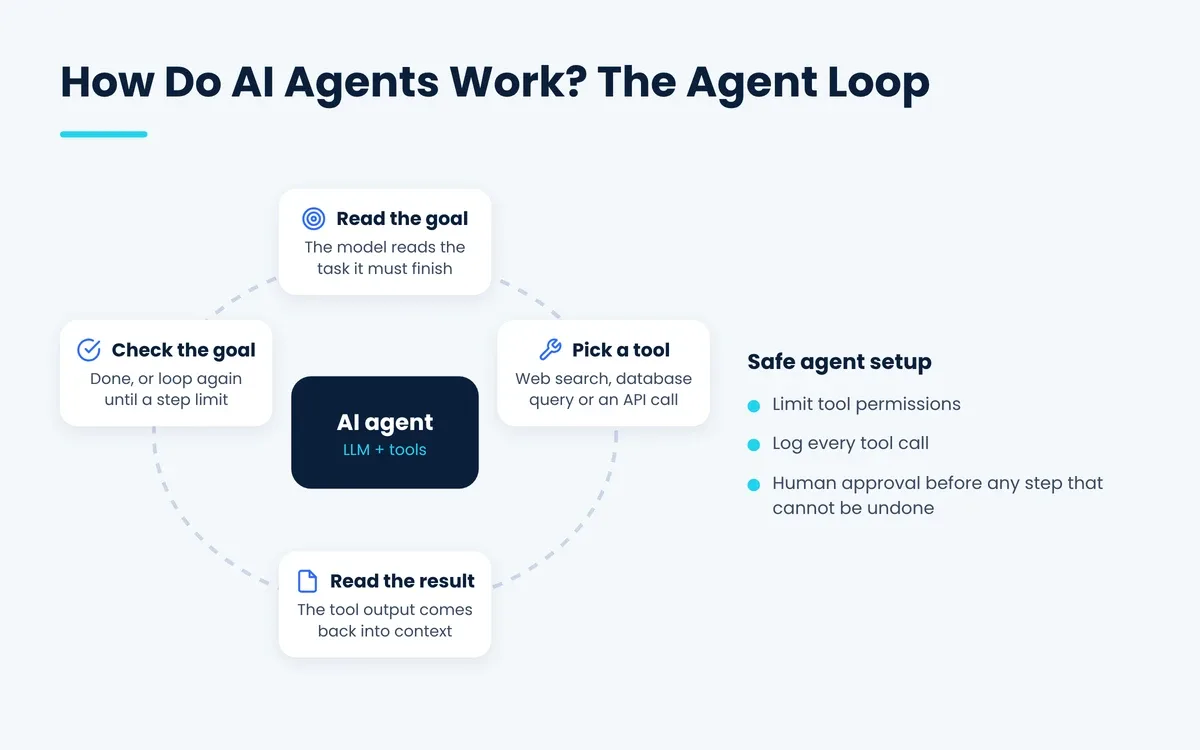
An AI agent is a language model wrapped in a loop that lets it plan a task, call outside tools, read the results, then choose its next action. The model supplies the reasoning, while the surrounding software supplies the ability to act.
The loop repeats four steps. The agent reads a goal, picks a tool such as a web search or a database query, receives the output, then judges whether the goal is met. It keeps going until it finishes or reaches a step limit set by its operator.
Adoption moved quickly through 2026. McKinsey reports roughly two in ten organizations scaling AI agents across the company, while 32% say they decided against buying at least one software product because coding agents let them build the feature in-house.
Agents raise both the value and the risk. A model that invents a fact produces a bad sentence, whereas an agent that invents a fact takes a bad action against a live system. Operators therefore limit tool permissions, log every call, then require human approval before any step that cannot be undone.
How Does Retrieval Grounding Improve Accuracy?
Retrieval-augmented generation, shortened to RAG, adds a search step in front of the model. The system finds the most relevant documents from a trusted source, then hands those documents to the model along with your question.
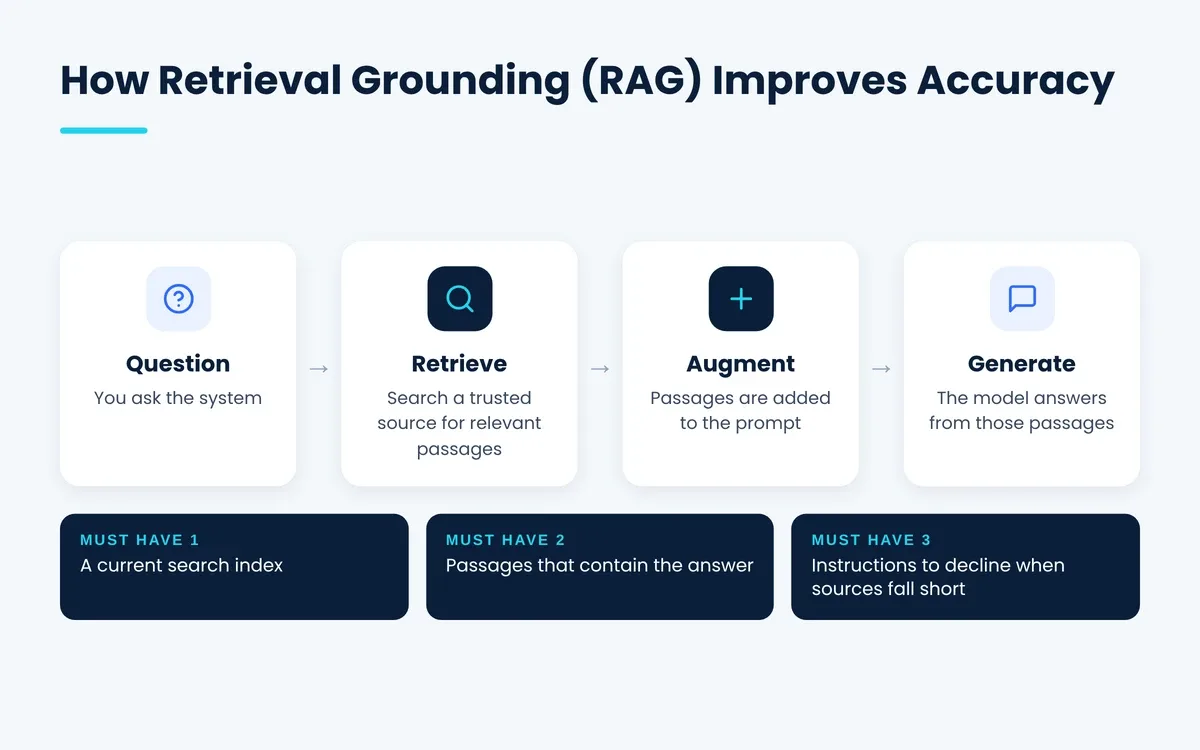
Grounding changes the job from recall to reading comprehension. Instead of pulling a half-remembered fact out of its weights, the model reads a passage placed directly in front of it, which is why grounded summarization produces far fewer invented details than open-ended factual recall.
Three design choices decide whether grounding delivers. The search index has to stay current, the retrieved passages must contain the answer, then the instructions have to tell the model to decline when the sources fall short. Teams that skip the third instruction bring the guessing behavior right back.
Why Does AI Make Things Up?
AI models invent facts because they generate the most probable continuation, not the most verified one. Standard benchmarks score a confident wrong answer the same as no answer at all, so guessing earns points while admitting uncertainty earns none.
Research published in Nature in April 2026 traced hallucinations straight to this incentive. Evaluations that mark a response correct or incorrect, with no credit for saying "I do not know," teach models to produce an answer no matter how weak their internal confidence. The behavior is a scoring artifact rather than a mysterious defect.
Error rates swing sharply by task, so any single headline number misleads. Grounded summarization sits at the low end, while open-ended factual recall sits much higher, and specialist domains fare worse of all. A 2026 study in Critical Care Explorations asked three frontier models for peer-reviewed references across ten neurocritical care topics with retrieval switched off, then had two blinded experts verify all 300 citations against PubMed, DOI records, and CrossRef.
Three practices cut the risk in production. Ground the model in retrieved sources, require citations a reader can open, then give explicit credit for abstention in your own evaluation rubric so the model stops treating silence as failure.
How Does Bias Enter an AI System?
Bias enters through the data, through design choices, then through the setting where the system gets deployed. A model trained on past hiring records inherits the preferences inside those decisions, then repeats them at scale while looking objective.
• Sampling bias. A group appears rarely in the training set, so accuracy for that group drops. NIST tested 189 face recognition algorithms from 99 developers and found demographic differentials in most of them.
• Label bias. Human annotators apply inconsistent standards, so the model learns their disagreement as though it carried meaning.
• Proxy bias. A permitted variable stands in for a prohibited one. A ZIP code, for example, tracks closely with demographics across many US cities.
Control exists at every stage. Teams audit datasets for coverage gaps, measure accuracy separately for each subgroup instead of reporting one average, then keep a named human accountable for consequential calls such as credit denial or medical triage. Explainability tools support that work by showing which inputs drove a given prediction.
How Much Energy Does AI Use?
Data centres used roughly 415 terawatt-hours (TWh) of electricity in 2024, accounting for about 1.5% of global electricity consumption, according to the International Energy Agency. The IEA projects that data-centre electricity consumption will more than double to around 945 TWh by 2030, slightly more than Japan’s current total electricity consumption with AI identified as a major driver of this growth.
Per-query numbers moved the opposite way, a detail most AI explainers still miss. The IEA reports that energy use per AI task has fallen by at least an order of magnitude annually in recent years, although more energy intensive uses including reasoning, video generation, and agentic tasks can consume substantially more energy. The IEA reports that simple text queries typically consume less electricity than running a television over the same period.
Total electricity demand continues to rise because AI adoption is growing faster than efficiency improvements can offset. Stanford’s AI Index reports that AI data-center power capacity reached 29.6 gigawatts, comparable to New York State’s peak electricity demand. Geographic concentration adds further pressure to local power grids. In Virginia, Data centers account for a substantial share of Virginia’s electricity demand, according to Carbon Brief’s analysis.
Where Does AI Work in the Real World Today?
Healthcare
The FDA has authorized 1,614 AI-enabled medical devices through the end of June 2026, and 1,230 of those, or 76%, work in radiology, according to the agency’s device list tracked by MedTech Dive. Most of these tools assist rather than decide. They flag a suspected bleed or move an urgent scan up the queue, leaving the diagnosis with the radiologist.
Financial Services
Banks and card networks run supervised models that score every transaction in milliseconds against learned fraud patterns. The same family of models support credit underwriting, anti-money-laundering alerts, plus algorithmic trading. Regulation pushes this sector toward explainable models, since a denied application requires a stated reason.
Retail and Media
Recommendation engines read purchase history alongside browsing behavior to rank products or titles, which is how streaming catalogs and online storefronts decide what to show first. Retailers extend the same models into demand forecasting, dynamic pricing, plus warehouse routing, where a small accuracy gains compounds across millions of transactions.
Customer Service and Internal Operations
Enterprise platforms now embed models directly inside workflow software, handling ticket classification, draft replies, plus knowledge lookup for support agents. Companies most often report cost reductions in supply chain management and service operations, along with manufacturing, while revenue gains cluster in marketing and sales.
What Are the Real Limits of AI in 2026?
Capability and business impact have pulled apart. McKinsey found 88% of organizations using AI in at least one business function, yet only about one-third have scaled it across the enterprise, and one in five names operating cost as an active brake on further use. Four limits explain most of that gap.
• Jagged capability. Performance swings unpredictably between tasks that look equally hard to a person, so pilots succeed while production workflows stall.
• Falling transparency. The Foundation Model Transparency Index average dropped to 40 from 58 after leading labs stopped publishing training code, dataset sizes, plus parameter counts.
• No causal understanding. Standard predictive models often learn correlations and do not automatically establish causal relationships. A system that predicts equipment failure accurately still cannot explain the physical cause without separate engineering analysis.
• Rising incident volume. Documented AI incidents reached 362 in the latest AI Index count, covering harms that range from faulty outputs to deliberate misuse.
Public sentiment tracks these limits closely. Roughly two-thirds of Americans think AI is moving too quickly, even while half of them use AI chatbots and 60% read AI-generated search summaries.
What Comes Next for AI?
Three shifts carry clear evidence behind them. Inference costs keep collapsing, with the cost of running a GPT-3.5-class model down roughly 280-fold since late 2022 according to Stanford’s AI Index, which pushes AI into products that could not have justified the expense two years ago.
Smaller specialized models keep gaining ground. Distillation trains a compact model to copy a large one, delivering most of the quality at a fraction of the cost. Many production systems now route easy questions to the small model, saving the expensive one for hard cases. The same compression makes on-device AI practical, so a phone or laptop handles the request without sending data to a server.
Governance is catching up unevenly. Enterprises are folding agent oversight into existing risk frameworks, while regulators focus on disclosure, energy siting, plus sector-specific safety rules. The practical advice for any organization adopting AI stays the same: verify outputs, ground models in your own sources, then measure results against a baseline you recorded before deployment.
Conclusion
AI works by learning statistical patterns from data, then applying those patterns to new inputs. The six-stage pipeline holds whether the system filters spam, reads a chest X-ray, or writes an essay. What changes between them is the architecture, the training data, plus the amount of computing power behind it.
The training and inference split is the single idea worth carrying away. Training is where a model learns, and it happens once. Inference is what you interact with, and it changes nothing inside the model. That distinction explains why a chatbot forgets your last conversation, why running an AI product costs more than building it, and why grounding a model in retrieved sources beats hoping it remembered a fact correctly.
It also gives you a practical test for any AI claim you meet. ask what the system was trained on, ask what it does at inference time, then ask how anyone measured that it works. Vendors who answer all three clearly are worth your attention.
Frequently Asked Questions
Does AI think like a human brain?
No. Neural networks borrow loose inspiration from biological neurons, though the mechanisms differ completely. A model multiplies numbers through layers of weights. It holds no goals of its own, and it builds no understanding beyond statistical association between patterns.
What is the difference between AI, machine learning, and deep learning?
AI is a broad field. Machine learning is a subset where systems learn from data. Deep learning is a subset of machine learning built on multi-layer neural networks. Every deep learning system is machine learning, though not every machine learning system is deep learning.
Does an AI model learn from my conversations?
Not during the conversation. The model’s weights stay frozen while it answers, so nothing you type changes the system. Whether logged conversations later feed a training run is a separate decision, stated in each provider’s data policy.
Why do two AI models give different answers to the same question?
Three things differ: the data each model absorbed, the preferences each was tuned toward during alignment, plus the randomness applied when the text gets generated. Running the same prompt twice on one model also produces variation unless the temperature setting sits at zero.
How much data does it take to train an AI model?
It depends on the task. A narrow image classifier trains usefully on tens of thousands of labeled examples, while frontier language models train on far larger text collections. Exact dataset sizes have become harder to confirm, since leading labs stopped publishing them, a change of the Foundation Model Transparency Index records in Stanford’s AI Index.
Can AI replace human judgment in important decisions?
AI should not independently replace human judgment in consequential decisions. Models capture correlation without causal reasoning, they carry the bias of their data, plus they state wrong answers with full confidence. Organizations therefore keep a named human accountable for credit denials, medical diagnoses, hiring outcomes, along with legal determinations.