


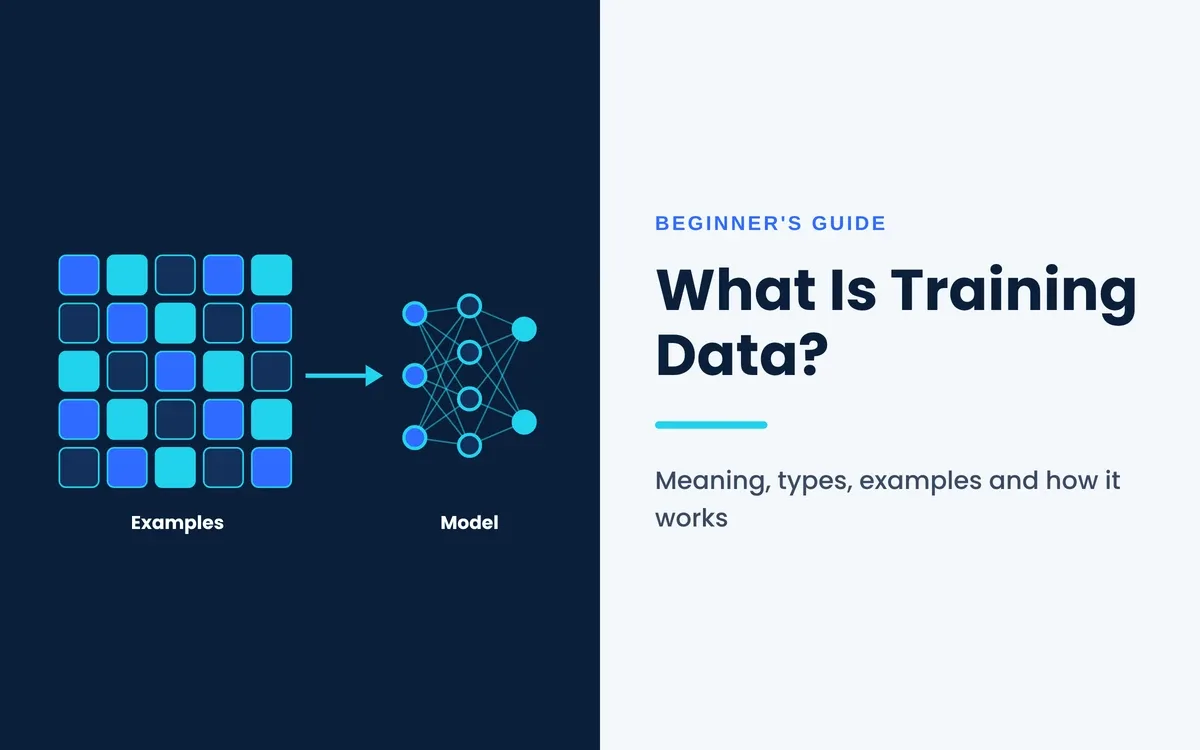
Training data means the examples that a machine learning model learns from. Training data for AI can be pictures, emails, sales records, or sentences. Consider them the exercises in a book that a student copies and studies.
In supervised learning, each example has a label in addition to the input features. The model is trying to match the correct answer, which is given by the label. The model guesses a value during training, then changes its settings to shrink the difference between the guess and the label. The model can only learn from the examples it is given. So the quality, coverage, and size of the dataset decide how good a model can be.
Below is a guide on the training data meaning in machine learning and the types of training data. It also illustrates the difference between training sets, validation sets, and test sets. Later sections detail the sources of AI training data and how teams prepare it. They also describe the impact of bias, privacy, and dataset size on results.
Key Takeaways
- A model is trained by the examples and labels in training data.
- Models learn by guessing, checking the error, and adjusting.
- Each training, validation, and test set has one job.
- Wrong labels and missing groups lower model accuracy.
- If the examples are biased, the predictions will be biased too.
- Privacy laws limit how teams can use personal data.
What Is Training Data in Machine Learning?
A simple training data definition: the set of examples an algorithm is trained on before going live. A simple training data definition is "learning examples." A few hundred rows or billions of documents can sit in a training dataset, also known as a training set.
The same customer email can play two roles. If the email is placed within the training set, then it affects the weights of the model. When it arrives after launch, the model only makes a prediction about it, and the model itself stays the same. In brief, machine learning training data constructs the model, while real data is what the completed model operates on.
Features, labels, and ground truth elements
Each example has features describing it and a label containing the correct answer that the model needs to predict. Features are also called attributes or input variables, and the label is called the target variable.
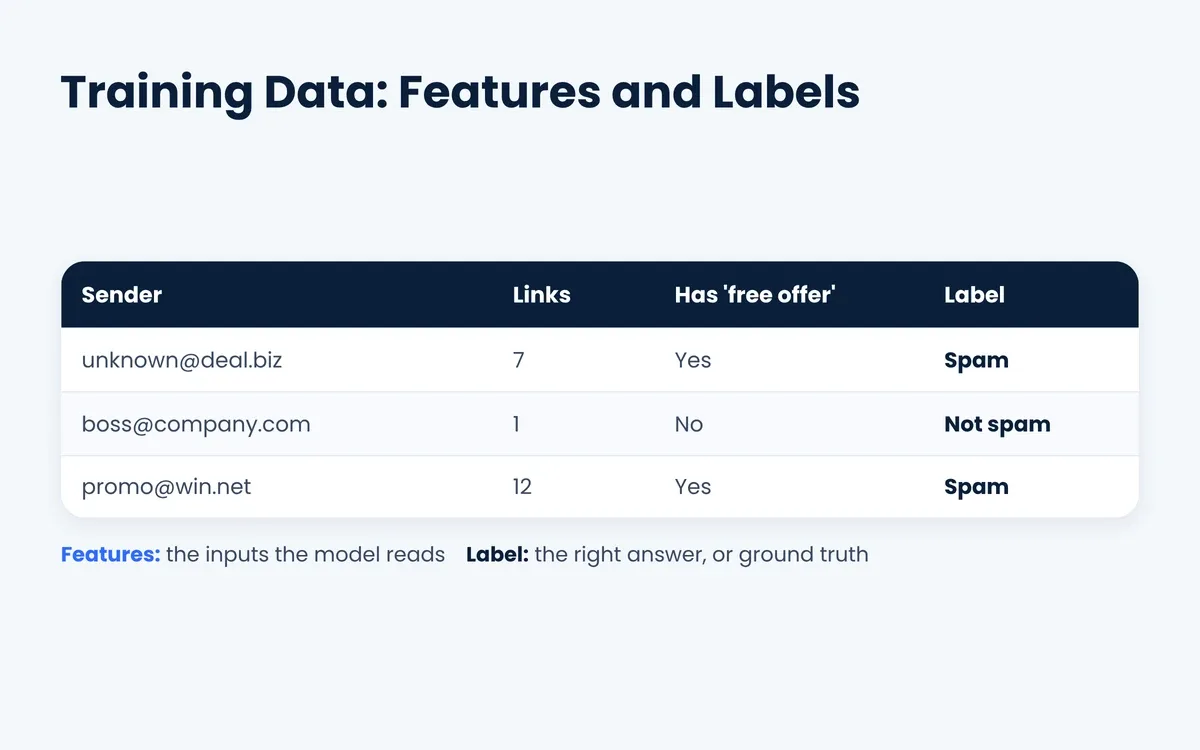
A machine breakdown prediction model uses machine temperature, vibration speed, and days since the last repair as features. Every row is also labeled with whether or not the machine failed within 30 days. Combined, each row becomes an input-output pair the model can learn from.
The checked, correct labels in a dataset are called ground truth data. Some teams call them gold standard labels or reference labels. The model is trained with the ground truth and evaluated using the ground truth. Because of this, a wrong label teaches the model a wrong lesson and also skews the test score.
Each example can also include a set of metadata, such as when it was collected, where it came from, and who labeled it. That extra detail helps teams trace problems later.
How Does an AI Model Learn From Training Data?
An AI model learns from the training data by repeating one process: make a guess, measure the error, and adjust the weights. After millions of small fixes, a model that started with random parameters eventually detects real patterns.
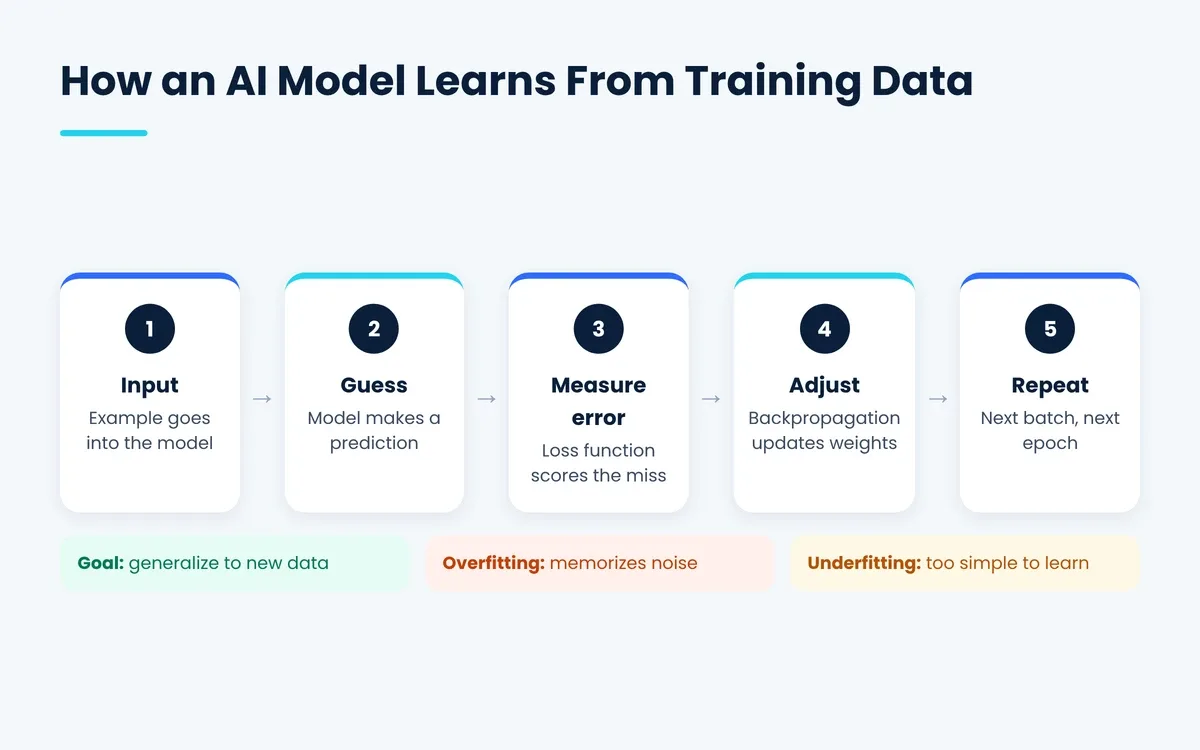
- Input: one instance or a mini batch of instances is fed to the model.
- Guess: the model makes a prediction using its current weights.
- Error: the loss function measures the distance between the guess and the correct label.
- Backpropagate: in neural networks, the model works out how much each of the weights contributed to the error. Then, an optimizer adjusts each weight a small amount to reduce the error.
- Repeat: each epoch consists of one pass over the training set, and most runs perform several epochs.
The goal is to generalize, which means making good predictions on new data that the model has not seen. An overfitting model learns the training set along with its noise and fails when it sees new inputs. The opposite of overfitting is underfitting, which occurs when the model is too simple to capture the true pattern. As a result, it does badly on both training and test data.
What Are the Types of Training Data?
There are three major types of training data: labeled, unlabeled, and synthetic data. They can also come in a structured or unstructured format. The data can contain text, pictures, audio, video, or sensor readings. The groups overlap, so one set of data can be unlabeled, unstructured, and multimodal at the same time.
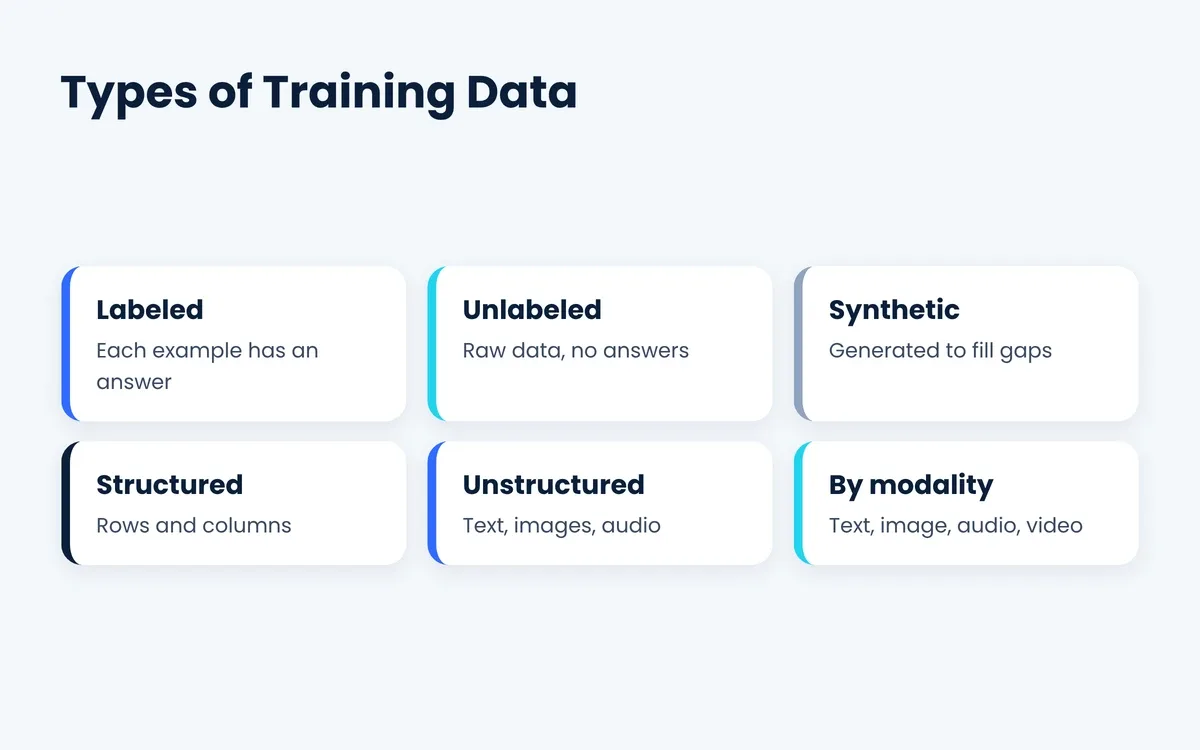
Labeled vs unlabeled data
What is labeled data? Labeled data pairs each input with a correct answer, for example an X-ray labeled "pneumonia." It is also known as annotated data, tagged data, or human-labeled data. This type of data is essential for supervised learning. Labeling data is expensive and slow, because a person, usually a specialist, has to review every example.
What is unlabeled data? Unlabeled data is data that has no answers attached to it, like unmarked pictures or web pages. Teams can collect huge amounts of it at low cost. Unsupervised and self-supervised methods find structure in it without any human tags. Large language models use both kinds, as the learning approaches section shows.
Synthetic training data
Synthetic training data is computer-generated data that mimics the patterns in real data but does not copy actual records. Simulations, rule-based tools, or generative models are used to make it. It can help cover unusual fraud cases, risky driving scenes, or patient records that privacy regulations restrict.
Testing synthetic data against real data is still necessary. A generator can only repeat patterns that it has learned, blind spots included. As a result, a model trained only on simulated data can fall short on noisy, real-world data.
Structured vs unstructured training data
Structured training data consists of rows and columns, while unstructured training data includes free-form text, images, audio, and video. Structured data takes the form of tables, such as bank transactions, sensor logs, or customer spreadsheets. Emails are unstructured, and the same goes for call recordings and medical scans. There are also semi-structured data objects, such as JSON files and tagged web pages.
The format shapes which task a model can learn. Tabular data is a good fit for models that predict churn, price, or credit risk. Language, vision, and speech systems are fed by unstructured data. It also requires extra work before training, for instance tokenization of text or image resizing.
Training data by modality
- Text data: reviews, support tickets, and documents for chatbots, search, and sentiment analysis.
- Image data: photos and scans for object detection and quality checks, as well as for medical imaging.
- Audio data: voice recordings and transcripts for speech recognition.
- Video data: frame sequences for action recognition and driver-assistance systems.
- 3D point cloud data: lidar scans for robots and self-driving systems.
- Time-series and sensor data: IoT data for machine maintenance and demand prediction.
- Multimodal data: paired text and visuals, such as images with captions, for models that read both together.
How Do Learning Approaches Use Training Data?
Each learning approach uses training data for machine learning differently. Supervised learning works from a set of labeled pairs, while unsupervised learning works from a set of raw data. Reinforcement learning does not need a fixed dataset for learning, but rather a set of rewards.
The extent of labeling a project requires depends on which approach a team adopts. Labeling is often the largest cost, and thus it influences the budget.
- Supervised learning uses labeled pairs for classification (spam or not spam) and regression (house price).
- Unsupervised learning finds segments in unlabeled data, like customer segments or odd network traffic.
- Semi-supervised learning combines a small labeled set with a large unlabeled set to reduce the cost of labeling.
- Self-supervised learning creates its own labels, such as guessing a word after it is covered up.
- Reinforcement learning is trial-and-error learning, where rewards are used instead of labeled examples.
- Transfer learning fine-tunes a model trained on a large set of data on a smaller set of data.
Training data for LLMs
Training data for LLMs is processed in stages: pretraining on large-scale unlabeled text, then fine-tuning on smaller curated datasets. During pretraining, a large language model learns grammar, facts, and reasoning by guessing which word comes next in a sentence.
Then fine-tuning takes place, using annotated examples of good answers to tune the model's behavior. For some training pipelines, reinforcement learning from human feedback (RLHF) is an extra step. Human reviewers compare the model's answers, and the model adapts its answers to the reviewers' preferences.
If there are mixed rankings at this stage, the model gets confused. False or low-quality text in the pretraining data can also lead a model to state wrong facts with high confidence, a problem known as hallucination.
difference between training data, validation data, and test data?
The training data is used to teach the model, the validation data is used to tune it, and the test data is used to score it on unseen examples. Most teams split one AI training data set into these three parts before training starts. Mixing up these roles makes the model look more accurate than it is. That gap shows up once the model goes live.
| Dataset | Main job | When teams use it | Typical share |
|---|---|---|---|
| Training data | Sets the model's weights | Every training pass | 60% to 80% |
| Validation data | Tunes settings and spots overfitting | During development | 10% to 20% |
| Test (holdout) data | Measures results on unseen data | Once, at the very end | 10% to 20% |
A common train validation test split is 80/10/10 or 70/15/15. For small datasets, k-fold cross-validation is used instead of a fixed validation set. With that approach, the data is divided into k equal subgroups, and each subgroup takes one turn as validation data. When a time-series project splits the data by date, the model cannot look ahead into the future.
The training data vs validation data line can blur. Developers check validation scores many times while they pick settings such as the learning rate. Over time, those choices start to fit the model to the validation set. For this reason, teams keep an independent test set, which stays unused until the end of the process.
The rule is even more rigid for training data vs test data. Any test information that reaches training, even through a cleaning step, counts as data leakage. A review by Kapoor and Narayanan at Princeton found leakage errors in 329 papers across 17 scientific fields. The effects ranged from small flaws to results that looked far better than they were.
Training data vs big data
Big data is any data that is very large, fast-moving, or varied, while training data is the part of the data prepared for teaching a model. Clickstream data from a store, for instance, is considered big data. Only after a team selects and cleans the logs do they become training data. The team then gives the data labels such as "purchased" and splits it into subsets.
Where Does AI Training Data Come From?
Sources of AI training datasets include public datasets, company-owned data, licensed data, web scraping, crowdsourcing, sensors, synthetic data, and user feedback. Teams rarely rely on one source, since good data for AI training usually comes from a mix of places. The mix of cost, fit, quality, and legal risk varies among sources. Most projects use two or more of these sources.
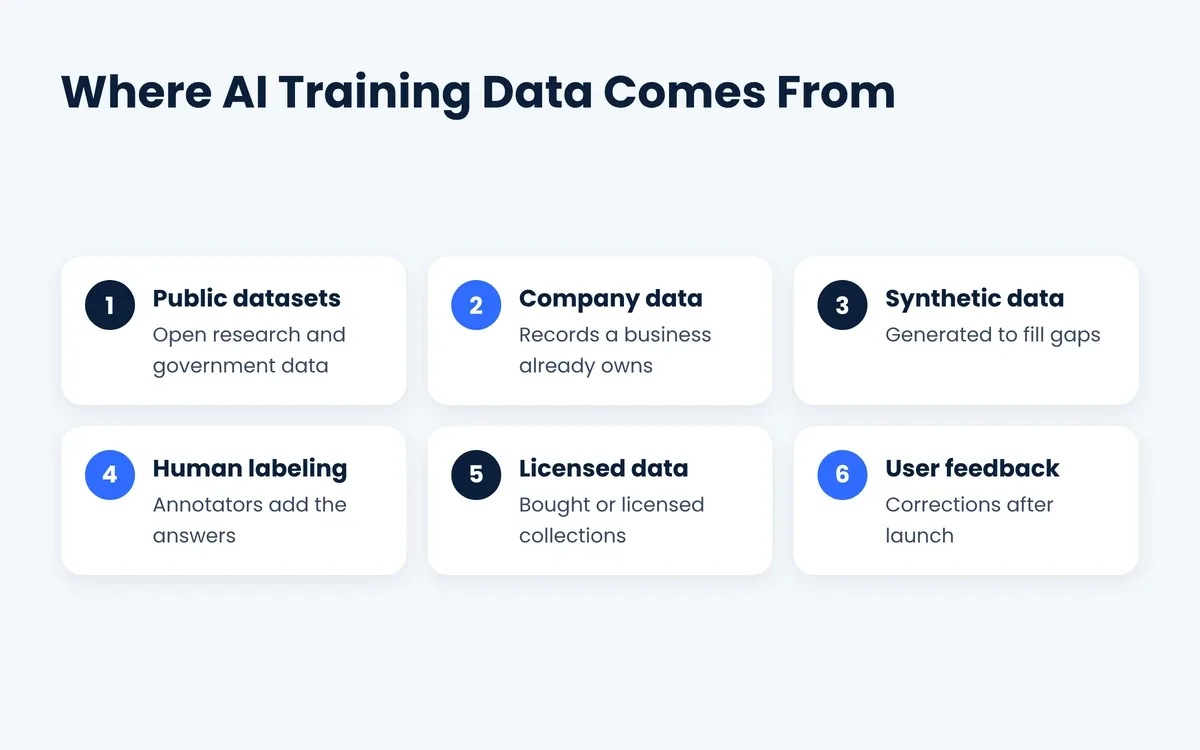
- Public data and open data are free and help teams create a rapid prototype. They are not always suitable for a business problem, and the licensing often prevents commercial use.
- First-party data, like support tickets, sales data, or app logs, suits the task well. It often must be cleaned, labeled, and given a consent review before use.
- Licensed data and data partnerships offer deep domain coverage and clear usage rights. They, in turn, are more expensive and receive updates less often.
- Web scraping collects huge amounts of text and images at a low price. It also brings up copyright, terms-of-service, and privacy concerns that need legal review.
- Crowdsourcing spreads labeling tasks among many people to speed the work up. It needs clear labeling rules and quality checks if it is to be effective.
- Sensors and IoT devices take continuous readings from cars, smart homes, and factory machines.
- Synthetic data fills in gaps for private or rare cases, as the synthetic data section explains.
- User feedback, like ratings and corrections, shapes later rounds of fine-tuning.
Knowing where AI training data comes from also safeguards a project from legal hassle. Provenance records describe where each example is from and under which license it falls. Those records save weeks of work when a quality or legal question comes up months after launch.
When you plan how to collect training data, begin with the prediction task. Specify the target label, the users of the model, and the circumstances in which the model will be used. Then check whether your sources cover each group and condition before collection begins.
How do you prepare your training data?
Preparing training data transforms raw data into processed, labeled, and standardized examples that the model can learn from. Raw data rarely lands in a state where a team can use it as is. Teams that know how to prepare training data don't run into many of the accuracy issues that come later.
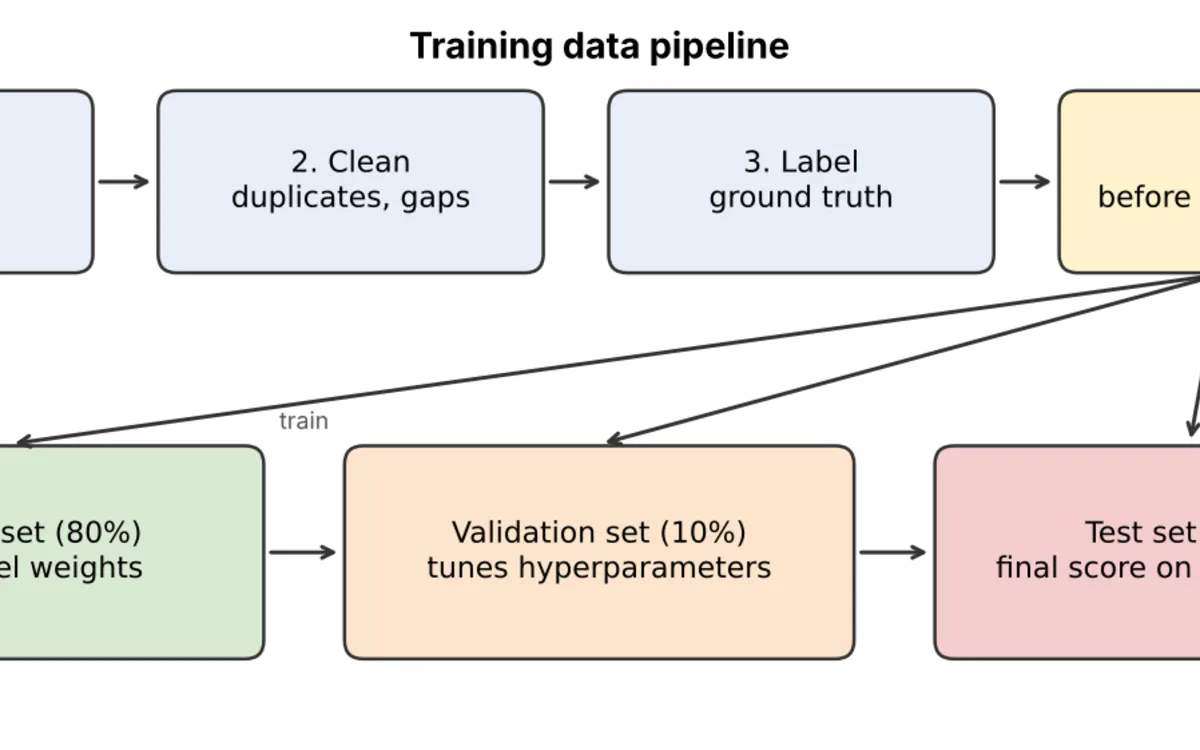
- Collect: compile examples that fit the task and the people the model will be used for.
- Clean: eliminate duplicate data, correct format errors such as mixed date styles, and fill in missing data. Eliminate outliers that come from errors instead of actual events.
- Label: add correct answers that follow written labeling guidelines, as discussed below.
- Split: divide the training, validation, and test sets before any scaling or other preprocessing.
- Preprocess: make useful features, scale numbers using min-max normalization or z-score standardization, and encode categories using one-hot encoding. Fit each step on the training set only, and the other sets then use the same settings.
- Augment and balance: grow small datasets with changed copies, like images that have been rotated or cropped. Add more examples of rare classes to ease class imbalance.
- Version and document: tag each dataset version, then note its sources, cleaning steps, and known issues.
Training data preprocessing changes what a model can learn. The k-nearest neighbors method compares examples by the distance between their feature values. A feature measured in thousands, like purchase amount, can drown out one measured in single digits, like weekly logins. Scaling puts both features on the same footing.
Data labeling and annotation
Data labeling, also called data annotation, adds correct answers to raw examples so a supervised model can learn from them. Labels can be categories, boxes drawn around objects, or written transcripts. They range from one sentiment tag on a review to outlines around every person in a street photo.
Human in the loop labeling mixes software with people. A model suggests labels, and human annotators accept, fix, or reject them. Active learning sends the examples the model is least sure about to people first. That way, expert time goes where it helps the model most.
Good labeling programs rely on four checks:
- Labeling guidelines that define each label with examples and edge cases.
- Agreement checks, where two or more people label the same sample and the team measures how often they match.
- Review rounds that settle disputes and confirm the final ground truth.
- Subject experts for specialist content, such as radiologists for scans or lawyers for contracts.
Label errors show up even in popular datasets that researchers use every day. Northcutt and colleagues found an average label error rate of at least 3.3% across the test sets of 10 popular datasets. The datasets covered images, text, and audio files. Errors at that level were enough to change which model ranked first on a benchmark.
What makes high quality training data?
High quality training data is accurate, complete, consistent, relevant, current, and diverse enough to cover every case the model will face. A gap in any of these areas leads to a specific failure once real users arrive.
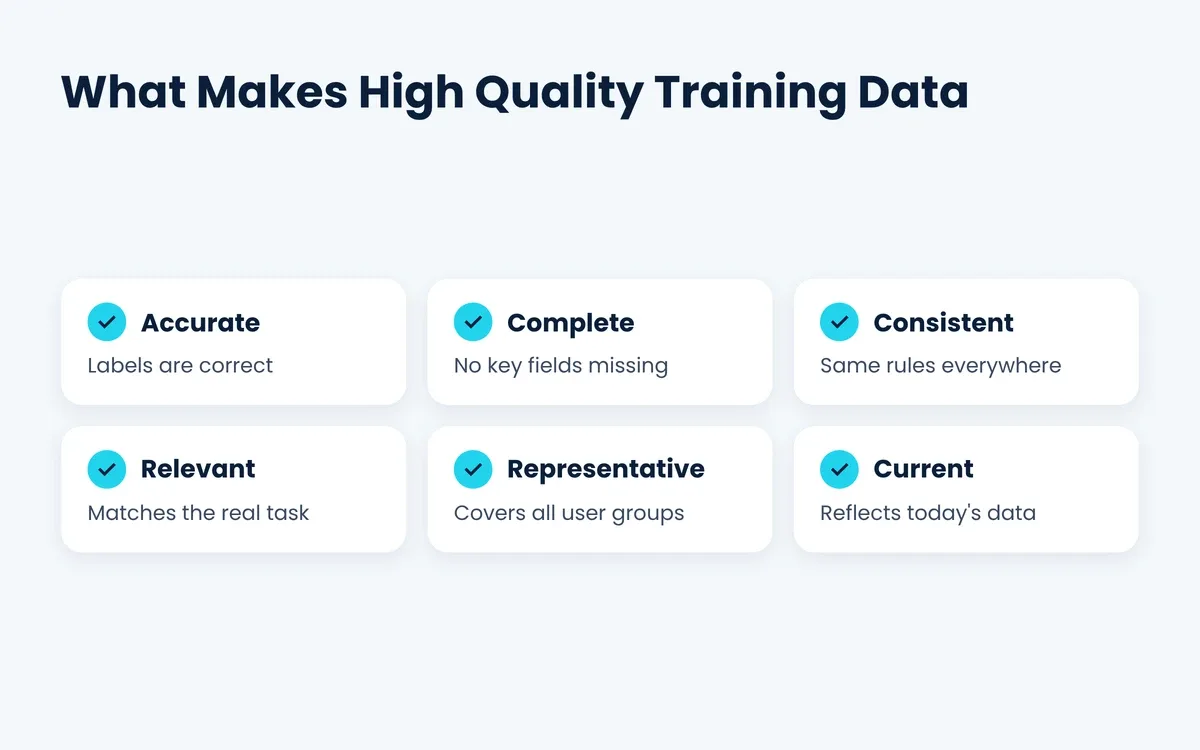
- Accuracy: labels and values are correct, so the model avoids false lessons.
- Completeness: key fields hold values, and the team has a plan for missing data.
- Consistency: each label means the same thing across every annotator and source.
- Relevance: examples match the real prediction task and its users.
- Timeliness: data reflects current patterns, because old data misses new fraud tricks or product names.
- Diversity and coverage: examples span the ages, regions, devices, and edge cases the model will meet.
Engineers sum this up as "garbage in, garbage out." A perfect algorithm trained on noisy data still gives noisy predictions. European law now reflects the same idea for high-risk AI. Article 10 of the EU AI Act says datasets for high-risk AI systems must be relevant and sufficiently representative. The same article asks for data that is, as far as possible, free of errors and complete.
Quantity and quality compete for the same budget. A smaller dataset with clean labels often beats a larger one full of label noise. That trade-off explains the rise of data centric AI, an approach that fixes the data before it tunes the model.
What Causes Training Data Bias?
Bias in training data appears when the examples misrepresent the people or situations a model will serve. The model then repeats that skew in its predictions. Data quality and bias go hand in hand. A dataset can be correct row by row and still be unfair as a whole.
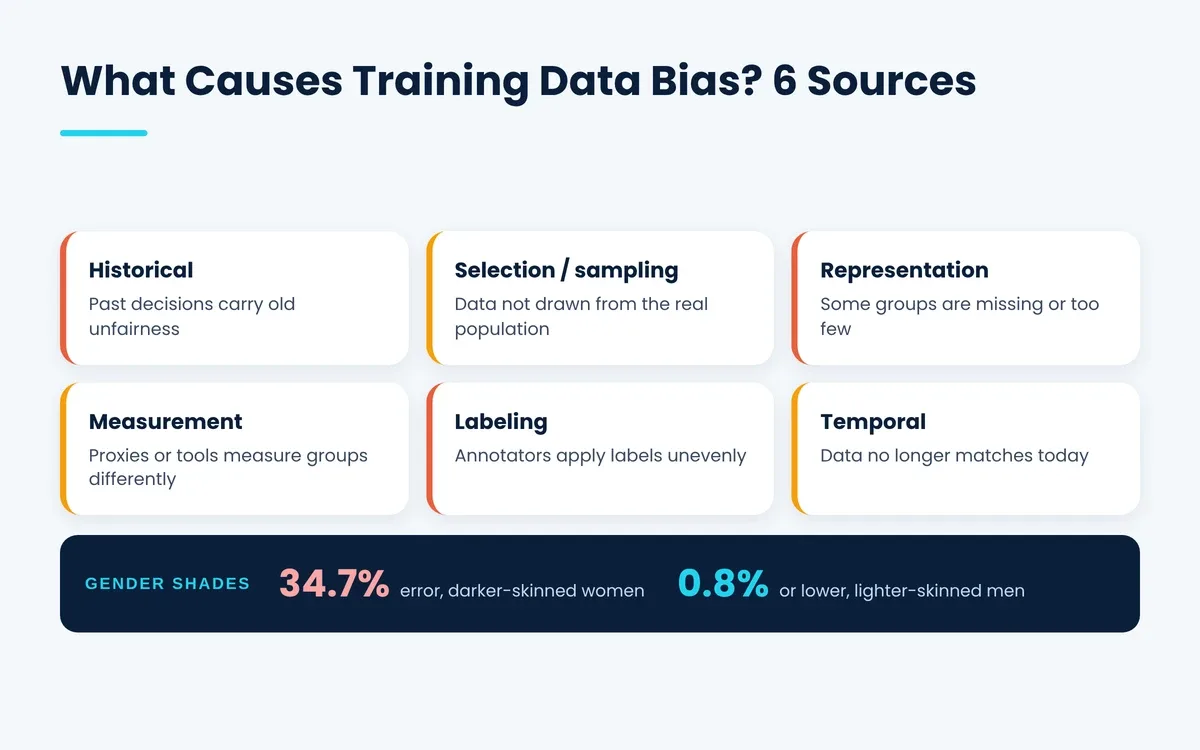
The Gender Shades study by Joy Buolamwini and Timnit Gebru tested 3 commercial gender classification systems. Error rates reached 34.7% for darker-skinned women but stayed at or below 0.8% for lighter-skinned men. The same paper found that 2 popular face datasets held 79.6% and 86.2% lighter-skinned subjects.
Bias can enter training data in six main ways:
- Historical bias: data reflects past unfairness, such as hiring records from years when one group filled most roles.
- Selection and sampling bias: the collection method skips groups, such as voice data recorded only from native speakers.
- Representation bias: some groups appear too rarely for the model to learn their patterns.
- Measurement bias: a feature measures the wrong thing, such as arrest records used in place of crime rates.
- Labeling bias: annotators label different groups in different ways.
- Temporal bias: patterns change over time, so old examples mislead the model.
The NIST SP 1270 report sorts AI bias into three groups: computational and statistical bias, human bias, and systemic bias. NIST also notes that a clean dataset alone cannot fix bias that comes from how people use a model.
How to reduce bias in AI training data
- Compare the dataset's mix of people with the population the model will serve.
- Measure accuracy for each subgroup, not only the overall score.
- Look for proxy features, such as zip codes or names, that stand in for protected traits.
- Add more examples of underrepresented groups through new collection, augmentation, or synthetic data.
- Check labels for consistency across groups and retrain annotators where gaps appear.
- Test for unfair outcomes before launch and keep checking after launch.
How much training data do you need?
The answer depends on task difficulty, model size, the number of features, data quality, and your accuracy goal, so no single number fits every project. Small, clean AI training sets often beat large, noisy ones for narrow tasks. People often ask how much training data is needed, but the right amount changes from one project to the next.
A narrow text classifier can work with a few thousand labeled examples. Some large language models, on the other hand, learn from trillions of tokens during pretraining.
Hestness et al. showed that deep learning error drops along a predictable power-law curve as the training set grows. In practice, each extra batch of data gives a smaller gain than the batch before it.
These signs suggest your model needs more training data:
- Training accuracy sits far above validation accuracy, which is a common sign of overfitting.
- Validation scores keep rising on a learning curve as you add more data.
- Results change a lot between training runs that use different random seeds.
- The model does poorly on certain subgroups or rare edge cases.
Training data and overfitting have a close link. A model with millions of parameters and only a few hundred examples has enough room to memorize all of them. More examples, data augmentation, regularization, and transfer learning all lower that risk. Transfer learning also helps teams reach good accuracy with far fewer labeled examples, because the pretrained model already knows general patterns.
How do privacy laws affect training data?
Training data privacy rules limit what personal data teams can collect, how long they keep it, and how they protect it. Personally identifiable information (PII) includes names, emails, and face photos. Any dataset with PII falls under data protection law in many countries.
- GDPR Article 5 says personal data in the EU must be adequate, relevant, and limited to what the purpose needs. Under GDPR, this rule goes by the name data minimization.
- The CCPA lets California residents learn what data a business holds, delete it, and opt out of its sale or sharing.
- Under HHS guidance, the HIPAA Safe Harbor method removes 18 types of identifiers from health data. These include names, full-face photos, and dates more specific than the year.
- The FTC's COPPA Rule requires parental consent before online services collect personal data from children under 13.
Privacy by design makes these rules easier to follow, because teams build safeguards into the pipeline from day one. Teams record consent and the legal basis for each source. They mask or remove identifiers early, limit access by role, and delete data once its purpose ends.
Federated learning offers another path, since it trains models across devices or hospitals without moving raw personal data to a central server. Data sovereignty rules add another layer, since some countries require their citizens' data to stay inside the country.
How do teams manage training data after launch?
Training data management continues after launch, because real-world data drifts away from the original training set over time. Teams need versioned, documented datasets to retrain and audit their models. A model trained on last year's shopping habits, for example, loses accuracy as prices, products, and habits change.
- Dataset versioning: tag every training set so each model version links back to the exact data behind it.
- Data lineage: record every step from the raw source to the final features, so others can repeat the work.
- Documentation: the Datasheets for Datasets proposal suggests recording each dataset's purpose, contents, collection process, and intended uses.
- Drift monitoring: watch for data drift, where inputs change, and concept drift, where the link between inputs and labels changes.
- Training-inference skew checks: confirm that live features match the features used during training. Many MLOps pipelines use a feature store for this job.
- Retraining schedule: refresh the model with new labeled data on a set schedule or when accuracy drops.
What are some training data examples in real life?
Training data examples in real life include tagged emails for spam filters, marked card payments for fraud checks, and annotated X-rays. Each one pairs an input with the outcome the model must predict.
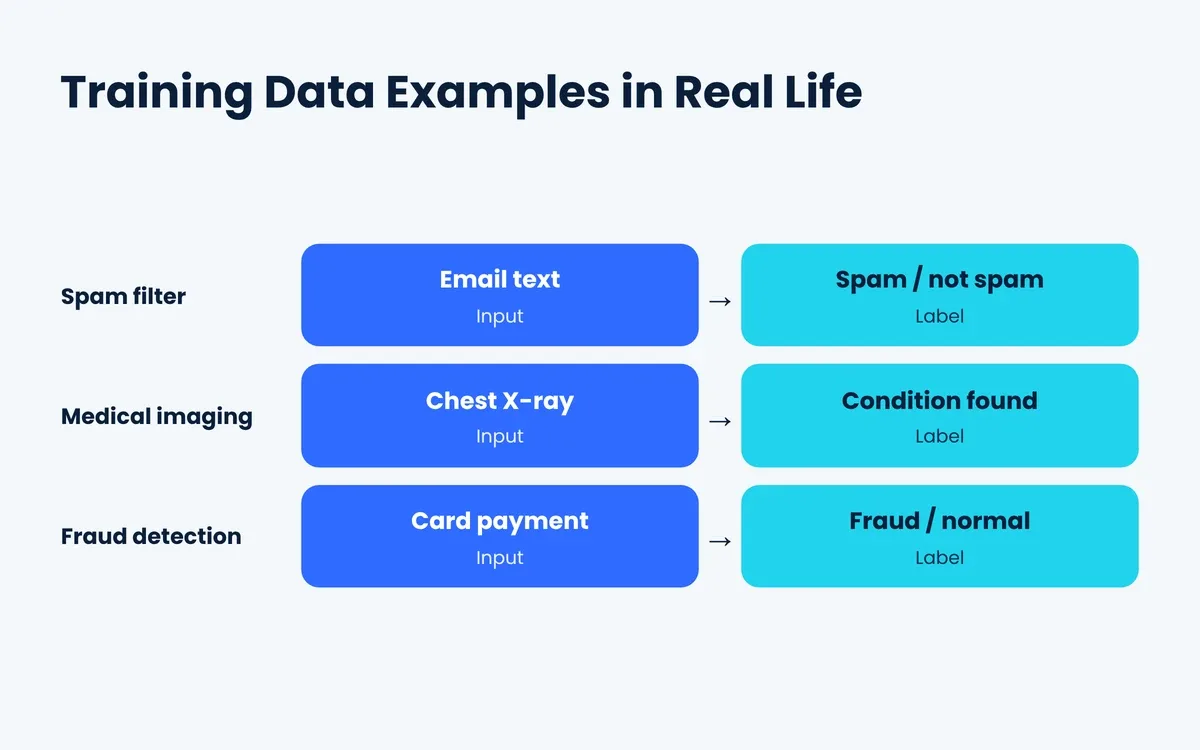
Worked example: training a spam filter
Here is a hypothetical project from start to finish. A small team starts with 10,000 clean emails, each one tagged "spam" or "not spam."
- Features: the team turns each email into features. These include word counts, the number of links, and whether the sender is a known contact.
- Split: an 80/10/10 split gives 8,000 training emails, 1,000 validation emails, and 1,000 test emails. Each set keeps the same share of spam.
- Train: the model learns that "free" in a subject line raises the odds of spam. A known sender lowers those odds.
- Tune: validation scores guide the team's setting choices and reveal overfitting early.
- Test: one final run on the 1,000 untouched test emails shows how the filter will perform in real life.
Spammers keep changing their wording, so each month the team adds freshly tagged emails and retrains the filter.
Other AI training data examples follow the same input and outcome pattern:
- Fraud detection: card transactions marked fraud or legitimate, with features like amount, location, and time.
- Medical imaging: X-rays or MRI scans that radiologists mark with findings or outlined areas.
- Speech recognition: audio clips paired with correct transcripts across many accents and noise levels.
- Sentiment analysis: product reviews tagged positive, negative, or neutral.
- Driver assistance: camera frames and lidar scans with boxes drawn around cars, people, and road signs.
- Recommendations: activity logs that show which items people clicked, bought, or skipped.
Conclusion
Artificial intelligence training data decides what a model can learn, how fairly it treats people, and how well it holds up after launch. Strong AI model training data starts with a clear prediction task and sources the team has the right to use. Careful cleaning, labeling, and splitting then come before any training run.
Training data quality deserves the same attention as the model itself. Accurate labels, wide coverage, and a strict wall around test data give you scores you can trust. Teams that document, version, and monitor their datasets keep their models accurate as the world changes.
FAQs
What is training data in AI in simple words?
Training data in AI is the set of examples a model studies to learn a task. The model looks for patterns that link inputs to answers. It then uses those patterns on new inputs it has never seen.
How is training data used once a model is live?
After launch, teams use training data to retrain and fine-tune the model as real-world patterns change. New labeled examples, user feedback, and fixed errors join the dataset. The model then learns from the updated version on a regular schedule.
Is synthetic data as good as real training data?
Synthetic data works well for rare events, private records, and balancing classes, but it rarely replaces real data. Most teams blend both kinds and test every model on real examples, since generators can miss how messy real inputs are.
What Is a Training Dataset?
A machine learning training dataset is the part of your data a model learns from, usually 70 to 80 percent of the total.
Who owns AI training data?
Ownership depends on the source of the data. A company controls its own first-party data within privacy law. Licensed data follows its contract, and public data follows its license. Courts in several countries are still deciding how copyright applies to scraped web content used for training.
Can a model keep learning after training?
Yes, but only when a team updates it through fine-tuning, RLHF, or retraining on new data. A live model does not learn on its own. Poor labels or mixed feedback can make the model worse. New examples need the same quality checks as the original set.
What is the difference between a dataset and a training set?
A dataset is the full collection of examples, while a training set is the part used to teach the model. The rest of the dataset becomes validation and test data, which the model never learns from.