


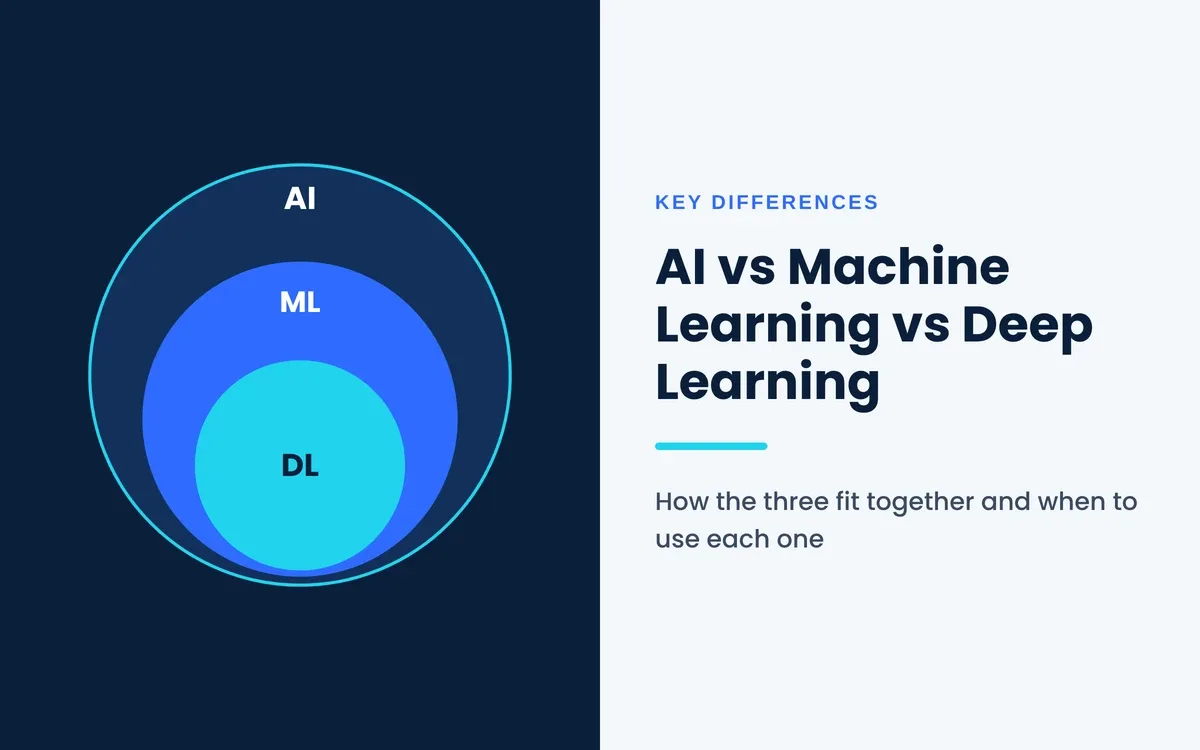
AI vs Machine Learning vs Deep Learning comes down to scope: AI is the broadest field, ML is a subset of AI, and DL is a further subset of ML. AI is the umbrella term for any system that can reason, plan, or recognize patterns the way people do. Machine learning is how most of today's AI gets built: algorithms learn from training data rather than hand-coded rules. Deep learning takes that idea further with multilayer neural networks that pick out features from images, sound, and text by themselves. So a spam filter is usually machine learning, while Face ID and ChatGPT rely on deep learning.
Not every AI system learns, though. A chess engine that searches possible moves or a chatbot that follows a fixed script still counts as AI, even with no training data behind it. Learning only enters the picture at the machine learning level. From there, the main shift is who does the prep work: in classic machine learning, people choose the features, while deep learning finds them on its own.
That self-learning ability is why deep learning sits behind large language models (LLMs) and most modern generative AI tools. It is also why the terms get blurred so often. News stories, product pages, and job ads tend to use all three words as if they meant the same thing, even though each one describes a different level of the same family.
Key Takeaways
- AI is the whole field, and ML and DL sit inside it.
- Every deep learning model is ML, but not every ML model is DL.
- Some AI follows hand-written rules and never learns.
- Classic ML needs people to pick features, while DL learns its own.
- Deep learning usually needs more data and computing power.
- Simpler ML models are easier to explain.
- Modern LLMs run on transformer neural networks.
- Pick based on your data, budget, and need to explain results.
How Do AI, Machine Learning, and Deep Learning Fit Together?
Each term sits inside the one before it, much like a set of nesting dolls.
A simple way to check the relationship is to read it in one direction only. Every deep learning model counts as machine learning, and every machine learning model counts as AI. The reverse does not hold, because a lot of AI never learns anything from data.
Read the chain AI, machine learning, deep learning from left to right, and each term gets narrower. The broad field sits under computer science, alongside data science and automation. Each step down the chain adds one extra idea: first learning from data, then learning through many layers.
| Layer | What it means | Plain example |
|---|---|---|
| Artificial intelligence | Any computer system that performs a task we link with human thinking | A chess program that searches millions of moves |
| Machine learning | AI that learns patterns from data instead of following only fixed rules | An email filter that learns what spam looks like |
| Deep learning | Machine learning that uses neural networks with many layers | A phone camera that recognizes your face |
What Is Artificial Intelligence?
The broadest term here is AI: any computer system built to handle tasks that normally need human thinking.
Those tasks include reasoning, planning, understanding language, and recognizing images. John McCarthy coined the term "artificial intelligence" in his proposal for the 1956 Dartmouth Summer Research Project. Many see that project as the start of AI research. So the idea of thinking machines is far older than today's chatbots and voice assistants.
Early AI did not learn from data at all, because experts wrote every rule by hand. A tax program that applies a fixed rate above a set income is a simple rule-based system. Expert systems took this further by storing hundreds of rules gathered from doctors or engineers.
Deep Blue, the chess computer, shows how far that older approach could go. It beat world champion Garry Kasparov 3.5 to 2.5 in 1997 while checking about 200 million positions per second. Its strength came from fast search plus chess knowledge that experts built into it. Modern machine learning works differently, since it picks up its skill mainly from training data.
Most AI you meet today is called narrow AI, because it is built for a defined set of tasks. There is no widely accepted evidence that artificial general intelligence (AGI) has been achieved. For a step-by-step look at the process, see how AI works.
What Is Machine Learning?
Machine learning takes a different route, rather than coding every rule by hand, developers train an AI model on examples. AI pioneer Arthur Samuel described it in the 1950s as giving computers "the ability to learn without explicitly being programmed." You show the system examples, and it works out the rules on its own.
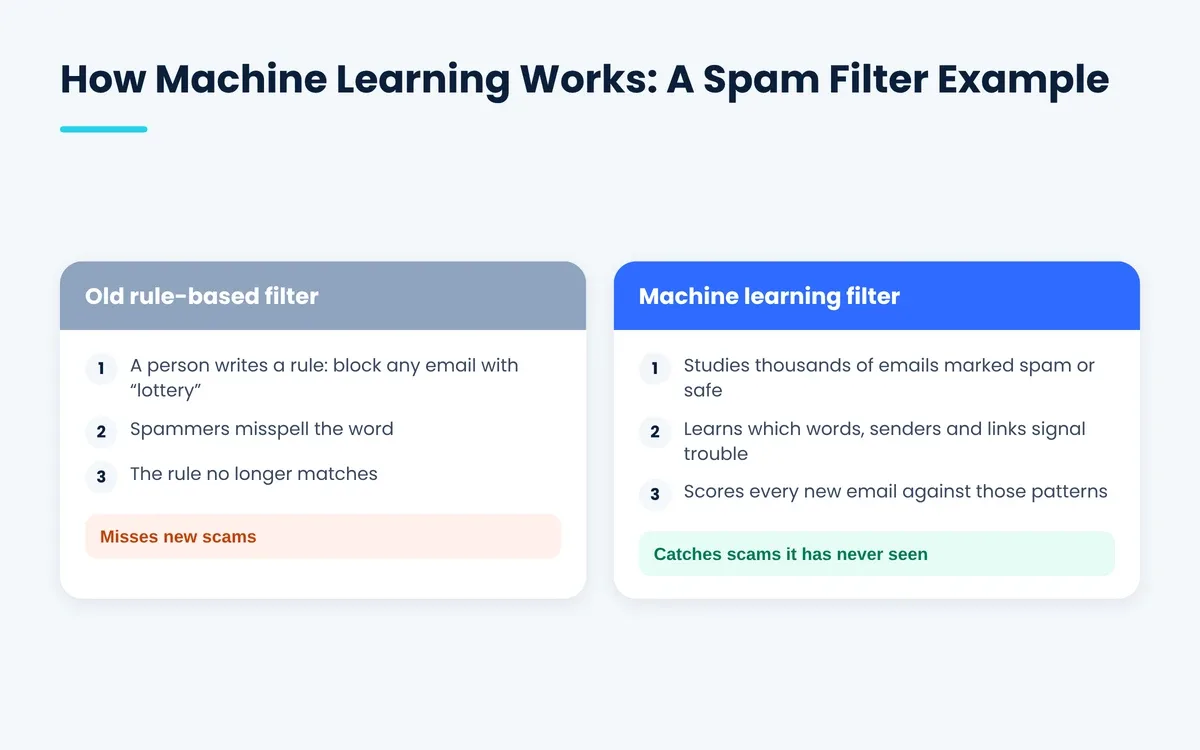
Think about the spam folder in your inbox, which quietly sorts junk mail every day. Nobody sits down and writes a rule for every scam email on the internet. An old-style filter might block any message that contains the word "lottery," and spammers would simply misspell it. A machine learning filter studies thousands of emails that people have already marked as spam or safe. Over time, it picks up which mix of words, senders, and links tends to mean trouble. It can then catch scams it has never seen before.
That filter still needs one important thing from people before it can start learning. Someone has to decide what the model should look at, such as the sender's address or the number of links. Data scientists call this step of choosing inputs by hand feature engineering. For a house price model, the features might be floor size, room count, and distance to schools. The algorithm then works out how much each of those features affects the final price.
Common machine learning algorithms include linear regression, decision trees, random forests, support vector machines (SVM), and k-means clustering. Most of them train quickly on a normal laptop with tools like scikit-learn.
What Are the Main Types of Machine Learning?
Machine learning is usually grouped into supervised, unsupervised, and reinforcement learning, with semi-supervised learning as a mix.
The right type depends on what data you have and what kind of feedback the model can get.
| Type | How it learns | Real example |
|---|---|---|
| Supervised learning | From labeled data, where each example has the right answer | Predicting house prices from past sales |
| Unsupervised learning | From unlabeled data, by finding groups or patterns | Grouping shoppers by buying habits |
| Reinforcement learning | From rewards and penalties after each action | Teaching a program to win a video game |
| Semi-supervised learning | From a small labeled set plus a larger unlabeled set | Sorting photos when only a few are tagged |
Each type comes with its own family of machine learning algorithms. Supervised learning often uses linear regression, logistic regression, decision trees, k-nearest neighbors, Naive Bayes, or support vector machines. Unsupervised learning leans on k-means clustering, hierarchical clustering, and principal component analysis (PCA). PCA shrinks a large dataset into fewer, more useful columns. Reinforcement learning uses reward-based methods such as Q-learning. It can also team up with deep learning. DeepMind's AlphaGo research combined deep neural networks with tree search to play Go.
All of these ML techniques share one goal, which is pattern recognition in data. That is why they power so much predictive analytics, from forecasting sales to spotting machines that are about to fail.
Supervised learning is widely used in business applications, from credit scoring to demand forecasting. It fits well when you have a clear target, such as "fraud" or "not fraud," plus past examples.
What Is Deep Learning?
Deep learning narrows the idea further, using neural networks with many layers to learn patterns step by step.
A neural network has an input layer, one or more hidden layers, and an output layer. "Deep" describes the depth of the network, meaning how many layers the data passes through. When a network has many hidden layers, people call it a deep neural network.
A face recognition model is a good way to see why those extra layers help. The first layers might pick up simple edges, while middle layers combine those edges into shapes like eyes or noses. Later layers then decide whether the whole pattern looks like a face. Nobody tells the network to look for eyes, since it finds that feature by itself during training.
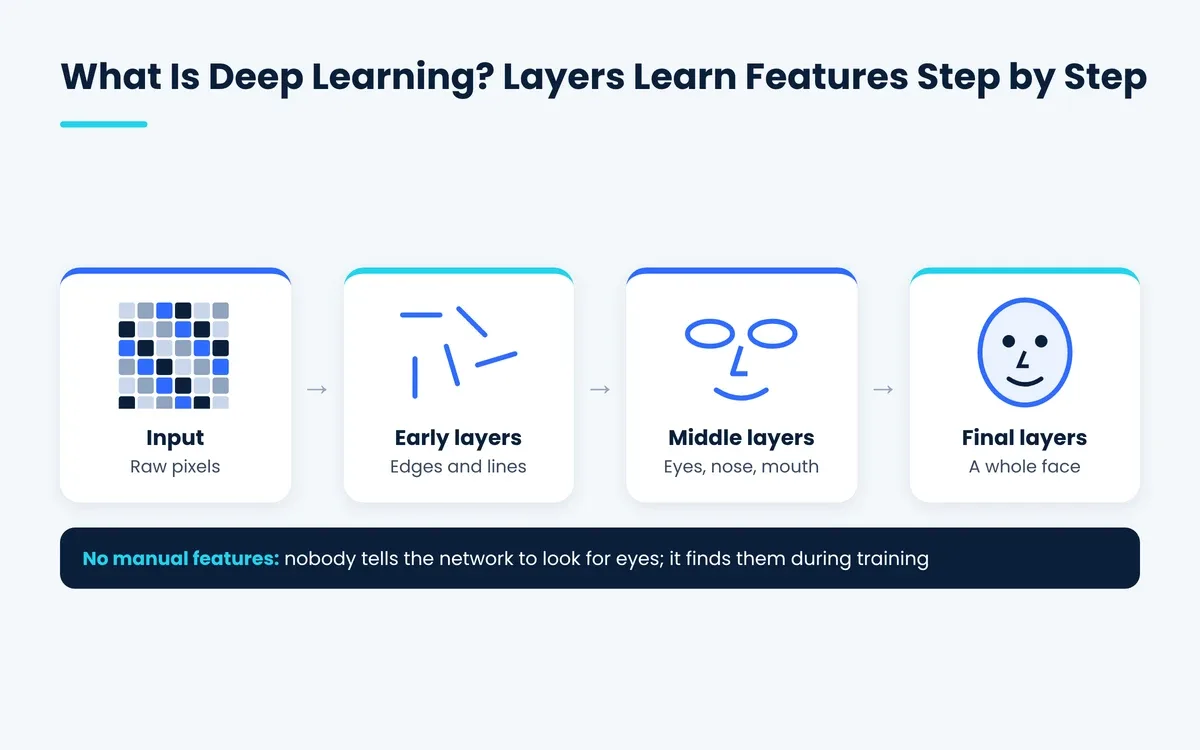
This removes much of the manual feature engineering that classic machine learning needs. The price is usually paid in data and computing power, especially for large models.
How Does a Neural Network Learn?
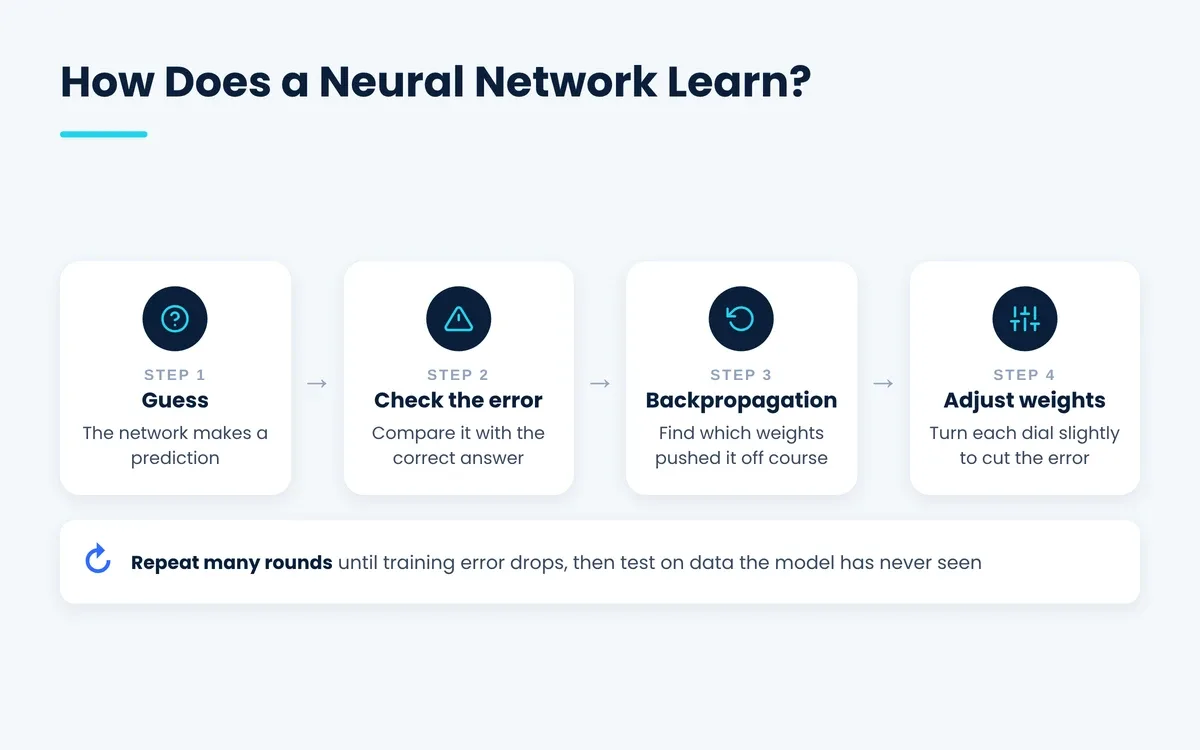
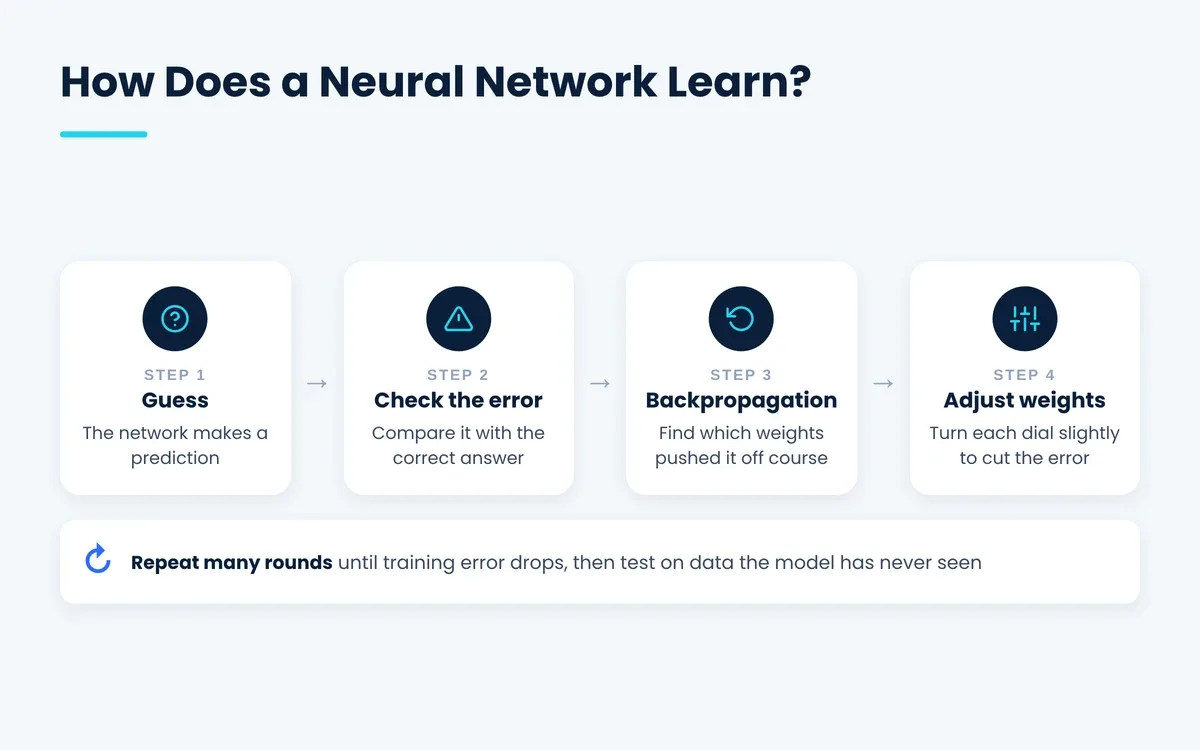
A neural network learns by making a guess, checking how wrong it was, and adjusting its settings a little.
Think of each connection in the network as a small dial called a weight. During training, the network makes a prediction and compares it with the correct answer. A method called backpropagation works out which dials push the answer off course, so each one can be turned slightly. After many rounds, the error on the training data goes down. The real test comes later, when the model sees new data it has never met.
What Are the Common Deep Learning Architectures?
Different network designs suit different data, from images to language.
The simplest design is the feedforward network, where data flows in one direction from input to output. The designs below build on that idea in different ways. A CNN scans an image in small patches, much like sliding a magnifying glass across a photo. A transformer instead looks at a whole passage and uses attention to weigh which words relate to each other.
| Architecture | Best at | Everyday example |
|---|---|---|
| Feedforward neural network | Simple tables of numbers | Basic scoring models and small classifiers |
| Convolutional neural network (CNN) | Images and video | Spotting tumors in scans, reading number plates |
| Recurrent neural network (RNN) | Sequences such as sensor readings | Predicting the next value in a time series |
| Long short-term memory (LSTM) | Longer sequences that need memory | Older speech recognition and translation systems |
| Transformer | Language and many other data types | Chatbots and large language models |
| Generative adversarial network (GAN) | Creating realistic new images | Turning sketches into photo-like pictures |
Each design earned its place for a reason. CNNs are closely tied to image data, because they detect small local patterns like edges, corners, and textures. RNNs and LSTMs were built for sequences, such as time series and early translation or speech tools. Transformers changed that approach by using attention to model relationships between different parts of a sequence. Today, transformer models lead many language tasks, from translation to chat. GANs work differently again, since two networks compete, one creating new content while the other judges it.
Developers often build these models with deep learning frameworks such as TensorFlow or PyTorch. Many teams also skip training from scratch and use transfer learning instead. They start from a model already trained on a huge dataset, then fine-tune it on their own data. This can reduce training time and the amount of labeled data needed for a specific task.
How Did Deep Learning Become So Popular?
Deep learning took off after 2012, once bigger datasets and faster GPUs made large neural networks practical to train. Our history of artificial intelligence covers the decades before that shift.
Neural networks have existed for decades, but early computers could not train big ones in a reasonable time. The milestones in the table below mark the main turning points along that path.
| Year | Milestone |
|---|---|
| 1956 | The Dartmouth summer project launches AI as a research field |
| 1997 | Deep Blue beats Kasparov using search and expert chess knowledge |
| 2012 | The AlexNet paper shows a deep CNN trained on GPUs can win at image classification |
| 2017 | Researchers introduce the transformer architecture, which later powers most LLMs |
| 2018 | Bengio, Hinton, and LeCun win the ACM Turing Award for deep learning |
| 2024 | Hopfield and Hinton receive the Nobel Prize in Physics for work on neural networks |
AI vs Machine Learning: What's the Difference?
All machine learning counts as AI, but plenty of AI works without any learning.
Suppose you want your home heating to switch on before you wake up. One option is a thermostat that follows a fixed schedule you set once. That counts as simple AI, yet it never learns a thing. A smart thermostat goes further, because it notices when you actually get up and adjusts itself week by week. That second thermostat is using machine learning, because it improves from your own data.
People confuse this pair more than any other combination of terms in the field. That is mostly because the AI products in the news do use machine learning inside. The table below lays out where the two parts ways.
| Point | AI | Machine learning |
|---|---|---|
| Scope | The whole field | One branch of the field |
| How it gets its rules | Hand-written rules, search, or learning | Learns rules from data |
| Need training data? | Not always | Yes |
| Example | A chatbot with a fixed decision tree | A chatbot that learns intent from past chats |
What Is the Difference Between Machine Learning and Deep Learning?
The split is about where features come from: people choose them in classic ML, while deep networks learn them.
Picture a model that sorts photos of cats and dogs. With classic machine learning, an engineer first turns each photo into measurements, such as ear shape or fur color. With deep learning, you feed in the raw pixels and let the layers figure out what matters.
The kind of data you have is the second thing that separates them. Classic machine learning works well on structured data, like the rows and columns in a spreadsheet. Deep learning usually does better on unstructured data such as images, audio, and free text.
| Point | Classic machine learning | Deep learning |
|---|---|---|
| Feature engineering | Mostly manual | Mostly automatic |
| Best data type | Structured tables | Images, audio, text, video |
| Data needed | Varies, often modest | Varies widely; training from scratch often needs a lot, while pretrained models can need far less |
| Hardware | A normal CPU is usually enough | Small networks run on a CPU, while large models usually train on GPUs |
| Training time | Seconds to hours | Minutes for small networks, up to weeks for large models |
| Explainability | Often easier to explain | Often hard to explain |
| Typical algorithms | Decision trees, SVM, regression | CNNs, RNNs, transformers |
The useful difference between deep learning and machine learning is not which one is "smarter." It lies in how features are handled, what kind of data the model receives, and how much computing it needs.
Deep Learning vs AI: How Do They Compare?
Deep learning is one part of AI, but AI covers many approaches that never touch deep neural networks.
Many beginners frame the topic as machine learning vs deep learning vs AI, as if three rival technologies were competing. They are really three levels of the same family, so the comparison works better as a ladder than a race.
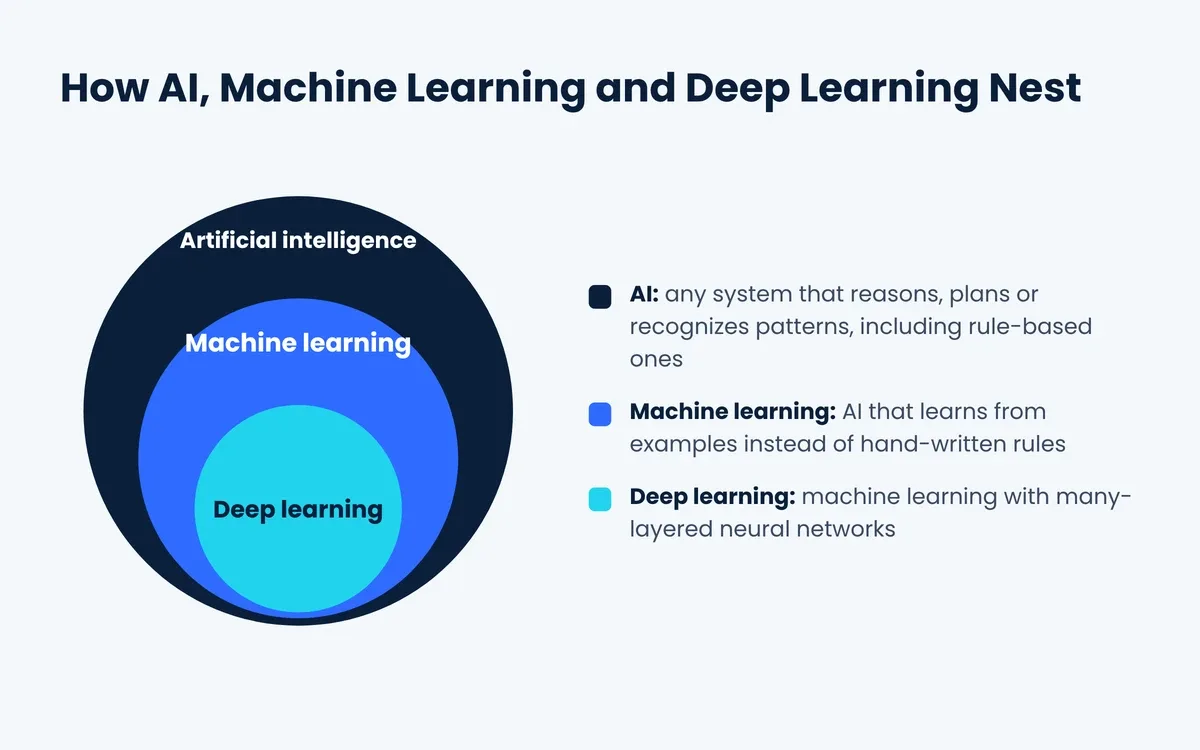
Image recognition is where the confusion starts for many readers. Most photo apps that spot faces or pets run on deep learning. So it is easy to assume all AI works that way. People often treat the two as one because most AI tools in the news run on deep learning. Chatbots, image generators, and voice assistants all rely on it. Still, AI existed for decades before deep learning became practical, and plenty of useful AI never touches a neural network.
A map app on your phone shows this split quite clearly. It may plan routes with classic search methods that involve no learning at all. Its voice assistant, however, relies on deep learning to understand your speech. Both systems fall under AI, but only the voice assistant in this example relies on deep neural networks.
The difference matters most when you plan a real project with a fixed budget. Deep learning brings strong accuracy on messy data, yet it also brings higher costs and harder-to-explain results. Other AI methods, such as rules or search, can be cheaper and easier to check. Calling a product "AI" tells you what it does for the user. Calling it "deep learning" tells you how its engine was actually built.
Where Do Neural Networks Fit In?
Neural networks and AI are often mixed up in everyday conversation. Neural networks are the building blocks of deep learning, which places them inside machine learning and AI.
An artificial neural network (ANN) is made of small units called neurons, arranged in layers. The input layer takes in data, such as the pixels of a photo. One or more hidden layers transform that data, while the output layer gives the final answer, such as "cat" or "dog." Each neuron multiplies its inputs by weights, adds them up, and passes the result through an activation function. That function decides how strongly the neuron should fire. It lets the network learn curved, complex patterns instead of only straight lines. The three comparisons below show where this neural network hierarchy fits.
AI vs Neural Networks
Neural networks are one type of model used in AI, not another name for AI itself.
They consist of connected nodes, loosely inspired by brain cells, that process numbers and pass the results through layers. The approach works well for images, speech, and text, where patterns are hard to describe by hand. Rule-based systems, search algorithms, and other methods can also produce AI systems, though.
The link between neural networks and AI is part to whole. A rule-based fraud check, for instance, is AI without any neural network. So is a route planner that searches a road map for the shortest path. Apple, on the other hand, describes Face ID as using anti-spoofing neural networks to guard against masks. When a product page says "powered by AI," it could mean either kind of system. It is worth asking which one before you trust the label.
Deep Learning vs Neural Networks
Depth is what separates them, since a network with one hidden layer is rarely called deep learning.
In the deep learning vs neural network comparison, a shallow network is still a neural network. It simply has too few layers to build up complex features step by step. Once you stack many hidden layers, most people would call the model deep learning. There is no official cutoff for how many layers count as deep. Modern image and language models often use dozens of layers, and some use far more.
An easy rule to remember: all deep learning uses neural networks, but not every network is deep. The small network in our test later in this article, with just two hidden layers, sits right on that border.
LLM vs Neural Network
An LLM is a large language model, and modern LLMs are usually built as transformer-based neural networks.
LLMs feel very different from older models, but under the hood they still have layers and weights trained with backpropagation. The main change is scale, since modern LLMs have billions of weights trained on huge text collections. The transformer design uses a method called attention to decide which words matter most. It lets the model weigh how each word in a passage relates to the others. Older recurrent networks had to step through text one word at a time instead.
AI vs Machine Learning vs Deep Learning
This AI vs ML vs deep learning table puts the three side by side on the points that matter most when you choose.
| Feature | Artificial intelligence | Machine learning | Deep learning |
|---|---|---|---|
| Scope | Broadest field | Subset of AI | Subset of machine learning |
| Main idea | Make machines act smart | Learn patterns from data | Learn layered features with neural networks |
| Human effort | High for rule-based systems | Medium, mainly for features and labels | Lower for features, higher for data and tuning |
| Data needed | From none to a lot | Often modest and structured | Often large and unstructured |
| Hardware | Varies | Usually a CPU | CPU for small models, GPUs for large ones |
| Explainability | High for rules | Medium | Often low |
| Example | Deep Blue chess search | Netflix-style recommendations | Face ID, voice assistants, LLMs |
Read the table from left to right, and you can watch human effort shift from writing rules to preparing data. Explainability usually drops along the same path, while the need for data and computing power tends to rise. Keep it as a quick AI vs ML vs deep learning cheat sheet for vendor pitches and job ads.
How Does Each Approach Work Inside a Real Product?
The machine learning vs AI vs deep learning choice is easiest to see inside a real product. The same product can be built with rules, machine learning, or deep learning, and each version behaves differently.
Take four products you have probably used this week, often without thinking about them. The table shows what each one would do at each level.
| Product | Rule-based AI version | Machine learning version | Deep learning version |
|---|---|---|---|
| Email spam filter | Blocks emails with banned words | Learns word and sender patterns from labeled emails | Reads full message text and images with a neural network |
| Movie recommendations | Shows the most popular titles | Learns from your viewing history and similar users | Learns rich patterns from viewing, artwork, and timing signals |
| Bank fraud check | Flags any payment above a fixed limit | Scores each payment using features like amount, place, and time | Spots unusual sequences across thousands of past transactions |
| Customer support chat | Follows a fixed menu of replies | Classifies the customer's intent from past tickets | Understands free-form questions and writes answers |
Netflix, for example, lists recommendations among its main machine learning research areas. Real products often mix all three levels inside a single app or service. A support bot might read a message with deep learning, then route it with a simpler model. After that, a plain rule can send any refund above a set amount to a person.
Where Do Generative AI and LLMs Fit?
Generative AI creates new text, images, or audio, and today it is largely powered by deep learning.
Modern generative AI tools are largely powered by neural network designs such as transformers and diffusion models. An LLM writes by predicting the next small piece of text, called a token, over and over. That simple loop lets it draft emails, code, or summaries.
It helps to compare generative AI with the predictive machine learning covered earlier. A predictive model answers a narrow question, such as "is this payment fraud?" A generative model produces something new, such as a reply to a customer. Both learn from data, but the generative kind needs far larger models and far more training text.
The same loop also explains a well-known weakness of chatbots and writing tools. Because an LLM predicts likely text rather than looking up facts, it can sometimes state wrong things with confidence. That is why people check its answers, especially on dates, numbers, and names.
Use of these tools has spread faster than most people expected. The 2026 AI Index from Stanford HAI reports that generative AI reached 53% population-level adoption within three years. The report also shows that rates differ a lot from country to country.
Deep Learning vs Machine Learning: Which One Should You Use?
Choosing between AI vs deep learning vs machine learning usually starts with the data you already have. Start with the simplest approach that fits your data, and move to deep learning only when the problem needs it.
Many teams jump straight to deep learning because it sounds advanced. Yet the hardest part of most projects is not the model at all. It is data labeling, cleaning, and the slow work of hyperparameter tuning to get good results. Our own small test later in this guide shows why that is often unnecessary for simple, structured problems. The table below matches common situations to a sensible first choice.
| Your situation | Good starting choice | Why |
|---|---|---|
| The logic is clear and rarely changes | Rule-based AI | Cheap, fast, and easy to audit |
| You have a spreadsheet of past records | Classic machine learning | Works well on structured data with modest compute |
| You must explain every decision | Simple machine learning, such as a decision tree | Easier to show why a result happened |
| You work with photos, audio, or video | Deep learning | Learns features from raw data |
| You need to understand or write language | Deep learning, often an existing LLM | Transformer models handle text well |
| You have very little data | Rules, simple machine learning, or a pretrained model | Training a deep model from scratch tends to overfit |
Where the model runs matters as well. Some deep learning models now run directly on phones and cameras, which is known as edge AI inference. This keeps data on the device and cuts delays, but it limits how large the model can be. Classic machine learning models are small enough to run almost anywhere.
Before you commit time or budget to a project, run through this quick checklist:
- Can a clear rule solve the problem without any learning?
- Do you have enough labeled examples, and are they recent?
- Is your data mainly tables, or is it images, sound, or text?
- Will users, auditors, or regulators need an explanation for each result?
- Can you afford GPU time, or would a ready-made model do the job?
What We Found When We Tested Machine Learning and a Neural Network
On a small, clean dataset, simple machine learning matched a small neural network while training about 28 times faster.
At O2SOFT, we wanted to see the feature engineering gap for ourselves. We ran a small test on the public scikit-learn digits dataset, which holds 1,797 small images of handwritten digits. We kept 450 images aside for testing and trained on the rest.
We compared three setups that differ in how much work the model does on its own. The first used logistic regression on 16 hand-made features, which were the ink totals for each row and column. The second used the same algorithm on all 64 raw pixels. The third was a small neural network on raw pixels, with two hidden layers of 64 and 32 neurons. We trained each setup on 100, 500, and 1,347 images, then averaged five random runs.
| Training images | ML with hand-made features | ML with raw pixels | Neural network with raw pixels |
|---|---|---|---|
| 100 | 82.0% | 89.1% | 85.4% |
| 500 | 86.2% | 94.8% | 94.8% |
| 1,347 | 88.7% | 97.8% | 97.0% |
| Training time at 1,347 images | 23 ms | 16 ms | 454 ms |
Three things stood out when we looked at the numbers side by side. Our hand-made features capped accuracy below 89%, because they threw away useful detail. Giving the model raw pixels helped far more than switching to a neural network. The neural network also failed to beat logistic regression here, even though it took about 28 times longer to train.
How we calculated it: Accuracy = correct predictions ÷ 450 test images × 100, averaged over five runs. Speed ratio = neural network training time ÷ logistic regression training time on raw pixels (454 ÷ 16 ≈ 28).
We ran this on a two-core cloud machine with scikit-learn 1.8, and our network was shallow. On large photos or long text, deeper networks usually pull ahead. That is why the shape of your data matters so much.
Common Myths About AI, Machine Learning, and Deep Learning
The most common myth is that the three terms mean the same thing.
- Myth: All AI learns from data. In reality, rule-based and search-based AI systems learn nothing from data and only follow the logic people give them.
- Myth: Deep learning is always more accurate. On small or structured datasets, simpler machine learning models often match it at a fraction of the cost.
- Myth: Machine learning needs no human input. People still choose the data, write the labels, pick the features, and set the goals.
- Myth: Neural networks work like a human brain. They borrow a loose idea from neurons, but the way they actually work is very different.
- Myth: An LLM understands like a person. It predicts likely words from patterns in its training data, without human-style understanding.
- Myth: More data always fixes a model. Biased or messy data can make a model worse, no matter how much of it you add.
These myths matter because they quietly shape real decisions about money, time, and staff. A team that believes deep learning always wins may spend months on a model that a spreadsheet-sized problem never needed. A buyer who thinks an LLM truly understands may skip the checks that catch its mistakes.
What Are the Limits and Risks of Each Approach?
Each level brings its own weak spot, so the risks change as you move deeper.
Rule-based systems, also called symbolic AI, are easy to follow, but they fail when a new situation falls outside the rules. Machine learning adapts better, although it can repeat any bias hidden in its training data. Deep learning adds the problem of low model interpretability. If a network with millions of weights rejects a loan, it can be hard to say exactly why. Teams often respond with explainable AI tools, which show which inputs pushed a decision one way or the other. Regular bias checks on training data are another common step, because algorithmic bias can hide in carefully built models too.
These limits show up in business results too, not just in technical reviews. In the McKinsey 2025 survey, 88% of respondents said their organizations use AI in at least one business function. Only about one-third said their companies had begun to scale their AI programs. The figures are self-reported, so they describe that group of respondents rather than every company.
A good way to avoid a stalled project is to question it early. These red flags are worth checking when a vendor or team pitches an AI project:
| Red flag | Why it matters |
|---|---|
| "It uses deep learning" with no reason given | The method should fit the data, not the marketing |
| No test results on data the model has not seen | The model may only memorize its training set |
| No plan to explain decisions | This can cause trouble in regulated areas like finance |
| Training data is old or narrow | Results may be biased or out of date |
| No plan for monitoring after launch | Accuracy often drops as real data changes |
Final Thoughts
If you remember one thing from this deep learning vs machine learning vs AI comparison, make it the nesting order, since most confusion disappears once that is clear. Every AI vs machine learning vs deep learning question comes back to that same order: AI holds ML, and ML holds DL. From there, the practical question is which level your problem really needs. A clear rule often beats a model when the logic is simple and stable. On tidy business data, a simple model often beats a deep one too. Deep learning earns its cost on photos, speech, and language, particularly when you can start from a pretrained model. Test every option on data it has never seen before you trust it.
Frequently Asked Questions
Is ChatGPT AI, machine learning, or deep learning?
ChatGPT is all three, since a deep learning model is also machine learning and AI. It runs on a large transformer-based language model trained on text. That puts it in the narrowest group, which sits inside the other two.
Can machine learning exist without AI?
No, machine learning always sits under the AI umbrella, even when it is taught separately. Universities sometimes teach it as its own subject, which can make it feel separate. The family relationship stays the same, though, no matter how a course is organized.
Is deep machine learning the same as deep learning?
Yes, "deep machine learning" is simply an older, longer name for deep learning. Both describe machine learning built on neural networks with many layers. You will mostly see the shorter term today in courses, papers, and job ads.
Is a decision tree AI or machine learning?
The answer depends on where the decision tree came from in the first place. A tree that an algorithm learned from data is machine learning, and so it is AI too. A tree someone drew by hand, like a support script, is rule-based AI. What matters is whether the rules came from data or from a person.
Do I need to learn machine learning before deep learning?
You do not have to, but it makes deep learning much easier to follow. Concepts such as training data, overfitting, and evaluation apply to both. Most courses teach basic machine learning first for this reason.
Is natural language processing machine learning or deep learning?
NLP is a field of AI that can use either one. Older NLP systems relied on rules and classic machine learning. Modern NLP relies heavily on deep learning, with transformer-based models leading many language tasks.
Is computer vision always deep learning?
No, but most modern computer vision uses deep learning, especially CNNs. Older systems used hand-made image features with classic machine learning. Deep learning replaced much of that manual work after 2012, when CNNs began winning image contests.
What tools do developers use for machine learning and deep learning?
Many developers use scikit-learn for classic machine learning, with TensorFlow or PyTorch for deep learning. All three have Python APIs, so most beginners learn them in the same language. Cloud GPUs are common for training larger deep models.
What is machine learning vs deep learning, in short?
Traditional machine learning often relies on features that people prepare. Deep learning can learn useful features from less-processed data. Both belong to the wider AI family, so the choice is about method rather than field. Deep learning is usually the more data-hungry and compute-hungry branch of machine learning.
Is data science the same as machine learning?
Not quite, since data science is the wider field and machine learning is one of its tools. Data scientists also clean data, run statistics, and build reports. Machine learning is the part that builds predictive models, such as sales forecasts or churn scores.
Does artificial general intelligence exist yet?
There is no widely accepted evidence that AGI has been achieved. Current systems are generally classed as narrow AI, because they work within defined capabilities. Researchers still disagree on how to define AGI and when it might arrive.
Why do large deep learning models use GPUs?
GPUs run thousands of simple math steps in parallel, which speeds up training a lot. Large networks repeat these steps billions of times during training. Small networks, like the one in our test, can train on an ordinary CPU.