


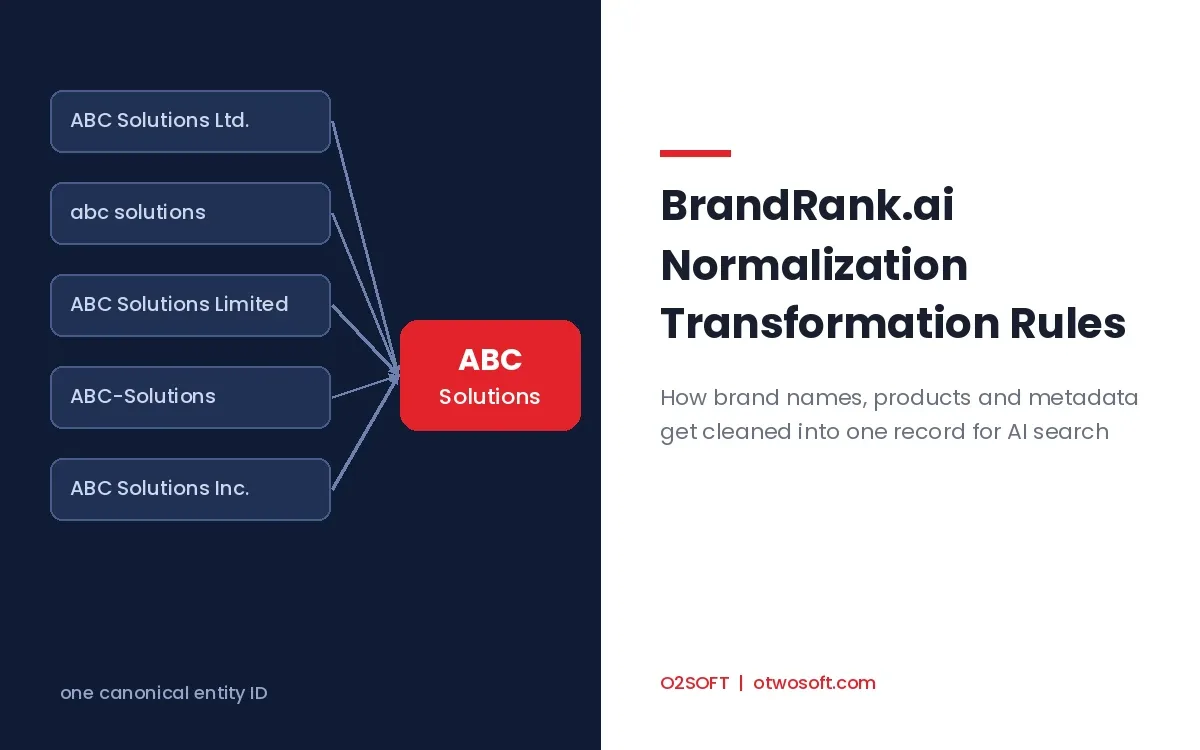
BrandRank.ai normalization transformation rules turn the many versions of a brand's name, product titles, and metadata into one clean record that AI systems read consistently. Normalization decides which version of a name is the official one. Transformation then rewrites raw values such as dates, prices, and URLs into a fixed format that software can compare without guessing.
The payoff shows up in three places. AI visibility reports count a brand once instead of four times, while analytics stop splitting one product into several rows. Structured data, in turn, tells search engines exactly which company a page describes. Marketing, sales, and data teams apply the same rules to Customer Relationship Management (CRM) records, product databases, email lists, plus the brand mentions pulled from ChatGPT or Gemini answers.
Most rule sets share five parts. Character cleanup comes first, followed by casing and suffix rules, alias mapping to a canonical entity, format standardization, and a validation step that checks nothing was merged by mistake. This guide walks through each part with examples, a recommended rule order, a sample configuration, and the mistakes that quietly break brand data.
Key Takeaways
- Normalization picks one canonical value for each brand, product, or field, while transformation changes the format of raw values so they can be compared.
- Rule order matters, so character fixes run before casing, casing runs before alias lookup, and validation runs last.
- Every merge of two names needs a second signal, such as a matching domain or address, to avoid joining unrelated companies.
- Raw values should stay stored next to normalized values, which makes every rule reversible.
- The same brand name normalization rules apply to AI answer tracking, CRM data, product catalogs, and email marketing.
What Are BrandRank.ai Normalization Transformation Rules?
They are data-processing principles that standardize brand information before an AI system or reporting tool counts it. The phrase describes a method rather than a single feature inside one product.
BrandRank.ai is an AI brand monitoring platform. Its official website describes daily tracking across seven answer engines, including ChatGPT, Gemini, and Claude. The platform reports scores for AI search visibility, Recommendation Share, brand vulnerability, and content readiness. Those pages describe the scores rather than any internal cleanup logic, so the nine rules in this guide are general data practice, not a documented BrandRank.ai feature. The company styles its own name as BrandRank.AI, while the search phrase and most articles use BrandRank.ai, which is a small example of the exact problem these rules solve.
What Is the Difference Between Normalization and Transformation?
Normalization chooses the canonical value, while transformation changes the shape of a value so systems can compare it. Mapping "ABC Solutions Ltd." to "ABC Solutions" is normalization. Rewriting "07/01/26" as "2026-07-01" is transformation, following the ISO 8601 date format.
Both steps run inside the same pipeline, which is why people often treat them as one task. Keeping them separate in your rule files makes debugging easier. When a report looks wrong, you can tell at once whether a name was mapped to the wrong entity or a value was written in the wrong format.
Which Kind of Normalization Does This Guide Cover?
This guide covers brand and entity normalization, which is different from database normal forms or statistical scaling. The word "normalization" carries three meanings in data work, and mixing them up leads to the wrong fix.
| Type of normalization | What it changes | Typical use |
|---|---|---|
| Brand and entity normalization | Names, aliases, metadata, and formats of business records | AI visibility tracking, CRM cleanup, product catalogs |
| Database normalization (1NF to BCNF) | How tables are split to remove redundancy | Relational database design |
| Statistical normalization | The scale of numeric values, such as min-max or z-score | Machine learning features, cross-category metrics |
Statistical scaling gets a full walkthrough in our guide to feature engineering, while broader cleaning practices for model inputs sit in our article on training data. The rest of this guide stays with brand and entity data.
Why Do Brand Name Normalization Rules Matter for AI Search?
Brand name normalization rules matter for AI search since every unmerged spelling splits one brand's signal into several weaker ones. AI search engines identify entities, connect relationships, and summarize structured information instead of simply matching keywords.
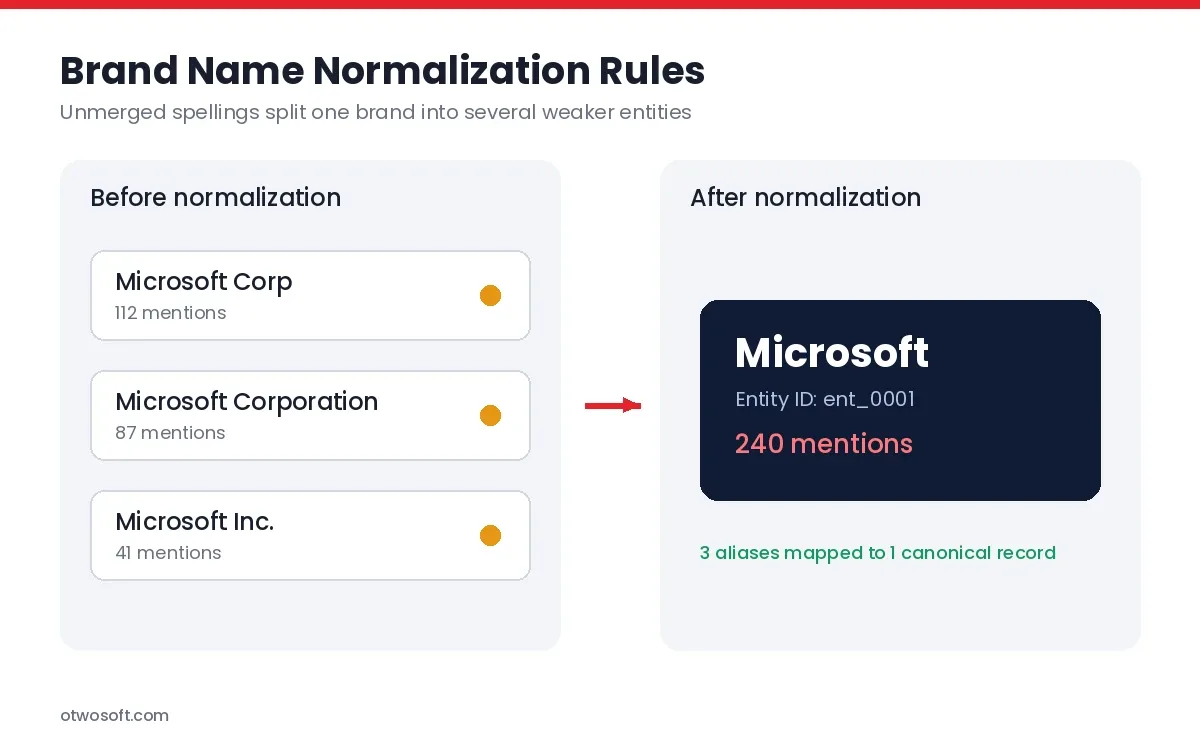
Take a customer database holding "Microsoft Corp", "Microsoft Corporation", and "Microsoft Inc." as separate rows. A visibility report built on that data shows three mid-sized companies where one large company exists. The reverse failure is just as damaging, as two unrelated businesses with similar names can get merged into one inflated record.
There are 3 main ways inconsistent brand data distorts results:
- Split counts happen when a single brand appears under several names, so its mentions, citations, and revenue spread across rows.
- False merges happen when different companies share a name, so one brand absorbs another's mentions or reviews.
- Stale aliases happen after a rebrand, when old names keep collecting mentions that never reach the current entity.
Search engines rely on the same consistency. Google Search Central explains that Organization markup helps Google disambiguate a company in search results, with separate properties for the brand name, an alternate name, and the registered legal name. Matching those values across your site is one of the simplest normalization wins, and a capable web development team can wire the markup into every template.
What Are the Core BrandRank.ai Normalization Rules?
There are 9 core brandrank.ai normalization rules: Unicode form selection, whitespace handling, homoglyph resolution, acronym-case preservation, legal suffix stripping, diacritic folding, abbreviation expansion, alias merging, and format standardization. Each rule handles one type of variation, which keeps the logic testable.
1. Unicode Normalization Form Selection
Pick Normalization Form C (NFC) as the default for brand text. The same visible character can be stored as different code point sequences, so two identical-looking names can fail to match until both are normalized. The W3C Character Model for string matching warns that compatibility forms such as NFKC remove meaning, turning "8½" into "81/2". Use NFKC only on a match key, never on the value you display or store as canonical. The full set of forms is defined in Unicode Standard Annex #15.
2. Whitespace and Punctuation-Split Anomaly Handling
Collapse repeated spaces, convert non-breaking spaces to regular spaces, and strip zero-width characters that scrapers pick up from web pages. Punctuation-split anomaly handling covers cases where "ABC Solutions" arrives as "ABCSolutions" or "ABC-Solutions". Generate a compact match key with spaces and hyphens removed, then compare keys instead of raw strings.
3. Homoglyph Resolution Precedence Rules
Resolve look-alike characters after Unicode normalization and before casing. A Cyrillic "Р" looks identical to a Latin "P" in most fonts, yet Unicode normalization does not fold them together. The Unicode Technical Standard #39 on security mechanisms lists these confusable characters, which makes it the right source for a homoglyph table. Flag mixed-script brand names for review, since they are a common sign of spoofed listings.
4. Acronym-Case Preservation Logic
Match on a case-folded key, but display the canonical casing from your exceptions registry. Blanket title-casing turns "IBM" into "Ibm" and "eBay" into "Ebay". Keep a protected list of brand names with intentional casing, and check that list before any default casing rule runs.
5. Legal Suffix Stripping
Remove suffixes such as Inc., Corp., Corporation, LLC, Ltd., and Limited from the match key, then store the full registered name in a separate legal name field. This lets "ABC Solutions Ltd." and "ABC Solutions Limited" resolve to one entity. Treat "ABC Solutions Inc." with care, as a different suffix in a different country can signal a separate legal company. Each entity record should hold three separate name fields: the canonical brand name used in reports, the registered legal name, and a dated list of former names kept for rebrands.
6. Diacritic Folding Exceptions Registry
Fold accents in the match key so "Café Lumière" and "Cafe Lumiere" find each other. Keep the accented form for display. A diacritic folding exceptions registry lists names where the accent changes identity, such as two local brands that differ only by one marked letter.
Non-Latin brand names need their own care. A filter that keeps only the letters a to z turns a Cyrillic or Japanese name into an empty key, which then matches every other empty key. Keep letters from every script in the match key, with a legal suffix list for each country. A Japanese company name can carry "株式会社" where an American one carries "Inc."
7. Abbreviation Expansion Confidence Gates
Expand abbreviations only when the context clears a confidence gate. "Intl" can safely become "International" inside a company name field. "MSFT" should map to Microsoft only in a stock-ticker context, never in free text where it could mean something else. Job titles follow the same logic, so "VP Sales" becomes "Vice President of Sales" when the field is known to hold titles.
8. Entity Alias Merging Safeguards
Map every confirmed alias to a canonical entity ID, but require a second matching signal before merging. Useful signals include the official domain, a postal address, a product line, or a verified social profile. Delta Air Lines and Delta Faucet share a first word, which is why name similarity alone never justifies a merge. Deterministic deduplication thresholds, such as an exact domain match plus a name-key match, keep these decisions repeatable.
9. Format Standardization for Dates, Currencies, Addresses, and URLs
Write dates in ISO 8601, currencies as ISO 4217 codes, and US mailing addresses according to USPS Publication 28. URLs follow the normalization steps in RFC 3986, with lowercase hosts and a consistent scheme, plus one canonical choice between the "www" and bare domain. Numeric span normalization heuristics are rules for reading numbers inside text. They handle locale differences, since "1.200" means one thousand two hundred in many European formats but one point two in US formats.
Rule Quick Reference
| Rule | Raw input | Normalized output |
|---|---|---|
| Unicode form | "Café" stored as e + combining accent | "Café" in NFC |
| Whitespace | "ABC Solutions" with a non-breaking space | "ABC Solutions" |
| Homoglyph | "Рro Wireless" with a Cyrillic Р | Flagged, then "Pro Wireless" |
| Acronym case | "ibm corporation" | "IBM" |
| Legal suffix | "ABC Solutions Limited" | "ABC Solutions" plus legal name field |
| Diacritics | "Cafe Lumiere" | Match key "cafelumiere", display "Café Lumière" |
| Abbreviation | "VP Sales" | "Vice President of Sales" |
| Alias merge | "Microsoft Corp" | Entity ID for Microsoft |
| Format | "July 1, 2026" | "2026-07-01" |
In What Order Should BrandRank.ai Transformation Rules Run?
Run character rules first, then token rules, then entity rules, then format rules, with validation at the end. The order changes the outcome, so a correct rule placed in the wrong position can still corrupt clean data.
- Convert every source to UTF-8, then apply NFC.
- Clean whitespace, invisible characters, and punctuation splits.
- Resolve homoglyphs and flag mixed-script names.
- Check the exceptions registry for protected casing and accents.
- Apply default casing, suffix stripping, and diacritic folding to the match key.
- Expand abbreviations that pass their confidence gate, then look up aliases.
- Standardize formats, then validate every merge against a second signal.
The W3C guidance explains why normalization should come before case folding, as folding text that is not yet normalized can produce mismatches. Two more ordering traps catch teams often. Default casing applied before the exceptions check breaks names like "eBay", and alias lookup run before suffix stripping misses every "Ltd." variant in the alias table.
How Does the BrandRank.ai Normalization and Transformation Task Work Step by Step?
The brandrank.ai normalization and transformation task runs in 6 stages: collect, profile, transform, resolve, validate, and publish. Each stage has its own output, so problems can be traced to the stage that caused them.
- Collect records from website pages, CRM systems, product databases, analytics tools, and AI answer logs, attaching the source and collection date to each record. Start with the two sources that feed the most reports, which is usually the CRM and the product database.
- Profile the data to count duplicate names, mixed casing, missing values, and odd characters before writing any rule.
- Transform values with the rule set, writing the result to a new column instead of overwriting the original.
- Resolve entities by matching cleaned keys against the canonical entity table, sending uncertain matches to a review queue. Fuzzy name matches below your tested similarity score belong in that queue, as do name matches with no second signal.
- Validate the output through sample checks and merge audits, then confirm that related records stayed connected. A random sample of 100 to 200 merges per rule release gives reviewers enough cases to spot a pattern of false merges.
- Publish the clean dataset to dashboards, schema markup, and reporting tools, while keeping the raw layer intact.
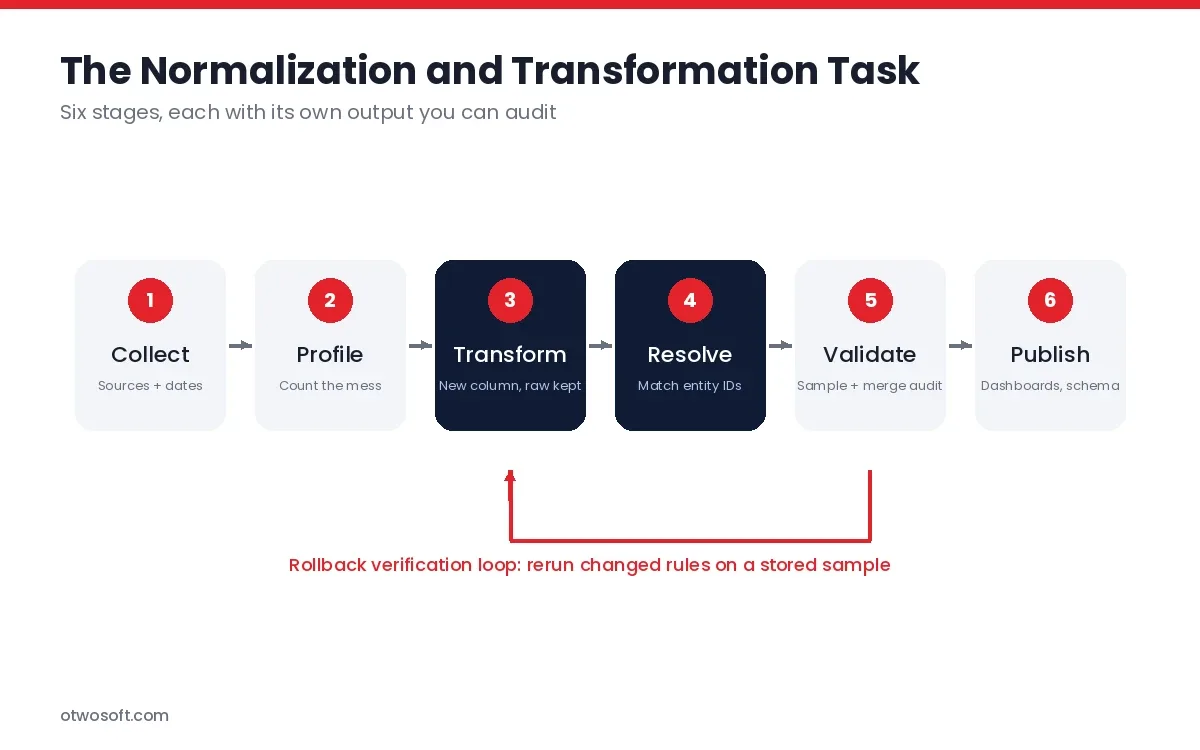
Ownership works best when data engineering runs the rule files and pipeline. Marketing operations should own the alias table plus the review queue, since that team knows which names belong together. Normalization rollback verification loops close the cycle. Whenever a rule changes, rerun it on a stored sample, compare the new output with the old, and reverse the change if unrelated records started merging. Teams with large volumes often hand the review queue to AI agents that propose merges for a human to approve. That setup removes the manual sorting while a person still makes the final call.
What Does Brand Normalization Look Like on Real Data?
Brand normalization on real data maps each raw value to one canonical name and one entity ID, while holding uncertain cases for review. The table below uses illustrative records, not data from a real company, to show the rules across three common entities.
| Raw value | Rules applied | Proposed match | Canonical value | Decision |
|---|---|---|---|---|
| ABC Solutions Ltd. | Suffix strip, domain match | ABC Solutions | ABC Solutions | Merged |
| ABC Solutions Limited | Suffix strip, domain match | ABC Solutions | ABC Solutions | Merged |
| ABC Solutions Inc. | Suffix strip, domain mismatch | ABC Solutions | Pending review | Held for review |
| Microsoft Corp | Suffix strip, alias lookup | Microsoft | Microsoft | Merged |
| Microsoft Corporation | Suffix strip, alias lookup | Microsoft | Microsoft | Merged |
| MSFT | Abbreviation gate | Microsoft | Microsoft | Merged in ticker fields only |
| Pro Wireless Earbuds | Token reorder, product ID match | Wireless Earbuds Pro | Wireless Earbuds Pro | Merged |
| Wireless Earbuds Professional | Abbreviation map, product ID match | Wireless Earbuds Pro | Wireless Earbuds Pro | Merged |
| Earbuds Pro | Product ID missing | Wireless Earbuds Pro | Pending review | Held for review |
Two rows stay on hold, and their canonical value stays empty until a reviewer approves the proposed match. "ABC Solutions Inc." might be a separate US company, and "Earbuds Pro" could be another seller's product. A rule set that merges everything looks tidy in a report while making the numbers less true.
Brand Name Normalization Rules AI Answer Trackers Need
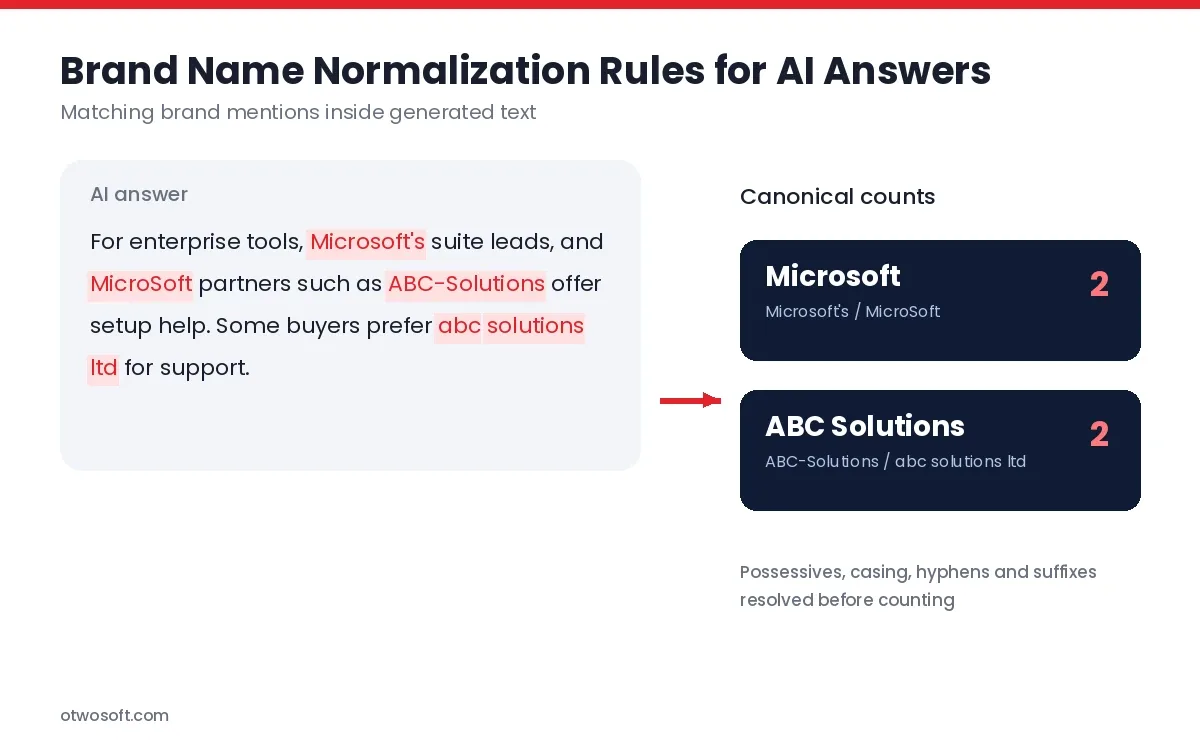
The brand name normalization rules AI answer trackers need cover possessives, word boundaries, product-to-parent links, and misspellings, since AI-generated text is messier than any database. An answer from ChatGPT or Gemini rarely writes a brand exactly as its official record does.
Tracking mentions inside generated answers needs 6 extra rules on top of the core set:
- Strip possessives and plurals, so "Microsoft's" and "Microsofts" count toward the canonical entity.
- Match on word boundaries, which stops a short brand name from matching inside a longer unrelated word.
- Link product names to their parent brand, so a mention of a flagship product counts for the company as well when your report needs that view.
- Allow small misspellings through fuzzy matching, but only above a fixed similarity score that you test on real answers.
- Use surrounding words to separate brands with common-word names, which matters for any brand whose name doubles as a dictionary word.
- Record the prompt, model, and date with every answer, since the same question can return different brands on different days.
Mentions, recommendations, and negative remarks should stay in separate fields, as a single count hides whether the model praised or warned against the brand. Our explainer on how AI works covers why outputs vary between runs, and our guide to generative AI explains how these models produce text in the first place.
How Do Brand Name Normalization Rules Apply to Email Marketing?
Brand name normalization rules email marketing teams follow keep the sender name, CRM merge fields, and contact lists consistent, which protects both deliverability and trust. Email exposes inconsistent brand data directly to customers, where a CRM error becomes a visible mistake.
The Federal Trade Commission (FTC) CAN-SPAM compliance guide requires the "From" and routing information in commercial email to accurately identify the business that sent it. The same guide sets other rules too, covering truthful subject lines, a valid postal address, and a working opt-out, so sender names are only one part of compliance. A single approved sender name, used across every campaign, handles the identity part while making your messages easier to recognize in the inbox.
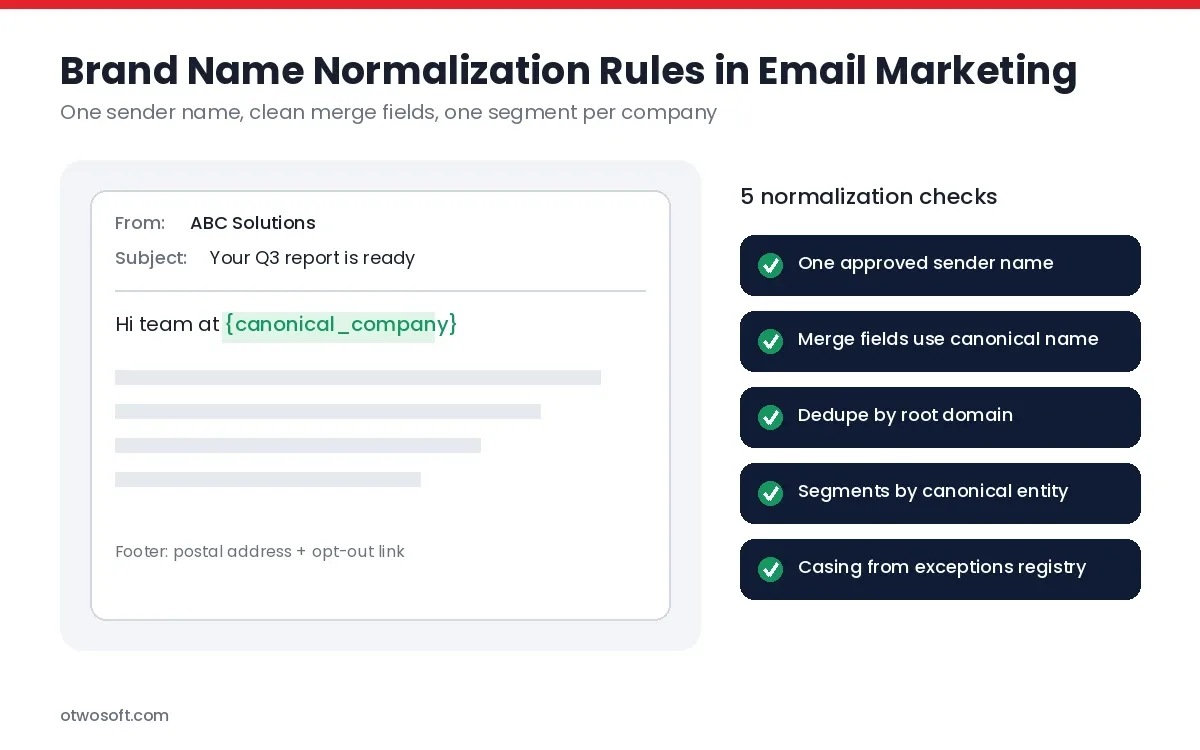
There are 5 places where email teams apply brand normalization:
- Sender names should use one approved brand string across every tool and campaign.
- Merge fields should pull the canonical company name, so a greeting never reads "Hi team at ABC Solutions Ltd. (Inc.)".
- Duplicate contacts should be found by root domain and canonical company, not by raw company text.
- Segments should group accounts by canonical entity, which keeps one company from landing in two segments.
- Subject lines and footers should follow the casing rules in your exceptions registry.
Clean company data makes campaign reporting honest as well. Open and reply rates grouped by canonical account show which companies engage, a theme we explore in our breakdown of innovative marketing campaigns.
How Do You Compare Brand Metrics Across Different Categories?
Compare brand metrics across categories by scaling each metric within its own category first, then comparing the scaled scores. A brand with 40 AI mentions in a small niche can outperform a brand with 400 mentions in a crowded category.
Min-max scaling, z-score standardization, and log transforms are the usual options, with z-scores handling outliers better and log transforms taming viral spikes. Our guide to feature engineering explains each method with worked numbers. The usual machine learning caution applies here as well: fit the scaling on current data, then reuse those exact settings on new data. Set a minimum sample size per category before scoring, as a category with five brands produces unstable results.
How Do You Write Normalization Rules in Code?
Write normalization rules as a versioned configuration file plus a small function that applies them in a fixed order. Keeping rules in configuration lets non-developers review them without reading code.
A minimal rule file can look like this:
version: 3
unicode_form: NFC
protected_names:
ibm: IBM
ebay: eBay
no_fold: ["maison élan"]
legal_suffixes: ["inc", "corp", "corporation", "llc", "ltd", "limited"]
merge_requires: ["name_key", "domain"]
The functions below implement every option in that file. Matching keys and merge decisions stay separate, so a shared name alone never triggers a merge:
import re
import unicodedata
def clean(name, rules):
text = unicodedata.normalize(rules["unicode_form"], name)
text = text.replace("\u00a0", " ").replace("\u200b", "")
return " ".join(text.split())
def match_key(name, rules):
text = clean(name, rules).casefold()
if text not in rules["no_fold"]:
decomposed = unicodedata.normalize("NFD", text)
text = "".join(c for c in decomposed if not unicodedata.combining(c))
tokens = re.findall(r"\w+", text) # \w keeps letters from any script
tokens = [t for t in tokens if t not in rules["legal_suffixes"]]
return "".join(tokens)
def display_name(name, rules):
key = match_key(name, rules)
return rules["protected_names"].get(key, clean(name, rules))
def can_merge(a, b, rules):
checks = {
"name_key": match_key(a["name"], rules) == match_key(b["name"], rules),
"domain": bool(a.get("domain")) and a.get("domain") == b.get("domain"),
}
return all(checks[c] for c in rules["merge_requires"])
We ran this code on sample strings before publishing. "ABC Solutions Ltd.", "ABC Solutions Limited", and "ABC Solutions" with a non-breaking space all returned the key "abcsolutions". The display function turned "ibm corporation" into "IBM" and "Ebay" into "eBay", while a Cyrillic name kept its full key instead of collapsing to an empty string. A record for "ABC Solutions Inc." on a different domain failed the merge check, which is the behavior the example table expects.
How Should You Test Rules Before They Ship?
Test every rule release with 4 checks before it touches production data. Each check catches a different kind of silent damage.
- Run a fixed set of test cases, with raw input and expected output, covering every rule in the file.
- Check idempotency by running the rules twice, since a second pass should never change the output of the first.
- Run regression tests against merges that reviewers approved earlier, so a new rule cannot break a match that was already correct.
- Write an audit trail for every merge, storing the source records, the rule version, the matching signals, and the reviewer decision.
Store the rule file in version control, tag each release, and record which version produced each dataset. Teams building this into a larger platform usually pair it with custom software development for the pipeline and AI development services for the matching models.
What Mistakes Break Brand Normalization?
The 6 most common brand normalization mistakes are over-merging, overwriting raw data, using NFKC everywhere, dropping meaningful words, treating cleanup as a one-time project, and ignoring rebrands. Each one produces data that looks clean while being wrong.
- Over-merging joins companies that share a word, which inflates one brand and erases another.
- Overwriting raw values removes the ability to audit or reverse a bad rule.
- Applying NFKC to stored values changes meaning, as the "8½" example from the W3C shows.
- Dropping stopwords removes intent signals, so "The" in a brand name such as "The Home Depot" should survive in the display name even when the match key ignores it.
- Treating normalization as a one-off cleanup lets new variations pile up within months as listings, reviews, and pages change.
- Ignoring rebrands leaves old names collecting mentions, so former names belong in the alias table with a date range.
A naming style guide shared across marketing, sales, and support prevents many of these errors at the source. The same guide should shape product names inside your apps, which is where UI/UX design decisions and data rules meet.
How Do You Measure Whether Normalization Works?
Measure normalization with 5 metrics: merge precision, unmatched rate, duplicate rate, rollback count, and AI mention consistency. Track each one per rule version so you can see which change helped or hurt.
- Merge precision is the share of sampled merges a reviewer confirms as correct.
- Unmatched rate is the share of incoming names that match no canonical entity.
- Duplicate rate is the share of entities that still appear under more than one active record.
- Rollback count is the number of rule changes reversed after validation.
- AI mention consistency is how often tracked answers name the brand in its canonical form across repeated prompts.
Here is how the numbers work on an illustrative release, not a measured client result:
| Metric | Formula | Example | Result |
|---|---|---|---|
| Merge precision | Correct merges ÷ sampled merges | 96 ÷ 100 | 96% |
| Unmatched rate | Unmatched names ÷ incoming names | 340 ÷ 8,500 | 4% |
| Duplicate rate | Entities with 2+ active records ÷ all entities | 45 ÷ 3,000 | 1.5% |
| Rollback count | Rule changes reversed after validation | 1 of 6 changes | 1 |
A precision below your target, such as 95%, is a reason to hold the release and tighten the rule that caused the bad merges. Build these checks into your brandrank.ai normalization guidelines so every rule change gets scored the same way. Run a pre-tokenization semantic drift audit each quarter, which means checking raw names before any rule touches them to see which new spellings have crept in. Sample the new names, note which rules caught them, then add aliases for anything new. Our guide to KPI examples shows how to set targets and review cadences for metrics like these.
Conclusion
BrandRank.ai normalization transformation rules give AI search engines, analytics tools, and marketing systems one clean version of every brand, product, and field. The benefits follow directly: accurate AI visibility counts, fewer duplicate records, and structured data that leaves no doubt about which company a page describes.
The method rests on five parts: character cleanup, casing and suffix rules, alias mapping, format standardization, plus a final validation pass. Run the rules in a fixed order, keep raw data beside clean data, and require a second signal before any merge. If you want help building a normalization pipeline or an AI visibility tracker, the team at O2SOFT can scope it with you through a free consultation.
Frequently Asked Questions
Is "normalization transformation rules" an official BrandRank.ai feature?
No, the phrase describes a general data-cleaning method rather than a documented product feature. BrandRank.ai publicly describes its visibility, vulnerability, and readiness scores, while the cleanup rules covered in this guide are standard practice for any brand dataset.
Do brandrank.ai normalization rules improve AI visibility?
Yes, clean brand data makes AI visibility measurement more accurate, though no rule set can guarantee that an AI model will mention a brand. Consistent names, structured data, and matching profiles give AI systems clearer signals. The final answer still depends on the prompt, the model, and its sources.
What is brand normalization?
Brand normalization is the process of mapping every variation of a brand name to one canonical name and entity ID. It covers spelling, casing, legal suffixes, abbreviations, and former names, so every report, CRM record, or AI tracker counts each brand once.
How often should brandrank.ai normalization guidelines be reviewed?
Review the guidelines at least quarterly, and immediately after a rebrand, acquisition, or product launch. New listings and AI answers introduce fresh variations every week, so a scheduled audit of unmatched names keeps the alias table current.
Can brand name normalization be fully automated?
No, automation handles most of the volume, but uncertain merges still need human review. Software can apply casing, suffix, and format rules at scale, while decisions about similar-named companies or ambiguous product names need someone who knows the business.
Which Unicode form should brand names use?
Brand names should be stored in NFC, with NFKC limited to temporary match keys. NFC keeps the visible text intact, while compatibility forms remove distinctions that can change a name's meaning.