


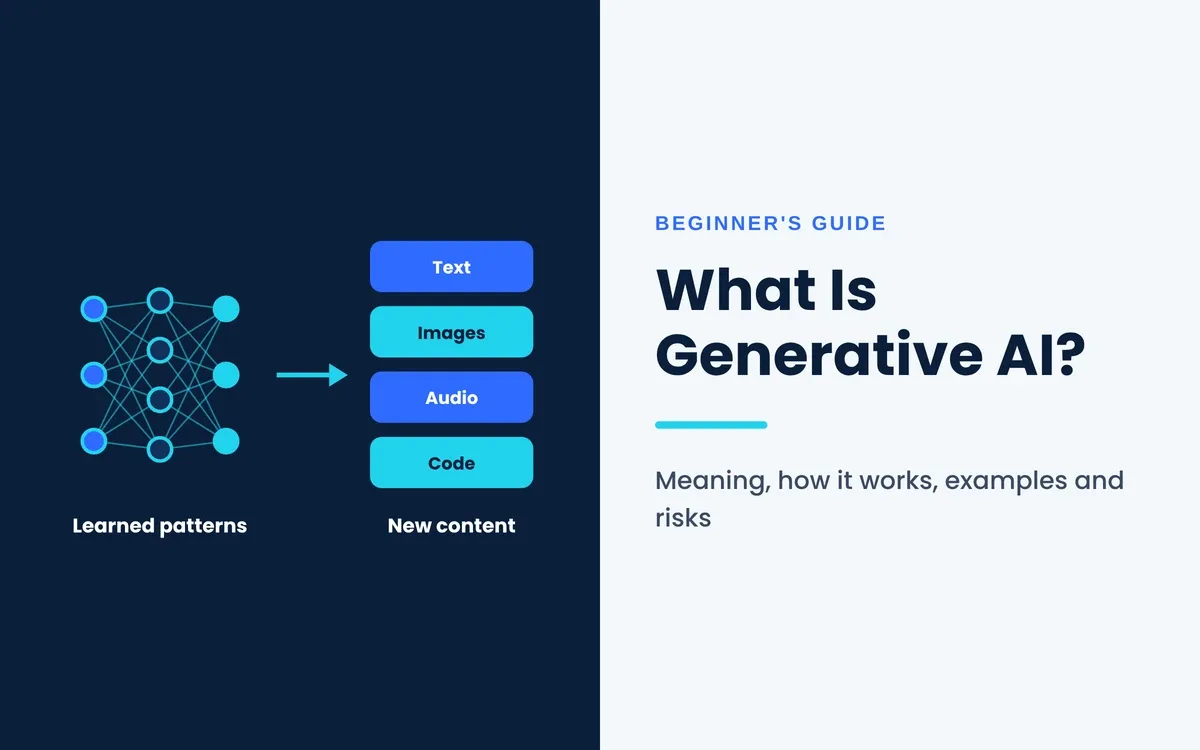
The simplest answer to what is generative AI comes down to one idea: software that learns patterns from huge amounts of data, then uses them to create new content such as text, images, audio, video, and code. Type a prompt into ChatGPT, Claude, or Gemini, and the language model behind it predicts the most likely next piece of output. It repeats that prediction one token at a time until it has built a complete answer. Image, audio, and video generators follow different processes, such as diffusion, which later sections explain.
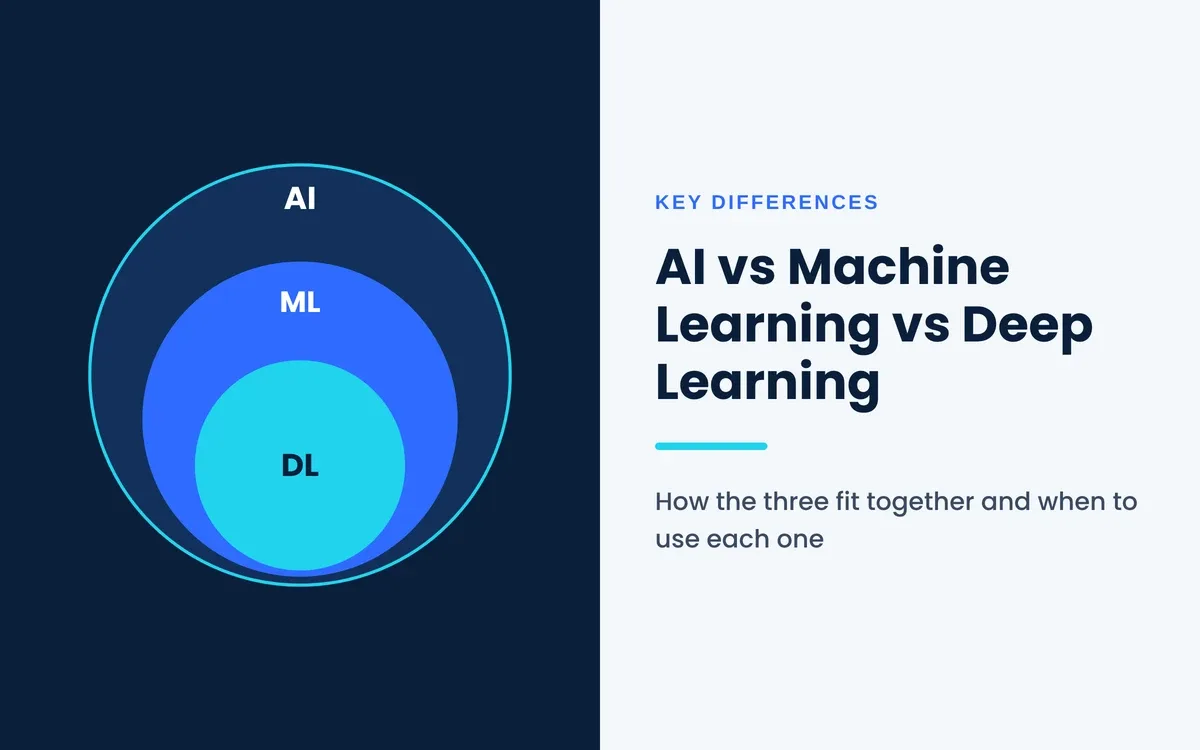
Generative AI sits inside machine learning, which itself is a branch of artificial intelligence. Older AI systems mostly sorted or scored data, for example by flagging spam or predicting loan defaults. A generative system goes further because it produces new output from the patterns it learned, whether that is a product description, a photorealistic image, or a working Python function.
Adoption has moved fast since ChatGPT launched in November 2022. The Stanford AI Index reports that private investment in generative AI reached $33.9 billion in 2024. Over the same year, the share of surveyed organizations using it in at least one business function jumped from 33% to 71%.
The sections below explain the generative AI meaning in plain language, how the technology works under the hood, and the main model types. Later sections cover real examples, a short history, the biggest risks, plus what it takes to build with it.
Key Takeaways
- Generative AI creates new content instead of only classifying data.
- Many modern generative AI tools use transformer-based or diffusion-based models, depending on the content they generate.
- Training, tuning, and generation form the three core phases.
- Hallucinations, bias, and copyright remain unsolved problems.
- Businesses get the best results when humans review outputs.
What Does Generative AI Mean?
Generative AI means artificial intelligence that produces original content, such as text, images, audio, video, or code, in response to a prompt by drawing on patterns it learned during training.
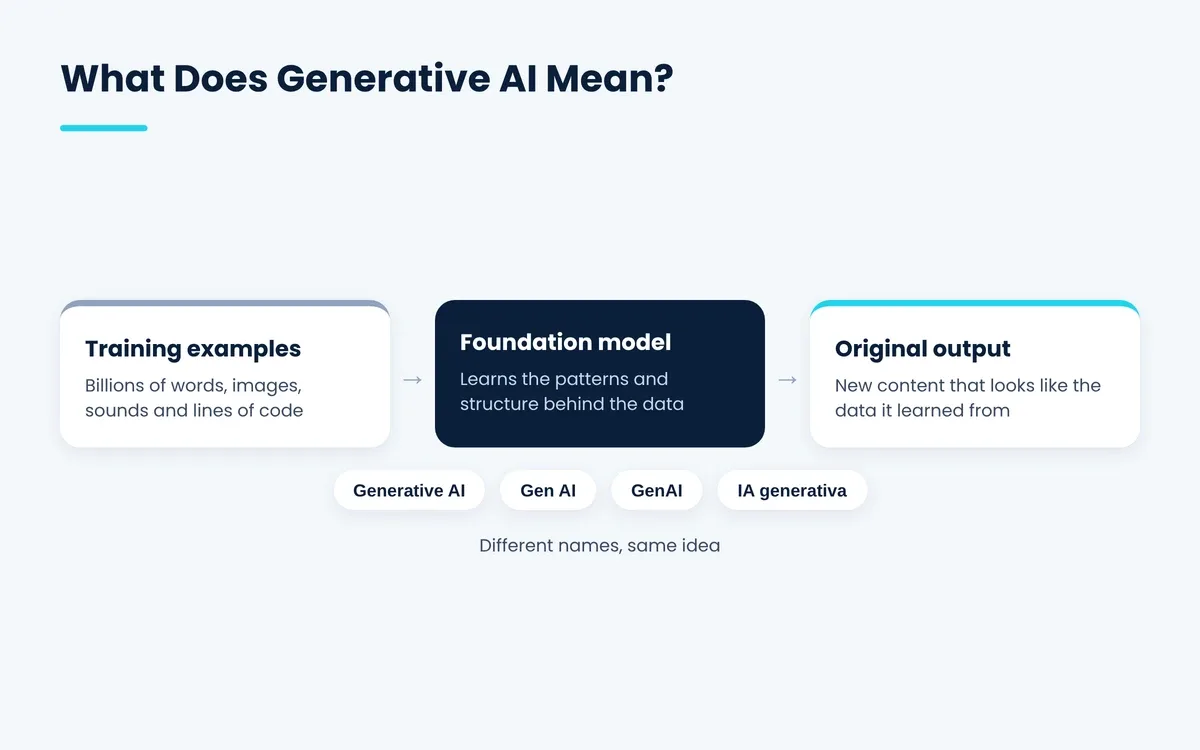
The word generative refers to generation, the act of producing new output. A predictive model answers a narrow question about existing data, whereas a generative model writes, draws, composes, or codes something fresh each time you ask it.
People who search "what is generative AI definition" usually want a formal source, and the clearest one comes from the US government. The NIST Generative AI Profile, published in July 2024, describes generative models as systems that imitate the structure of their input data. Those systems then produce derived synthetic content, including images, video, audio, and text.
Common Names: Gen AI, GenAI, and IA Generativa
Generative AI is also called gen AI, GenAI, or gen-ai in headlines and job posts. In Spanish, the term is IA generativa. These names all refer to AI systems that generate new content from learned patterns, so the answer to what is gen AI or what is GenAI is the same definition this guide covers.
Which Is the Best Description of Generative AI?
The best description of generative AI is a type of machine learning that learns the patterns in its training data and uses them to create new, similar content.
Quizzes in an introduction to generative AI course often ask which is the best description of generative AI, and the answer they expect matches the sentence above. Options that describe a system that only sorts, ranks, or retrieves existing records describe predictive or search systems instead.
The shortest generative AI definition fits in one line for a non-technical audience: a machine that learns from examples and then makes new examples. To define generative artificial intelligence for engineers, add three details. The system relies on deep neural networks, learns from mostly unlabeled data through self-supervised training, then samples its output from probability distributions. A short gen AI definition and a technical definition of generative AI never contradict each other, so you can define generative AI at whichever depth your reader needs.
How Does Generative AI Work?
Generative AI works in three phases: developers train a large foundation model on raw data, tune that model for a specific job, then generate, evaluate, and retune its outputs.
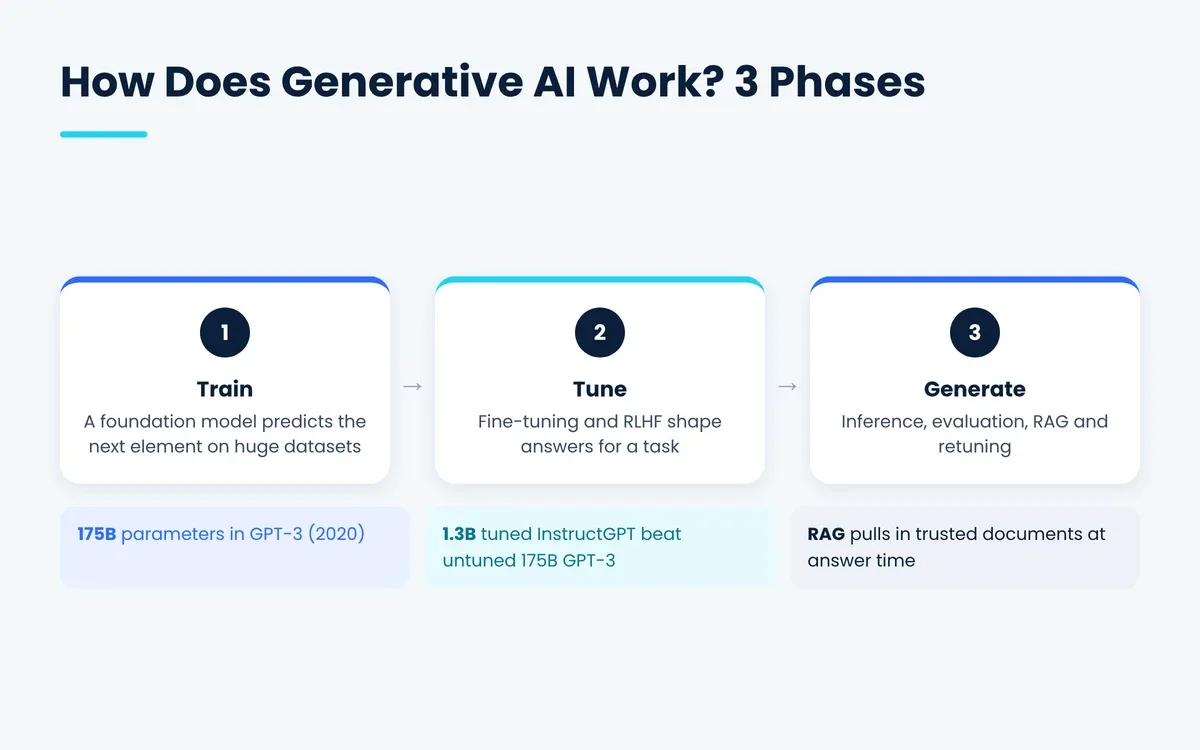
Each phase answers a different engineering question. Training decides what the model knows, tuning decides how it behaves, and evaluation decides whether the output is good enough to ship. Our guide on how AI works covers the broader learning process, so this section focuses on how generative AI works specifically.
Phase 1: Training a Foundation Model
Every generative product starts with a foundation model, a large deep learning model that serves as the base for many different applications. You can read more about model structure in our explainer on what an AI model is.
During training, the model reads billions of examples of text, images, or code drawn from its training data. It repeatedly predicts the next element in a sequence, compares that guess with the real data, then adjusts its internal weights to shrink the error.
Those weights are called parameters, and they store everything the model has learned. GPT-3, released by OpenAI in 2020, contained 175 billion parameters according to the original GPT-3 paper. Training at that scale runs on thousands of graphics processing units (GPUs) for weeks, which explains why only a few labs build foundation models from scratch. Open-weight releases such as Meta's Llama 2, launched in July 2023, let other developers skip that expensive step.
Phase 2: Tuning With Fine-Tuning and RLHF
A foundation model knows a great deal about language, yet it has no idea how your support team answers refund questions, so developers tune it for the job.
- Fine-tuning feeds the model labeled examples, such as 2,000 real customer questions paired with approved answers, so it learns the expected format and tone.
- Reinforcement learning with human feedback (RLHF) asks people to rank several responses to the same prompt, then trains the model to prefer the higher-ranked style.
RLHF became standard practice after the InstructGPT paper appeared in 2022. In that study, people preferred answers from a tuned 1.3 billion parameter model over the untuned 175 billion parameter GPT-3. Data-labeling work for both methods takes a lot of human time, so many teams outsource it to specialist annotation vendors.
Phase 3: Generation, Evaluation, and Retuning
Once deployed, the model produces outputs during inference, the stage where it answers real prompts. Teams review those outputs, measure accuracy against test sets, then retune the model on a regular schedule.
Retrieval augmented generation (RAG) adds another lever to this loop. Instead of relying only on what the model memorized, a RAG system searches a trusted document store and hands the most relevant passages to the model alongside the prompt. The technique comes from a 2020 RAG paper by researchers at Facebook AI Research, and it lets a chatbot quote your current pricing page rather than guess.
A Worked Example: One Prompt From Input to Output
Here is what happens when a user types the prompt "Write a two-sentence product description for a stainless steel water bottle" into a text generation tool.
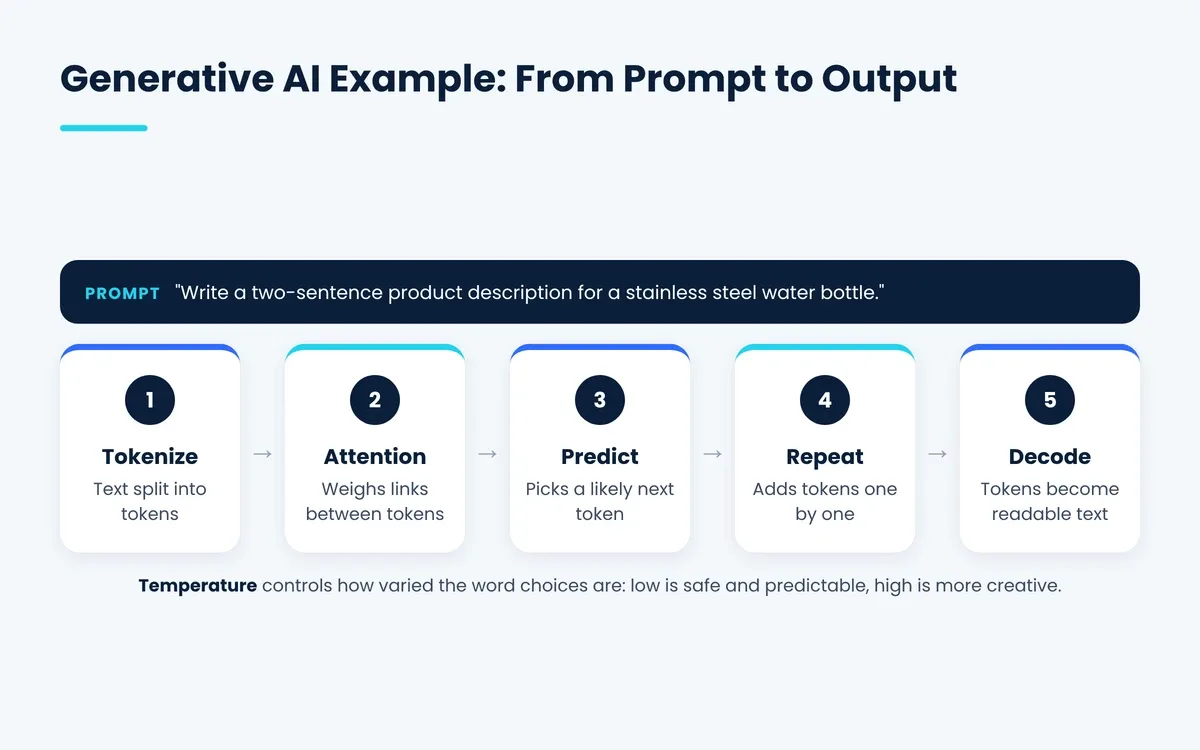
- Tokenization: the model splits the prompt into tokens, small chunks of text, then maps each token to a numerical representation called an embedding.
- Attention: transformer attention helps the model weigh relationships between tokens and use their context, so it can focus on the words that matter most, such as "two-sentence" and "stainless steel."
- Prediction: the model calculates a probability for every token in its vocabulary and selects a likely next token, for instance "Keep."
- Repetition: it appends that token to the sequence and repeats the prediction step until it reaches a stop signal.
- Output: the finished tokens decode into readable text, such as "Keep drinks cold for 24 hours with double-wall stainless steel insulation. The leak-proof lid fits standard cup holders for easy travel."
Run the same prompt twice and you will usually get two different descriptions, because the model samples from probabilities rather than looking up a stored answer. A setting called temperature controls how adventurous that sampling gets, with lower values producing safer, more repetitive wording.
What Are the Main Generative AI Models?
The four main generative artificial intelligence models are variational autoencoders (VAEs), generative adversarial networks (GANs), diffusion models, and transformers, with most current tools built on transformers or diffusion models.
| Architecture | First introduced | How it generates | Common uses |
|---|---|---|---|
| Variational autoencoder (VAE) | 2013 | Compresses data into a latent space, then decodes new variations | Anomaly detection, image variation, data compression |
| Generative adversarial network (GAN) | 2014 | A generator creates samples while a discriminator judges them | Face synthesis, style transfer, data augmentation |
| Diffusion model | 2015 | Adds noise to training data, then learns to remove it step by step | Text-to-image tools such as Stable Diffusion |
| Transformer | 2017 | Uses attention to model relationships between tokens | Large language models, code assistants, multimodal models |
These four are not strictly parallel categories. Transformers are a neural network architecture, while VAEs, GANs, and diffusion models describe ways of learning to generate data, and a diffusion model can use a transformer inside it.
Variational Autoencoders (VAEs)
An autoencoder pairs two neural networks: an encoder that compresses data into a latent space and a decoder that rebuilds it. Diederik Kingma and Max Welling added a probabilistic twist in their 2013 VAE paper, which lets the decoder sample new variations instead of copying the input. VAEs supported early progress in image recognition, natural language processing, and anomaly detection, such as spotting unusual patterns in medical scans.
Generative Adversarial Networks (GANs)
Ian Goodfellow and colleagues at the University of Montreal introduced GANs in a 2014 GAN paper. A generator network produces fake samples, a discriminator network tries to separate them from real ones, and that contest pushes the generator toward realistic output. GANs still drive style transfer, such as turning a photo into a pencil sketch, along with synthetic data used to train other models.
Diffusion Models
Diffusion models learn by destroying data and then reversing the damage. During training they add random noise to an image until it turns into static, then learn each step needed to remove that noise. The approach first appeared in a 2015 diffusion paper by researchers at Stanford and Berkeley. Diffusion sampling now powers Stable Diffusion along with later versions of DALL-E.
Transformers
Google researchers described the transformer in the 2017 transformer paper, titled Attention Is All You Need. Its attention mechanism lets the model read a whole sequence at once and weigh how strongly each token relates to the rest, which made training on internet-scale data practical. Large language models (LLMs) such as the GPT series behind ChatGPT, Claude, Gemini, and Llama all use transformer architectures.
Multimodal Foundation Models
Recent systems combine these ideas into multimodal foundation models that accept and produce several content types in one model. A single assistant can now read a chart, answer in text, and describe a photo within the same conversation. Text-to-video models such as OpenAI's Sora, announced in February 2024, pair a transformer backbone with diffusion-style generation.
How Is Generative AI Different From Traditional AI?
Traditional, or discriminative, AI predicts a label or a number from existing data, while generative AI creates new data that resembles what it learned.
| Factor | Traditional (predictive) AI | Generative AI |
|---|---|---|
| Main job | Classify, score, or forecast | Create new content |
| Typical output | "Spam" or "not spam," a risk score | An email draft, an image, a block of code |
| Training data | Mostly labeled examples | Mostly unlabeled data, followed by tuning |
| Example system | Fraud detection model | Customer service chatbot that writes replies |
| Best fit | Structured, tabular data | Language, images, audio, and code |
The line between the two blurs inside real products. A bank can use a predictive model to flag a suspicious transaction, then use a generative model to draft the explanation sent to the customer. Generative models are not the right choice for every job either. A tabular data study presented at NeurIPS 2022 found that tree-based methods still outperform deep learning on typical spreadsheet-style data.
Generative models belong firmly to the neural network tradition described in our symbolic vs connectionist AI guide. For the wider family tree, see our overview of the types of AI.
Which Task Is a Generative AI Task?
A task counts as generative when the system must produce new content, such as a cover letter, a logo concept, a song, or code, rather than label or retrieve existing content.
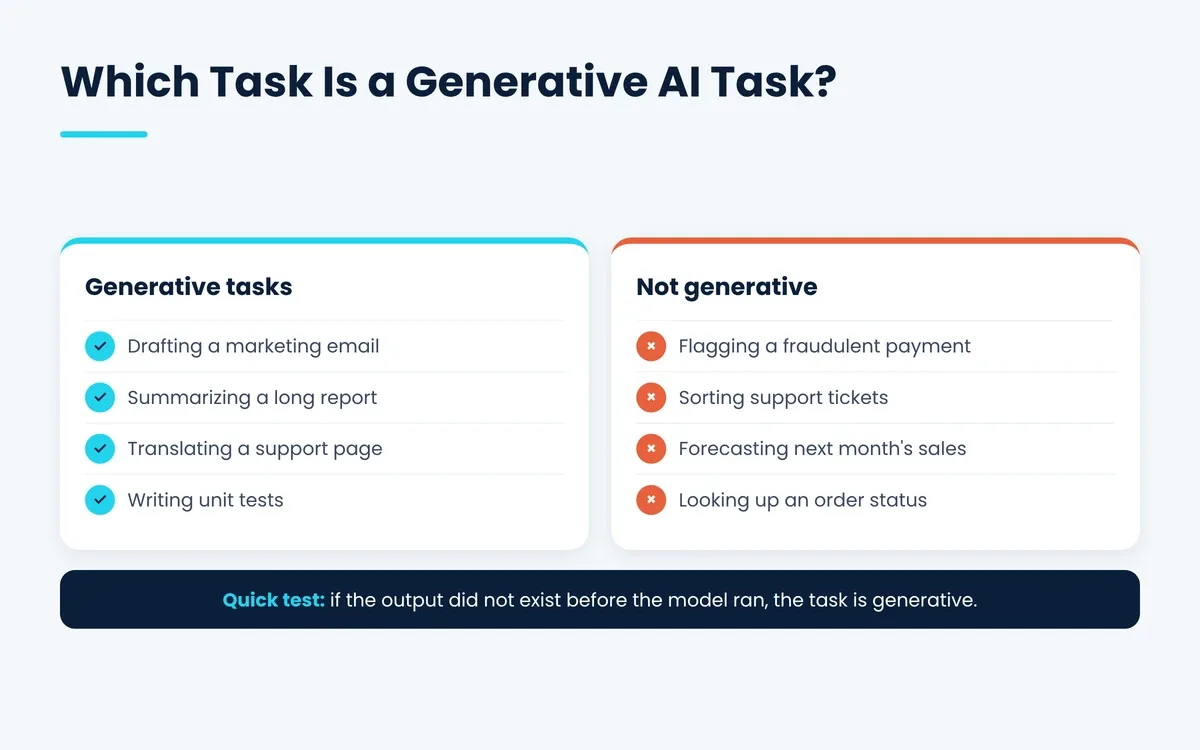
Course quizzes often ask which task is a generative AI task and then list four options. A quick test settles it: ask whether the output exists before the model runs, and when the answer is no, the task is generative.
Generative tasks include:
- Drafting a marketing email from a short brief
- Producing a product photo variation from a text prompt
- Turning a meeting transcript into a written summary
- Translating a support article into Spanish
- Writing unit tests for an existing function
Non-generative tasks include:
- Flagging a credit card transaction as fraudulent
- Sorting incoming support tickets into five categories
- Predicting next month's sales from past data
- Returning a stored order status to a customer
Summaries and translations count as generative because the model writes new sentences, even though the meaning comes from a source document.
What Can Generative AI Create? Examples by Content Type
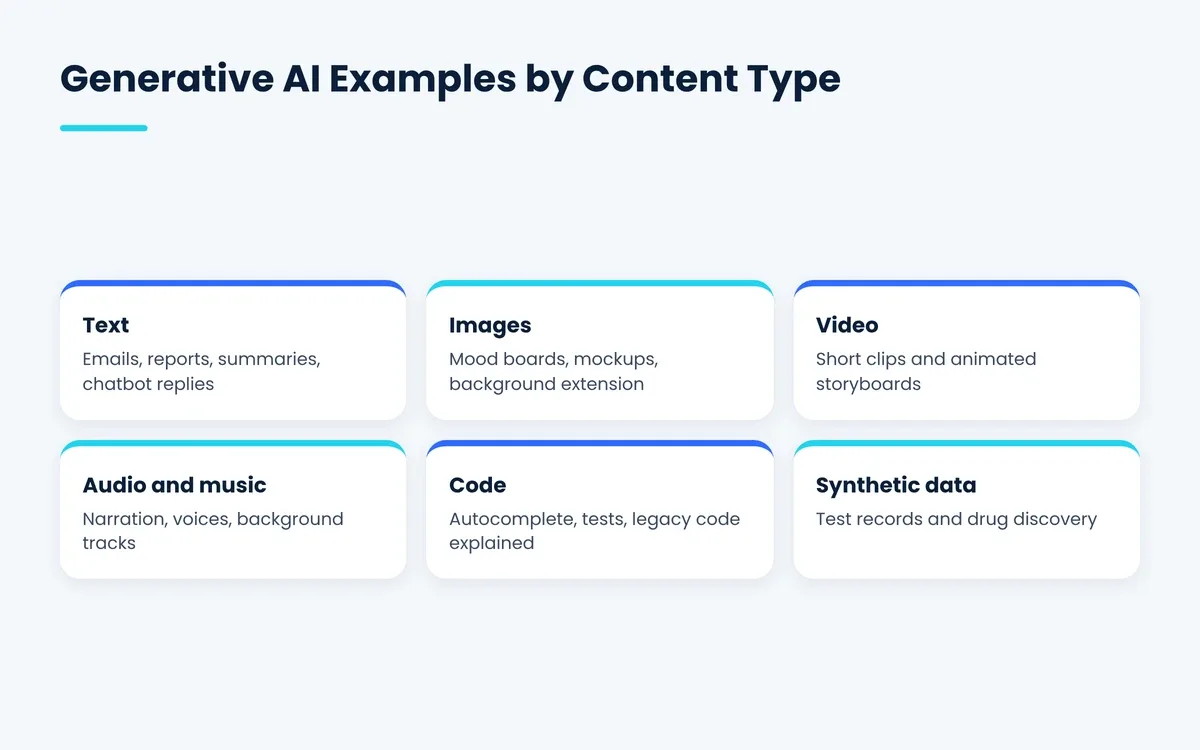
Generative AI can create text, images, video, speech, music, software code, and synthetic data, and each content type relies on a model trained for that format.
Text Generation
Large language models write emails, reports, blog drafts, meta descriptions, contract summaries, and chatbot replies. A customer service chatbot built on an LLM can answer a billing question in plain language. When a request falls outside its scope, the bot hands the conversation to a human agent.
Image Generation
Text-to-image models such as Stable Diffusion, DALL-E, and Midjourney turn a written description into an original picture. Designers use them for mood boards, ad variations, and product mockups, while photo editors rely on image-to-image models to extend backgrounds or remove unwanted objects.
Video Generation
Text-to-video models generate short clips from a prompt or animate a still image. Marketing teams use them for storyboards and social clips well before a full production budget exists.
Audio, Speech, and Music
Text-to-speech models produce natural narration for audiobooks and voice assistants. Text-to-music models compose original tracks from a short description of mood, genre, and tempo.
Software Code
Text-to-code models autocomplete functions, translate between programming languages, explain legacy code, and write tests. Code assistants now sit inside popular editors, so teams handling web development or mobile app development projects can hand off boilerplate and test scaffolding. Senior engineers still need to review every suggestion, because generated code can hide subtle bugs or security flaws.
Synthetic Data and Science
Generative models create synthetic records that mimic real data without exposing personal details, which helps teams test software or train other models safely. In drug discovery, researchers use them to propose new molecular structures with chosen properties.
A single example of generative AI often combines several of these formats. A real estate app, for instance, can write a listing description from property data, create a virtual staging image, then read the summary aloud for accessibility.
What Are Generative AI Tools?
Generative AI tools are applications that put a generative model behind a simple interface, usually a chat box or prompt field, so people can create content without writing code.
A model and a tool are different things. The model is the underlying technology, such as a GPT or Gemini model, while the tool is the application people use on top of it, such as the ChatGPT app or an image editor with a generate button.
The main categories look like this:
- Chat assistants: ChatGPT from OpenAI, Claude from Anthropic, and Gemini from Google DeepMind handle writing, research, analysis, and coding help.
- Image generators: Midjourney, Stable Diffusion, and DALL-E produce illustrations, concept art, and ad creatives.
- Video generators: text-to-video tools such as Sora create short clips and animated scenes.
- Code assistants: editor plugins suggest code, explain errors, and write tests.
- Open-weight models: Llama and other open-source foundation model projects let developers host and fine-tune a model on their own servers.
Developers reach most of these models through application programming interfaces (APIs), which lets a company embed text, image, or voice generation inside its own product. Choosing a gen AI tool comes down to three questions: what content you need, where your data must stay, and how much control you want over the model.
How Do Businesses Use Generative AI?
Businesses use generative AI to draft content, answer customer questions, write and review code, summarize documents, and personalize marketing, usually with a human checking the final output.
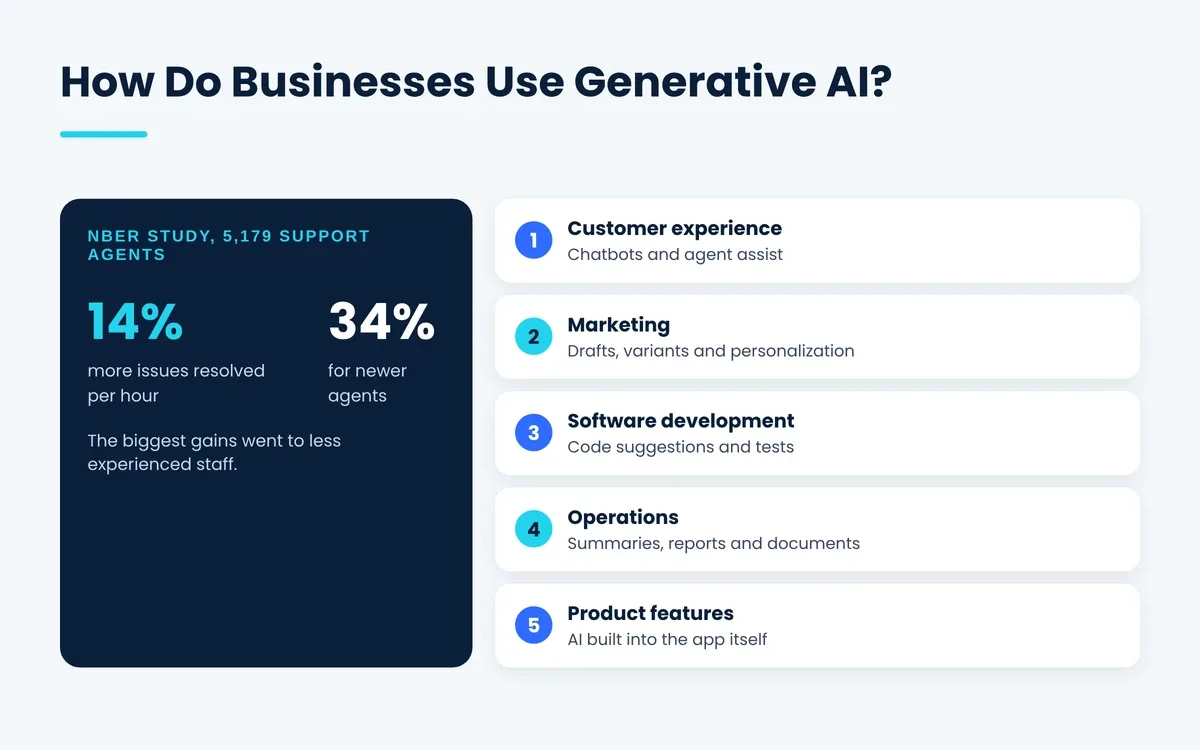
The strongest evidence so far comes from customer support. An NBER study by Erik Brynjolfsson, Danielle Li, and Lindsey Raymond, titled Generative AI at Work, tracked 5,179 support agents at one Fortune 500 software company. In that setting, an AI assistant raised issues resolved per hour by 14% on average. Newer, less experienced agents saw the biggest jump, a 34% gain, so the result describes one workplace rather than a guaranteed gain for every support team.
The most common generative AI applications fall into five areas:
- Customer experience: chatbots and virtual assistants answer routine questions around the clock.
- Marketing: teams produce first drafts of ad copy, landing pages, and product descriptions in their brand voice.
- Software development: code generation speeds up testing and the modernization of legacy applications, a common goal in custom software development projects.
- Operations: staff use contract summaries, invoice drafts, and internal knowledge search powered by RAG.
- Product features: apps ship AI writing helpers, image editing, or smart onboarding directly inside the user experience.
O2SOFT's client EyeCast case study shows the product side of this shift, where AI-driven onboarding helped lift user activation by 73%, a first-party result from one client project rather than independent research. Public use has grown alongside business use, and a Pew Research Center survey from February 2026 found that 44% of US adults use ChatGPT, up from 18% in 2023. Pew changed the question wording in 2026, so the two figures are not a strict like-for-like comparison.
When Was Generative AI Invented? A Short History of Generative AI
Generative AI has no single invention date: its roots reach back to Andrey Markov's 1906 probability chains, while deep generative models arrived with VAEs in 2013.
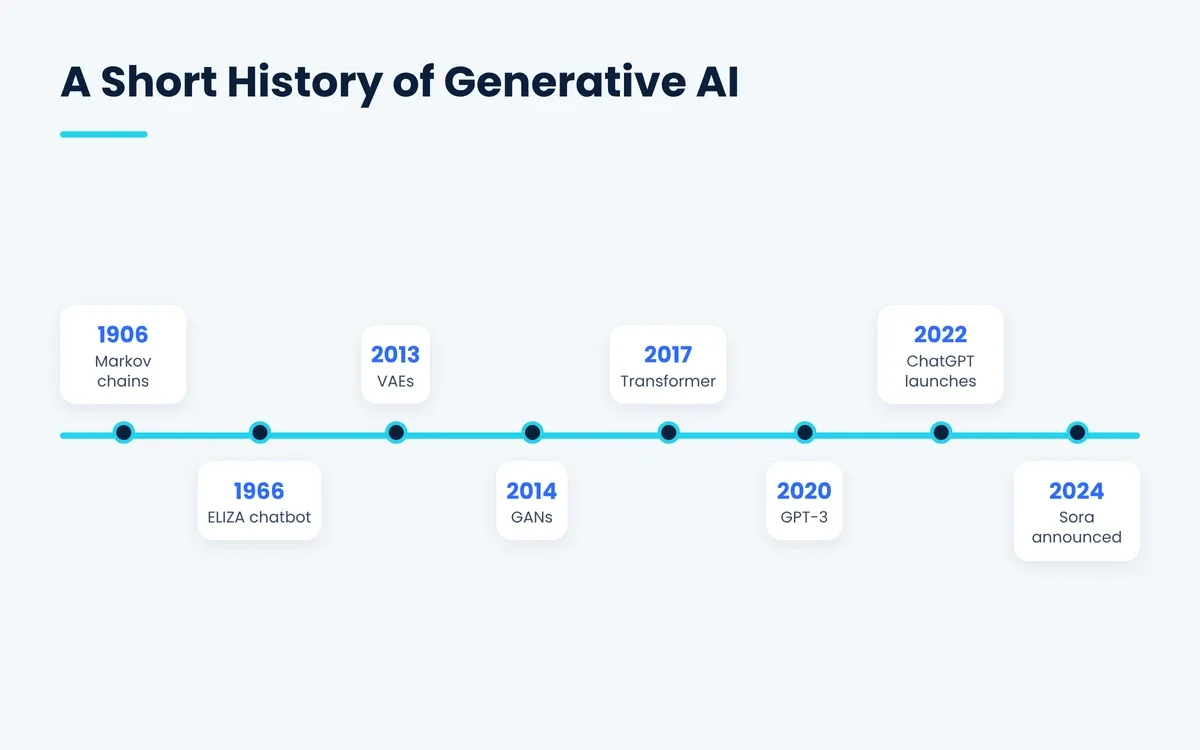
So when was generative AI created in the form people use today? The modern era starts with the 2017 transformer paper, while the public breakthrough came with ChatGPT's launch on November 30, 2022.
- 1906: Andrey Markov publishes the probability chains that later power autocomplete-style text prediction.
- 1966: Joseph Weizenbaum describes ELIZA, an early chatbot, in a 1966 ACM paper.
- 2013: Variational autoencoders introduce deep generative modeling with latent spaces.
- 2014: Generative adversarial networks make sharp synthetic images practical.
- 2015: Researchers introduce diffusion models for image generation.
- 2017: The transformer architecture appears in the paper Attention Is All You Need.
- 2018: OpenAI releases GPT-1, its first generative pretrained transformer.
- 2020: GPT-3 arrives with 175 billion parameters.
- 2022: Midjourney, Stable Diffusion, and ChatGPT bring image and text generation to the public.
- 2023 to 2024: GPT-4, Llama 2, and Sora push models toward multimodal input and video output.
That timeline answers the related question of when did generative AI start, depending on whether you mean the math, the first chatbot, or the deep learning era. For the full arc from Alan Turing onward, read our history of AI timeline.
Generative AI vs Agentic AI: What Is the Difference?
Generative AI creates content in response to a prompt, while agentic AI uses that content to plan steps, call tools, and complete multi-step goals with limited human input.
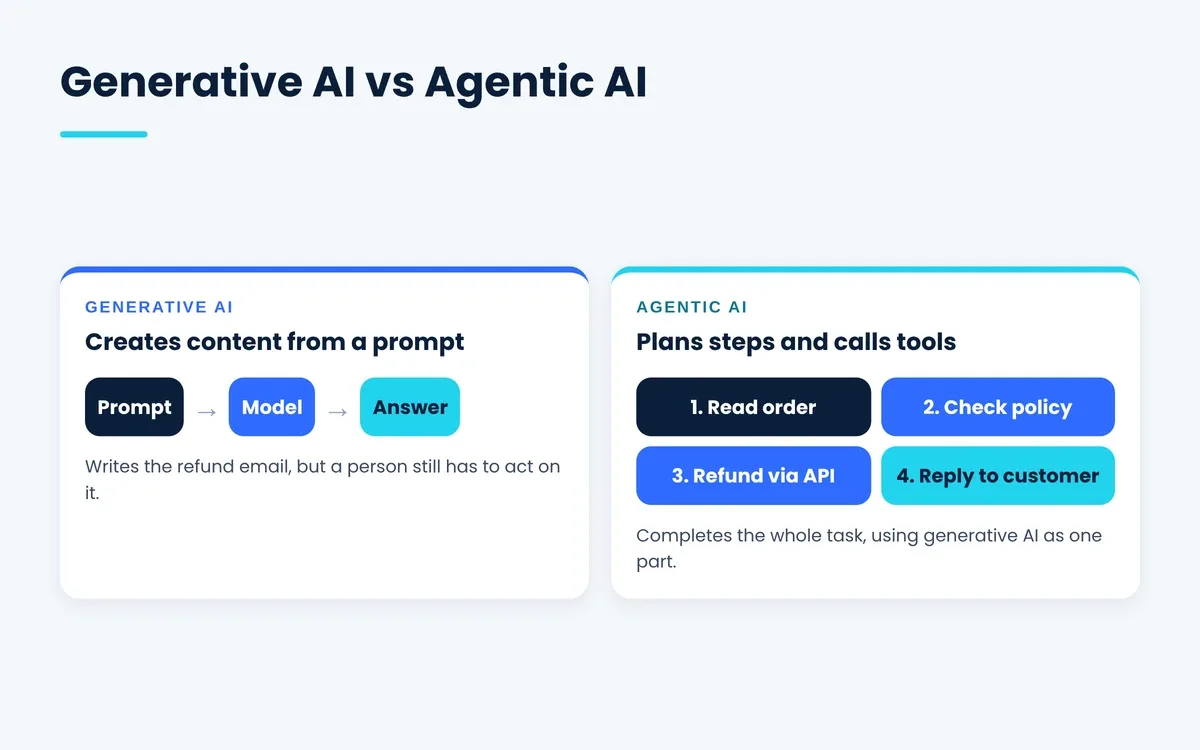
A generative model can draft a reply to a customer who wants a refund. An AI agent built on that model can read the order record, check the refund policy, issue the refund through an API, then send the reply.
Agents rely on generative models for reasoning and language, so the two technologies work together rather than compete. Teams exploring this next step can begin with AI agent development for one narrow workflow before scaling to others.
What Are the Risks and Limitations of Generative AI?
The main risks of generative AI are hallucinations, biased output, copyright and privacy exposure, deepfakes, security misuse, model collapse, and high energy costs.
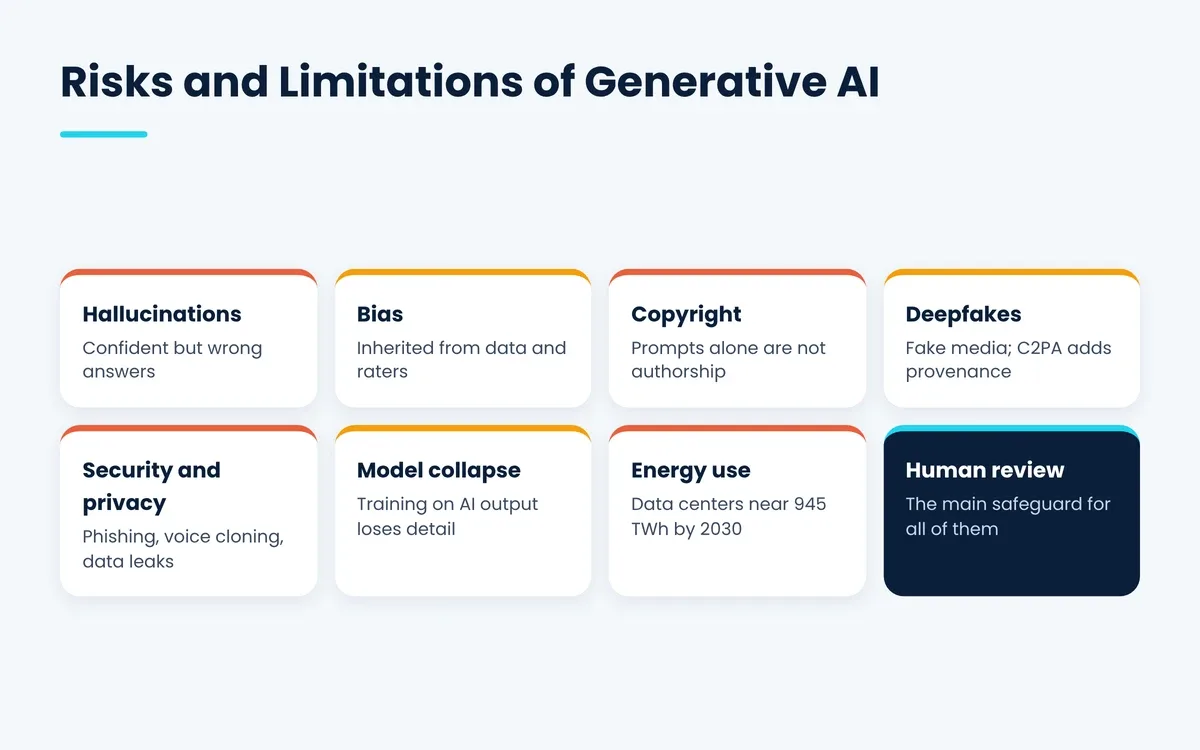
The NIST Generative AI Profile groups these concerns into 12 risk categories, ranging from confabulation to information security, and recommends controls for each one.
Hallucinations and Inconsistent Output
A hallucination is a confident answer that is simply wrong, such as an invented legal citation or a fake statistic. Because models sample from probabilities, the same prompt can also return different answers, which causes trouble in regulated workflows. Grounding answers with RAG, adding guardrails, and keeping a human reviewer in the loop reduce the problem without removing it entirely.
Bias
Models absorb the biases present in their training data and in the people who rate their outputs. Diverse data, documented evaluation, and regular audits of real outputs help teams catch skewed results before customers see them.
Copyright and Ownership
The US Copyright Office concluded in January 2025 that prompts alone do not make a user the author of an AI-generated output. In the United States, protection depends on sufficient human-authored expression, so output generated from prompts alone does not qualify, while human edits, creative selection, or arrangement of AI output can.
Deepfakes and Watermarking
Deepfakes are synthetic images, audio, or video that show real people saying or doing things they never did. The C2PA standard attaches tamper-evident provenance data to media files, while the EU AI Act sets transparency duties in Article 50: deployers must disclose deepfakes, and providers of generative systems must mark synthetic output in a machine-readable format. These duties apply from August 2, 2026, with a limited transition period for some marking and detection requirements, and the exact obligation depends on a company's role.
Security and Privacy
Attackers use generative AI to write convincing phishing emails and clone voices for fraud. Inside companies, staff who paste customer records into a public chatbot create a data leak, so clear usage policies matter as much as technical controls.
Model Collapse
A 2024 Nature study found that models trained repeatedly on AI-generated data lose rare details from the original distribution and degrade over successive generations. As more web content comes from machines, AI-generated training data becomes a quality risk that model builders must filter out.
Energy Costs
Training and running large models consumes significant electricity. The International Energy Agency projects in its base case that data center electricity demand will more than double to about 945 terawatt-hours by 2030, with AI as the largest driver of that growth.
How Do You Start With Generative AI Development?
Generative AI development usually follows five steps: pick one business problem, choose a model, ground it in your data, test outputs with real users, then monitor and retune after launch.
- Define a narrow use case. Pick one workflow with a measurable result, such as cutting first-response time on support tickets.
- Choose build or buy. Use an existing gen AI tool for internal productivity, or call a model through an API when the feature belongs inside your product.
- Ground the model in your data. Start with prompt engineering, add RAG for company knowledge, then reserve fine-tuning for tasks that need a fixed format or tone.
- Evaluate before launch. Test accuracy, bias, latency, and cost on real examples, keeping a human review step for high-stakes outputs.
- Monitor and return. Track failures after launch and update prompts, retrieval sources, or tuning data on a schedule.
RAG suits knowledge that changes often, such as policies or prices, because you update documents instead of retraining the model. Fine-tuning suits stable behavior, such as a fixed JSON output format or a consistent brand voice. A clear interface matters as much as the model itself, which is why UI/UX design belongs in the plan from day one.
Learning resources shorten the ramp-up as well. Generative AI courses from universities and cloud providers teach prompt engineering, RAG, plus evaluation methods. For product managers, an introduction to generative AI course is a sensible first step before scoping a build.
Conclusion
The answer to what is generative AI starts with a simple idea: software that creates new content from learned patterns. The details explain why it behaves the way it does. Foundation models learn from massive training data, tuning shapes their behavior, while RAG plus human review keep outputs accurate and on brand.
The technology already writes, draws, codes, and speaks well enough to change daily work across marketing, support, and software teams. Its limits are just as real, from hallucinations to copyright gaps, so the organizations that benefit most treat generative AI as a capable assistant that still needs oversight. You can find more guides on this topic in our generative AI articles or browse the full list of our services.
Frequently Asked Questions
What does generative AI mean in simple terms?
Generative AI means software that creates new content after learning from examples. You describe what you want in plain language, and the model writes text, makes an image, or produces code that did not exist before.
What is the difference between AI and generative AI?
Generative AI is one branch of artificial intelligence. Every generative system counts as AI, yet most AI systems, such as fraud detectors or recommendation engines, predict or classify data rather than create new content.
Is ChatGPT generative AI?
Yes, ChatGPT is a generative AI chatbot. Its name stands for Generative Pre-trained Transformer, and it uses a large language model to write responses one token at a time based on your prompt.
What does GenAI mean in a job posting?
In a job posting, GenAI refers to experience with generative AI models and tools. Employers usually expect skills such as prompt engineering, working with LLM APIs, building RAG pipelines, and evaluating model outputs for accuracy.
When did generative AI start?
Generative AI started with simple statistical models in the early 20th century, but the modern version began with deep generative models in 2013 and 2014. ChatGPT brought it to the mainstream in November 2022.
Can generative AI replace human workers?
Current evidence points to changed tasks rather than wholesale replacement. Field studies show the largest gains for less experienced staff, which suggests generative AI works best as an assistant that humans supervise.
Can I copyright content made with generative AI?
In the United States, content generated from prompts alone cannot be copyrighted, according to the US Copyright Office. Work that includes meaningful human authorship, such as substantial editing or creative arrangement of AI output, can still qualify for protection.