



Artificial intelligence (AI) is technology that lets computers perform tasks that normally require human intelligence, such as understanding language, recognizing images, spotting patterns, making predictions, and deciding what to do next. Most AI today learns these skills from data instead of following hand-written rules.
AI is already part of ordinary life. It filters spam out of your inbox, suggests the next show you watch, flags suspicious card payments, and powers chatbots like ChatGPT, Claude, and Gemini. In McKinsey's late-2025 global survey, 88% of organizations said they use AI in at least one business function, up from 78% a year earlier (McKinsey, The State of AI).
This introduction to AI covers what the term means, how it works, how it differs from machine learning and deep learning, the main types of AI, real examples, where the field came from, and the risks worth taking seriously. Each section stands on its own, so feel free to jump to the part you need.
Key Takeaways
- AI is a broad field. Machine learning is a subset of AI, deep learning is a subset of machine learning, and most generative AI tools are built on deep learning.
- Every AI system in use today is narrow AI: strong at specific tasks, without general human-level understanding. Artificial general intelligence (AGI) does not exist yet.
- Modern AI learns from data during training, gets refined through tuning, and then applies what it learned to new inputs.
- The biggest practical risks are confident wrong answers, biased outcomes, privacy leaks, and weak oversight. Good governance reduces all four.
- Demand for AI skills is rising: the US Bureau of Labor Statistics projects data scientist jobs to grow 34% from 2024 to 2034.
What is artificial intelligence?
Artificial intelligence is the branch of computer science focused on building systems that can reason, learn, perceive, and act in ways we would call intelligent if a person did them. AI stands for artificial intelligence, and the term describes both the scientific field and the software products that come out of it.
Artificial intelligence explained in simple terms
Think of ordinary software as a recipe. A programmer writes every step, and the computer follows those steps exactly. AI works more like an apprentice. Instead of being handed every rule, it studies thousands or millions of examples and works out the patterns itself. Show a system with enough labeled photos of cats and dogs, and it learns to tell them apart in photos it has never seen.
That ability to generalize from examples is what separates most modern AI from traditional programs. It explains why AI copes well with messy, real-world information, and also why it sometimes fails in ways nobody predicted.
Artificial intelligence definition: what experts and US law say
Experts and lawmakers define artificial intelligence in slightly different ways. John McCarthy, the computer scientist who coined the term "artificial intelligence" in 1955, described the field as the science and engineering of making intelligent machines. Stuart Russell and Peter Norvig, authors of the textbook Artificial Intelligence: A Modern Approach, organize the field around four goals: systems that think like humans, act like humans, think rationally, or act rationally.
US federal law is more concrete. The National Artificial Intelligence Initiative Act of 2020 defines AI as "a machine-based system that can, for a given set of human-defined objectives, make predictions, recommendations or decisions influencing real or virtual environments". Executive Order 14179, signed in January 2025, kept that same statutory definition. Defense policy also uses a broader, five-part definition from Section 238(g) of the National Defense Authorization Act for Fiscal Year 2019.
What the Turing Test measures
In his 1950 paper "Computing Machinery and Intelligence," Alan Turing proposed a practical test: if a person chatting by text cannot reliably tell a machine from a human, the machine is showing intelligent behavior. Modern chatbots can pass casual versions of this test. That says more about how persuasive fluent language is than about whether a machine understands anything, which is why researchers now judge AI on specific benchmarks and real-world tasks.
How does AI work?
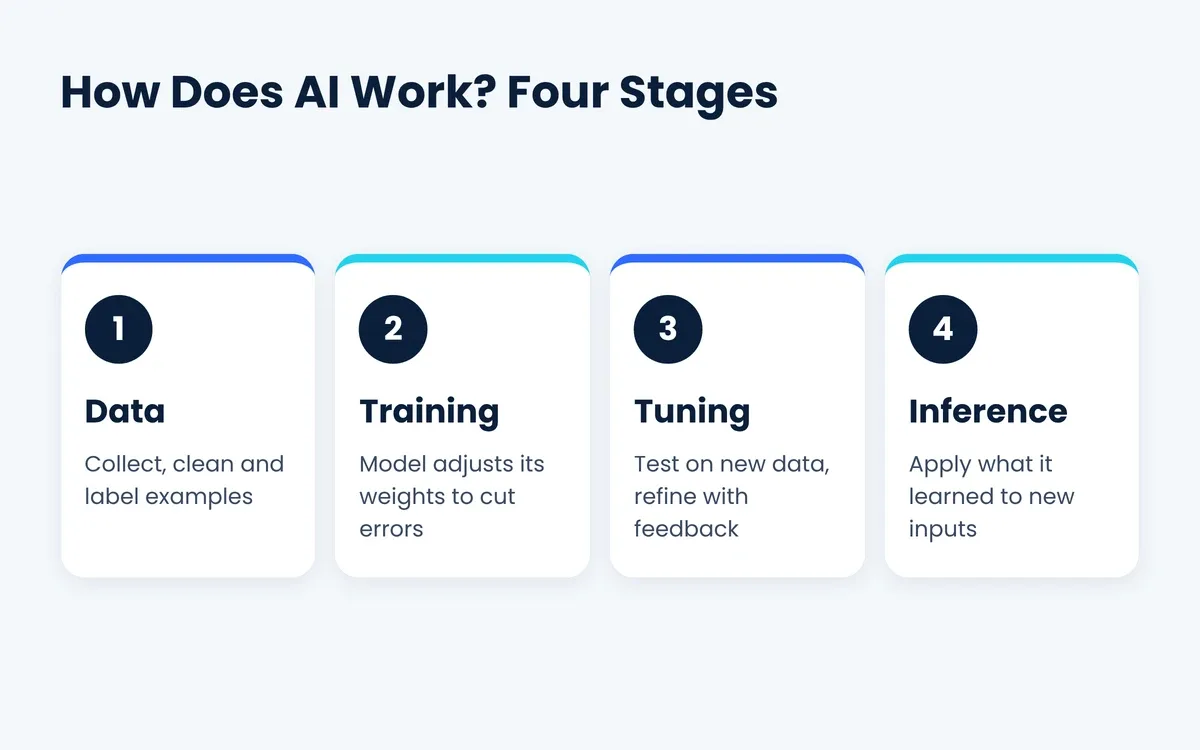
Most AI systems work by learning patterns from data and then applying those patterns to new situations. The process has four broad stages: preparing data, training a model, evaluating and tuning it, and putting it to work.
- Data collection and preparation. Engineers gather examples for the task, such as transaction records, medical images, or text, then clean and label them. Poor or unrepresentative data is one of the most common reasons AI projects disappoint.
- Training. An algorithm works through the data and repeatedly adjusts the model's internal settings, called parameters or weights, to reduce its errors. Large models have billions of parameters and are trained on clusters of specialized chips.
- Evaluation and tuning. The model is tested on data it has not seen before. Developers then refine it with fine-tuning on narrower data, reinforcement learning with human feedback (RLHF), where people rate outputs so the model learns which answers are useful, or both.
- Inference and deployment. The finished model goes into a product and handles new inputs: answering a question, scoring a payment for fraud, or reading an X-ray. Teams keep monitoring it, because accuracy can slip as real-world data changes.
Many generative AI products also use retrieval augmented generation (RAG). Instead of relying only on what it absorbed during training, the model first pulls relevant passages from a trusted source, such as a company's help center, and bases its answer on them. RAG is one of the most practical ways to cut down on made-up answers.
Not every AI system learns from data. Rule-based systems, often called symbolic AI or expert systems, follow logic that people write by hand. They remain common where every decision must be traceable, as in some compliance and tax software. For a longer walkthrough, see how AI works, explained step by step.
AI vs machine learning vs deep learning vs generative AI
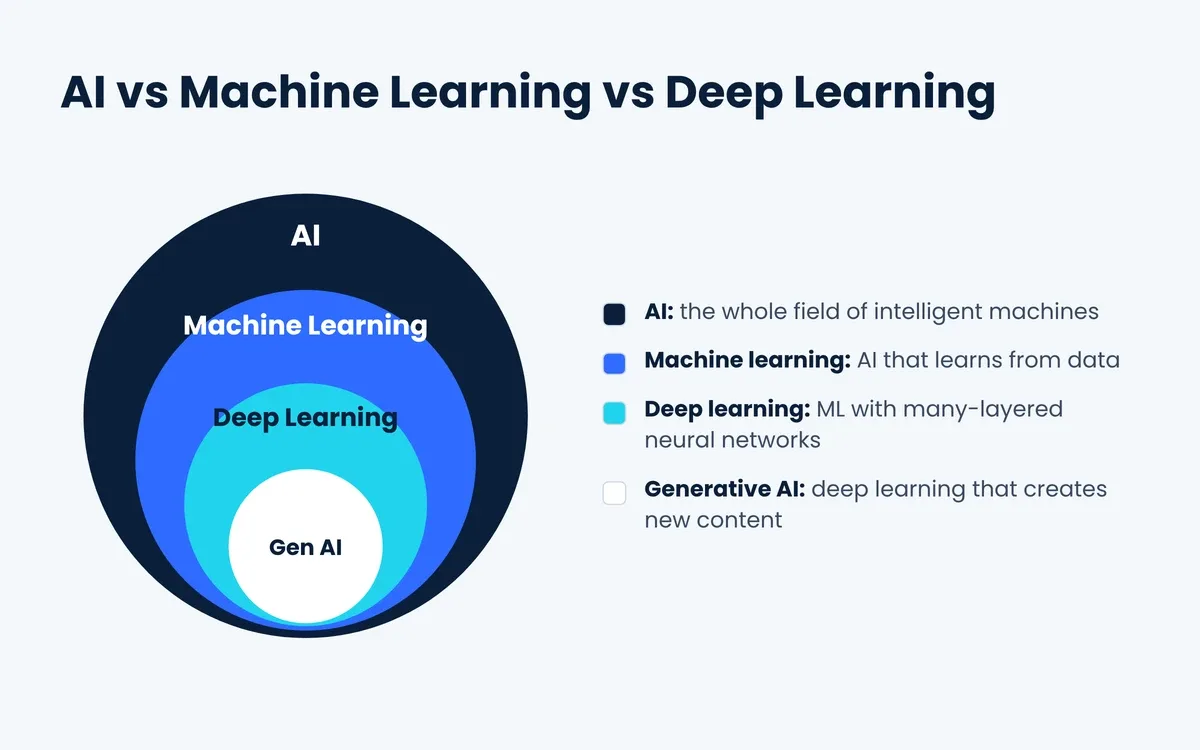
When you compare AI vs machine learning vs deep learning, the first thing to know is that these terms are nested, not interchangeable. Artificial intelligence is the whole field. Machine learning is one way to build AI. Deep learning is a type of machine learning. Generative AI is an application of deep learning that creates new content.
| Term | What it is | Everyday example |
|---|---|---|
| Artificial intelligence (AI) | Any technique that lets machines perform tasks that need human-like intelligence, including rule-based systems | Chess engines, voice assistants, fraud filters |
| Machine learning (ML) | AI that learns patterns from data instead of relying only on hand-coded rules | Streaming recommendations, spam filters |
| Deep learning (DL) | Machine learning that uses neural networks with many layers | Face unlock, speech recognition |
| Generative AI (gen AI) | Deep learning models that produce new text, images, audio, video, or code | ChatGPT, Midjourney, DALL-E |
Machine learning
Machine learning gives computers the ability to get better at a task through experience. The machine learning definition in US law describes it as an application of AI that learns and improves from data or experience without being explicitly programmed. The main approaches are:
- Supervised learning: the model trains on labeled examples, such as emails marked "spam" or "not spam," and learns to predict labels for new data.
- Unsupervised learning: the model finds structure in unlabeled data, such as grouping customers with similar buying habits.
- Semi-supervised and self-supervised learning: the model uses a little labeled data, or creates its own training signal from raw data. Large language models learn mostly this way, by predicting the next word across enormous amounts of text.
- Reinforcement learning: the model learns by trial and error and earns rewards for good actions. DeepMind combined it with deep neural networks to build AlphaGo, which beat Go champion Lee Sedol in 2016.
Popular machine learning algorithms include linear and logistic regression, decision trees, random forests, support vector machines, and k-means clustering. Each suits a different kind of problem, as our complete guide to machine learning explains.
Deep learning and neural networks explained
A neural network is a model loosely inspired by the brain. It is built from layers of connected nodes, or neurons: an input layer that receives data, one or more hidden layers that transform it, and an output layer that produces the result. Every connection carries a weight, and training adjusts those weights until the outputs are accurate.
Deep learning means using neural networks with many hidden layers. The extra depth lets a model discover features on its own. In an image model, early layers pick up edges, middle layers recognize shapes, and later layers identify whole objects. Deep learning took off in 2012, when a network called AlexNet far outperformed older methods in the ImageNet image-recognition competition, with help from graphics processors (GPUs).
Generative AI and large language models explained
Generative AI creates new content instead of only sorting or predicting. Most generative tools run on foundation models: very large models trained on broad data that can be adapted to many tasks. Popular generative AI examples include ChatGPT for writing, Midjourney for images, and GitHub Copilot for code.
Large language models (LLMs) are foundation models for text. OpenAI's GPT models, Anthropic's Claude, Google's Gemini, and Meta's Llama are all built on the transformer architecture, which Google researchers introduced in 2017. An LLM repeatedly predicts the most likely next chunk of text, called a token. Repeat that simple objective at a massive scale, and you get systems that can summarize, translate, write code, and answer questions.
Image generators such as Midjourney and DALL-E typically rely on diffusion models, which learn to turn random noise into a picture one step at a time. Earlier techniques include generative adversarial networks (GANs) and variational autoencoders (VAEs). In practice, generative AI works in three phases: training a foundation model, tuning it for a job like chat or coding, then generating, evaluating, and improving its outputs. Go deeper with what generative AI is and how it works and large language models explained.
Types of artificial intelligence
AI is usually grouped in two ways: by capability, meaning how broadly intelligent a system is, and by functionality, meaning how it uses memory and context.
By capability: artificial general intelligence vs narrow AI
| Type | Also called | What it means | Exists today? |
|---|---|---|---|
| Artificial narrow intelligence (ANI) | Weak AI, narrow AI | Performs specific tasks well but cannot carry understanding beyond what it was trained for | Yes. All current AI, including ChatGPT |
| Artificial general intelligence (AGI) | Strong AI, general AI | Matches human ability to learn and reason across almost any domain | No. Theoretical and debated |
| Artificial superintelligence (ASI) | Superintelligence | Exceeds human intelligence in virtually every area | No. Hypothetical |
The weak AI vs strong AI distinction comes down to understanding. A narrow system can write a moving essay about grief without experiencing anything. Generative AI, for all its range, is still narrow AI. The 2026 Stanford AI Index report captured how uneven today's systems are: models that reach gold-medal level at the International Mathematical Olympiad read analog clocks correctly only about half the time. See our full guide to the types of artificial intelligence.
By functionality: four levels of AI
- Reactive machines respond to the current input with no memory of the past. IBM's Deep Blue, which defeated world chess champion Garry Kasparov in 1997, is the classic example.
- Limited memory AI uses recent information to make decisions. Self-driving cars track the speed and position of nearby vehicles, and chatbots remember earlier messages in a conversation. Nearly all modern AI sits here.
- Theory of mind AI would understand that others have beliefs, emotions, and intentions. It does not exist yet.
- Self-aware AI would have a sense of self. It remains purely hypothetical.
Key AI technologies and fields
A handful of AI disciplines show up again and again in real products.
Natural language processing (NLP)
NLP helps computers understand and produce human language. Common natural language processing examples include voice assistants like Siri and Alexa, live translation, email autocomplete, sentiment analysis of product reviews, and customer service chatbots. Google's BERT model, released in 2018, later helped Google Search interpret the meaning behind queries rather than matching keywords alone.
Computer vision
Computer vision teaches machines to interpret images and video. Computer vision applications include face unlock on phones, license plate readers, defect detection on factory lines, and tools that help radiologists spot abnormalities. Medical imaging is one of its most mature uses: of the more than 1,500 AI-enabled medical devices on the FDA's public list through early 2026, about three-quarters are in radiology.
Robotics
Robotics pairs AI with sensors and motors so machines can act in the physical world. Shakey the Robot, developed at the Stanford Research Institute starting in 1966, was the first mobile robot able to reason about its own actions. Today, AI-guided robots move inventory in warehouses, assist surgeons, and inspect pipelines.
AI agents and agentic AI
An AI agent is a system that takes actions toward a goal instead of only answering questions. A typical agent perceives its situation, plans the steps, reasons about options, uses tools such as a browser, calendar, or code editor, and adjusts based on results. Agentic AI describes systems, often several agents working together, that complete multi-step work with limited human supervision.
Companies are experimenting with agents faster than they are scaling them. In McKinsey's 2025 survey, 62% of respondents said their organizations were at least experimenting with AI agents, while only about a third reported scaling AI programs across the enterprise.
Examples of artificial intelligence in everyday life
Most people use AI many times a day without noticing. Common uses of AI include:
- Chatbots and virtual assistants: ChatGPT, Claude, Gemini, Microsoft Copilot, Siri, and Alexa answer questions, draft text, and handle simple tasks.
- Recommendations: streaming services, online stores, and social feeds predict what you are likely to watch, buy, or read next.
- Navigation: map apps estimate arrival times and reroute you around traffic using patterns from millions of trips.
- AI fraud detection: banks and card networks score each transaction in milliseconds and hold the ones that look unusual.
- Email filtering: spam and phishing filters adapt as new scams appear.
- Photo features: phones sort pictures by face, brighten low-light shots, and erase unwanted objects.
- Self-driving cars: Waymo was providing around 500,000 paid driverless rides per week across 10 US cities earlier in 2026. Tesla's driver-assistance features also depend on computer vision.
- Generative AI at work: drafting emails, summarizing meetings, creating images, and writing or reviewing code.
How businesses use AI: use cases by industry
AI in business usually follows the same pattern: find a repetitive decision that depends on data, then use a model to make it faster, cheaper, or more consistent.
| Industry | Common AI use cases |
|---|---|
| Healthcare | Medical image analysis, clinical note summaries, drug discovery, patient risk prediction |
| Finance and banking | Fraud detection, credit risk scoring, anti-money-laundering alerts, customer support |
| Retail and e-commerce | Product recommendations, demand forecasting, pricing, visual search |
| Manufacturing | Predictive maintenance, computer vision quality checks, supply chain planning |
| Customer service | Chat and voice agents, ticket routing, call summaries, real-time agent assistance |
| Cybersecurity | Threat detection, phishing analysis, automated incident response |
| Transportation and logistics | Route optimization, autonomous vehicles, fleet maintenance |
AI in healthcare
Healthcare AI helps clinicians read scans, predict which patients may get worse, and reduce time spent on paperwork. In research, Google DeepMind's AlphaFold predicted protein structures at a scale that earned Demis Hassabis and John Jumper a share of the 2024 Nobel Prize in Chemistry.
Predictive maintenance AI
Predictive maintenance systems analyze sensor readings such as vibration, temperature, and sound to predict when a machine is likely to fail. Maintenance teams can then fix equipment during planned downtime instead of scrambling after a breakdown.
AI in customer service
AI now resolves routine requests like order tracking and password resets, routes complex issues to the right specialist, and writes a summary of every conversation. The setups customers like best hand off to a human quickly when the problem needs one.
A brief history of artificial intelligence
AI has gone through several cycles of excitement and disappointment, which our full AI history timeline covers in more detail. These milestones shaped the field:
| Year | Milestone |
|---|---|
| 1950 | Alan Turing publishes "Computing Machinery and Intelligence" and proposes the Turing Test. |
| 1956 | The Dartmouth Summer Research Project on Artificial Intelligence, organized by John McCarthy, Marvin Minsky, and others, launches AI as a research field. Allen Newell, J.C. Shaw, and Herbert Simon present the Logic Theorist, often called the first AI program. |
| 1958 | Frank Rosenblatt introduces the perceptron, an early neural network later built as the Mark I Perceptron machine. |
| 1966 | Joseph Weizenbaum's ELIZA imitates a therapist through simple pattern matching, and work begins on Shakey the Robot. |
| 1969 | Marvin Minsky and Seymour Papert publish "Perceptrons," which highlights the limits of simple neural networks and cools interest in them. |
| 1970s to early 1990s | Funding swings between hype and "AI winters." Expert systems create a commercial boom in the 1980s. |
| 1995 | Stuart Russell and Peter Norvig publish "Artificial Intelligence: A Modern Approach." |
| 1997 | IBM's Deep Blue defeats world chess champion Garry Kasparov. |
| 2011 | IBM Watson beats Jeopardy! champions Ken Jennings and Brad Rutter. Apple introduces Siri. |
| 2012 | AlexNet wins the ImageNet challenge and starts the deep learning era. |
| 2016 | DeepMind's AlphaGo defeats Go champion Lee Sedol. |
| 2017 | Google researchers introduce the transformer architecture behind today's LLMs. |
| 2022 | OpenAI releases ChatGPT, bringing generative AI to the mainstream. |
| 2023 | GPT-4 and rival models arrive; NIST publishes its AI Risk Management Framework. |
| 2024 | The EU AI Act enters into force. |
| 2025 to 2026 | AI agents move from demos into business workflows. The 2026 AI Index reports that generative AI reached 53% population adoption faster than the PC or the internet did. |
Benefits of artificial intelligence
The benefits of AI come down to doing certain work faster, at a larger scale, or more consistently than people can alone.
- Automation of repetitive tasks: data entry, invoice processing, and first-line support need far less manual effort, which frees people for work that needs judgment.
- Faster analysis: models can scan millions of records for trends, anomalies, or fraud that a person would miss.
- Consistency: a well-tested model applies the same criteria every time and does not get tired at 3 a.m.
- Constant availability: AI assistants and monitoring tools keep working through nights, weekends, and holidays.
- Personalization: learning apps, online stores, and health programs can adapt to each person.
- Accessibility: speech-to-text, live captions, and image descriptions support people with hearing or vision loss.
- Scientific discovery: AI speeds up protein research, materials science, and weather forecasting.
None of these benefits happens automatically. Each depends on good data, a clear goal, and people who check the results.
Risks and limitations of AI
The risks of AI are not distant science fiction. Most are visible right now, and the public knows it. In a Pew Research Center survey conducted in June 2025, half of US adults said the growing use of AI in daily life makes them more concerned than excited, while just 10% said they were more excited than concerned.
Confident mistakes (hallucinations)
Generative AI can produce false information that sounds authoritative. In the 2023 case Mata v. Avianca, lawyers were sanctioned after submitting a brief that cited court decisions ChatGPT had invented. Any AI output you rely on should be checked against a reliable source.
AI bias and fairness
Models learn from historical data, so they can repeat historical discrimination. A hiring model trained on past résumés may favor the kinds of candidates a company hired before. Reducing bias takes representative data, testing results across different groups, and human review of high-stakes decisions.
AI data privacy
AI systems often rely on large amounts of personal data, and what you type into a chatbot may be stored or used to improve the service. Laws such as the EU's General Data Protection Regulation (GDPR) and a growing list of US state privacy laws limit how that data can be collected and used.
Security threats and misuse
Criminals use AI to write convincing phishing emails and to clone voices and faces for fraud. Inside companies, unapproved tools create a quieter risk. A Cost of a Data Breach Report 2026 found that shadow AI, meaning employees using AI apps without security approval, was involved in 43% of security incidents at breached organizations, up from 20% a year earlier, and those breaches cost an average of $5.39 million.
Jobs and skills
AI will reshape many jobs and eliminate some. The World Economic Forum's Future of Jobs Report 2025 projects that technology and other major trends will create 170 million jobs and displace 92 million by 2030, a net gain of 78 million. The catch is that the people who lose jobs are not always the people qualified for the new ones.
Transparency, energy use, and control
The 2026 AI Index found that the most capable AI models are now among the least transparent about how they are built. Training and running large models also uses significant electricity and water. And as AI systems act more independently, keeping meaningful human oversight gets harder.
AI ethics, governance, and responsible AI
AI ethics asks what AI should and should not do. AI governance is how organizations and governments make sure those standards are met. Responsible AI is the everyday practice of building and using AI in ways that are fair, transparent, accountable, safe, and respectful of privacy.
Principles most frameworks share
- Fairness and inclusion: outcomes should not discriminate against people or groups.
- Transparency and explainability: people should be able to understand, at the right level of detail, why a system produced a result. Explainable AI refers to the methods that make this possible.
- Accountability: a named person or team owns each AI system and its decisions.
- Privacy and security: data is protected, and systems resist attacks and misuse.
- Reliability and safety: systems are tested before launch and monitored afterward.
- Human oversight: people can review, override, or switch off AI decisions that affect others.
Frameworks and rules to know
- NIST AI Risk Management Framework: a voluntary US framework, released in 2023, built around four functions: govern, map, measure, and manage.
- ISO/IEC 42001: an international standard for AI management systems that organizations can be certified against.
- EU AI Act: the first comprehensive AI law, which sorts AI systems by risk and bans certain uses. In 2026, EU lawmakers agreed to postpone most high-risk obligations to December 2027, and to August 2028 for AI built into regulated products.
- United States: there is no single federal AI law. Policy comes through executive orders, including EO 13960 (2020) on trustworthy AI in federal agencies and Executive Order 14365 (December 2025) on a national AI policy framework, plus state laws in California, Colorado, Texas, and elsewhere.
For most businesses, AI governance starts with basics: a list of the AI tools in use, a rule about what data can go into them, a named owner for each high-impact system, and a human review step before AI makes decisions about people.
Careers in artificial intelligence
AI job opportunities reach well beyond research labs. Hospitals, banks, retailers, manufacturers, and government agencies all hire people who can build, deploy, and manage AI.
| Role | What the job involves |
|---|---|
| Machine learning engineer | Builds, trains, and deploys models in production systems |
| AI engineer | Integrates models, including LLMs and agents, into apps and business workflows |
| Data scientist | Analyzes data and builds predictive models that guide decisions |
| AI research scientist | Develops new algorithms and model architectures |
| NLP engineer | Builds systems that understand and generate text and speech |
| Computer vision engineer | Builds systems that interpret images and video |
| Data engineer | Designs the pipelines that collect and prepare data for AI |
| Robotics engineer | Combines AI with hardware to build autonomous machines |
AI salary and job outlook
The US Bureau of Labor Statistics reports a median annual wage of $112,590 for data scientists as of May 2024, and projects employment in the role to grow 34% from 2024 to 2034, compared with 3% for all occupations. Specialized AI engineering roles often pay more, and sites such as Glassdoor and Payscale track current ranges by location and experience.
Most AI roles call for programming (usually Python), statistics, and hands-on work with machine learning tools. A degree in computer science or data science helps, and a portfolio of real projects shows employers what you can actually build.
The future of artificial intelligence
Predictions about AI go stale quickly, so these are the trends with the strongest evidence behind them as of 2026:
- Agents that complete work: expect more AI that books, files, codes, and reconciles across software tools, with people approving the important steps.
- Multimodal AI as the default: models that handle text, images, audio, and video together are replacing single-purpose tools.
- Smaller models on personal devices: phones and laptops with dedicated AI chips can run capable models locally, which helps privacy and speed.
- AI as a standard lab tool: protein design, materials research, and climate modeling increasingly depend on it.
- Rules with real deadlines: the EU AI Act, US state laws, and industry standards will shape what companies can deploy.
- The AGI debate: some AI lab leaders believe general intelligence could arrive within years, and many researchers doubt it. What is measurable is steady progress: on SWE-bench Verified, a coding benchmark built from real software issues, top performance rose from about 60% to near 100% in a single year.
How to start using AI responsibly
You do not need a technical background to get real value from AI. A few habits make a big difference:
- Start with a specific task. "Turn this 20-page report into five action items" gets better results than "help me with this."
- Give context. Tell the tool who the audience is, what format you want, and what to avoid. That is the heart of prompt engineering.
- Verify anything important. Check facts, figures, quotes, and citations against the original source.
- Protect sensitive information. Keep customer records, passwords, and confidential plans out of AI tools your organization has not approved.
- Keep people in charge of high-stakes calls. Let AI inform decisions about hiring, lending, health, or legal matters, not make them alone.
Conclusion
Artificial intelligence is not a single technology. It is a family of methods that let computers learn from data and act on what they learn. Today's AI is narrow, powerful, and imperfect: it can read scans, translate languages, drive cars, and write code, and it can also be wrong, biased, or misused. Knowing how it works is the best defense against both hype and fear.
Frequently asked questions
What is AI?
The AI meaning is simple: computer systems that perform tasks that usually require human intelligence, such as understanding language, recognizing images, and making decisions.
What does AI stand for?
AI stands for artificial intelligence, a term John McCarthy coined in 1955 to describe machines that perform tasks requiring human intelligence.
Is ChatGPT artificial intelligence?
Yes. ChatGPT is a generative AI chatbot built on large language models. It is still narrow AI: capable across many language tasks, but without general, human-level understanding.
What is the difference between AI and machine learning?
AI is the broad goal of making machines act intelligently. Machine learning is one method for reaching that goal, in which systems learn from data instead of following only programmed rules. All machine learning is AI, but not all AI uses machine learning.
Does artificial general intelligence exist?
No. AGI, an AI that can learn and reason across any domain as well as a person, remains theoretical. Every AI product available today is narrow AI.
Can AI think or feel?
Today's AI processes patterns in data. It does not have human-like understanding, emotions, or goals of its own, even when it describes feelings convincingly. Whether any machine could ever have genuine experiences is still an open philosophical question.
Will AI take my job?
AI is more likely to change the tasks within most jobs than to erase whole professions overnight, though routine and entry-level work faces real pressure. The World Economic Forum expects job disruption equal to 22% of today's jobs by 2030. The best protection is learning how AI is used in your field and building the skills to work with it.
What are simple examples of AI?
Spam filters, Siri and Alexa, streaming recommendations, map apps that predict traffic, face unlock on phones, and chatbots like ChatGPT are all everyday examples of AI.
How can I start learning AI?
Take a free introductory course, learn basic Python, and practice with real tools. Then choose one focus, such as machine learning, NLP, or AI in your own industry, and build a small project.