


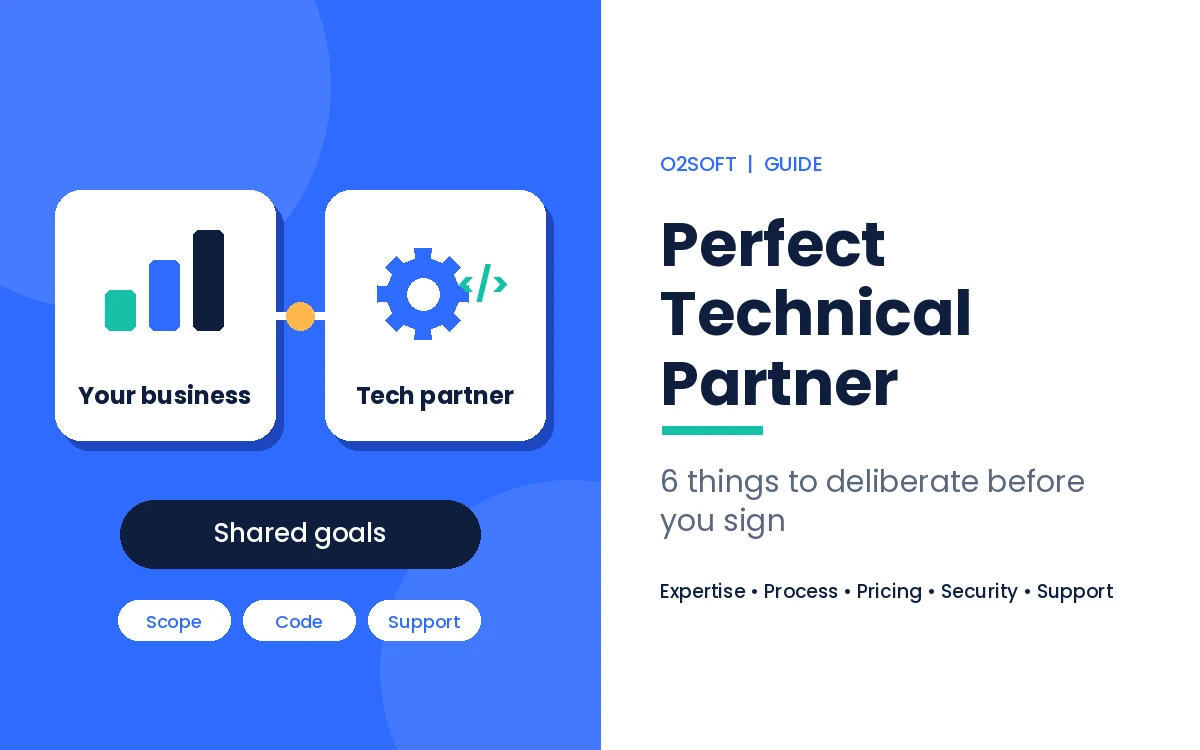
The perfect technical partner is an outside engineering team that treats your product goals as its own, from the first discovery call through years of releases and support. Your team contributes knowledge of customers and operations, while the partner contributes engineering depth on architecture, cost or scope.
A strong technology partnership brings 3 benefits: senior engineers without a long hiring cycle, fewer costly build mistakes and a product your team can run after handover. Companies hire technical partners to build new software, modernize legacy systems, add artificial intelligence (AI) features or extend an existing team.
The 6 components to evaluate are business alignment, relevant expertise, a visible delivery process, fair pricing, security with clear code ownership and post-launch support.
O2SOFT has built AI, web and mobile products for startup founders and in-house product teams since 2012. The guidance in this article comes from that project work.
What is a technology partner?
A technology partner is a company that contributes technical capability to your business under a shared goal. A vendor typically quotes the exact scope you send over in the request. A technical partner questions whether you should build it at all, suggests a cheaper route when one exists and stays accountable for results after launch.
| Factor | Vendor | Technology partner | Strategic partner |
|---|---|---|---|
| Goal | Deliver a defined task | Deliver a working product outcome | Grow both businesses together |
| Scope | Fixed and written up front | Evolves with the product | Spans products, markets or channels |
| Pricing | Per task or fixed fee | Fixed price, time and materials, or dedicated team | Revenue share, joint investment or equity |
| Role in decisions | Follows instructions | Advises on architecture and priorities | Shapes a joint roadmap |
| Typical length | Weeks to months | Months to years | Multiple years |
Most companies looking for a software development partner need the middle column. Strategic alliances tend to come later, once each side has something the other cannot easily build.
What is a strategic partnership in the tech industry?
A strategic partnership in the tech industry is a long-term arrangement in which two companies combine technology, data, distribution or expertise to reach a shared goal faster. Both companies share the risk, plan together and judge success by joint results, which sets a strategic technical partner apart from an ordinary services contract.
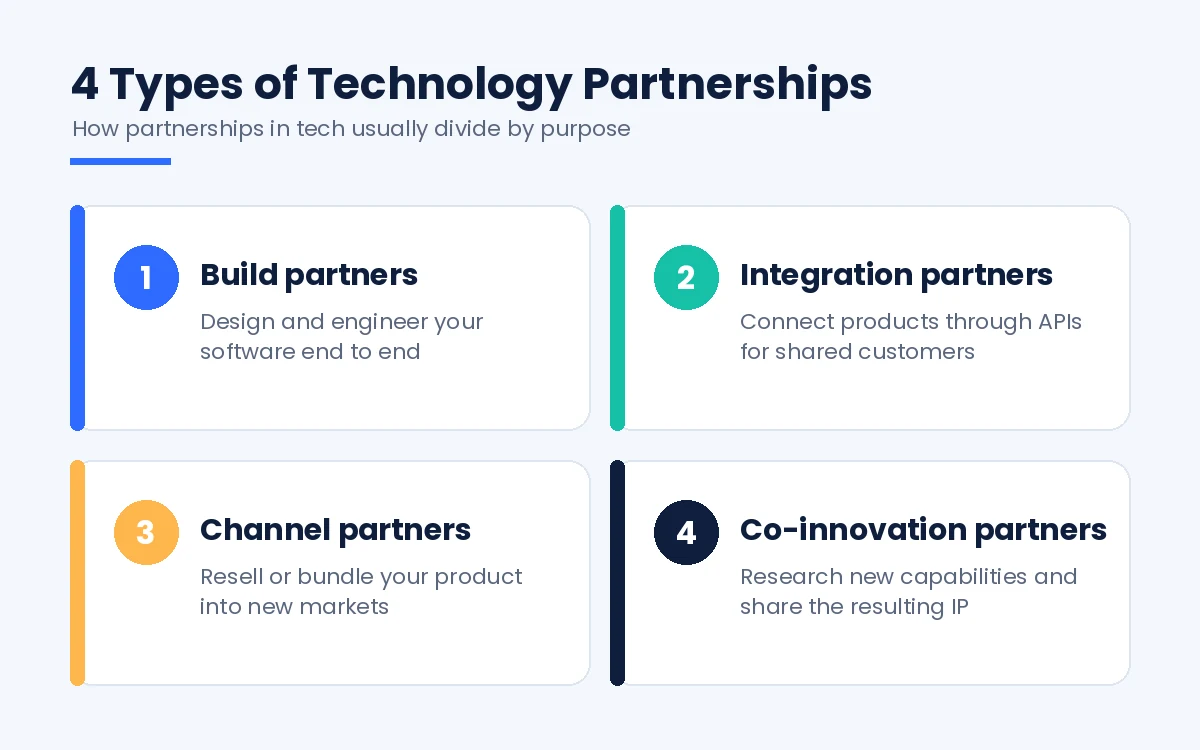
Partnerships in tech fall into 4 main types: build, integration, channel and co-innovation partners.
• Build partners design and engineer software for you, which is the focus of this article.
• Integration partners connect their product to yours through application programming interfaces (APIs). A systems integration partner does this work across several platforms at once.
• Channel partners resell or bundle your product into markets your own sales team struggles to reach.
• Co-innovation partners fund or research new capabilities together and often split the resulting intellectual property (IP).
Vendors often call themselves technology and solution partners, meaning they supply the software along with the services needed to run it. The terms technological partners and, less often, technologic partners describe the same arrangement. Managed services partners and cloud technology partners run infrastructure or applications on your behalf.
Large platform companies formalize these relationships through programs such as the Amazon Web Services (AWS) Partner Network, the Microsoft AI Cloud Partner Program and Google Cloud Partner Advantage. These certifications confirm platform training, but they say little about how a firm manages a full project.
In Deloitte's 2024 Global Outsourcing Survey, 83% of executives said they already use AI within their outsourced services. The partner you hire therefore has a growing say in how artificial intelligence enters your operations.
When a vendor lists its announced alliances, ask for the joint customers and shared product roadmap behind each one.
6 things to deliberate before choosing the perfect technical partner
Six factors decide whether a technical partnership holds up after the contract is signed. Rate each candidate from 1 to 5 on every factor during technology partner selection, then compare weighted totals.
1. How well they understand your business
A capable partner asks about your customers, revenue model and constraints in the first conversation, ahead of any talk about technology or price. Notice whether the team repeats your goals back accurately or pushes back on weak ideas. Agreement with every idea in the first call usually means the hard questions will surface later, when changes cost more.
Bring the business problem to that first call, not a feature list. "We need a better dashboard" is a request, while "sales managers cannot see which renewals are at risk" is a problem a partner can solve.
After the first meeting, ask each candidate to summarize your project in one paragraph and compare it with your own brief.
2. Proven expertise in your stack and domain
Technical expertise is easy to claim but harder to prove, so ask for work that resembles yours in platform, scale or industry. A firm pitching a web platform should show live web products. A firm selling AI agent development should demonstrate agents running in production for real clients.
Useful case studies describe the problem, the approach and a measurable result. Our case studies, including EyeCast and KIPS LMS, follow that format.
If your product includes AI, ask 3 questions to take the conversation a level deeper:
• How will you collect, clean and label the training data our models learn from?
• How will you decide between a hosted model and a custom AI model for our use case?
• How do you test for overfitting before a model reaches real users?
Any serious AI development partner answers these questions in writing before scoping model work. Partners selling generative AI features should explain where their outputs come from and how they check accuracy.
3. A delivery process you can see into
A visible delivery process lets you follow the work sprint by sprint, from planning through demo. Most firms run some form of Agile methodology, so ask the partner to walk you through a typical sprint before you sign. Find out who attends each stage and what you receive at the end of it.
Expect access to the shared task tracker and other productivity tools, a predictable demo schedule and one named person responsible for delivery. Each demo should show working software in a test environment, since slides and screenshots make it easy to hide unfinished features from a client.
Agree on a small set of key performance indicators (KPIs), such as release frequency, defect rates and budget burn. The O2SOFT delivery process shows how these stages can run from discovery through post-launch support.
4. Pricing model and total cost of ownership
Rework, delays and thin handover documentation all land on your budget later, which is why the lowest quote rarely produces the lowest total cost. Compare the 3 common engagement models first, then the headline numbers:
| Model | How it works | Best for | Main risk |
|---|---|---|---|
| Fixed price | Agreed scope for an agreed fee | Small, well-defined projects | Change requests become expensive |
| Time and materials | You pay for hours actually worked | Evolving products and MVPs | Budget drifts without close oversight |
| Dedicated team | A reserved team works only on your product | Long-term roadmaps | Paying for idle capacity if priorities stall |
Ask every candidate to price the same written scope under the model they recommend, then explain that recommendation. Their reasoning shows whether the firm is optimizing for your product or for its own utilization.
5. Security, compliance and ownership of the code
Your partner will handle customer data, credentials and source code, which makes security a qualifying test in technical due diligence. Two common forms of independent evidence need different checks during review.
An ISO/IEC 27001 certificate shows that an accredited certification body has audited the firm's information security management system, so check its scope, issuing body and expiry date. A System and Organization Controls (SOC 2) report is an attestation issued by an independent CPA firm under AICPA standards. Ask for the latest report, then check which systems and dates it covers.
Code ownership needs the same scrutiny, because a commissioned work does not automatically become a "work made for hire" under U.S. copyright law. The U.S. Copyright Office lists the statutory requirements, including an eligible category of work and a written agreement signed by both parties. Define IP ownership through an explicit clause that assigns the code, designs and documentation to you once invoices are paid. Copyright and assignment rules differ by country, so check the law that governs your contract.
6. Post-launch support and long-term commitment
Reliable technical partner support after launch means defined response times, regular updates and a team that still knows your codebase. Ask what support covers during the first 90 days after release, including response times for critical bugs. Then confirm who will keep libraries, servers or app store builds current as your user base grows.
A partner who builds for scale from day one, with clean architecture and documentation, spares you an expensive rebuild when traffic climbs. Our guide to how long mobile app development takes shows where post-launch work fits into a mobile timeline.
Bridging technical and non-technical partners: meaning, collaboration and who does what
Bridging technical and non-technical partners means turning business goals into technical decisions that both sides can follow. This kind of technical collaboration happens every week when a non-technical founder or business team works with a technical delivery team.
Start by naming one translator on each side of the relationship. On your side, a product owner usually fills that role, while the partner provides a delivery or project manager. Decide early who the partner's staff report to day to day. Unclear reporting lines lead to duplicated work and missed priorities.
Agree where the partner's teams will work from, how many hours of time-zone overlap you need and which tools will hold decisions. Settle these points before finalizing hosting, frameworks or any other technology decision. Teams spread across countries depend on written decisions more than teams sharing one office.
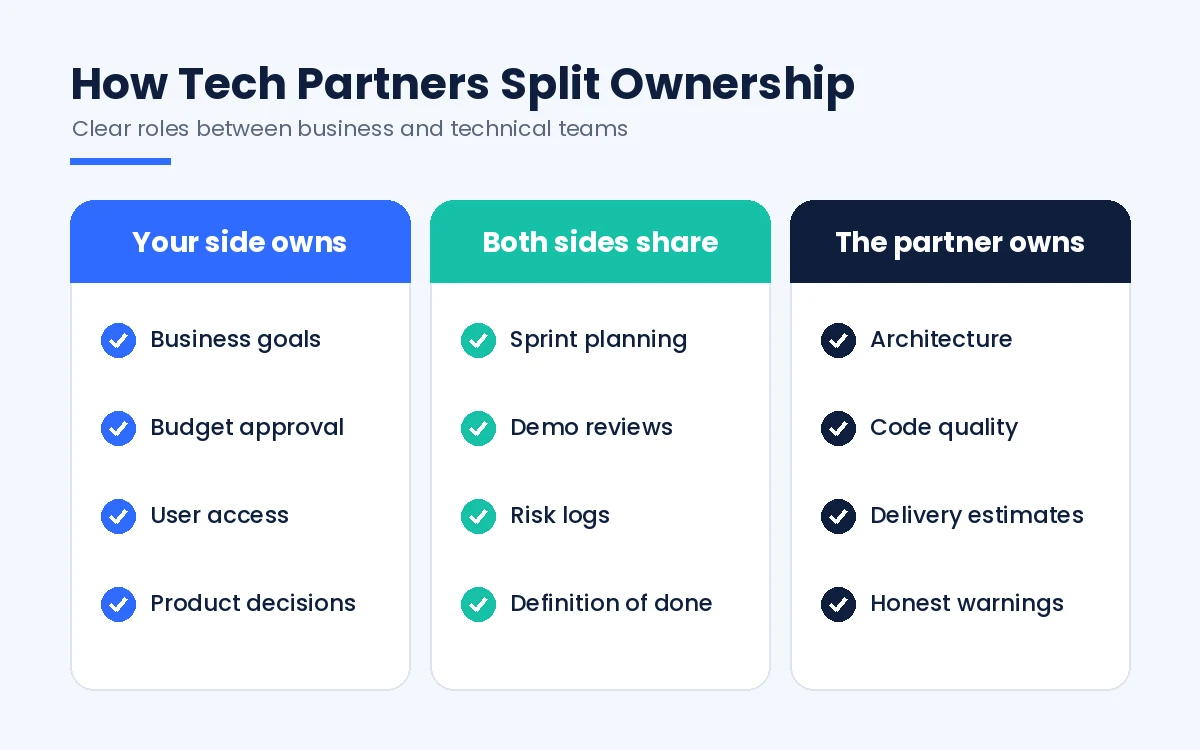
A clear split of ownership between the two sides looks like this:
• Your side owns the business goals, budget approval, user access and final product decisions.
• The partner owns architecture, code quality, delivery estimates and early warnings about risk.
• Both sides share sprint planning, demo reviews, risk logs and the definition of done for each release.
How to be the perfect partner to your technical team
To be the perfect partner to your technical team, give them the real problem, access to the people who live with it and specific feedback on their work. Clients who arrive with a fixed feature list rarely get better ideas back from the partner. A partner improves a brief after seeing how the workflow runs in practice, including the edge cases your staff handle by hand.
Four habits make a client easier for any technical team to build for:
• Share the business reason behind each requirement along with the requested output.
• Report problems with screenshots, steps to repeat them and the business impact on users.
• Assign one decision-maker who can approve scope changes within a working day.
• Decide which parts of the system your own developers must maintain without the partner after handover.
This level of access produces better software and keeps the knowledge inside your company after the contract ends. Confirm data portability in the same conversation, including the right to export your data in a standard format at any time.
What belongs in a technology partner agreement
A technology partner agreement needs 7 core clauses: scope with change control, IP assignment, confidentiality, service levels, release responsibilities, payment milestones and exit terms. Most disputes trace back to a missing or vague clause, so review each one in your draft:
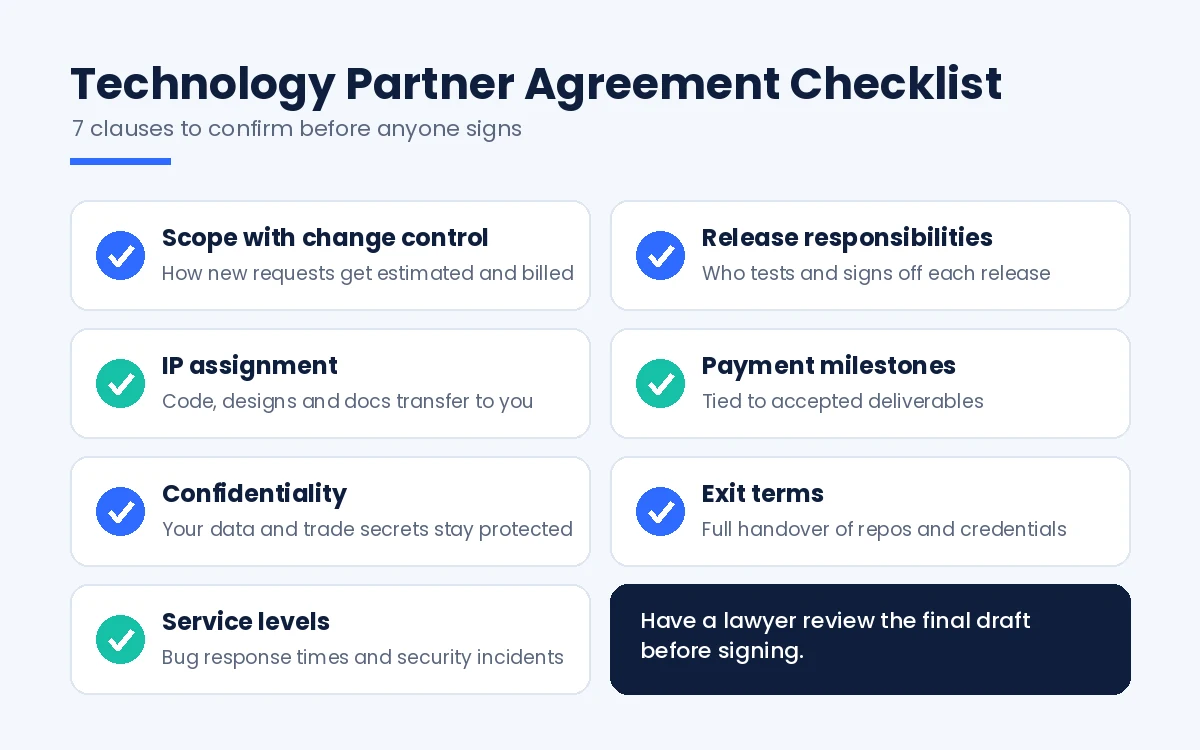
• Scope with change control describes how new requests get estimated, approved and billed.
• IP assignment transfers code, designs and documentation to you on payment.
• Confidentiality covers your data, your users' data and any trade secrets shared during the work.
• Service levels set bug response times, uptime targets and who handles security incidents.
• Release responsibilities state who runs testing and who signs off each release before it reaches production.
• Payment milestones are tied to accepted deliverables, not calendar dates alone.
• Exit terms include a full handover of repositories, credentials and documentation if you part ways.
Spell out what happens when the partner's performance slips, such as missed milestones or repeated quality failures. A defined remedy, like a correction period followed by the right to terminate with a full handover, gives both sides a clear process to follow. Have a lawyer review the final draft before anyone signs, because enforceability varies by jurisdiction and contract type. Treat this article as general information, not legal advice, when you draft your own contract terms.
Tips for negotiating strategic partnership deals in tech
These 6 tips for negotiating strategic partnership deals in tech work for hiring a development firm or forming broader technology partnerships:
1. Open with the outcome you need in twelve months, then ask each partner how they would reach it ahead of any rate discussion.
2. Ask for a paid discovery phase or pilot so both sides can test the relationship before the full build. Two to four weeks (10 to 20 working days) is a sensible starting range.
3. Trade commitment for price only when the numbers work, for example a lower day rate in exchange for a longer engagement with clear exit points.
4. Keep intellectual property, data access and exit terms off the bargaining table, as those clauses protect the business itself.
5. Put every verbal promise in writing, as the people who negotiate a deal are rarely the people delivering it months later.
6. Agree how disputes will be escalated before the first one happens, naming the people on each side who make the final call.
How to choose a startup technology partner
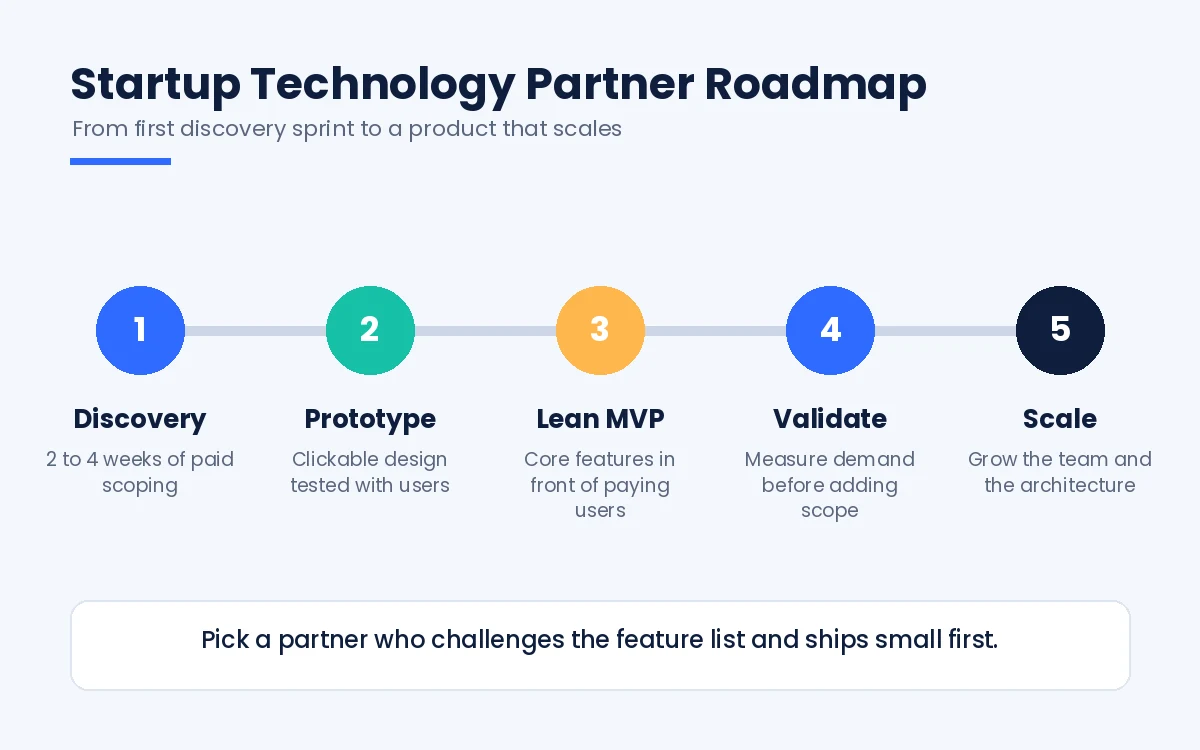
To choose a startup technology partner, prioritize speed of learning over team size and pick a firm willing to challenge your feature list. Early-stage companies benefit most from a partner who ships a lean minimum viable product (MVP) and helps validate demand before scaling the build.
Treat offers to build in exchange for equity with caution. These deals blur the line between supplier and co-founder, which makes it harder to replace the partner if quality drops.
A short discovery sprint is a low-risk way to start custom software development or mobile app development for a startup. Early prototypes should then go through UI/UX design testing, where user interface (UI) and user experience (UX) choices are checked with real users before any production code is written.
Red flags and a scorecard for comparing tech partners
Five red flags should end a conversation with a potential partner early:
• Refuses to let you speak with past clients or see relevant work samples.
• Quotes a firm price before learning your scope or your users.
• Cannot name the people who will actually work on your product.
• Avoids putting code ownership in writing or keeps repositories under its own account.
• Promises unrealistic timelines without explaining what will be cut to meet them.
Score each remaining candidate from 1 to 5 with this suggested scorecard, which reflects O2SOFT's own evaluation method and not an industry benchmark:
| Criterion | Weight | What a 5 looks like |
|---|---|---|
| Business alignment | 20% | Restates your goals accurately and challenges weak assumptions |
| Relevant expertise | 20% | Shows comparable projects with measurable results |
| Delivery process | 15% | Gives you tracker access, regular demos and agreed KPIs |
| Pricing and total cost | 15% | Explains the recommended model and its risks for your scope |
| Security and ownership | 20% | Provides audit evidence and a full IP assignment clause |
| Post-launch commitment | 10% | Offers defined support terms and a plan for scaling |
Multiply each score by its weight, then add the results to get a total for each partner. Treat any score below 3 on security or ownership as disqualifying, whatever the total.
Choosing the right technology partner
The perfect technical partner treats your product goals as its own, adds senior engineering capacity without a long hiring cycle and leaves your team able to run the product. Judge each candidate on business alignment, relevant expertise, delivery process, pricing, security with code ownership and post-launch support, then record the details in a clear technology partner agreement.
Compare technology partner services for your AI, web or mobile product with our team, starting with a free first conversation. You can browse the full range of software development services or read more about O2SOFT before that call.
Frequently asked questions
Which technology partner is right for my business?
The right technology partner for your business is the firm with relevant past work, a transparent process and a contract that gives you full code ownership. Which technology partner fits best depends on your product stage and risk tolerance. A practical approach is to shortlist two or three firms, then run a paid discovery phase with your favorite.
What technology partner model suits an early-stage startup?
The technology partner model that suits most early-stage startups is a time-and-materials arrangement with a small dedicated team, as scope changes quickly while the product finds its market. A fixed-price contract can suit a startup with a tight budget and a firmly defined scope.
How are tech partners different from vendors?
Tech partners differ from vendors by sharing responsibility for the outcome of the project. A vendor delivers a defined task for a fee, while a partner advises on architecture, flags risks early and supports the product after launch.
What do technology partner services usually include?
Technology partner services usually include 6 core services: discovery workshops, UX design, software development, quality assurance, cloud deployment and ongoing maintenance. Some firms add AI consulting, data engineering or dedicated teams that extend your in-house staff. Confirm in writing which of these services your quote covers.
How long should technology partner selection take?
As a practical planning estimate, technology partner selection takes four to eight weeks (roughly 20 to 40 working days) from first calls to a signed contract. That window leaves time for reference checks, a discovery phase and legal review.
Is a technology partnership the same as outsourcing?
No, a technology partnership is not the same as outsourcing. Outsourcing hands a defined piece of work to an outside firm, whereas a partnership adds shared goals, joint planning and long-term accountability. Many outsourcing deals become partnerships once trust builds, at which point the contract and governance need updating.
Is a certified AWS or Microsoft partner always the best choice?
No. A platform certification confirms training on a specific technology and says little about whether the firm can run your whole project. Treat AWS, Microsoft or Google partner status as one signal, then check case studies and client references.