



Generative AI is used in cybersecurity to turn large volumes of security data into usable output: alert summaries, detection rules, incident reports, phishing verdicts, patch drafts and training scenarios. A large language model (LLM) reads logs, alerts and threat reports, then writes text, code or synthetic data. A human analyst checks that output before any action reaches production.
The main benefits are faster alert triage, shorter incident reports, wider coverage for small security teams and quicker vulnerability fixes. In the Defense Advanced Research Projects Agency (DARPA) AI Cyber Challenge, finalist systems found 54 synthetic vulnerabilities in real open-source code, patching 43 of them without human help.
Anyone asking how can generative AI be used in cybersecurity will find 12 practical uses in this guide, from security operations center (SOC) triage to secure code review. Every use rests on four components: a trained model, the security data it reads, the prompts or workflows that direct it, plus the guardrails that keep its output in check.
The same technology gives attackers cleaner phishing emails, voice clones and faster exploit research. For that reason, the later sections cover the key security concern with generative AI, data security controls, human oversight rules and a 7-step plan for safe adoption.
What Is Generative AI in Cybersecurity?
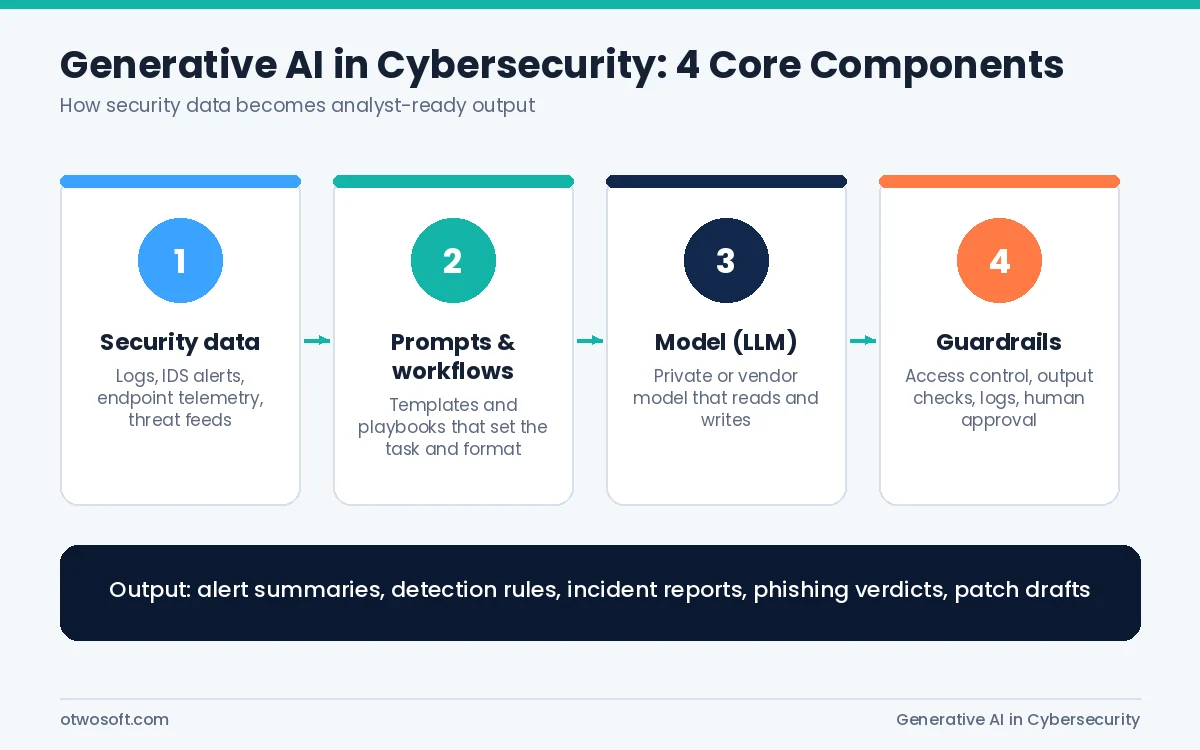
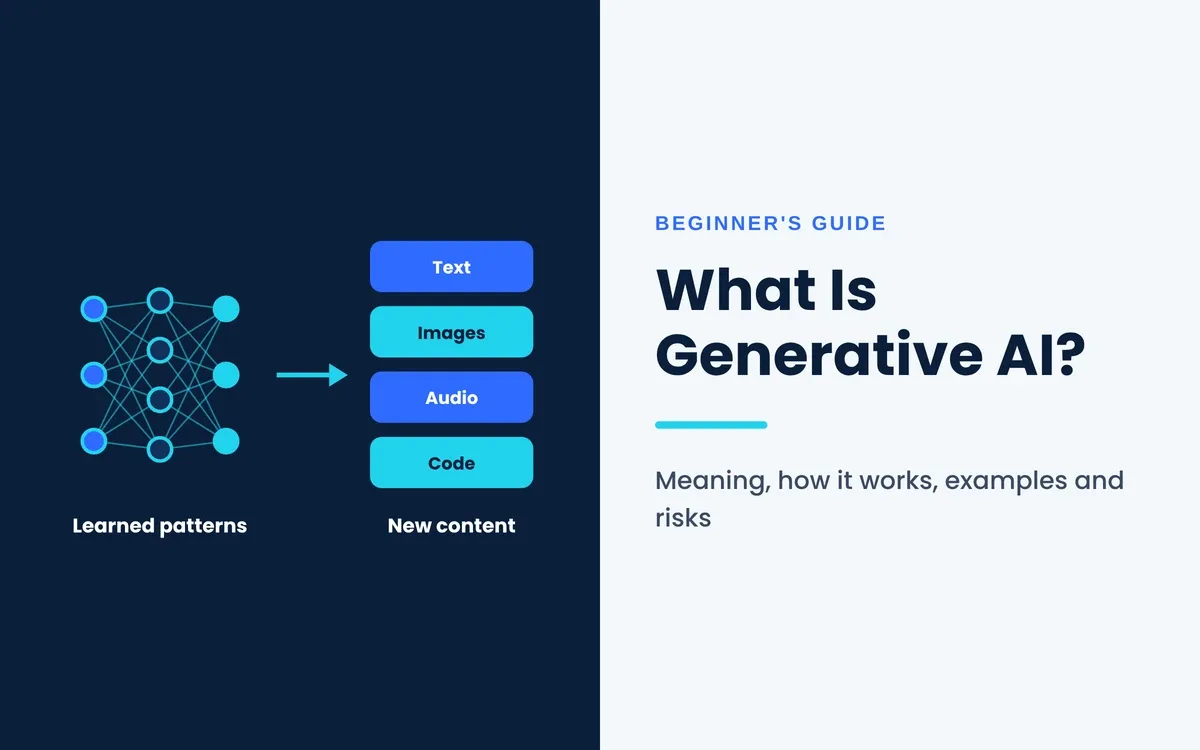
Generative AI in cybersecurity is the use of models that create new content, including text, code, queries or synthetic data, to detect, investigate and stop cyber threats. Classic security machine learning sorts events into safe or malicious. A generative model goes one step further by explaining the event, drafting the response, then writing the detection rule for the next attempt.
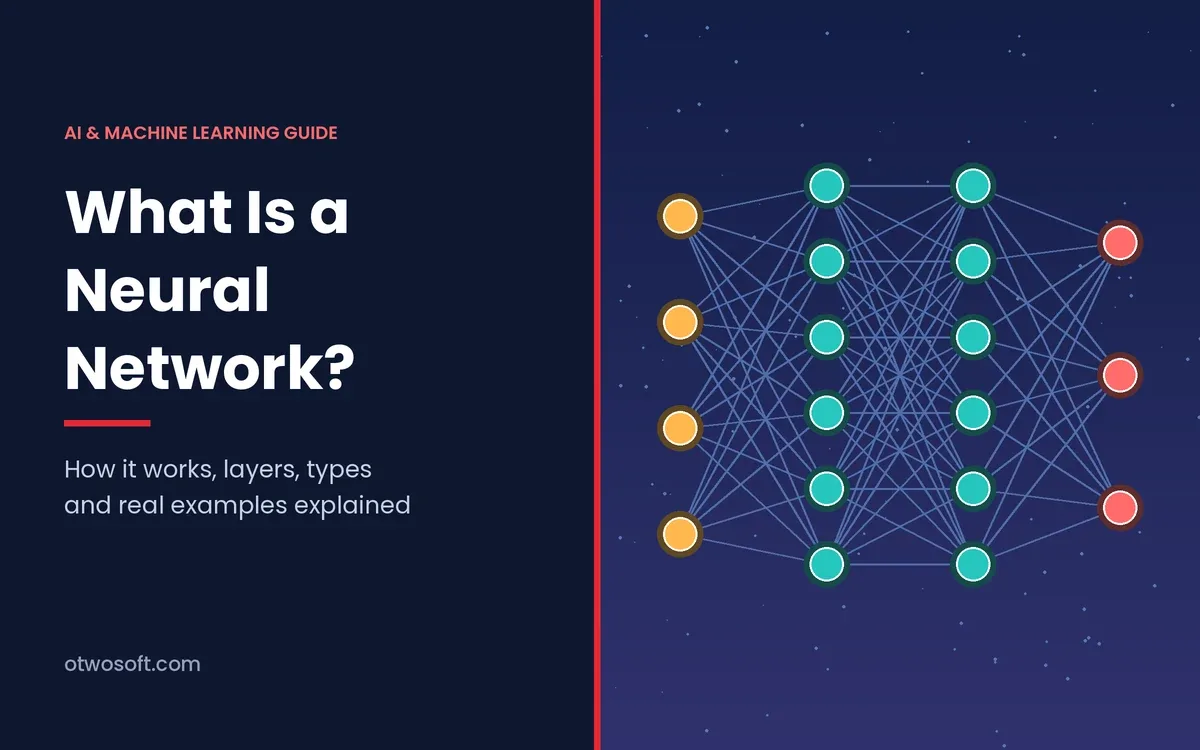
The difference comes from how the models learn. Generative AI learns the structure of its training data well enough to produce new examples, while the classifiers in older security tools only learn where one category ends. Most generative security tools run on deep learning, the branch of machine learning that trains layered neural networks on very large datasets.
The 4 Components of a Generative AI Security System
A generative AI security system has 4 components, with each one shaping how far analysts can trust the final output:
- Model. An LLM or a smaller domain model trained on text, code or security data. Many teams run a private LLM inside their own cloud so alerts and customer data never reach a public service.
- Security data. Network logs, endpoint telemetry, intrusion detection system (IDS) alerts, vulnerability databases, malware samples and threat intelligence feeds give the model its context.
- Prompts and workflows. Prompt templates with automation playbooks tell the model what to produce, in which format, for which analyst tier.
- Guardrails. Access controls, output filters, logging and human approval steps stop the model from leaking data or taking unsafe actions.
Model quality depends on the data pipeline behind it. Raw logs need feature engineering before a model can learn from them, since timestamps, IP addresses and process names have to become consistent inputs. Training then follows the usual path of how AI works, from data collection through evaluation. Evaluation matters most in security: a detection model with overfitting scores well on test data yet misses new attacks in production.
How Has Gen AI Affected Security?
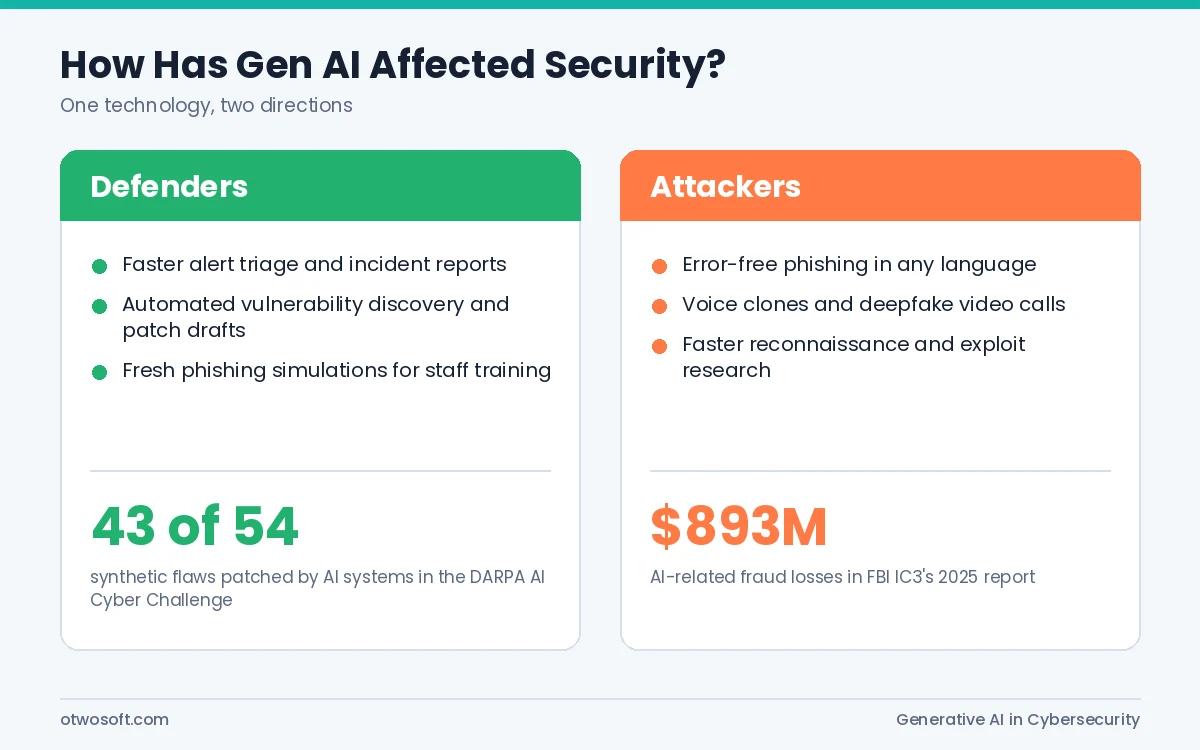
Gen AI has affected security in two directions at once: defenders now investigate and patch faster, while attackers now write more convincing scams at lower cost. Public data from law enforcement agencies measures both shifts.
On the attack side, the FBI Internet Crime Complaint Center (IC3) tracked AI as a separate complaint descriptor for the first time in its 2025 Internet Crime Report. The center logged 22,364 AI-related complaints with $893 million in losses, inside a record total of $20.877 billion across 1,008,597 complaints.
On the defense side, the DARPA AI Cyber Challenge showed in August 2025 that autonomous systems built on LLMs can find and fix flaws in real open-source software. Finalist systems discovered 18 real-world vulnerabilities on top of the synthetic bugs planted by the organizers.
The UK National Cyber Security Centre (NCSC) expects the gap to widen. Its assessment of AI and the cyber threat to 2027 judges that AI-enabled tools will almost certainly help threat actors exploit known vulnerabilities faster. Unpatched systems face the biggest jump in exposure.
How Can Generative AI Be Used in Cybersecurity? 12 Use Cases
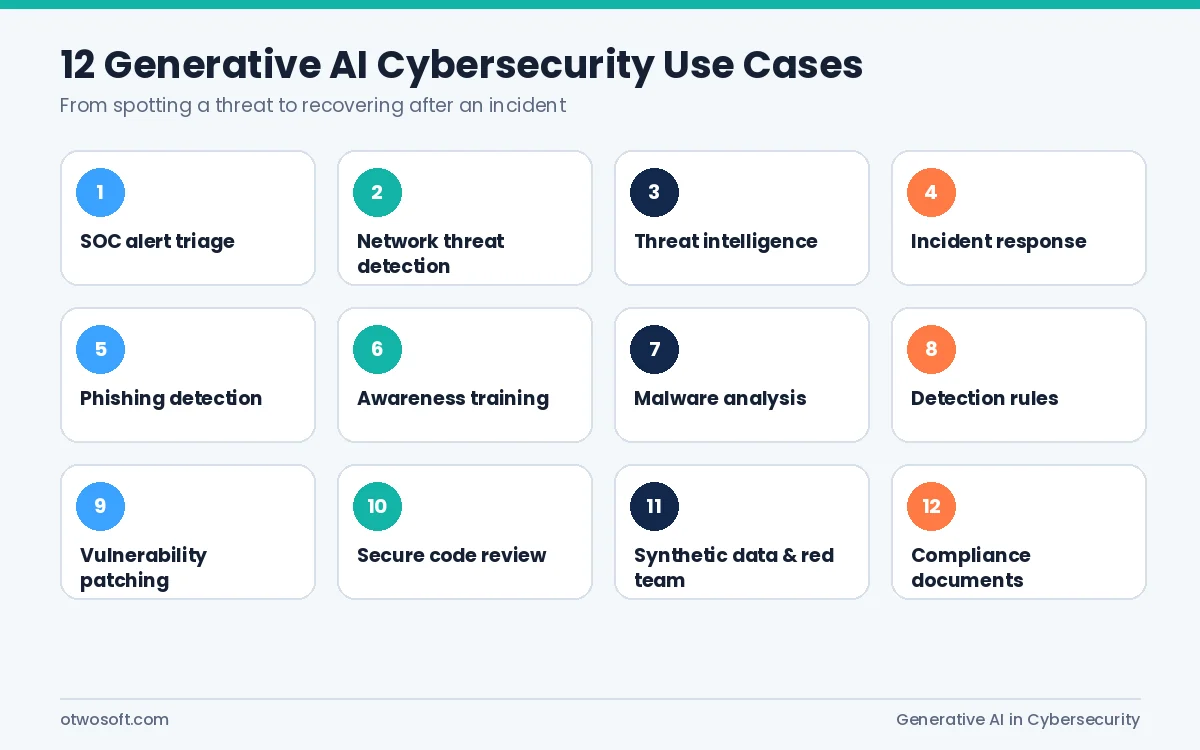
Security teams apply generative AI to 12 proven tasks today, including alert triage, phishing analysis, detection engineering or vulnerability patching. Together, the 12 generative AI cybersecurity use cases cover the full defense cycle, from spotting a threat to recovering after an incident. Each entry below states the task, the model's role and the point where a human still decides.
1. SOC Alert Triage Support
A SOC receives thousands of alerts a day, with false positives making up most of the queue. Generative AI reads each alert with its surrounding logs, writes a plain-language summary, then ranks the alert by likely impact. A Tier 1 analyst then works from a ready summary instead of raw event data, which brings junior staff closer to the output of a Tier 3 analyst. The same summaries speed up shift handovers, since the incoming team reads one status note instead of dozens of open tickets.
2. Network Threat Detection and Anomaly Explanation
Behavioral models learn what normal traffic looks like on a network, then flag deviations such as an unusual login hour, a sudden data transfer or lateral movement between servers. Generative AI adds the explanation layer. The model states why the event looks suspicious, lists the affected assets, then names the MITRE ATT&CK technique the pattern matches. Analysts close true alerts faster when the reasoning arrives with the alert.
3. Threat Intelligence Summarization
Threat advisories, vulnerability disclosures and dark web chatter arrive faster than any team can read them. A generative model condenses a 30-page report into the few facts that matter to one environment. The model then checks the asset inventory for the affected software before drafting a short briefing for leadership. Threat intelligence summarization pipelines of this kind free senior analysts from hours of routine reading.
4. Incident Response Playbooks and Reports
During an incident, generative AI groups related alerts, builds a forensic timeline, then drafts the first root-cause narrative while responders contain the threat. After the incident, the same model writes the executive summary, the technical report and the lessons-learned record. Incident response playbook synthesis then turns each closed case into a reusable playbook for the next similar event.
5. Phishing Detection and Analysis
Phishing and spoofing rank among the most frequently reported complaint types in FBI IC3 data. A generative model inspects the sender, links, tone and request in a suspicious email, then explains in plain words why the message looks malicious. Analysts confirm verdicts faster with that reasoning in hand. Employees learn the warning signs whenever a reported email comes back with the explanation attached.
6. Security Awareness Training and Phishing Simulation
Generative AI creates realistic phishing simulations, voice-call scripts and short incident scenarios for staff training. Security awareness micro-scenarios built this way change every round, so employees learn to spot tactics instead of memorizing the same three old examples. Training teams run the simulations inside a controlled platform with written approval from leadership.
7. Malware Analysis
Reverse engineers paste decompiled code or sandbox output into a model to get a readable description of the sample. The description covers which files the malware touches, how it persists and where it sends data. Malware behavior narrative drafting cuts the time between capturing a sample and publishing indicators of compromise. The analyst still verifies every claim against the sandbox evidence.
8. Detection Rule Authoring
An engineer describes a behavior in plain English, such as a PowerShell process downloading a file to run from a temp folder. The model drafts a matching security information and event management (SIEM) query, Sigma rule or YARA rule. Detection rule authoring assistance turns a two-hour writing job into a short review task, provided the engineer tests every rule against real logs before deployment.
9. Vulnerability Discovery and Patch Drafting
LLM-based systems now find and fix software flaws without a human in the loop. In the DARPA AI Cyber Challenge final, competing systems analyzed real open-source projects, discovered 54 unique synthetic vulnerabilities, patching 43 of them. Security teams apply the same method on a smaller scale. The model explains a scanner finding, checks whether the flaw is reachable, then drafts a patch with a short patch prioritization rationale.
10. Secure Code Review and Faster Security Software Development
Generative coding assistants review pull requests for injection flaws, hard-coded secrets or unsafe dependencies, then suggest a corrected version of the code. Security engineers use the same assistants to write scripts, parsers or integrations, which speeds up the development of internal security software. The review works best inside the delivery pipeline, where every pull request for custom software or a customer-facing web application passes the same security checks before release.
11. Synthetic Data and Red Team Simulation
Generative models create synthetic logs, fake credentials and simulated attack traffic for testing detection systems. Synthetic data fills the gap for rare attacks that appear too seldom in real logs to train on, while carrying no real customer records. Red team scenario ideation follows the same route. The model proposes attack paths based on MITRE ATT&CK techniques, so teams can anticipate future threats before an adversary tries them.
12. Compliance and Regulatory Documentation
Audits demand written evidence for every control. Generative AI maps logs and tickets to framework requirements, drafts control narratives, then flags gaps in policy documents. Compliance evidence narrative assembly with security policy clause generation spares compliance teams from rewriting the same paragraphs every audit cycle, with the compliance owner signing off on the final text.
Generative AI Use Cases Mapped to the NIST Cybersecurity Framework
The NIST Cybersecurity Framework (CSF) 2.0 from the National Institute of Standards and Technology (NIST) groups security work into six functions. The table below maps each function to the generative AI tasks that support it, so teams can see where their coverage is strong or missing.
| NIST CSF function | What the function covers | Generative AI tasks that support it |
|---|---|---|
| Govern | Strategy, policy, roles and risk appetite | Security policy clause drafting, risk statements, board summaries |
| Identify | Assets, risks and vulnerabilities | Vulnerability explanation, reachability checks, patch prioritization rationale |
| Protect | Access control, training and secure development | Secure code review, phishing simulation, awareness micro-scenarios |
| Detect | Monitoring and anomaly discovery | Alert summaries, anomaly explanation, detection rule drafts |
| Respond | Containment, analysis and communication | Forensic timelines, incident reports, playbook synthesis |
| Recover | Restoration and lessons learned | Post-incident reviews, recovery checklists, stakeholder updates |
Benefits of Generative AI and Cybersecurity Working Together
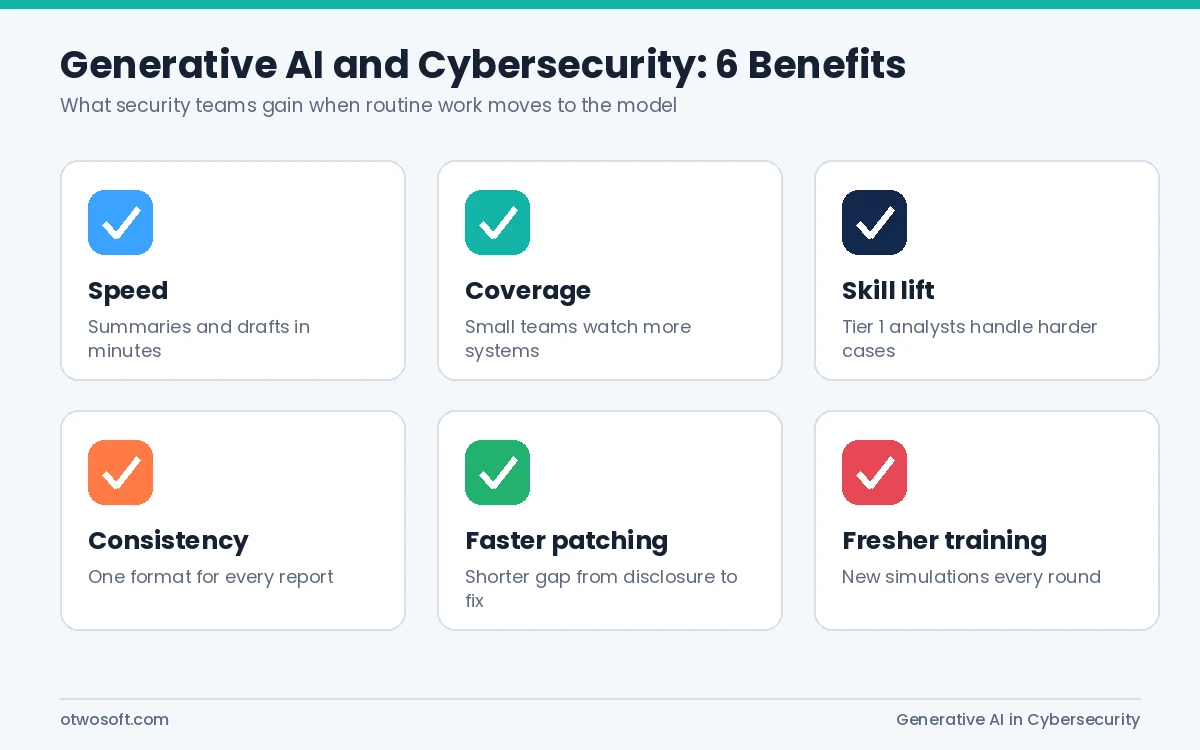
Generative AI and cybersecurity teams working together produce 6 main benefits:
- Speed: alert summaries, reports and patch drafts arrive in minutes instead of hours.
- Coverage: a small team monitors more systems once routine reading moves to the model.
- Skill lift: Tier 1 analysts handle cases that once needed senior staff.
- Consistency: reports, playbooks and regulatory documentation follow one format every time.
- Faster patching: vulnerability explanations with patch drafts shorten the gap between disclosure and fix.
- Fresher training: new simulations every round keep security awareness programs current.
The skills shortage makes these benefits urgent. The 2025 ISC2 Cybersecurity Workforce Study, based on 16,029 professionals, found AI to be the most-cited skill need at 41%. In the same study, 73% of respondents expect AI to create more specialized cybersecurity skills rather than remove roles.
How Attackers Use Generative AI
Attackers use generative AI in 5 main ways, based on an FBI public service announcement on AI-enabled fraud:
- Phishing text: models write fluent emails in any language, removing the spelling mistakes that once gave scams away.
- Fake profiles: generated photos with fake biographies support social engineering, romance scams and investment fraud.
- Voice clones: short audio clips imitate a relative or an executive to demand an urgent payment.
- Deepfake video: real-time video calls impersonate company leaders, police officers or other authority figures.
- Forged documents: generated images of IDs or credentials support identity fraud.
Skilled groups apply AI to reconnaissance, vulnerability research and exploit development as well, based on the NCSC assessment. Defenders answer with the same technology: models that score suspicious emails, deepfake detection for video, plus call-back procedures that verify any voice request for money or access.
What Is a Key Security Concern When Using Generative AI?
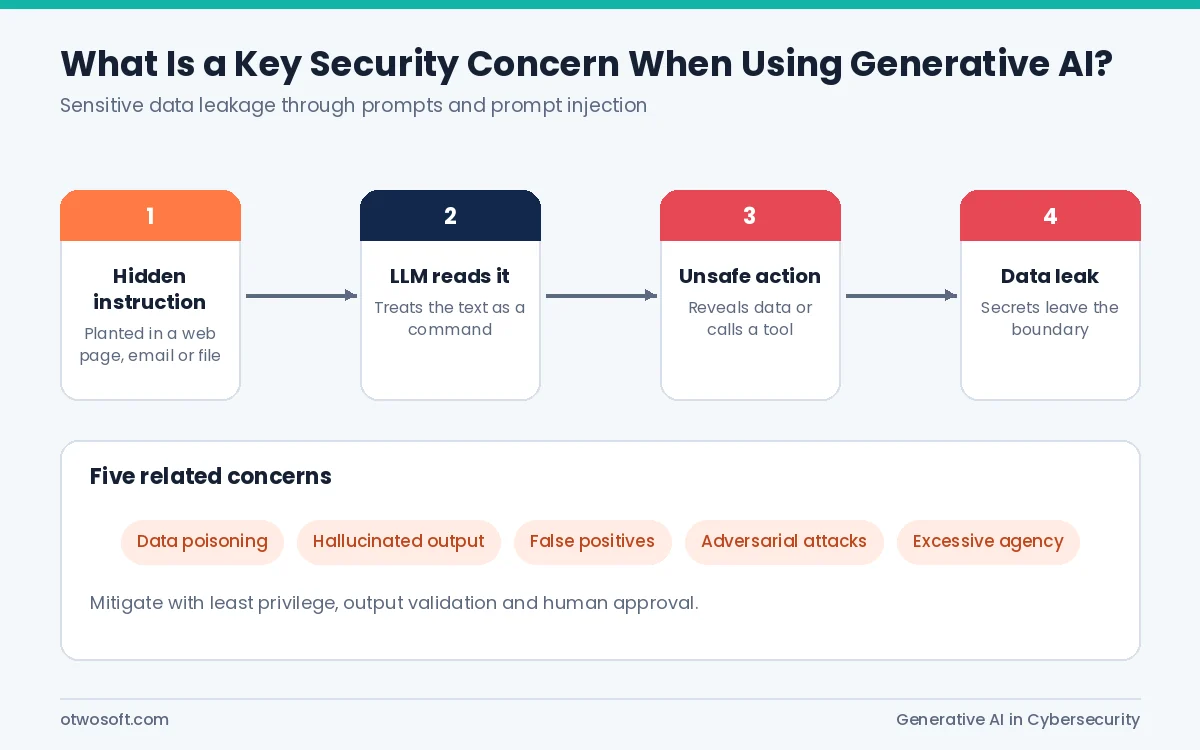
A key security concern when using generative AI is sensitive data leakage, either through what employees paste into prompts or through prompt injection attacks. Both problems share one root cause. An LLM treats every piece of text in its context as possible instructions, so it cannot reliably separate a trusted command from a hostile one.
Prompt injection holds the first position in the OWASP Top 10 for LLM Applications, the reference list maintained by the Open Worldwide Application Security Project (OWASP). A direct injection comes from a user typing malicious instructions into a chat. An indirect injection hides instructions inside a web page, email or document that the model reads later, which makes AI agents with email or database access a high-value target.
Five more concerns follow close behind:
- Data poisoning: attackers plant manipulated samples in training data so the model learns the wrong patterns.
- Hallucinated output: a model states false facts or invents a fix that does not work.
- False positives and missed threats: a poorly tuned model floods analysts with noise or stays silent during real attacks.
- Adversarial attacks: crafted inputs push a model to classify malicious activity as safe.
- Excessive agency: an AI agent with broad permissions takes a harmful action after a single bad instruction.
NIST lists information security among the 12 generative AI risks in its Generative AI Profile, NIST AI 600-1. The July 2024 profile pairs those risks with more than 200 suggested actions.
OWASP Top 10 Risks for LLM Applications (2025)
The 2025 OWASP list gives security teams a shared checklist for testing any generative AI system before launch.
| OWASP ID | Risk | What the risk means |
|---|---|---|
| LLM01 | Prompt injection | Crafted input changes the model's behavior or bypasses its rules |
| LLM02 | Sensitive information disclosure | The model reveals personal, financial or proprietary data |
| LLM03 | Supply chain | Compromised models, datasets or plugins enter the system |
| LLM04 | Data and model poisoning | Manipulated training or fine-tuning data corrupts the output |
| LLM05 | Improper output handling | Downstream systems run model output without validation |
| LLM06 | Excessive agency | The model holds more permissions or autonomy than its task needs |
| LLM07 | System prompt leakage | Hidden instructions or secrets in the system prompt get exposed |
| LLM08 | Vector and embedding weaknesses | Flaws in retrieval stores leak or corrupt the model's context |
| LLM09 | Misinformation | The model presents false content as fact |
| LLM10 | Unbounded consumption | Uncontrolled usage drives up cost or causes outages |
Generative AI Data Security: 6 Controls for Prompts, Training Data and Outputs
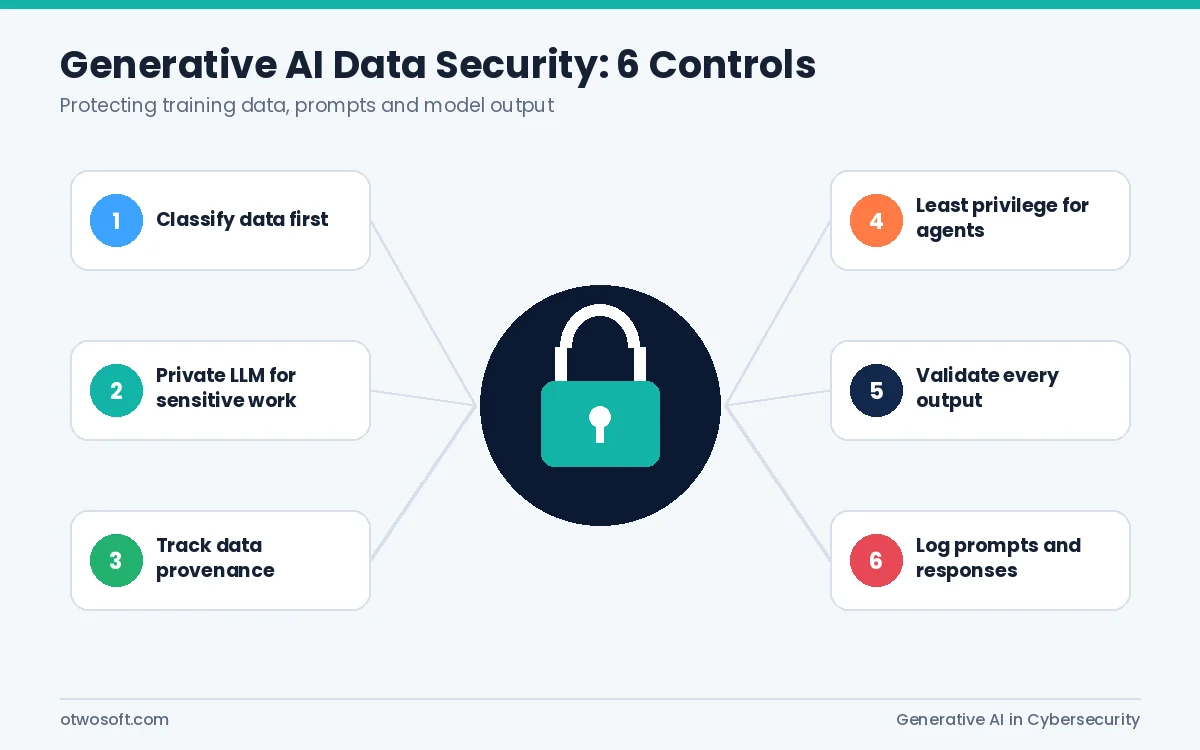
Generative AI data security protects three assets: the data used to train or fine-tune a model, the data employees send in prompts, plus the output the model returns. In May 2025, the Cybersecurity and Infrastructure Security Agency (CISA) published joint guidance with the National Security Agency (NSA), the FBI and allied agencies. The guidance names three main threats to AI data: weak data supply chains, maliciously modified data and data drift.
Six controls cover most of the risk:
- Classify data before it reaches a model. Block secrets, customer records or source code from public AI tools with data loss prevention (DLP) rules.
- Run a private LLM for sensitive work. Host the model in your own cloud tenant or on premises so prompts and outputs stay inside your boundary.
- Track data provenance. Record where every training or retrieval document came from, then verify sources with hashes or signatures.
- Apply least privilege to AI agents. Give each agent only the tools and data its task needs, with separate credentials per agent.
- Validate every output. Treat model output as untrusted input, sanitizing it before it reaches a browser, database or shell.
- Log prompts and responses. Keep audit trails for incident response, retention rules and policy checks.
Why GenAI Human Oversight in Cybersecurity Matters
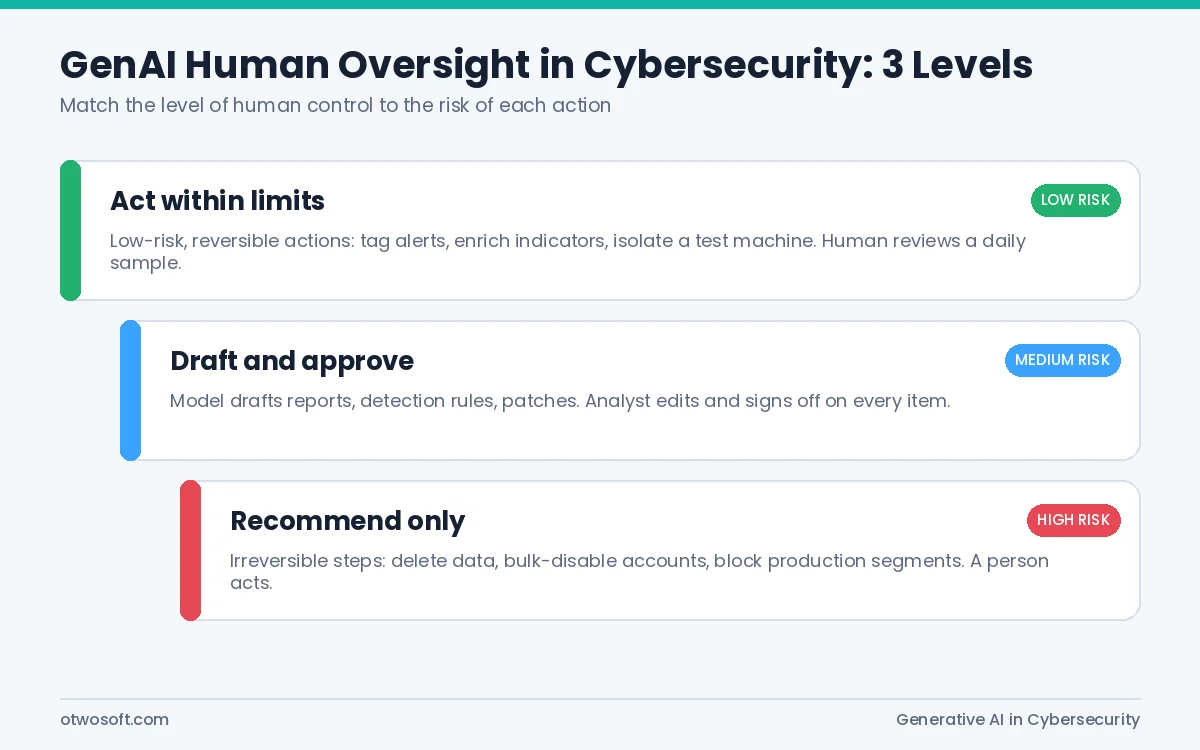
GenAI human oversight in cybersecurity means a qualified analyst reviews, approves or can reverse every model action that affects systems, data or people. Models make confident mistakes while attackers target the model itself, so a human checkpoint stops one bad output from turning into an outage or a breach.
Teams match the level of oversight to the risk of each action. Three oversight levels work well in practice:
- Draft and approve: the model drafts reports, detection rules, patches or customer messages, while an analyst signs off on every item.
- Act within limits: the model takes low-risk, reversible actions such as tagging an alert, enriching an indicator or isolating a test machine, with a human reviewing a daily sample.
- Recommend only: the model suggests irreversible or high-impact steps, such as deleting data or blocking a production network segment, while a person carries them out.
Attackers now fake voices or faces well enough to fool trained staff, so verification steps such as call-backs or second approvals stay outside any model's control. A written GenAI human oversight cybersecurity policy names each action type with its level. The policy matters most for AI agents with access to email, tickets or production systems, since one injected instruction can trigger a real action.
How to Use Gen AI for Cybersecurity: 7 Steps
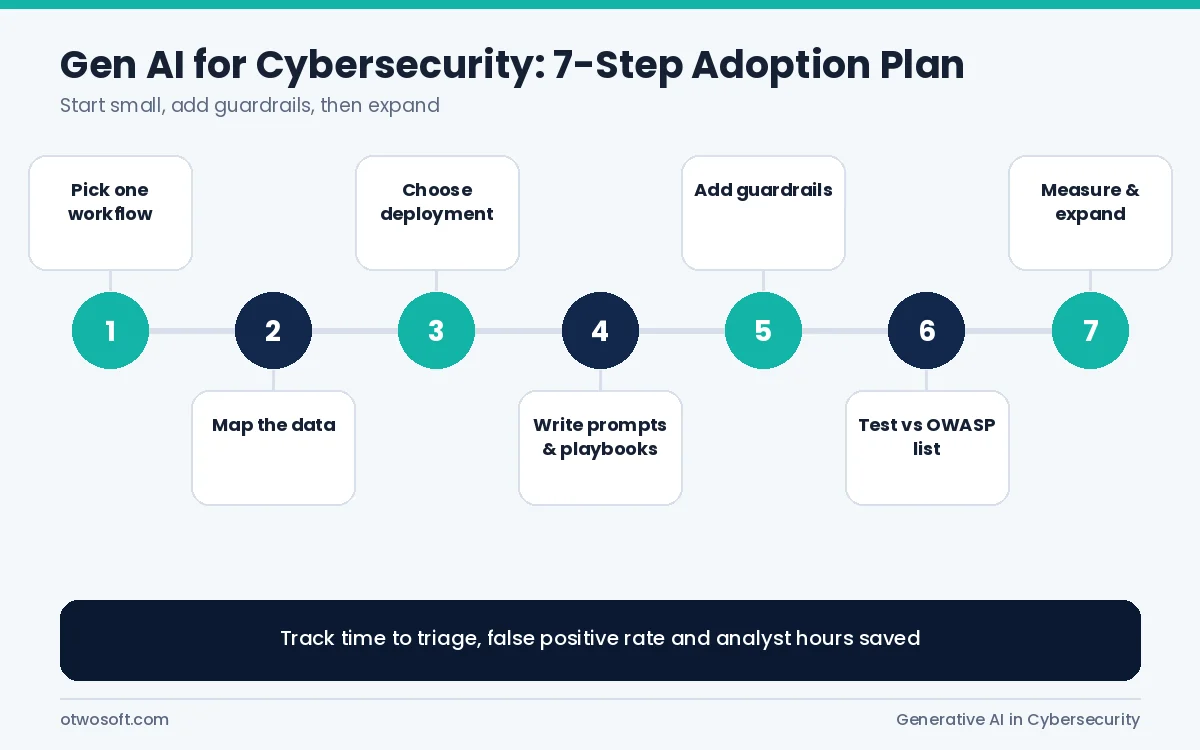
To use gen AI for cybersecurity safely, follow these 7 steps:
- Pick one painful workflow. Start with alert summaries, phishing triage or report writing, where errors are cheap to catch.
- Map the data the workflow needs. List every log source, ticket field and document the model will read, then remove anything the task does not require.
- Choose the deployment model. Use a private or self-hosted LLM for sensitive data and a vendor tool for low-risk tasks.
- Write prompt templates and playbooks. Fix the output format so every summary or rule follows the same structure.
- Add guardrails before launch. Set permissions, output validation, logging and the oversight level for each action.
- Test against the OWASP list. Run prompt injection, data leakage and poisoning tests, followed by a red team exercise.
- Measure, then expand. Track time to triage, false positive rate and analyst hours saved before moving to the next workflow.
Commercial assistants such as Microsoft Security Copilot and Google Cloud Security AI Workbench cover common SOC tasks out of the box. Organizations with custom data or strict privacy needs often build their own layer, starting with a proof-of-concept AI build on one workflow before moving to production. Connected security products follow the same pattern, as in the EyeCast multi-location video surveillance platform, where AI-driven onboarding lifted user activation by 73%.
Generative AI Cybersecurity Market Size and Outlook
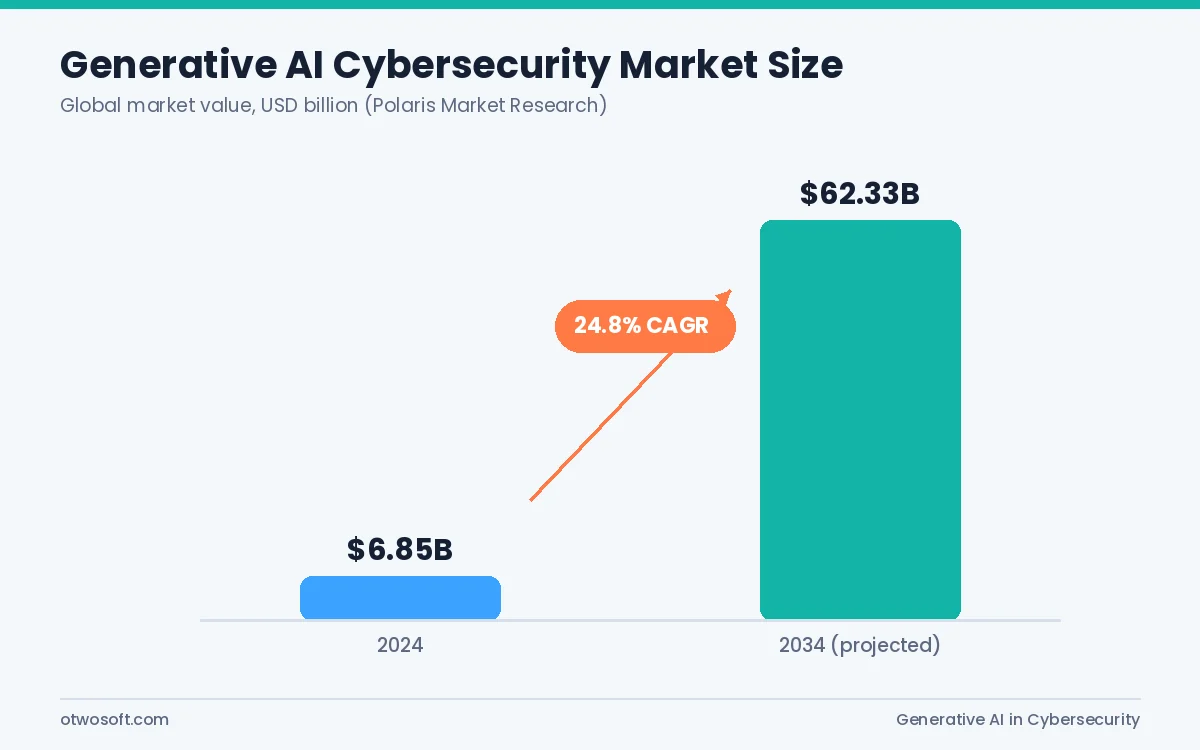
Polaris Market Research values the generative AI cybersecurity market at USD 6.85 billion in 2024 and projects USD 62.33 billion by 2034, a compound annual growth rate (CAGR) of 24.8%. North America held the largest share in 2024.
Three forces drive this growth: AI-driven attacks, the shortage of skilled analysts and stricter data protection rules. The NCSC expects a digital divide by 2027 between organizations that keep pace with AI-enabled threats and those that fall behind. Early, controlled adoption is therefore a security decision as much as a budget one.
Conclusion
The answer to how can generative AI be used in cybersecurity comes down to 12 practical uses. Alert summaries, threat detection, incident reports and phishing analysis cover daily operations. Detection rules, vulnerability patching, secure code review, synthetic data and compliance documentation cover the engineering side. Every use runs on the same four components: a trained LLM, the security data it reads, its prompt workflows, plus the guardrails around it.
The key security concern with generative AI is sensitive data leakage through prompts or prompt injection, so data security controls with human oversight belong in the design from day one. Teams that start with one workflow, test it against the OWASP list, then expand step by step get faster defense without handing control to a model.
Frequently Asked Questions
How can generative AI be used in cyber security by a small team?
A small team gets the most value from three uses: alert summaries, phishing triage and report writing. All three tasks take the most analyst time while carrying low risk when a human reviews the output. None of them needs a custom model to start.
Can generative AI be used in cybersecurity to detect attacks on a network?
Yes, generative AI helps detect attacks on a network by learning normal traffic patterns, flagging deviations such as unusual logins or data transfers, then explaining why each event looks suspicious. Detection works best when the model sits on top of existing IDS and SIEM tools rather than replacing them.
Can generative AI speed up the development of security software?
Yes, generative AI speeds up security software development by drafting code, tests, parsers or detection rules from plain-language descriptions. The DARPA AI Cyber Challenge showed LLM-based systems patching real code automatically, yet every generated change still needs testing before release.
How can generative AI be used to anticipate future threats?
Generative AI anticipates future threats by analyzing threat intelligence, past incidents and attacker techniques, then simulating likely attack paths against your own environment. Zero-day exploit hypothesis generation with red team scenario ideation gives defenders a list of weak points to fix before an attacker finds them.
Which options apply in the KnowBe4 "select all that apply" question on generative AI in cybersecurity?
Security awareness quizzes, including the KnowBe4 module, usually list defensive with offensive uses together. Defensive options include detecting threats in large volumes of data, automating incident response, generating synthetic test data, plus simulating phishing attacks for training. The usual offensive option is writing convincing phishing emails. Check the exact wording in your module, since answer sets differ between versions.
Will generative AI replace cybersecurity jobs?
No, generative AI is shifting cybersecurity work rather than replacing the people who do it. The 2025 ISC2 study found most professionals expect AI to create more specialized skills. Organizations still need people for judgment, accountability and verification.
Is generative AI safe for sensitive data?
Generative AI is safe for sensitive data only with controls in place. The controls are a private LLM or an enterprise contract that excludes training on your data, data loss prevention on prompts, least-privilege access and full logging. Public consumer chatbots are not a safe place for credentials, customer records or source code.