


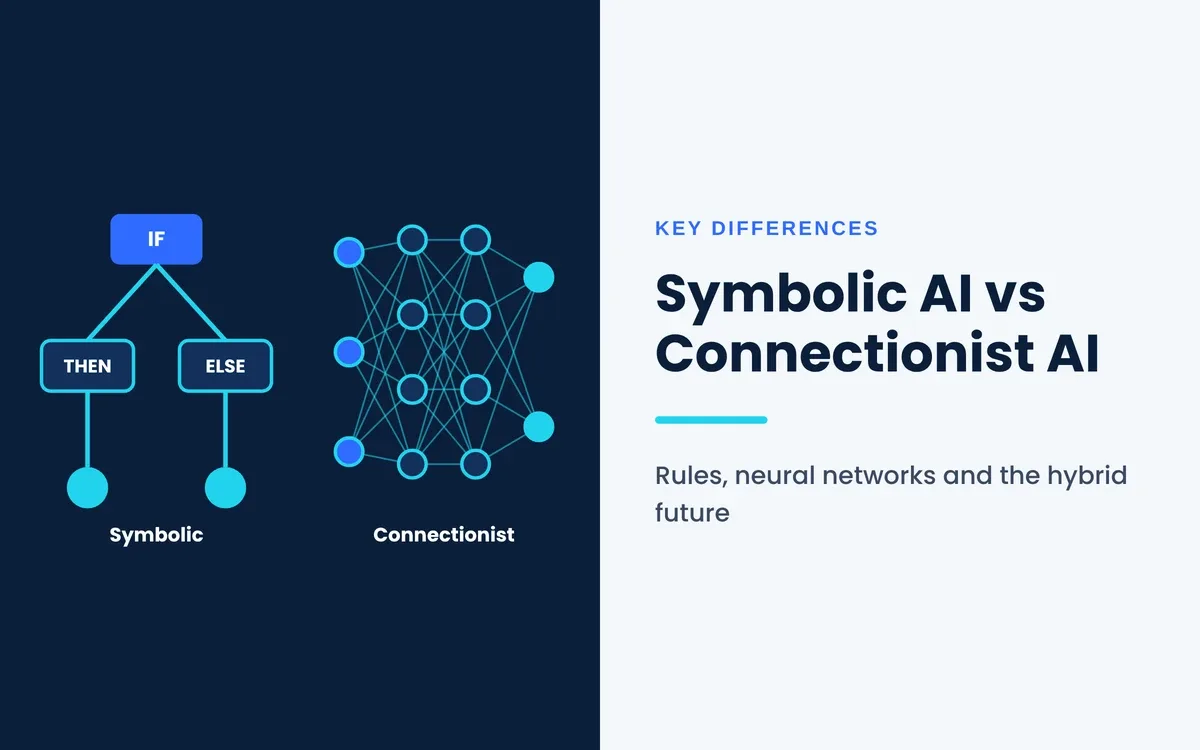
Symbolic AI vs connectionist AI is a comparison of two ways to make computers smart. Symbolic AI follows rules that people write by hand. Connectionist AI learns from examples with a neural network, so nobody has to write the rules for it.
Both are symbolic and connectionist approaches to AI, and the easiest way to picture them is like teaching someone to sort mail. With the symbolic method, you hand them a rulebook that says which zip codes go into which bin. With the connectionist method, you show them thousands of sorted letters until they figure out the pattern on their own.
Each method gives intelligent systems a different strength. Rules are easy to check because you can read them line by line. Neural networks are better with messy things like photos, voices, and everyday language. Today, some of the most impressive AI tools use both methods together.
Below, we explain how each approach works in plain terms. You will also see where each one shows up in real products. Then we cover their weak spots and how the two are now being combined.
Key Takeaways
- Symbolic AI follows rules that people write.
- Connectionist AI learns patterns from example data.
- Rule-based decisions are much easier to trace.
- Many neural networks benefit from lots of data.
- Expert systems are classic symbolic AI.
- Face, speech, and chat tools are connectionist AI.
- Neuro-symbolic AI mixes learning with logical rules.
What Is Symbolic AI?
Symbolic AI is a type of artificial intelligence that works with clear symbols and written rules. People can read those symbols, and the computer uses logic to combine them into answers.
A symbol is simply a name for something real. In a medical system, the word "Aspirin" stands for the drug itself. A rule then says that aspirin is a painkiller. That kind of symbolic representation is easy for anyone to read, which is the main strength of symbolic AI knowledge representation. The computer links rules like these together, much like you would solve a logic puzzle on paper.
You will see this approach under several names. Some are older labels, and some describe a specific style of building it:
- Classical AI, traditional AI, and GOFAI ("good old-fashioned AI") are historical names for early symbol-based research.
- Rule-based AI and rule-based systems describe programs built from if-then rules.
- Logic-based AI puts formal logic, deductive reasoning, automated reasoning, and theorem proving at the center.
- Symbolic artificial intelligence, the symbolic approach, and the symbolic paradigm are general umbrella terms.
Two researchers gave this idea its theory in 1976. Allen Newell and Herbert Simon argued that working with symbols is enough to produce intelligent behavior. Their "physical symbol system" idea guided symbolic AI research for years afterward.
What Does AI Symbolism Mean?
AI symbolism means describing the world to a computer with names and labels that a person can read. The computer works with ideas like "customer" or "invoice" instead of raw pixels or sound.
People who search for symbolism AI are usually asking about this same idea. Engineers store that human-created knowledge in four common ways:
- Logical statements record facts, for example "every mammal breathes air."
- Semantic networks draw ideas as points joined by labelled links.
- Ontologies list the types of things in a field and how they relate.
- Knowledge graphs store facts as connected entities that software can search.
How Does Symbolic AI Work?
Symbolic AI keeps facts and if-then rules in a knowledge base. A part called the inference engine checks those rules one by one to reach a conclusion.
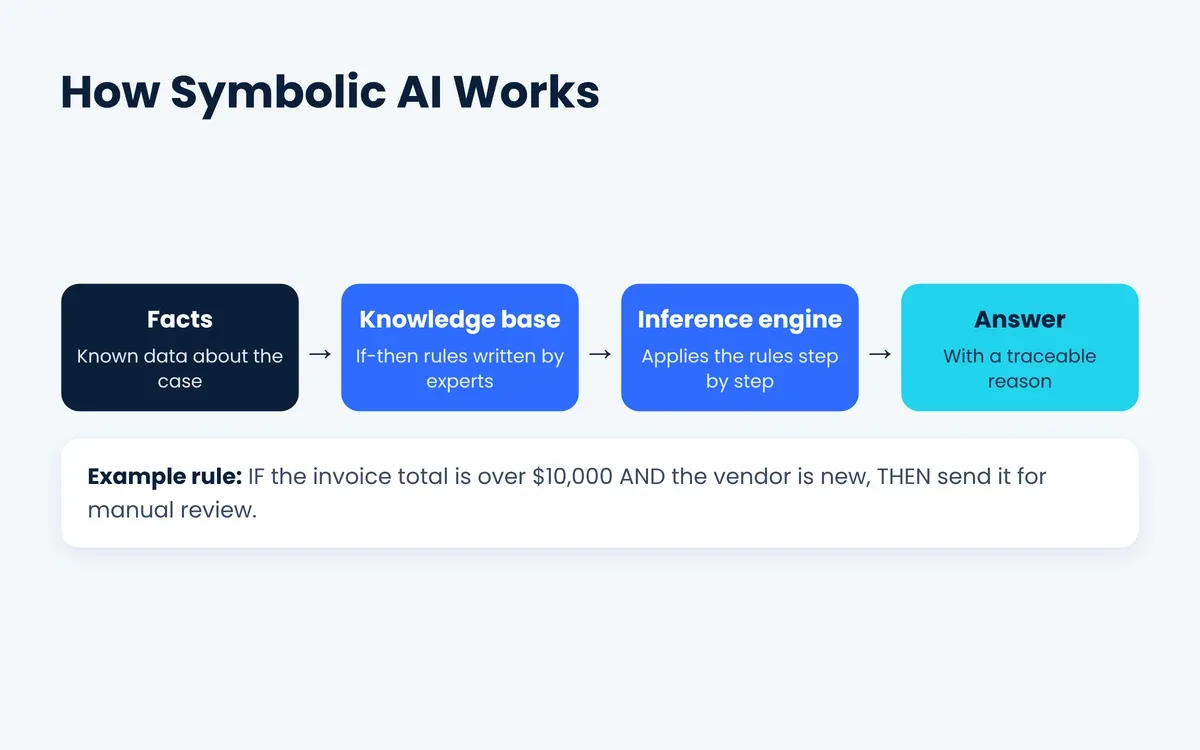
A classic expert system has five parts. It has a knowledge base, a memory for the current case, and an inference engine. It also has an explanation tool and a screen for the user. Here is how a decision moves through it:
- Collect the knowledge. Engineers talk with experts, then turn what they know into hand-coded rules.
- Write the rules. Each rule follows a fixed format. For example: IF a payment is over $10,000 AND the account is under 30 days old, THEN flag it for review.
- Run the inference engine. The engine compares the facts with each rule. Forward chaining starts with the facts and works toward an answer. Backward chaining starts with a goal and looks for facts that support it.
- Give the answer. The system returns a decision along with the rules it used to get there.
MYCIN is a well-known early example from Stanford in the 1970s. It used more than 600 handcrafted rules to find the bacteria behind blood infections and suggest antibiotics. In evaluations, its advice compared well with that of infectious disease specialists. Its developers documented the project in Rule-Based Expert Systems, their 1984 book on the MYCIN experiments.
Businesses soon followed. John McDermott built a system called R1 for Digital Equipment Corporation, which later renamed it XCON. It used production rules to put together computer orders, as his paper in Artificial Intelligence explains.
Rule engines are still common anywhere the logic comes from laws, price lists, or eligibility checks. In those cases, auditors need to see which rule approved or rejected each record. Symbolic AI explainability makes that record easy to produce.
What Is Connectionist AI?
Connectionist AI is a type of artificial intelligence built from artificial neurons linked in a network. The network learns from examples and keeps what it learns in weighted connections.
The name comes from those connections. The Stanford Encyclopedia of Philosophy describes neural networks as simple models of the brain. Each one has many small units, and each link between units has a "weight" that shows how strong it is.
Connectionist artificial intelligence also goes by connectionism, the connectionist approach, the connectionist paradigm, neural network AI, or neural computation. Some writers call it sub-symbolic AI or subsymbolic AI, too.
A connectionist system does not store an idea in one place. Instead, an idea like "cat" shows up as a pattern of activity across many processing units. This is called distributed representation, and it is the core of connectionist AI knowledge representation. For example, a 1987 network named NETtalk learned to read English words aloud. It never gave consonants and vowels their own units. Each one appeared as a different pattern spread across the whole network.
Connectionist AI today covers five main families of models. Each family uses a different network architecture:
- Perceptrons are the simple, one-layer networks that started the field.
- Multilayer neural networks add hidden layers so they can learn harder patterns.
- Convolutional neural networks (CNNs) are built for images.
- Recurrent neural networks (RNNs) handle sequences like text and audio.
- Transformers power today's chatbots and translation tools.
What Are the Building Blocks of a Neural Network?
A neural network is made of layers of artificial neurons, the weighted links between them, biases, and activation functions. Together, these parts decide how the network turns an input into an answer.
- Input layer: takes in the raw data, such as the pixels of a photo.
- Hidden layers: turn that data into more useful features, step by step.
- Output layer: gives the final answer or label.
- Nodes: the artificial neurons, also called processing units.
- Weights: numbers on each link that make a signal stronger or weaker.
- Biases: small extra values that shift when a neuron switches on.
- Activation functions: simple formulas, like ReLU, that decide each neuron's output. Older papers call them transfer functions.
- Loss function: a score that shows how wrong the network's answer was.
- Parameters: all the neural network weights and biases learned in training.
How Does Connectionist AI Work?
Connectionist AI sends data through its layers and checks how wrong the answer is. Everything it knows comes from its training data, so the quality of those examples sets its limits. It then adjusts its weights a little and repeats this many times until its answers become reliable.
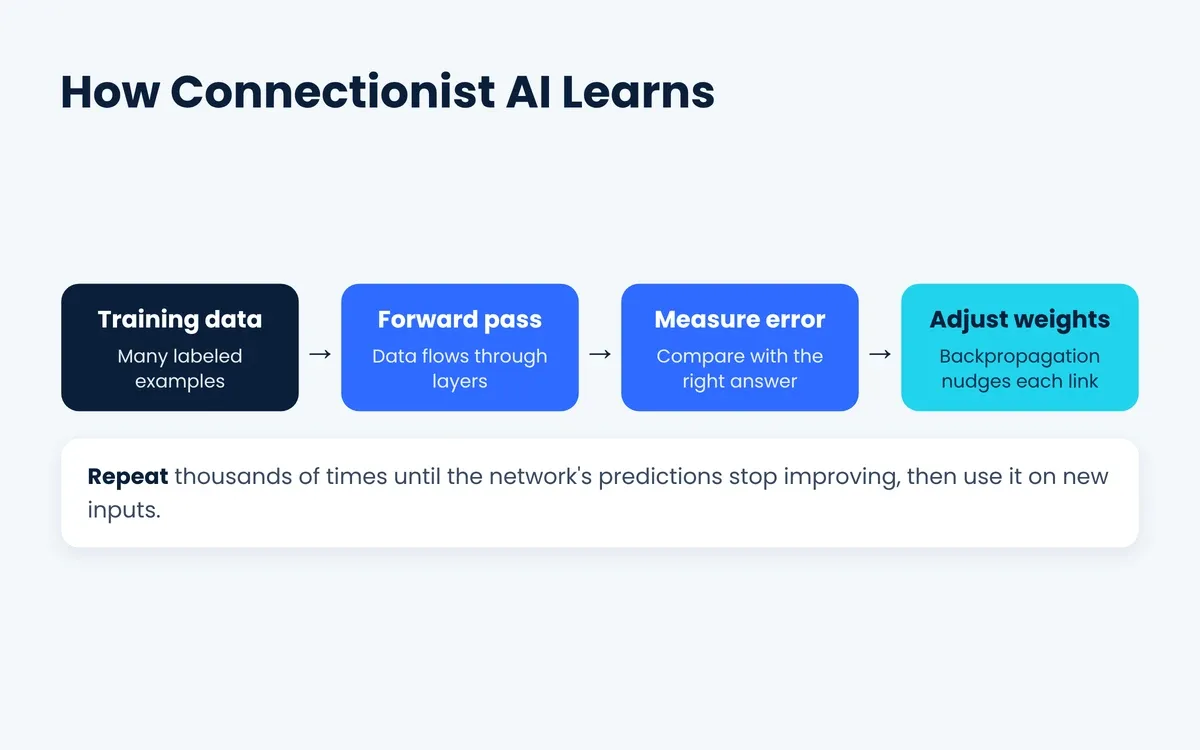
Training follows the same basic loop:
- Turn the input into numbers. A photo becomes pixel values. A sentence becomes a list of numbers.
- Pass the numbers forward. Each neuron multiplies what it receives by its weights. It then passes the result to the next layer.
- Check the answer. The loss function compares the network's guess with the correct label in the training data.
- Trace the mistake backward. A method called backpropagation works out how much weight is added to the error.
- Adjust the weights. An optimization method such as gradient descent moves each weight slightly in a better direction.
Once trained, a neural network can generalize to inputs it did not see during training. Take a spam filter trained on labelled emails. A brand-new scam email still gets caught because its wording looks like spam the filter learned from.
Networks can learn in different ways. In supervised learning, every example comes with the right answer. In unsupervised learning, the network finds groups in data with no answers attached. Representation learning goes a step further, since the network discovers useful features by itself. All three are forms of statistical learning.
What Is the Difference Between Symbolic AI and Connectionist AI?
The main difference is where the knowledge lives. In symbolic AI, it sits in rules that people can read. In connectionist AI, it sits inside the network's weights, which the system learned from data.
People also phrase this search as symbolic AI vs connectionism, connectionist AI vs symbolic AI, or symbolic AI and neural networks. Some write it out in full as symbolic artificial intelligence vs connectionist AI.
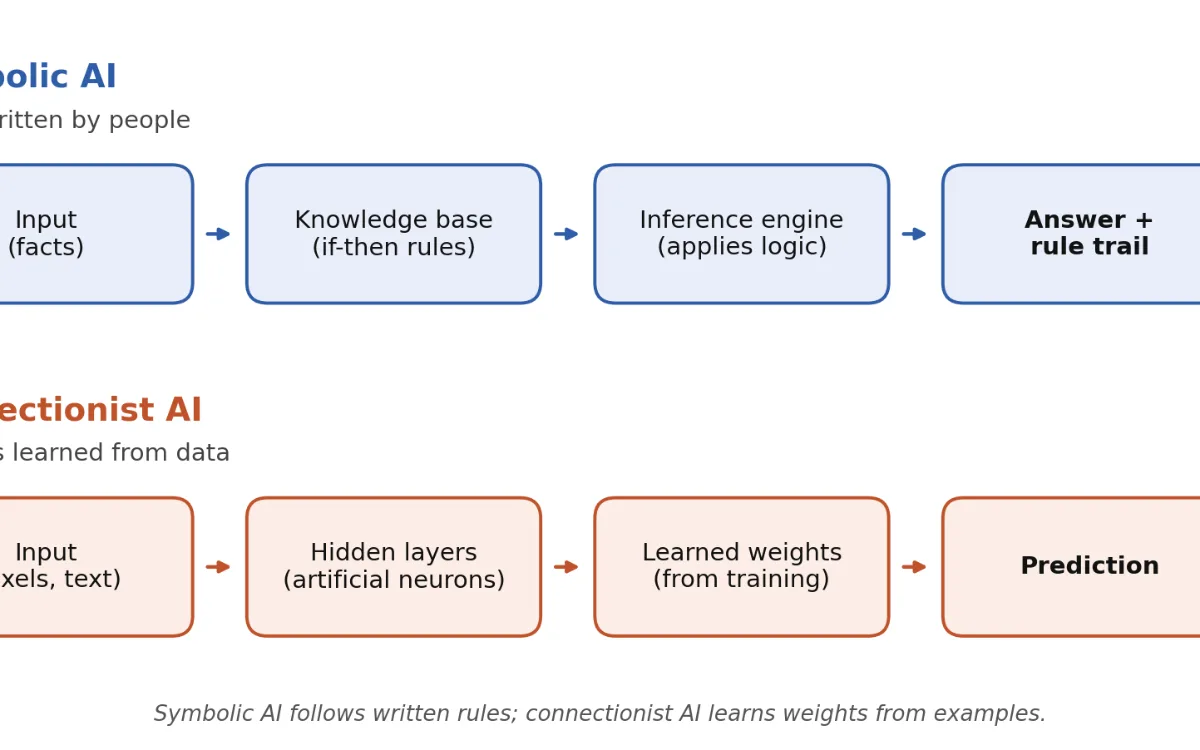
A symbolic system moves facts through written rules and returns an answer with its rule trail. A connectionist system moves input through layers of neurons and returns a prediction shaped by its learned weights.
The table below compares the symbolic approach vs connectionist approach across 12 points, so the difference between symbolic and connectionist AI is easy to scan.
| Point of comparison | Symbolic AI | Connectionist AI |
|---|---|---|
| Core idea | Thinking by following rules | Learning from examples |
| How knowledge is stored | Readable symbols and rules | Patterns spread across weights |
| Where knowledge comes from | Experts who write the rules | Training data |
| How it learns | People add or edit rules | Training with backpropagation |
| Style of reasoning | Step-by-step logic | Pattern recognition |
| Data requirements | Expert knowledge can reduce data needs | Often benefits from lots of training data |
| Interpretability | High, since each step can be traced | Low, often called a black box |
| Handling the unexpected | Struggles outside its rules | Copes better with messy input |
| Scalability | Large rule sets get hard to manage | Grows with more data and computing |
| Computing needs | Rule-based work often runs on modest hardware | Training can need a lot of computing; running it can use CPUs, GPUs, or special chips |
| Typical mistake | Can fail when no rule covers the case | Can give a wrong prediction with high confidence |
| Classic examples | Expert systems, theorem provers | Image, speech, and language models |
Explicit vs Implicit Knowledge
In a symbolic system, you can open the knowledge base and read every rule. That is explicit knowledge. In a neural network, the knowledge is implicit, because no single weight matches an idea a person would recognize.
Researchers describe the same split as explicit vs distributed representation. Others call it structured knowledge vs learned representations, or knowledge representation vs pattern learning. In practice, it changes who looks after the system. Experts update a rule base, whereas data scientists retrain a model.
Rules vs Learning
Rules vs learning is the everyday version of this debate. Some people call it rules vs data. When you weigh rule-based vs data-driven AI, start with one question: do you already know the logic?
Tax brackets, shipping zones, and loan criteria are written down already. Rules handle them well. Handwriting, customer mood, and product defects are much harder to describe in rules. For those, learned patterns tend to work better.
So choosing between predefined rules vs learned patterns mostly depends on the task. There is a cost side, too. With hand-coded rules vs machine learning, rules take expert time, but models take time to collect and label data.
Logical Reasoning vs Pattern Recognition
Symbolic reasoning capabilities are strongest in tasks with many logical steps. Planning a delivery route with fixed limits is one example. Each step follows from the one before it.
Neural computation is stronger at recognizing things in noisy input. It can spot a face in a blurry photo or hear a word in a loud room. People sometimes call this split symbolic reasoning vs neural computation, logic vs neural networks, or knowledge vs patterns.
In 1988, philosophers Jerry Fodor and Zenon Pylyshyn made a famous criticism of neural networks. They said a person who understands "John loves Mary" also understands "Mary loves John."
In their view, neural networks did not explain that ability well. The reasoning vs learning debate still comes back to this point today.
Interpretable AI vs Black Box AI
Interpretable AI vs black box AI is really about transparency vs adaptability. A symbolic system can show the rules behind its answer. Auditors, clinicians, and other reviewers often need to understand how a system reached its output.
A deep neural network does not give that kind of trail. Its decision process is spread across many numbers, so it is hard to inspect. The US defense research agency, DARPA, ran an Explainable AI program to build tools for this problem. Connectionist AI interpretability matters most in lending, healthcare, and hiring, where regulators or the people affected can ask for an explanation.
Data and Computing Power
A rule-based system mostly needs expert knowledge instead of data. Many of them run fine on ordinary computers.
Many modern neural networks benefit from large datasets and fast hardware. For big models, the computational resources required for training add real cost. Once trained, though, smaller models can often run on a laptop or phone. In practice, connectionist AI scalability depends mostly on how much data and computing budget a team has.
Symbolic vs. Subsymbolic AI: Is It the Same Comparison?
Mostly, yes. Symbolic vs. subsymbolic AI is a common way to describe this same distinction. "Subsymbolic" refers to knowledge that is not stored as readable symbols.
In a neural network, no single unit stands for a word or idea. Meaning only appears in the pattern across many units. That is why the Stanford Encyclopedia calls these representations sub-symbolic.
The history of symbolic AI and connectionism is also a story about ideas. A column in AI Magazine links the debate to an old question in philosophy. One side believed knowledge comes mainly from reasoning. The other side believed it comes mainly from experience.
Difference Between Symbolic Systems and Machine Learning?
Symbolic systems follow rules that people write ahead of time. Machine learning systems find their own patterns in example data.
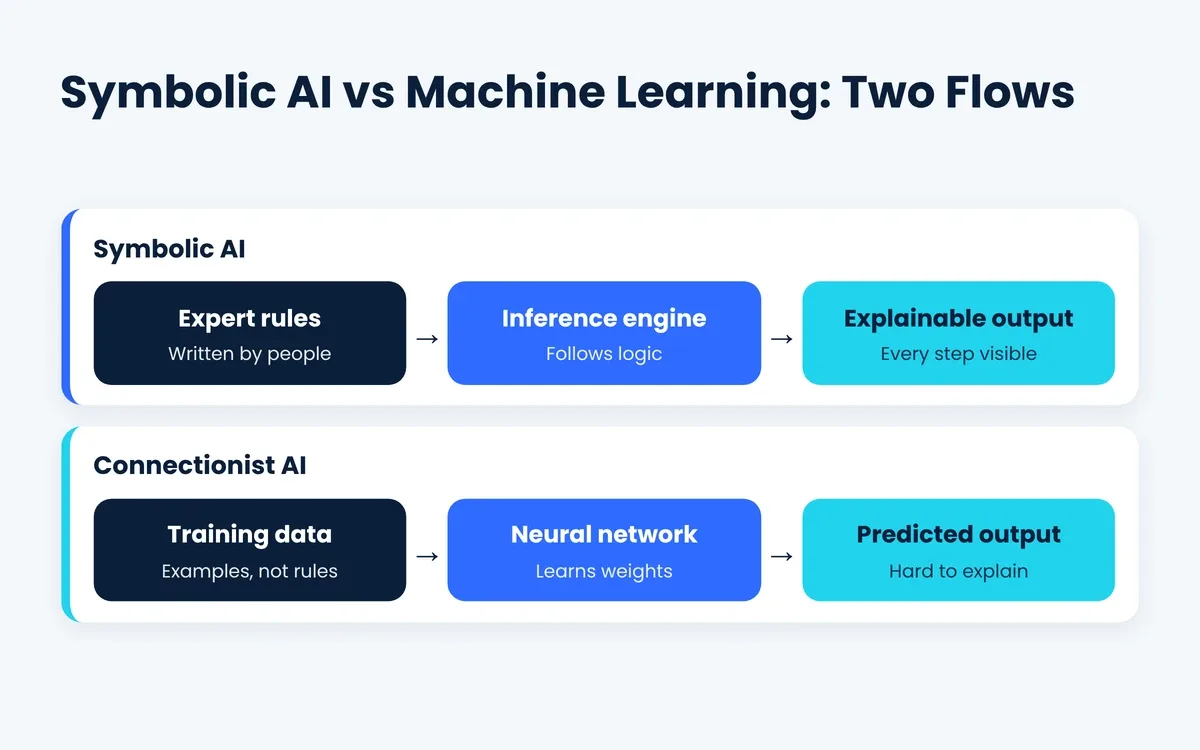
The symbolic AI vs machine learning question is close to the connectionist debate, but it is not identical. Machine learning is a bigger group. It includes neural networks, yet it also covers linear models, support vector machines, and decision trees.
Modern connectionist AI is usually built with machine learning. Still, machine learning is broader than connectionist AI. A decision tree, for example, can give readable if-then style decisions. It is a machine learning method, but it is not a neural network.
So symbolic AI vs neural networks is the narrower question. Symbolic AI vs machine learning asks something wider: does the logic come from human experts or from data?
Keep in mind that symbolic and connectionist AI are not the only ways to group AI systems. Statistical, generative, multimodal, and agentic approaches can overlap with both. The two labels work best as a useful lens for comparing designs, not as strict boxes that every system must fit into.
Where Do Generative, Statistical, and Agentic AI Fit?
These newer labels describe what a system does, not how it stores knowledge. Most of them sit on the connectionist side, and some borrow symbolic parts.
- Statistical AI uses probability to make predictions. Older spam filters and Bayesian networks belong here, and neural networks are one statistical method among many.
- Generative AI creates new text, images, or audio. Tools like ChatGPT run on large neural networks, so their core is connectionist.
- Multimodal AI handles more than one kind of input at once, such as a photo together with a question about it. These models are connectionist too.
- Agentic AI plans steps and uses tools to finish a task. An agent often pairs a neural language model with symbolic parts, such as a fixed plan, a calculator, or a database query, which makes many agents hybrid systems in practice.
How Did the Symbolic vs Connectionist AI Debate Evolve?
Both ideas started in the 1950s. Each one led the field at different times, and researchers began combining them in recent years.
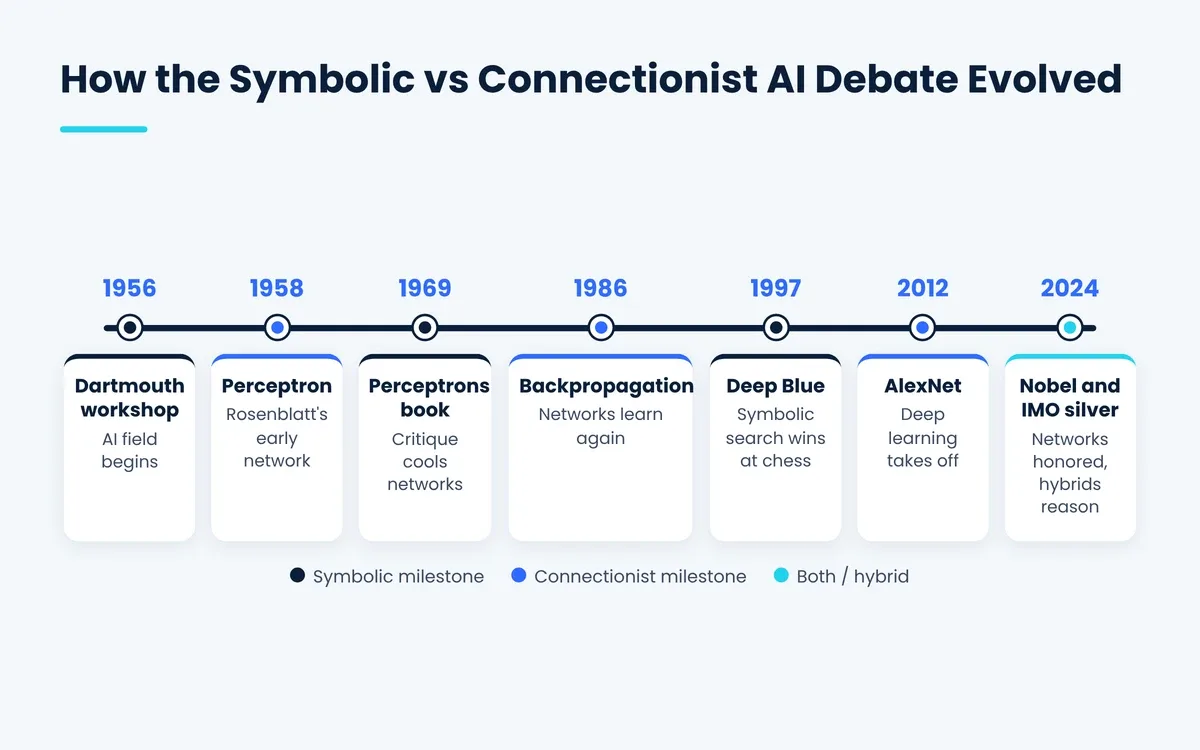
Here are the key moments:
- 1956: A summer workshop at Dartmouth launches AI as a field. The 1955 Dartmouth proposal suggested that every part of learning and intelligence can, in principle, be described precisely enough for a machine to simulate it.
- 1958: Frank Rosenblatt shows off the perceptron, an early learning machine, as the Cornell Chronicle recalls.
- 1969: Marvin Minsky and Seymour Papert publish Perceptrons. The book points out limits of simple networks, and interest in them drops for years.
- 1982: John Hopfield creates a network that can store and recall patterns, according to the Nobel Prize committee.
- 1986: David Rumelhart, Geoffrey Hinton, and Ronald Williams show how backpropagation trains deeper networks in Nature.
- 1997: IBM's Deep Blue beats chess champion Garry Kasparov. It relied on search and a hand-tuned scoring method, checking 200 million positions per second, says IBM.
- 2012: The AlexNet team wins the ImageNet competition with a 15.3% top-5 test error rate, compared with 26.2% for the second-best entry, as their NeurIPS paper reports.
- 2019: The ACM gives its 2018 Turing Award to Yoshua Bengio, Geoffrey Hinton, and Yann LeCun for deep learning.
- 2024: Hopfield and Hinton win the Nobel Prize in Physics for their work on neural networks.
- 2024: DeepMind's AlphaProof and AlphaGeometry 2 reach silver-medal level at the International Mathematical Olympiad. Both pair neural models with formal, rule-based proof checking.
- 2025: DeepMind publishes the AlphaProof method in Nature, as its IMO report notes. The system writes proofs in Lean, a formal language whose checker accepts only proofs that follow strict logical rules.
Neural networks took the lead once two things came together. The ACM points to faster GPU computers and access to large amounts of data. Since 2024, the trend has turned toward combining both approaches, especially in math and science, where answers must be both creative and provably correct. The debate runs through the whole history of artificial intelligence.
What Does Each Approach Look Like on a Real Task?
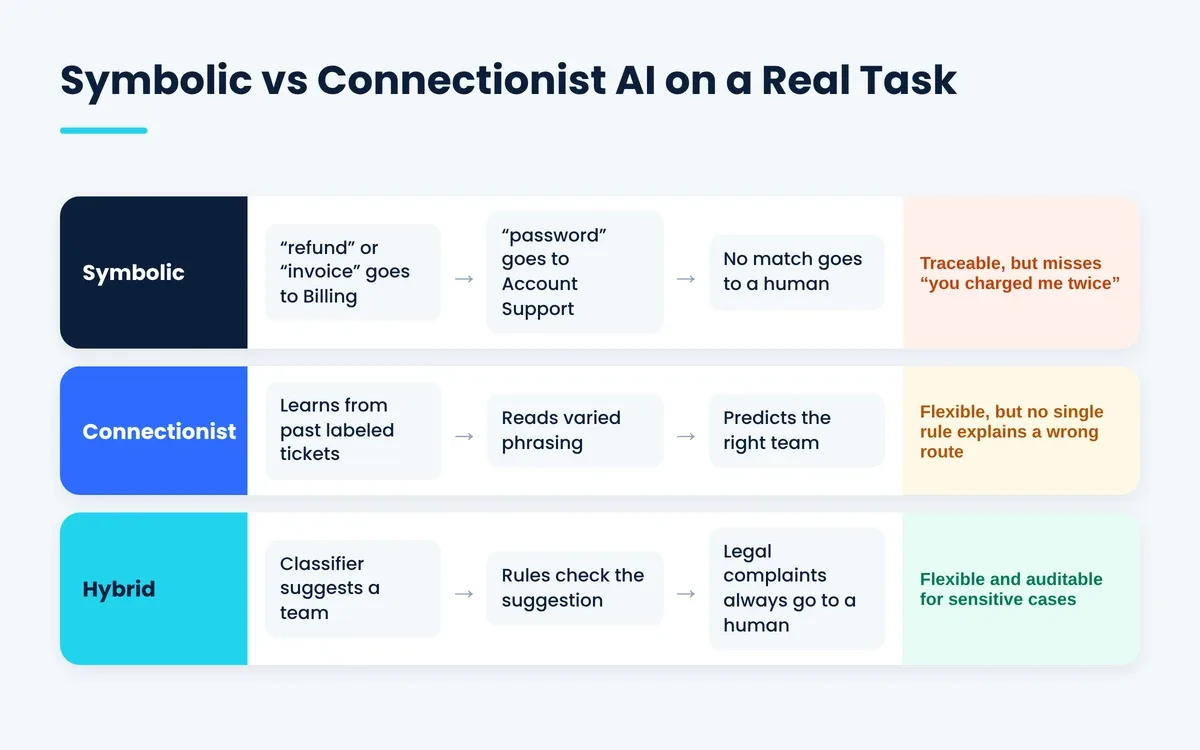
The clearest way to see the difference is to give both approaches the same job. Below, each one routes customer support emails to the right team.
The Symbolic Version
A support lead writes the routing logic as rules. For example:
- IF the subject contains "refund" or "invoice", THEN send the ticket to Billing.
- IF the message mentions "password" or "login", THEN send it to Account Support.
- IF no rule matches, THEN send it to a human for review.
The team can go live on day one, since no training data is needed. When a manager asks why a ticket went to Billing, the system points to rule 1. The weak spot shows up quickly, though. A customer who writes "you charged me twice" never uses the word "refund", so the ticket falls through to manual review. Somebody then has to add another rule, and the rule list keeps growing.
The Connectionist Version
Here the team collects past tickets that agents have already sorted. A text classifier trains on those labelled examples and learns which wording tends to belong to which team.
This version handles "you charged me twice" well because it has seen many billing complaints phrased in different ways. The trade-offs are different, however. The team needs a good set of labelled tickets before launch. When a ticket lands in the wrong queue, the model cannot point to a single rule that caused it.
The Hybrid Version
Many teams end up combining the two. The classifier suggests a team for each ticket, and a short list of rules then checks that suggestion. One rule can say that any ticket mentioning a legal complaint always goes to a human, whatever the model predicts. That keeps the flexibility of learning while the most sensitive cases stay under clear, auditable control.
What Are the Strengths and Limitations of Each Approach?
Symbolic AI is clear and needs little data, but it breaks when a case falls outside its rules. Connectionist AI is flexible with messy input, but it often needs more data and is harder to explain.
Symbolic AI: Advantages and Disadvantages
Advantages of symbolic AI:
- Each decision can be traced back to a rule.
- Rule-based systems can give the same output every time, as long as the rules and inputs stay the same.
- Works with little or no training data.
- Can encode documented laws, policies, and business rules explicitly.
- Rules can be reused in other systems.
Disadvantages of symbolic AI:
- Classic rule-based systems need experts to write and maintain rules, which gets slow and costly as the rule base grows.
- Fails when a case does not match any rule.
- Weak at common sense and at seeing or hearing.
- Symbolic AI scalability suffers as rule sets grow large.
Connectionist AI: Advantages and Disadvantages
Advantages of connectionist AI:
- Learn straight from data, with no hand-written rules.
- Can still work with noisy or incomplete input when it has learned the right patterns.
- Very good at images, speech, and language.
- Often gets better as more training data is added.
Disadvantages of connectionist AI:
- Hard to see why it made a decision.
- Large models can need a lot of data and computing power.
- Can overfit, which means it memorizes training data instead of learning the general pattern.
- Tiny, hidden changes to an input can fool it. These are called adversarial examples.
The Stanford Encyclopedia covers both of those last two problems. Both issues can affect how reliable a connectionist system is and how well it generalizes in real-world settings.
Where Are Symbolic AI and Connectionist AI Used Today?
Symbolic AI runs compliance checks, product setup tools, and knowledge graphs. Connectionist AI runs computer vision, speech recognition, language tools, and fraud detection.
Symbolic AI examples include expert systems, theorem provers, and compliance engines. Connectionist AI examples include the neural networks behind image, speech, and language tools. In many companies, the applications of symbolic AI and the applications of connectionist AI work side by side:
- Healthcare: Symbolic AI in healthcare includes guideline checkers and drug interaction alerts. Connectionist AI in healthcare includes networks that read X-rays and support diagnosis.
- Finance: Rule engines enforce anti-money-laundering limits and compliance checks. Neural models score card payments to catch fraud.
- Manufacturing: Setup tools check product options against engineering limits. Vision models spot defects on the production line.
- Cybersecurity: Firewall rules block known threats. Anomaly detection models flag unusual network activity.
- Robotics and navigation: Symbolic planners decide the order of tasks and routes. Neural networks make sense of camera and lidar data.
- Language: Grammar checkers and scripted chatbots follow rules. Large language models write and translate text.
- Business automation: Workflow engines send invoices to the right place by rule. Document AI pulls details out of scanned forms.
A common setup uses both at once. First, a neural OCR model reads a receipt. Then a rules layer checks the totals and tax codes before the record is saved.
What Is Neuro-Symbolic AI?
Neuro-symbolic AI is a hybrid approach that combines a neural network with symbolic reasoning. The neural part usually handles perception or pattern recognition, whereas the symbolic part applies explicit rules or logic.
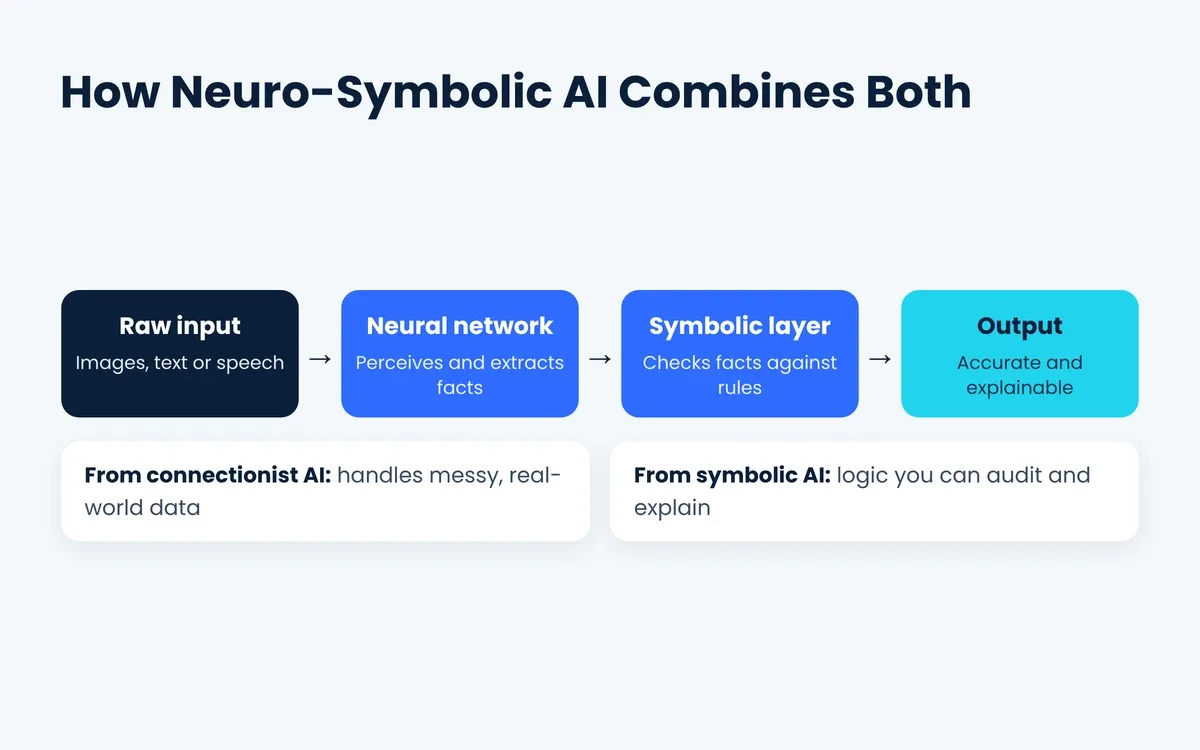
A common hybrid AI pattern uses three stages:
- A neural network turns raw input, such as an image or sentence, into structured representations or candidate facts.
- A symbolic part applies rules, logic, or a knowledge graph to those facts.
- When the system is designed for it, the symbolic part can also show the reasoning in a form people can check.
The idea is not new. The Stanford Encyclopedia traces hybrid models back to Paul Smolensky's work in 1990. He found a way to store symbol structures inside a neural network.
Here are four recent neural-symbolic systems:
- AlphaGeometry: A language model suggests helpful shapes to add to a geometry problem. A symbolic engine then does the formal proof. Google DeepMind reports that it solved 25 of 30 olympiad problems, close to the 25.9 average of human gold medalists.
- AlphaGeometry 2: The newer version solved 83% of past olympiad geometry problems, up from 53%, according to DeepMind.
- Neuro-Symbolic Concept Learner: Researchers at MIT built a model that learns ideas like color and shape from pictures and questions. It then runs small symbolic programs to answer new questions, as their ICLR paper explains.
- Language models with knowledge graphs: A 2024 survey on arXiv sees these setups as a meeting point of symbolic and connectionist AI.
Combining both approaches aims at the weak spots in the table above. The neural part removes the need to hand-write rules for seeing and reading. The symbolic part can keep the output inside clear, checkable limits.
How Do You Choose Between Symbolic, Connectionist, and Hybrid AI?
Symbolic AI is often a good fit when the logic is known and must be auditable. Connectionist AI is often a good fit when patterns are hard to write down. A hybrid can suit systems that need both learned perception and clear rules.
These six rules of thumb can help:
- Consider symbolic AI when laws, price lists, or fixed criteria decide the answer.
- Consider symbolic AI when every decision needs a clear record.
- Consider connectionist AI when your input is images, audio, or free text.
- Consider connectionist AI when you already have many labelled examples.
- Consider a hybrid when a system must understand messy input and then follow strict rules.
- Consider a hybrid when mistakes carry legal, financial, or safety costs.
Conclusion
Symbolic AI vs connectionist AI is not a contest with a single winner. Symbolic systems start from human knowledge and reason their way to a decision. Connectionist systems start from data and learn their way to a pattern. Rules give you precision and a clear record, whereas neural networks give you flexibility with messy, real-world input. When wrong answers carry legal or safety consequences, a hybrid design is worth evaluating. That is especially true if the system needs both learned perception and firm rules. For the full process behind both approaches, see how AI works.
FAQs
Is symbolic AI the same as rule-based AI?
Not exactly. Rule-based AI is one kind of symbolic AI. The wider field also includes ontologies, semantic networks, logic programming languages like Prolog, and theorem provers.
Is connectionist AI the same as neural networks?
Mostly, yes. Artificial neural networks (ANNs) are the main technology behind connectionist AI. Connectionism also began as a theory in cognitive science about how the mind works.
How does symbolic AI learn?
Classic symbolic AI does not learn by itself. People add or change its rules by hand. Some symbolic methods, such as inductive logic programming, can learn new rules from examples.
Which AI uses predefined rules, and which learns from data?
Symbolic AI uses predefined rules that experts write. Connectionist AI learns from data by adjusting its weights during training.
Why is symbolic AI more interpretable?
Every answer in a symbolic system points back to named rules and facts. A reviewer can follow those steps and see exactly how the answer was reached.
Why are neural networks called connectionist?
Neural networks store what they learn in the strength of the links between neurons. The knowledge lives in the connections, which is where the name comes from.
Is ChatGPT symbolic or connectionist AI?
ChatGPT is mainly based on neural network language models, so its core is connectionist. A given setup can also use symbolic parts, such as tools, code execution, or structured databases.
Can symbolic and connectionist AI be combined?
Yes. Neuro-symbolic AI combines neural networks with symbolic reasoning. AlphaGeometry is a good example, since it solved geometry problems that earlier rule-only systems could not.
Which approach is better for a business application?
No single approach wins every time. The best choice depends on your data, your rules, and how much each decision needs to be explained.