


The history of artificial intelligence spans decades of research. It began with early ideas about machine reasoning and gradually developed into the AI systems we use today. Alan Turing's work in the 1930s and 1940s helped lay the theoretical foundations of AI. In 1956, the Dartmouth workshop helped establish artificial intelligence as a formal field of research. Since then, AI has gone through several major stages. These include symbolic AI, expert systems, machine learning, deep learning, and today's generative AI and foundation models.
The history of artificial intelligence covers myths, logic, early computers and modern chatbots. It includes bold promises, deep funding cuts and sudden breakthroughs. Each era added a new piece to the puzzle. This guide walks you through that story in order. You will learn who invented AI, when AI started and how it grew into the tools people use today. You will also find a decade-by-decade AI timeline and clear answers to common questions.
Key Takeaways
- No single person invented AI.
- Alan Turing laid important foundations for machine intelligence.
- John McCarthy coined the term "artificial intelligence" in 1955.
- The 1956 Dartmouth workshop helped establish AI as a research field.
- AI went through two major AI winters.
- Machine learning and deep learning later drove major advances.
- The 2017 Transformer helped shape modern language models.
- ChatGPT brought generative AI to a mass audience in 2022.
- Current AI development includes agents, reasoning models, safety and governance.
What Is Artificial Intelligence?
Artificial intelligence, or AI, is a branch of computer science. It builds systems that perform tasks we link with human intelligence. These tasks include reasoning, learning, planning, perception and language.
AI works like a broad umbrella machine learning sits under it. Machine learning lets a system learn patterns from data instead of following only fixed rules. Deep learning sits inside machine learning, it uses artificial neural networks with many layers.
Other AI fields include natural language processing, computer vision, robotics, knowledge representation and reinforcement learning. Each one has its own story. Together, they form the evolution of artificial intelligence.
The Origins of Artificial Intelligence
The origins of AI stretch back thousands of years. Early societies had no computers. They did have stories, clever machines and ideas about how reasoning works.
Ancient Automata and Artificial Beings
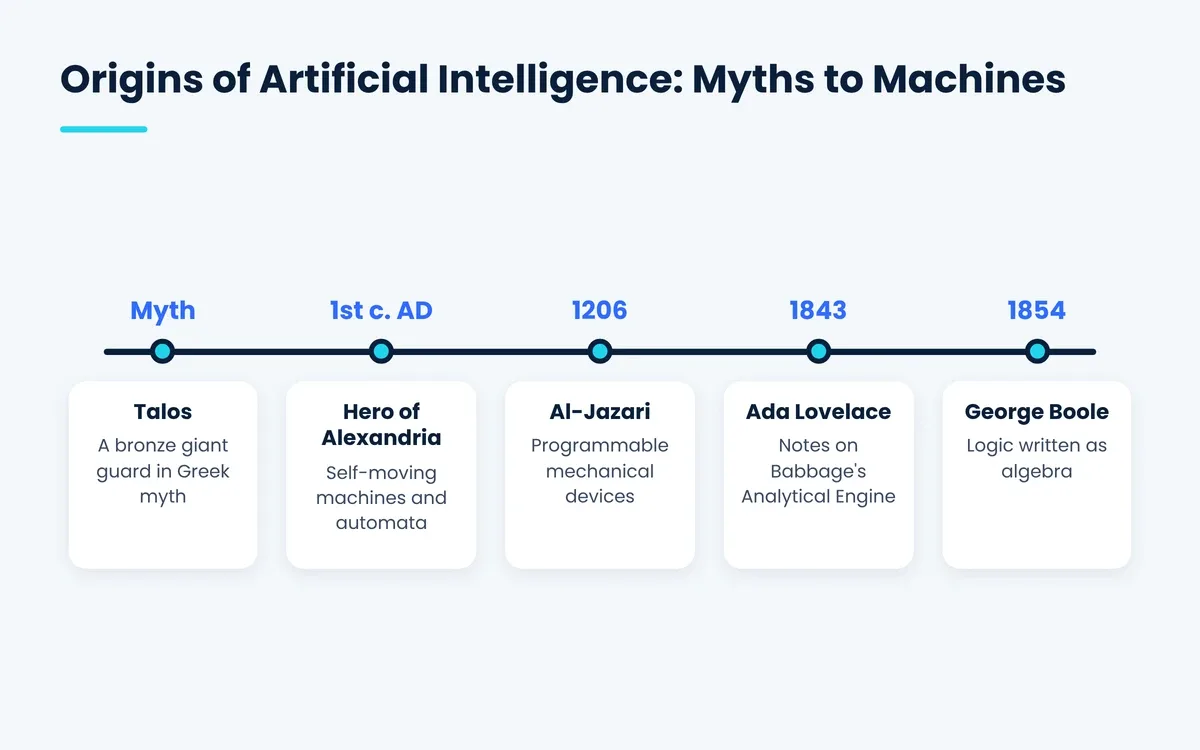
Greek mythology describes Talos, a giant bronze man who guarded the island of Crete. The myth shows an early wish to create artificial beings that could act on their own.
Real mechanical automata followed. Hero of Alexandria, a Greek engineer of the first century AD, described machines that moved using water, air and weights. In 1206, the engineer Al-Jazari wrote a book on ingenious mechanical devices. Some historians view his musical automata as early examples of machines whose behavior could be mechanically controlled.
These devices did not think. Still, they showed that a machine could follow a set sequence of actions. That idea of a programmable machine runs through the whole history of thinking machines.
Formal Logic and Mathematical Reasoning
AI also grew from the study of reasoning itself. Aristotle developed the syllogism, a formal way to draw conclusions from premises. Euclid built geometry from a small set of axioms and step-by-step proofs.
In the ninth century, the Persian scholar Al-Khwarizmi wrote major works on algebra and arithmetic. The word "algorithm" comes from the Latin form of his name.
Later, René Descartes explored the relationship between mechanical bodies, language and human reasoning. He argued that no machine could use language as flexibly as people do. Gottfried Leibniz dreamed of a formal language that could turn reasoning into calculation.
In 1854, George Boole published The Laws of Thought. His algebra of logic later became central to digital circuits and computer science.
Early Calculating Machines
Mechanical calculators appeared in the seventeenth century. Blaise Pascal built a calculating machine in 1642. Leibniz later built the stepped reckoner, which could also multiply and divide.
In the 1830s, Charles Babbage designed the Analytical Engine. It was a general-purpose mechanical computer, though he never finished building it. In 1843, Ada Lovelace published detailed notes on the engine. She saw that it could work with symbols, not only numbers. Her notes included an algorithm for the Analytical Engine, often described as the first published computer program.
The Foundations of Modern AI
Modern AI's theoretical roots reach back to the 1930s and 1940s. They include Alan Turing's work on computation and machine intelligence, and McCulloch and Pitts' model of artificial neurons. Electronic computers then gave researchers a real machine to test their ideas.
Alan Turing and Machine Intelligence
In 1936, Alan Turing described an abstract device we now call the Turing machine. It showed how a simple machine that follows rules could, in principle, carry out any step-by-step calculation.
During the Second World War, Turing worked on codebreaking at Bletchley Park. After the war, he turned to a bigger question. In his 1950 paper, "Computing Machinery and Intelligence" he asked whether machines could think.
Turing swapped that vague question for a practical test. He called it the imitation game. A human judge chats through text with a person and a machine. If the judge cannot reliably tell which is which, the machine passes. Today, we call this the Turing Test.
Artificial Neurons and Early Neural Networks
In 1943, Warren McCulloch and Walter Pitts published a model of artificial neurons. They showed that simple units, linked together, could compute logical functions. Their work laid early ground for neural networks.
In 1949, psychologist Donald Hebb proposed that links between neurons grow stronger when they fire together. People often sum up this idea as Hebbian learning. It shaped later learning rules in machine learning.
In 1951, Marvin Minsky and Dean Edmonds built SNARC. This early machine simulated a small neural network. It hinted that machines might one day learn from experience.
Cybernetics and Information Theory
In 1948, Norbert Wiener published Cybernetics. The book studied control and feedback in animals and machines. That same year, Claude Shannon published his mathematical theory of communication. It gave scientists a precise way to measure information.
Both ideas fed into early AI research. They encouraged scientists to treat thinking as a form of information processing.
AI History Timeline
| Period | Key development | Why it mattered |
|---|---|---|
| 1940s–1950s | Early computing and neural-network ideas | Laid the groundwork for machine-based reasoning |
| 1955–1956 | Dartmouth proposal and workshop | Established “artificial intelligence” as a research field |
| 1950s–1960s | Symbolic AI and early programs | Researchers solved mathematical and logical problems |
| 1970s | First AI winter | Funding and interest fell after progress lagged behind expectations |
| 1980s | Expert systems | Rule-based systems found use in specialized business and technical fields |
| Late 1980s–1990s | Second AI winter | Expert-system limits and lower investment slowed the field |
| 1990s–2000s | Machine learning rises | Statistical methods increasingly replaced hand-written rules |
| 2012 | Deep-learning breakthrough in image recognition | Neural networks achieved major gains in computer vision |
| 2017 | Transformer architecture introduced | Transformers became a major foundation for modern language and generative AI |
| 2018–2022 | GPT series and ChatGPT | Language models scaled up and reached mainstream users |
| 2020s | Generative AI | Large models learned to generate text, images, code, audio, and more |
The Birth of Artificial Intelligence in 1956
Many historians treat 1956 as the year AI became a field of its own. The key event took place at Dartmouth College in New Hampshire.
The Dartmouth Workshop
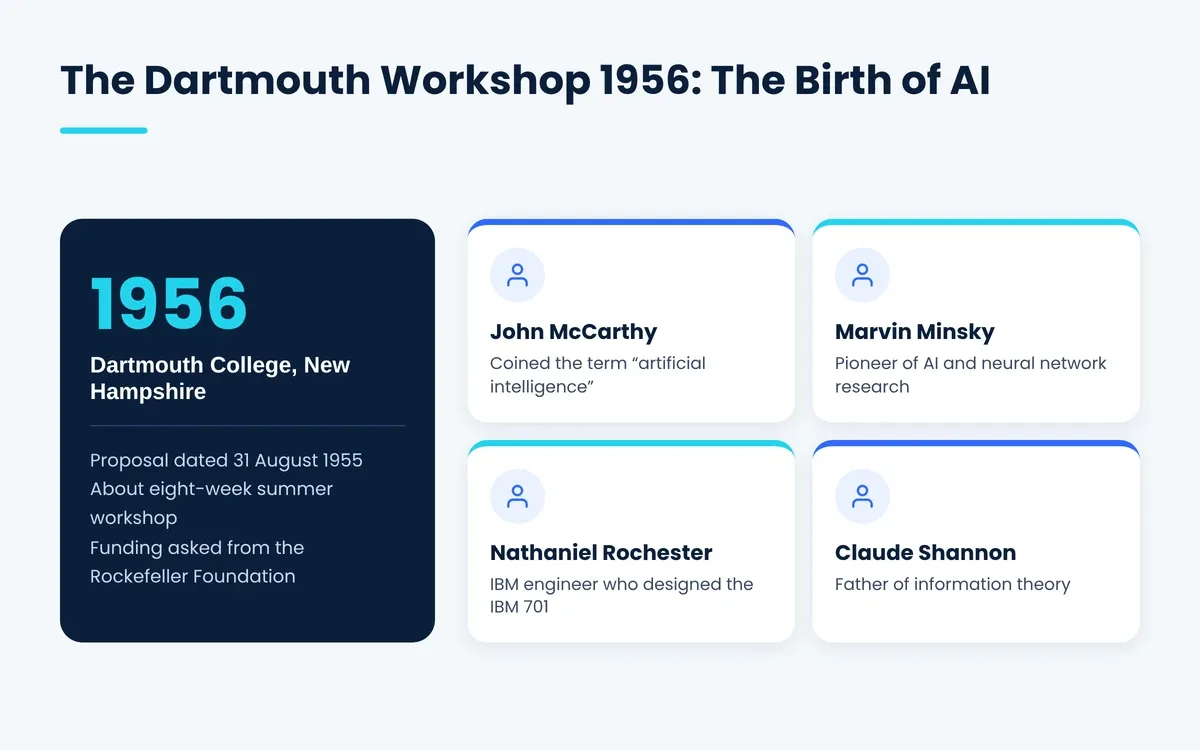
On 31 August 1955, four researchers wrote the original proposal for a summer research project. They were John McCarthy, Marvin Minsky, Nathaniel Rochester and Claude Shannon. They asked the Rockefeller Foundation to fund the event.
The proposal rested on a bold idea. It suggested that a machine could, in principle, simulate every feature of learning or intelligence if we could describe it precisely enough.
The workshop ran for about eight weeks in the summer of 1956. Researchers came and went during that time. They discussed language, abstraction, neural networks and self-improving machines.
The event did not build a thinking machine. Still, it became the workshop that helped establish AI as a new field of research. Stanford's AI100 report also points to Dartmouth as the moment AI took shape as a field.
Who Coined the Term Artificial Intelligence?
John McCarthy coined the term "artificial intelligence." He used it in the 1955 proposal for the Dartmouth project, as Dartmouth notes. The name stuck, and researchers still use it for the whole field today.
Logic Theorist and Early AI Programs
Allen Newell, Herbert A. Simon and Cliff Shaw built the Logic Theorist in 1955 and 1956. Logic Theorist is widely regarded as one of the earliest AI programs and is often described as the first program designed to perform symbolic reasoning. It proved mathematical theorems using symbolic reasoning and heuristics.
The program proved 38 of the first 52 theorems in Chapter 2 of Principia Mathematica. Alfred North Whitehead and Bertrand Russell wrote that famous work on logic. For one theorem, it found a shorter proof than the original, as one study of its source code explains. Newell and Simon brought this working program with them to Dartmouth.
The Early Years of AI
The years after Dartmouth brought fast progress and high hopes. New AI laboratories grew at places such as MIT, Stanford and Carnegie Mellon. ARPA, the US agency that later became DARPA, funded much of this early AI research.
Symbolic AI and Problem Solving
Early researchers focused on symbolic AI. This approach stores knowledge as symbols and rules. A program then works through those symbols to reach conclusions.
Newell and Simon followed up with the General Problem Solver in 1957. It tried to solve many kinds of problems with one general method, called means-ends analysis. In 1958, John McCarthy created LISP. This programming language became a favourite tool for AI research for decades.
Search and heuristics became core ideas. A heuristic is a rule of thumb. It helps a program cut down the number of options it must check.
Game Playing and Machine Learning
Games gave researchers a clear way to test machine intelligence. Arthur Samuel at IBM built a checkers program that improved by playing against itself. His 1959 paper helped popularise the term "machine learning."
That idea, a program that gets better through experience, sits at the heart of modern machine learning algorithms.
Natural Language Processing and ELIZA
Researchers also tried to make computers handle human language. Between 1964 and 1966, Joseph Weizenbaum at MIT built ELIZA. It used simple pattern matching to mimic a therapist in conversation.
ELIZA did not understand anything. Yet some users felt it did. This reaction troubled Weizenbaum. People still use the phrase "ELIZA effect" for our habit of reading understanding into a machine.
Around 1970, Terry Winograd built SHRDLU. It could follow typed commands about coloured blocks in a small virtual world.
Robotics and Shakey
From 1966 to 1972, researchers at the Stanford Research Institute (SRI) developed Shakey. It combined a camera, sensors and planning software. Shakey could map its surroundings and plan simple routes. Many sources describe it as the first mobile robot that could reason about its own actions.
Perceptrons and Neural Networks
In 1958, Frank Rosenblatt introduced the perceptron at the Cornell Aeronautical Laboratory. It learned to sort simple patterns by adjusting its connection weights. Cornell later described his work as arriving about 60 years too soon.
In 1969, Marvin Minsky and Seymour Papert published Perceptrons. The book showed the limits of simple single-layer networks. Its analysis highlighted important limits of single-layer networks and became part of the broader decline in interest in neural-network research during the following period.
The First AI Winter
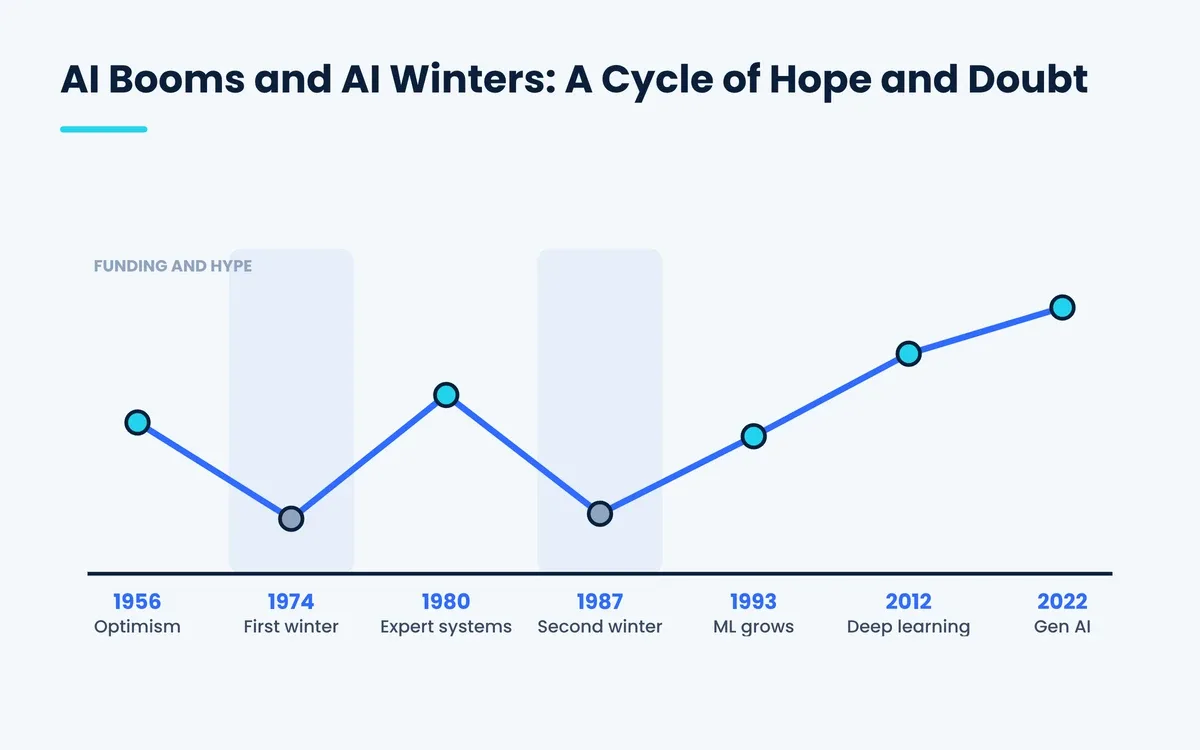
Early AI researchers made big promises. In 1965, Herbert Simon predicted that machines would do any work a person can do within twenty years. Progress did not match those claims. Funding bodies grew impatient.
The period of reduced funding and interest that followed became the first AI winter. The first AI winter is generally dated to the mid-1970s, with funding and interest recovering in the early 1980s.
Limits of Early AI
Early programs worked well in small, controlled worlds. They struggled with real problems. Three limits stood out.
- Limited computer power: Machines of the time had little memory and slow processors.
- Combinatorial explosion: The number of possible options grew too fast for programs to search.
- Commonsense reasoning: Programs lacked the everyday knowledge that humans take for granted.
Later, Hans Moravec and others noted a strange pattern. Tasks that feel hard for people, like chess, can be easy for computers. Tasks that feel easy, like walking or seeing, can be very hard. People call this Moravec's paradox.
Machine translation was also disappointing. In 1966, the US ALPAC report judged machine translation research harshly. US funding for that work fell sharply afterwards.
The Lighthill Report and Funding Cuts
In 1973, the UK Science Research Council published the Lighthill Report. Sir James Lighthill criticised the field for missing its early goals. He named combinatorial explosion as a core problem.
The Lighthill Report contributed to funding cuts in the UK and became an important event in the decline later known as the AI winter. In the US, DARPA also moved its money toward projects with clearer practical goals.
The Rise of Expert Systems
AI bounced back in the 1980s. The driver this time was the expert system. This type of program captures the knowledge of human specialists as rules.
Knowledge Representation and Knowledge Engineering
Expert systems depend on knowledge representation. Engineers interview experts and turn their know-how into "if-then" rules. A reasoning engine then applies those rules to new cases. This work grew into a discipline called knowledge engineering.
DENDRAL, MYCIN and XCON
Work on DENDRAL began at Stanford in 1965. It helped chemists identify molecules from mass spectrometry data. It showed that AI could support specialised scientific tasks.
MYCIN followed in the 1970s, also at Stanford. It suggested diagnoses and treatments for certain blood infections. Doctors never used it in routine care. Even so, it became an influential research system.
In 1980, Digital Equipment Corporation began using XCON. The system helped configure computer orders. Its success encouraged many firms to invest in expert systems.
Japan's Fifth Generation Computer Project
In 1982, Japan launched the Fifth Generation Computer Systems project. It aimed to build powerful machines for logic programming and AI, using languages like Prolog. The project pushed other countries to boost their own AI funding. The UK responded with the Alvey Programme.
The Second AI Winter
The expert system boom did not last. Several problems piled up at the same time.
AI Hype and Commercial Expectations
Companies expected expert systems to transform business. Many systems proved costly to build and hard to update. They often failed when they met cases outside their rules.
Decline of Expert Systems
In 1987, the market for specialised Lisp machines collapsed. Cheaper desktop computers from Apple and IBM could now handle the same work. The Fifth Generation project also ended without reaching its main goals.
Funding and confidence fell again. A second AI winter set in and lasted into the early 1990s.
The Revival of Neural Networks and Machine Learning
While expert systems struggled, other ideas quietly gained strength. Researchers turned back to neural networks and to statistics.
Backpropagation and Connectionism
In 1982, John Hopfield described a network that could store and recall patterns. In 1986, David Rumelhart, Geoffrey Hinton and Ronald Williams published a Nature paper on backpropagation. The method lets multi-layer networks learn by passing errors backwards through their layers.
Others had described similar methods earlier. Still, this paper helped bring backpropagation to a wide audience. It revived connectionism, the view that intelligence can emerge from many simple connected units.
In 1989, Yann LeCun and colleagues at Bell Labs used a convolutional neural network to read handwritten zip codes. This work later shaped modern computer vision.
Probabilistic Reasoning and Statistical Methods
Real-world data is messy and uncertain. In 1988, Judea Pearl published a major book on probabilistic reasoning. His work on Bayesian networks gave AI a clear way to reason under uncertainty.
Fuzzy logic also found practical uses. Lotfi Zadeh proposed it in 1965. By the late 1980s, Japanese firms used it in trains, cameras and home appliances.
Reinforcement Learning
Reinforcement learning teaches an agent through rewards and penalties. Richard Sutton and Andrew Barto helped shape this field. Christopher Watkins introduced Q-learning in 1989.
In 1992, Gerald Tesauro's TD-Gammon learned to play backgammon at a strong level, mostly through self-play. In 1998, Sutton and Barto published a textbook that became a standard guide for the field.
AI in the 1990s and 2000s
AI began to move out of the lab and into products. Some researchers avoided the "AI" label during this time. They spoke of machine learning, data mining or intelligent systems instead.
Deep Blue Beats Kasparov
In May 1997, IBM's Deep Blue defeated world chess champion Garry Kasparov in a six-game match. It became the first computer to beat a reigning world champion in a match under standard tournament time controls.
Deep Blue relied on raw search power. IBM says it could evaluate 200 million chess positions per second.
Intelligent Agents and Narrow AI
Researchers began to frame AI around intelligent agents. An agent senses its environment and acts to reach a goal. This view tied many subfields together under one idea.
Most successful systems of this era were narrow AI. They did one task well, such as spam filtering, fraud detection or product recommendations.
Data Mining and Speech Recognition
The growth of the internet created huge amounts of data. Companies used data mining to find patterns in customer behaviour. Speech recognition improved steadily through statistical methods.
In 2005, Stanford's self-driving car, Stanley, won the DARPA Grand Challenge. It drove itself across a long desert course. The win helped spark later work on autonomous vehicles.
Big Data and Faster Computers
By the late 2000s, three trends came together. Large datasets became common. Computers grew much faster. Researchers also found that graphics processing units (GPUs) could train neural networks far faster than standard chips.
In 2006, Geoffrey Hinton and colleagues showed a new way to train deep networks one layer at a time. This work helped bring the term "deep learning" into wide use.
The Deep Learning Revolution
The 2010s turned deep learning from a niche idea into the main engine of AI progress.
ImageNet and AlexNet
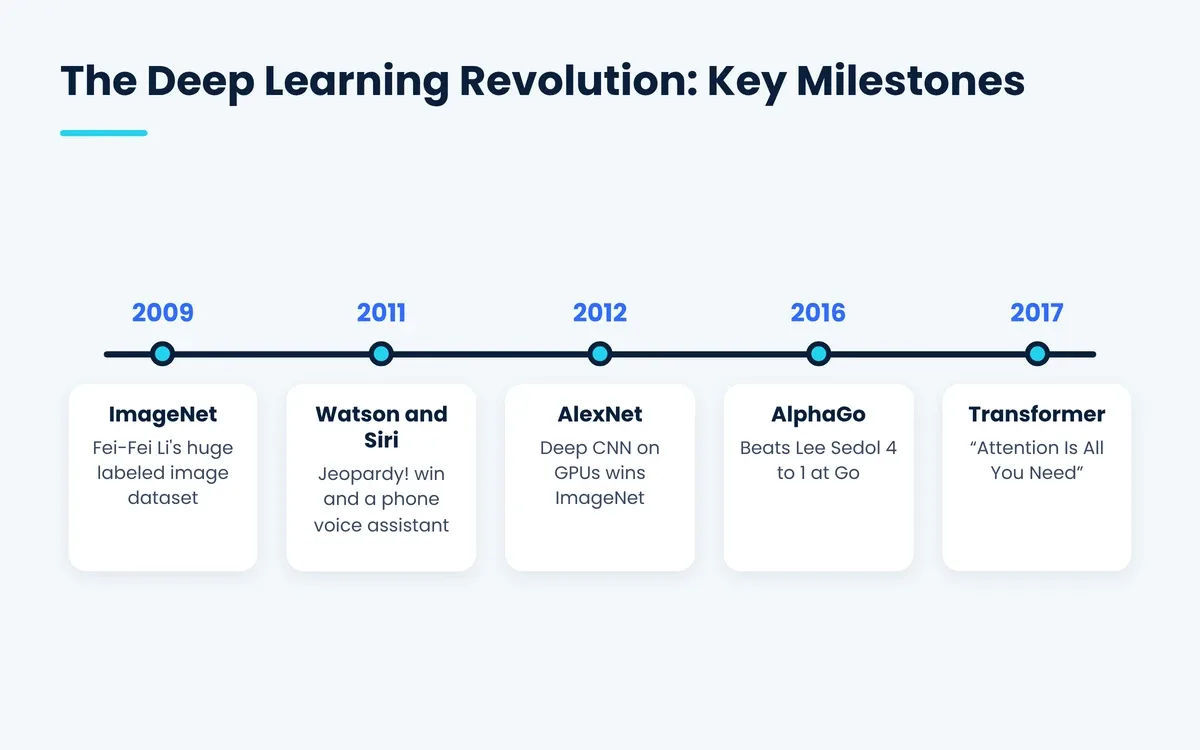
Fei-Fei Li led the creation of ImageNet, a huge dataset of labelled images, released in 2009. From 2010, a yearly contest used it to test image recognition systems.
In 2012, Alex Krizhevsky, Ilya Sutskever and Geoffrey Hinton entered AlexNet. This deep convolutional neural network trained on GPUs. It beat rival entries by a wide margin. Many researchers see this moment as the start of the deep learning boom.
Hinton, Yann LeCun and Yoshua Bengio later received the 2018 ACM Turing Award for their work on deep neural networks.
IBM Watson and Voice Assistants
In 2011, IBM Watson beat two top human champions on the quiz show Jeopardy!. The same year, Apple launched Siri on the iPhone 4S. Voice assistants soon brought AI into daily life.
AlphaGo
Go has far more possible positions than chess. Many experts expected computers to need many more years to master it.
In March 2016, DeepMind's AlphaGo beat top player Lee Sedol 4 to 1 in Seoul. AlphaGo combined deep neural networks, reinforcement learning and tree search.
The Transformer Architecture
In 2017, a Google team published a paper called Attention Is All You Need. It introduced the Transformer. Transformers use attention mechanisms to model relationships between elements in a sequence. They also train well on parallel hardware.
The 2017 Transformer architecture became a major foundation for later large language models, including the GPT series and ChatGPT.
The Rise of Generative AI
The 2020s brought generative AI into the mainstream. These systems create new text, images, audio, video and code.
Large Language Models and GPT
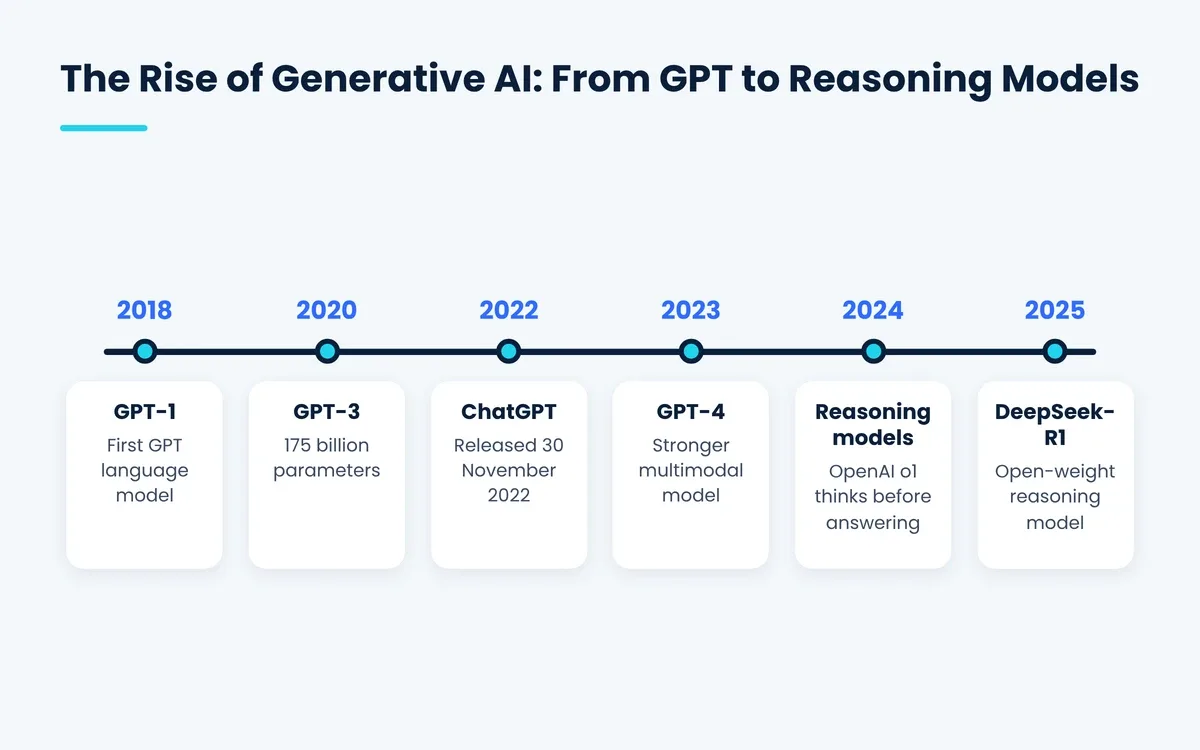
OpenAI released GPT-1 in 2018 and GPT-2 in 2019. GPT-3 followed in 2020 with 175 billion parameters. Each model learned from vast amounts of text. IBM's AI timeline lists these GPT releases among key milestones.
Image generation also leapt forward. OpenAI showed DALL-E in 2021. Tools such as Midjourney and Stable Diffusion reached the public in 2022.
ChatGPT
On 30 November 2022, OpenAI released Introducing ChatGPT as a free research preview. It lets anyone talk to a large language model in plain language. Its fast growth brought generative AI to a mass audience.
OpenAI released GPT-4 in March 2023. Google, Anthropic, Meta and others soon launched their own chatbots and models. The race to build better AI assistants had begun.
Multimodal AI, AI Agents and Reasoning Models
Recent AI systems do more than chat. Three trends stand out.
- Multimodal AI: Models now handle text, images, audio and video in one system.
- AI agents: Agents combine AI models with tools and software to complete multi-step tasks. Research has focused on how well these systems can plan, use tools and operate with limited human intervention.
- Reasoning models: In September 2024, OpenAI released o1, a model built to spend more time working through a problem before it answers. Other labs have since released their own reasoning models. The 2025 AI Index reported growing interest in this test-time compute approach and early progress in AI agents.
AI in Everyday Life
AI now runs quietly behind many daily tools. It powers search results, maps, email filters, translation apps and fraud alerts. Hospitals use it to help read medical images. Businesses use it for customer service and data analysis.
AI and the Nobel Prizes
In October 2024, John Hopfield and Geoffrey Hinton won the Nobel Prize in Physics. The committee honoured their foundational work that enables machine learning with artificial neural networks.
That same week, Demis Hassabis and John Jumper of Google DeepMind shared the Nobel Prize in Chemistry with David Baker. Hassabis and Jumper won for protein structure prediction, the work behind AlphaFold.
AI Safety, Ethics and Governance
As AI grew more capable, new questions grew louder. Governments, companies and researchers now spend far more time on how to use AI responsibly.
AI Safety
AI safety aims to stop AI systems from causing harm, whether by accident or through misuse. In November 2023, the UK hosted an AI Safety Summit at Bletchley Park, where Turing once worked.
AI Alignment
AI alignment asks a simple but hard question. How do we make sure an AI system pursues the goals its designers intend? Researchers study ways to keep AI behaviour in line with human values.
AI Ethics
AI ethics covers fairness, bias, privacy, transparency and the effect of AI on jobs. These issues grow more pressing as AI touches more areas of life.
AI Governance
Lawmakers have started to write rules for AI. The European Union's AI Act entered into force on 1 August 2024. It takes a risk-based approach, and its rules apply in stages.
Artificial General Intelligence and the Future of AI
Most Artificial Intelligence in use today is narrow AI. It excels at specific tasks but lacks broad, flexible understanding.
What Is AGI?
Artificial general intelligence, or AGI, describes a system that could match human ability across most intellectual tasks. Some people also discuss superintelligence, a system that would exceed human ability.
Experts disagree on whether AGI will arrive, when it might arrive and what it would look like. Nobody can predict this with confidence.
What Comes Next?
The history of AI suggests a pattern. Periods of excitement often meet hard limits. Real progress then comes from new ideas, more data and better hardware.
The next chapter will likely focus on reliable AI agents, stronger reasoning, human-AI collaboration and clear safety rules.
Artificial Intelligence Timeline
This AI history timeline sums up the key milestones by decade.
Before the 1940s
- Ancient myths describe artificial beings such as Talos.
- Hero of Alexandria and Al-Jazari build mechanical automata.
- Aristotle, Al-Khwarizmi, Leibniz and Boole shape formal logic and mathematical reasoning.
- 1843: Ada Lovelace publishes notes on Babbage's Analytical Engine.
- 1936: Alan Turing describes the Turing machine.
1940s
- 1943: McCulloch and Pitts publish a model of artificial neurons.
- 1948: Norbert Wiener publishes Cybernetics. Claude Shannon publishes his theory of communication.
- 1949: Donald Hebb proposes a theory of how neurons learn.
1950s
- 1950: Turing publishes "Computing Machinery and Intelligence" and proposes the imitation game.
- 1951: Minsky and Edmonds build SNARC.
- 1955: McCarthy and colleagues coin "artificial intelligence" in the Dartmouth proposal.
- 1956: The Dartmouth workshop takes place. Newell and Simon present the Logic Theorist.
- 1957: Newell and Simon create the General Problem Solver.
- 1958: Rosenblatt introduces the perceptron. McCarthy creates LISP.
- 1959: Arthur Samuel's paper helps popularise "machine learning."
1960s
- 1965: Work on DENDRAL begins at Stanford.
- 1966: Weizenbaum publishes ELIZA. The ALPAC report criticises machine translation.
- 1966 to 1972: SRI develops Shakey the robot.
- 1969: Minsky and Papert publish Perceptrons.
1970s
- Around 1970: Winograd built SHRDLU.
- 1970s: Stanford researchers develop MYCIN.
- 1973: The Lighthill Report appears in the UK.
- Mid-1970s: The first AI winter begins.
1980s
- 1980: Digital Equipment Corporation starts using XCON.
- 1982: Japan launches the Fifth Generation project. Hopfield describes his network.
- 1986: Rumelhart, Hinton and Williams publish their backpropagation paper.
- 1987: The Lisp machine market collapses. The second AI winter begins.
- 1988: Judea Pearl publishes his book on probabilistic reasoning.
- 1989: Watkins introduces Q-learning. LeCun's team reads handwritten digits with a neural network.
1990s
- 1992: TD-Gammon learns to play backgammon through self-play.
- 1997: Sepp Hochreiter and Jürgen Schmidhuber introduce Long Short-Term Memory (LSTM) networks.
- 1998: Richard Sutton and Andrew Barto publish Reinforcement Learning: An Introduction.
2000s
- 2005: Stanley wins the DARPA Grand Challenge.
- 2006: Hinton's team advances deep network training.
- 2009: ImageNet launches.
2010s
- 2011: IBM Watson wins Jeopardy!. Apple launches Siri.
- 2012: AlexNet sparks the deep learning boom.
- 2016: AlphaGo beats Lee Sedol.
- 2017: Google researchers introduce the Transformer.
- 2018: OpenAI releases GPT-1.
2020s
- 2020: OpenAI releases GPT-3.
- 2022: OpenAI launches ChatGPT on 30 November.
- 2023: OpenAI releases GPT-4. The UK hosts the AI Safety Summit.
- 2024: The EU AI Act enters into force. OpenAI releases o1. The Nobel Prizes in Physics and Chemistry recognize work connected to neural networks and AI-based protein structure prediction.
- 2025: DeepSeek releases DeepSeek-R1, drawing attention to reasoning models and open-weight AI.
- 2025–2026: AI agents, reasoning models and multimodal systems expand into new research and software applications.
AI Developments in 2025 and 2026
Reasoning and agentic systems became important areas of AI development. In January 2025, DeepSeek released DeepSeek-R1, a reasoning model that used large-scale reinforcement learning during post-training. DeepSeek also released the model weights and smaller distilled models, giving researchers and developers access to versions of the system for further use and experimentation.
Open-weight models also became more competitive. Stanford's 2025 AI Index reported that the performance gap between leading open-weight and closed-weight models had narrowed substantially by early 2025. The 2026 report found that the gap changed again during 2025, showing how quickly the model landscape was evolving.
AI agents also moved from simple conversational systems toward task completion. The 2026 AI Index reported substantial improvements in computer-use agents during 2025, while also noting that these systems still failed on a significant share of structured tasks. This reflects a broader shift in AI research from generating answers toward systems that can take actions and complete workflows.
Conclusion
The history of artificial intelligence is a story of big dreams and hard lessons. It began with myths and logic. It gained a name at Dartmouth in 1956. It then rose and fell through cycles of hope and doubt.
Symbolic AI and expert systems taught researchers the value of knowledge. They also showed the limits of fixed rules. Neural networks, machine learning and big data then changed the game. Deep learning, Transformers and large language models brought AI into daily life.
Today, AI faces new questions about safety, fairness and control. The next era will depend on how well people answer them. One lesson from the past stands out. Progress rarely moves in a straight line, but each setback has pushed the field toward better ideas.
Frequently Asked Questions
Who invented artificial intelligence?
No single person invented AI. John McCarthy coined the term in 1955 and co-organised the 1956 Dartmouth workshop. Alan Turing, Marvin Minsky, Claude Shannon, Nathaniel Rochester, Allen Newell and Herbert Simon also played founding roles.
When did AI start?
AI became a formal research field in 1956 at the Dartmouth workshop. Its roots go further back. They include Turing's 1950 paper, the 1943 artificial neuron model and centuries of work in logic.
How old is AI?
As a named field, AI turns 70 in 2026. The ideas behind it are much older and reach back to ancient myths and early logic.
What was the first AI program?
Many historians name the Logic Theorist, built by Newell, Simon and Shaw in 1955 and 1956. It proved mathematical theorems using symbolic reasoning.
What is the Turing Test?
The Turing Test checks whether a machine can hold a text conversation that a human judge cannot tell apart from a person's. Alan Turing proposed it in 1950 as the imitation game.
What was the AI winter?
An AI winter is a period of reduced funding and interest in AI. The first came in the 1970s. The second ran from the late 1980s into the early 1990s.
When did deep learning begin?
Its roots go back to early neural network research. Deep learning took off in 2012, when AlexNet won the ImageNet contest by a wide margin.
When did generative AI become popular?
Generative AI reached a mass audience after OpenAI released ChatGPT on 30 November 2022. Earlier models, such as GPT-3 and DALL-E, had already shown its potential.
What is the difference between AI, machine learning and deep learning?
AI is the broad field of building intelligent systems. Machine learning is a part of AI that learns from data. Deep learning is a part of machine learning that uses neural networks with many layers.
What is the future of artificial intelligence?
Experts expect more capable AI agents, better reasoning and closer human-AI teamwork. They disagree on whether or when AGI will arrive. Safety and governance will likely shape how AI develops.