



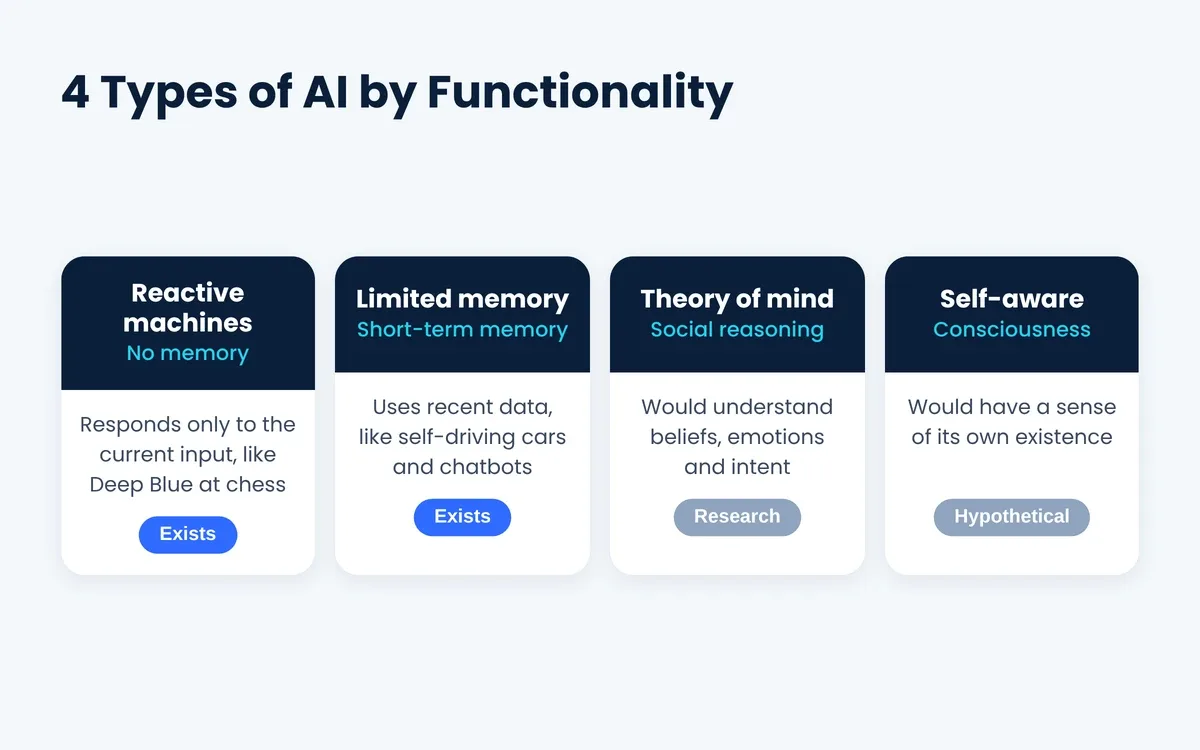
The types of AI fall into two standard classification systems. By capability, AI has three types: narrow AI, general AI and superintelligence. By functionality, AI has four types: reactive machines, limited memory, theory of mind and self-aware AI. Everyday AI products, from Siri to self-driving taxis, count as narrow AI. General AI is still disputed, while superintelligence is purely theoretical.
Only two of the four functional types exist today. A reactive machine such as IBM’s Deep Blue reacts to the present input without storing experience. A limited memory system learns from training data first. It then uses recent context to decide, as a self-driving car or a large language model does.
Theory of mind AI would understand human emotions, while self-aware AI would have consciousness. Nobody has built either of these types yet.
How many types of AI are there in total? The answer depends on the lens you use. Both main frameworks together give seven categories, while the older weak-versus-strong split gives two. Technology-based lists add different forms of AI, such as machine learning, computer vision, generative AI and agentic AI.
The sections below cover the types of artificial intelligence with examples. A diagram shows how the two frameworks connect. After that, a worked example runs one real task through four AI types, which makes the differences easy to see.
Key Takeaways
- Experts classify AI by capability and by functionality.
- Three capability types: narrow, general, superintelligence.
- Four types of AI by functionality: reactive to self-aware.
- Deployed AI systems are generally treated as narrow AI.
- Only reactive and limited memory systems exist today.
- Generative AI and agentic AI are narrow AI technologies.
How Many Types of AI Are There?
AI has three types by capability and four by functionality, which gives seven common categories of AI. Other systems exist too, so the number in any textbook depends on the lens its author picked.
You will meet these five AI classification systems most often.
- Capability (3 types): narrow, general and super intelligence. This lens compares how broad a system’s intelligence is with a human’s.
- Functionality (4 types): reactive machines, limited memory, theory of mind and self-aware AI. Researcher Arend Hintze described this model in 2016 for The Conversation.
- Weak vs strong (2 types): a philosophical split. Weak AI only imitates understanding, while strong AI would truly understand.
- Technology: fields such as machine learning, natural language processing, computer vision, generative AI and robotics.
- Risk level: regulators group AI by potential harm. The EU AI Act, for example, uses four risk tiers.
The question “how many AIs are there” has a second answer. Hugging Face alone hosts millions of public models. Even so, they all fit into a handful of classification lenses.
The capability and functionality frameworks answer different questions. As a result, you can describe one AI system with labels from both. The next two sections cover each framework in turn.
What Are the 3 Types of AI Based on Capabilities?
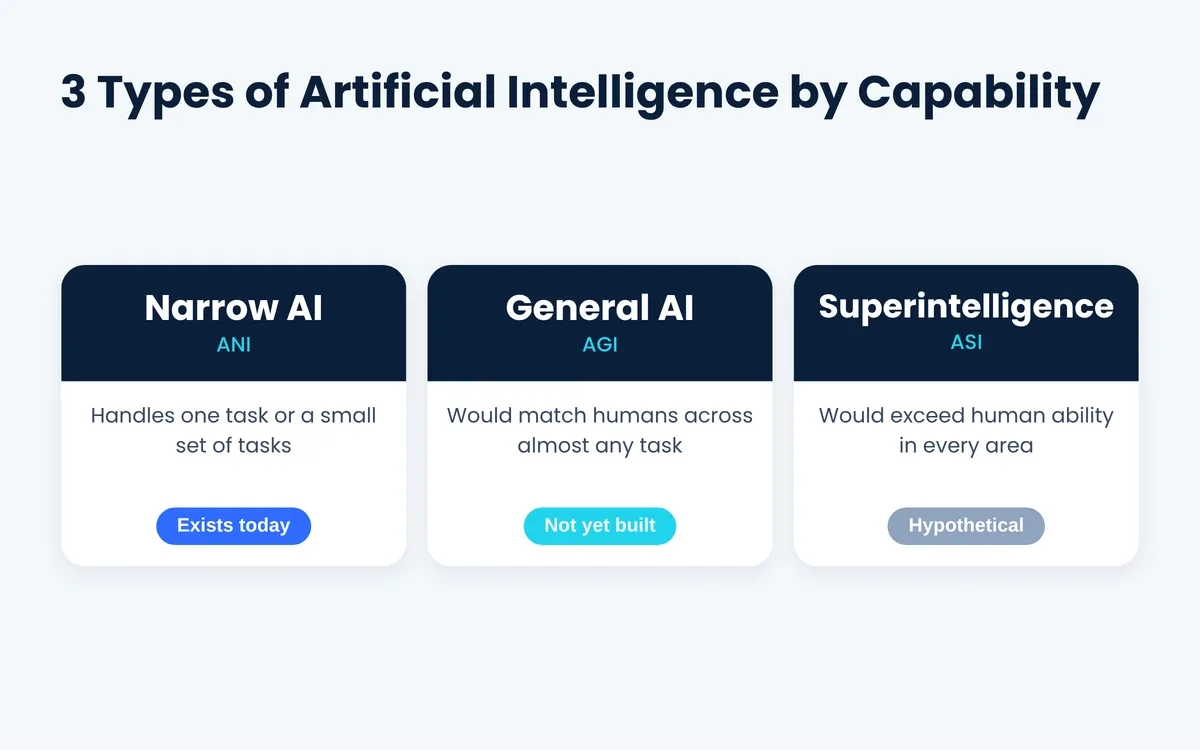
The three capability types are artificial narrow intelligence (ANI), artificial general intelligence (AGI) and artificial superintelligence (ASI). Today’s deployed systems are generally treated as narrow AI. Claims that frontier models have reached AGI remain disputed.
Capability-based classification ranks AI capabilities like a ladder. Each rung shows how many kinds of problems a system can handle. It also shows how well the system performs against skilled humans. That is why people call these three types of artificial intelligence the levels of artificial intelligence.
What Is Narrow AI?
Narrow AI is AI trained for one task or a small set of related tasks. People also call it weak AI or artificial narrow intelligence. However, it cannot carry that skill over to unrelated problems.
A chess engine plays brilliant chess yet cannot book a flight. In the same way, a spam filter sorts email without understanding a single message.
Narrow AI powers almost all artificial intelligence products in use today. Most types of AI tools you meet at work or at home belong here. Common artificial intelligence examples include the systems below.
- Virtual assistants: Siri, Alexa, Google Assistant and Microsoft Copilot handle requests within a set range of skills.
- Question answering: IBM Watson beat Jeopardy! champions Ken Jennings and Brad Rutter in 2011. The same system could not drive a car or hold an open conversation.
- Recommendation engines: Netflix and Amazon use your past behavior to predict what you will watch or buy.
- Facial recognition: your phone unlocks by matching your face to a stored template.
- Chatbots and large language models: ChatGPT, Claude and Gemini write text, code and analysis from prompts.
- Image generators: DALL-E and Midjourney turn written descriptions into pictures.
- Home robots: an iRobot Roomba maps rooms to clean floors, but that skill stops at cleaning.
Adoption shows how far narrow AI has spread. Stanford’s 2026 AI Index found that 88% of organizations use AI in at least one business function. Generative AI also reached 53% of the world’s population within three years.
The artificial intelligence capabilities at this level run deep but narrow. Narrow AI often beats humans inside its own domain, yet it breaks outside it. A model trained on English contracts misreads Urdu legal documents. Likewise, a vision system trained on daytime roads struggles in heavy snow until engineers add that data.
What Is General AI?
General AI is a hypothetical system that could learn any intellectual task a human can. Other names for it are artificial general intelligence (AGI) and strong AI. Such a system would carry knowledge between unrelated fields without retraining. No lab has built a system that researchers broadly accept as AGI.
Different organizations define AGI in different ways. OpenAI’s charter calls it “highly autonomous systems that outperform humans at most economically valuable work.” That definition focuses on economic output rather than on how the system thinks.
In 2023, researchers at Google DeepMind proposed a more measurable way to separate different levels of AI. Their “Levels of AGI” paper grades systems on two things: performance and generality.
The paper starts at Level 0, which covers systems that are not AI at all. Above it sit five AI levels: emerging, competent, expert, virtuoso and superhuman. Competent AGI is the second level of AI performance, where a system beats 50% of skilled adults across most non-physical tasks.
The same paper labeled the chatbots of that time “emerging AGI.” That label means they performed like an unskilled human across many kinds of work. Most researchers still treat those chatbots as narrow AI, because their reliability swings sharply from task to task.
A practical example of general AI helps here, even though it is hypothetical. Picture one system that diagnoses a patient, writes the discharge letter and fixes a bug in the hospital’s scheduling software. The same system then learns a new board game from its rulebook alone, without any extra training.
What Is Superintelligence?
Artificial superintelligence (ASI) is a theoretical AI that would outperform the best human minds in almost every field. Those fields include science, strategy, social skills and creativity. ASI does not exist, and experts disagree sharply on whether it ever will.
Philosopher Nick Bostrom made the idea popular in his 2014 book Superintelligence. In DeepMind’s framework, the superhuman level means a system beats 100% of humans on a task. An ASI would reach that level across general tasks, not just in one narrow game.
Superhuman skill in a single field already exists, which causes some confusion. AlphaGo beat every human Go player, yet it could not hold a conversation or drive a car. For that reason, it remains narrow AI rather than a step toward superintelligence.
Narrow AI vs General AI vs Superintelligence: What Is the Difference?
The difference between them comes down to scope. Narrow AI works within one domain, general AI would match humans in every domain, and superintelligence would surpass them. The table below compares the three capability types at a glance.
| Attribute | Narrow AI (ANI) | General AI (AGI) | Superintelligence (ASI) |
|---|---|---|---|
| Other names | Weak AI, task-specific AI | Strong AI, human-level AI | ASI, superintelligent AI |
| Scope | One task or domain | Any intellectual task a human can do | Every domain, beyond human ability |
| Skill transfer | Limited to its training domain | Transfers across unrelated domains | Transfers and improves beyond humans |
| Status in 2026 | Deployed at scale | Claimed by some labs; not broadly accepted | Theoretical |
| Examples | Siri, ChatGPT, Waymo Driver, Netflix recommendations | None verified | None |
What Are the 4 Types of AI Based on Functionality?
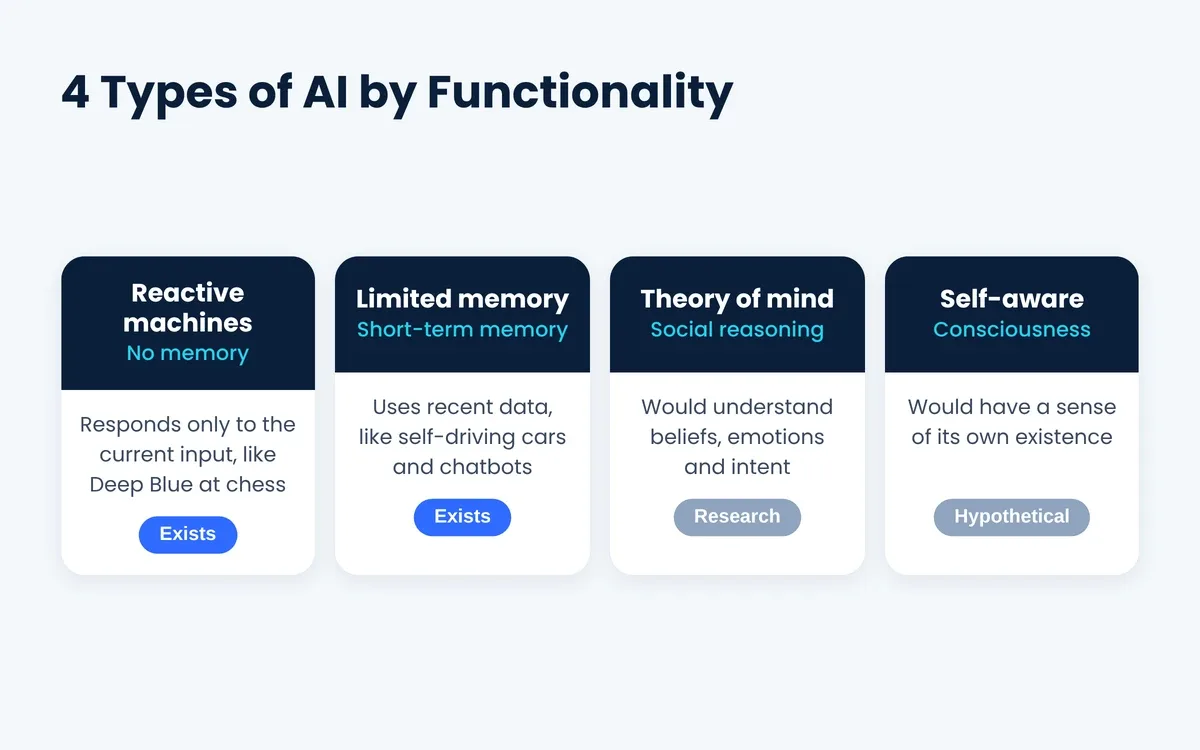
The four types of artificial intelligence based on functionality are reactive machines, limited memory, theory of mind and self-aware AI. Arend Hintze, then at Michigan State University, ranked them by two traits. The first is how a system uses memory, and the second is how well it understands other minds.
Reactive machines and limited memory AI exist today. The other two types remain ideas, so the functionality ladder has two filled rungs and two empty ones.
What Are Reactive Machines?
Reactive machine AI responds to the current input with a fixed strategy and keeps no memory of past events. Because of that, it cannot learn from experience while it runs. Give it the same input twice, and you get the same output twice.
IBM’s Deep Blue is the classic example. This chess computer beat world champion Garry Kasparov in 1997 by weighing up to 200 million positions per second. Even so, it kept no record of earlier games.
Hintze also placed Google DeepMind’s AlphaGo in this group, since it judged each move from the board in front of it. AlphaGo beat Go champion Lee Sedol 4 to 1 in March 2016. A paper in Nature explains how its neural networks learned from human games and self-play.
Reactive systems still earn their place where predictable behavior matters more than learning. Game engines, fixed rule filters and safety interlocks all benefit from giving the same answer every time.
What Is Limited Memory AI?
Limited memory AI learns from past training data and then uses recent observations to decide what to do. Self-driving cars, recommendation engines and large language models all fit this description. Its memory is “limited” because it never builds lasting, lifelong experience the way a person does.
Self-driving cars show limited memory at work. Cameras, LIDAR and other sensors track the speed and direction of nearby vehicles in real time. A decision engine then uses that data to plan a safe path. In March 2026, TechCrunch reported that Waymo gave 500,000 paid driverless rides per week across 10 U.S. cities.
Large language models use two kinds of limited memory. Their parameters store patterns learned in training. Meanwhile, the context window holds the current chat as short-term memory. That memory disappears when the session ends, unless a separate feature saves notes.
Most limited memory systems follow the same machine learning lifecycle.
- Data collection: gather labeled or unlabeled training data.
- Model training: adjust model weights to recognize patterns.
- Prediction: apply the trained model to new inputs.
- Feedback: compare predictions with real outcomes.
- Iteration: retrain the model on fresh data.
What Is Theory of Mind AI?
Theory of mind AI would understand that people have beliefs, intentions and emotions that shape their behavior. It would then adjust its own responses to match. The term comes from psychology, where it describes a child learning that other people think differently.
Language models now pass some psychology tests for theory of mind, and that result has sparked real debate. In a 2024 study in PNAS, Michal Kosinski gave 11 large language models 40 false-belief tasks. ChatGPT-4 solved 75% of them, which matches the score of a typical six-year-old child.
Other researchers argue that passing a test is not the same as having the ability. In a 2023 paper on arXiv, Tomer Ullman showed that tiny changes to the same tasks made models fail. His result points to pattern matching rather than real understanding. No deployed system meets Hintze’s full definition of theory of mind AI.
What Is Self-Aware AI?
Self-aware AI would have consciousness, meaning an inner sense of its own existence, feelings and goals. No existing system has it, and Hintze placed this type at the top of his ladder as the final, purely theoretical stage.
Scientists have no agreed test for machine consciousness, so even defining self-aware AI is hard. When a chatbot writes “I feel curious,” it repeats patterns from human writing. It is not reporting an inner experience that anyone can verify.
Narrow vs Limited-Memory AI Explained
Narrow AI and limited memory AI are not rival categories, so a self-driving car counts as both. Narrow AI describes how broad a system’s abilities are. Limited memory, on the other hand, describes how the system uses data. Every limited memory system deployed today also qualifies as narrow AI.
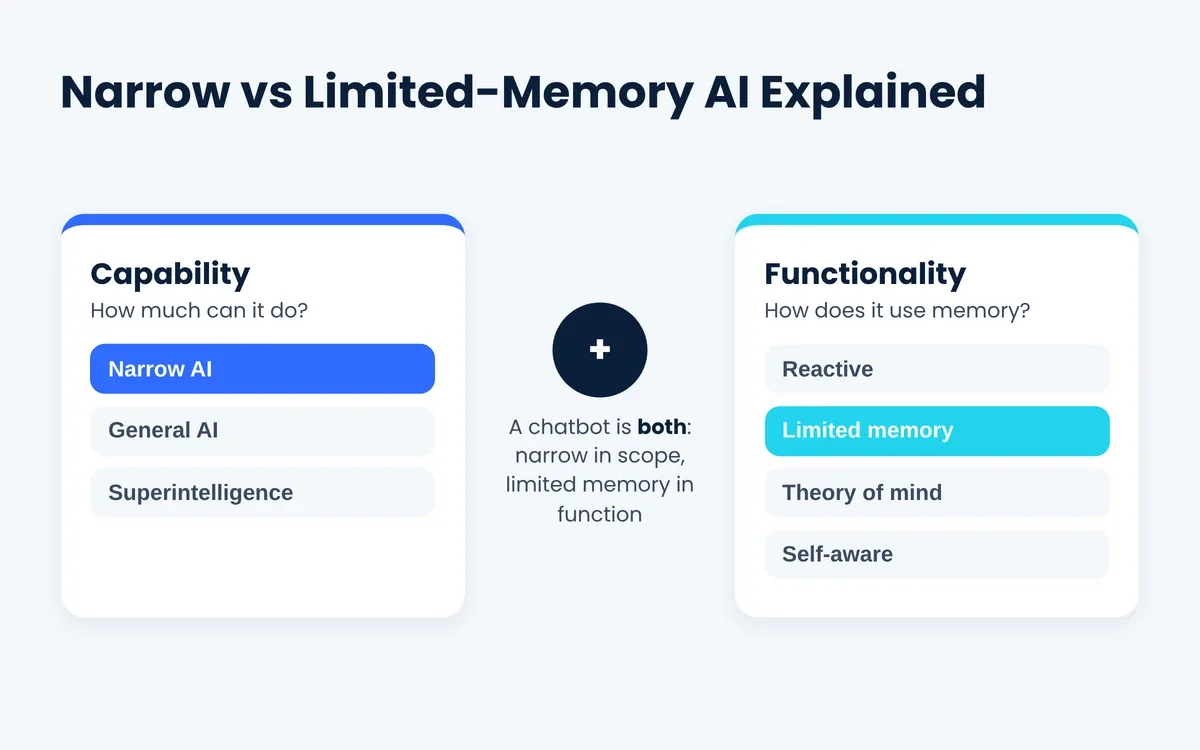
The confusion comes from lists that mix both frameworks into one set of AI categories. The chains below show which category of AI each familiar product belongs to.
- Siri, Alexa and Google Assistant: virtual assistant, then narrow AI.
- ChatGPT, Gemini and Claude: large language model, then generative AI, then narrow AI.
- Deep Blue and AlphaGo: reactive machine, then narrow AI.
- Self-driving cars: limited memory AI, then narrow AI.
- DALL-E and Midjourney: image generator, then generative AI, then narrow AI.
How Do the Capability and Functionality Types Connect?
Reactive and limited memory systems both operate within narrow AI today. Theory of mind and self-aware AI go beyond any system built so far. Researchers often link them with more general forms of intelligence.
The diagram below shows both frameworks side by side. Treat them as two lenses on the same field rather than one strict hierarchy.
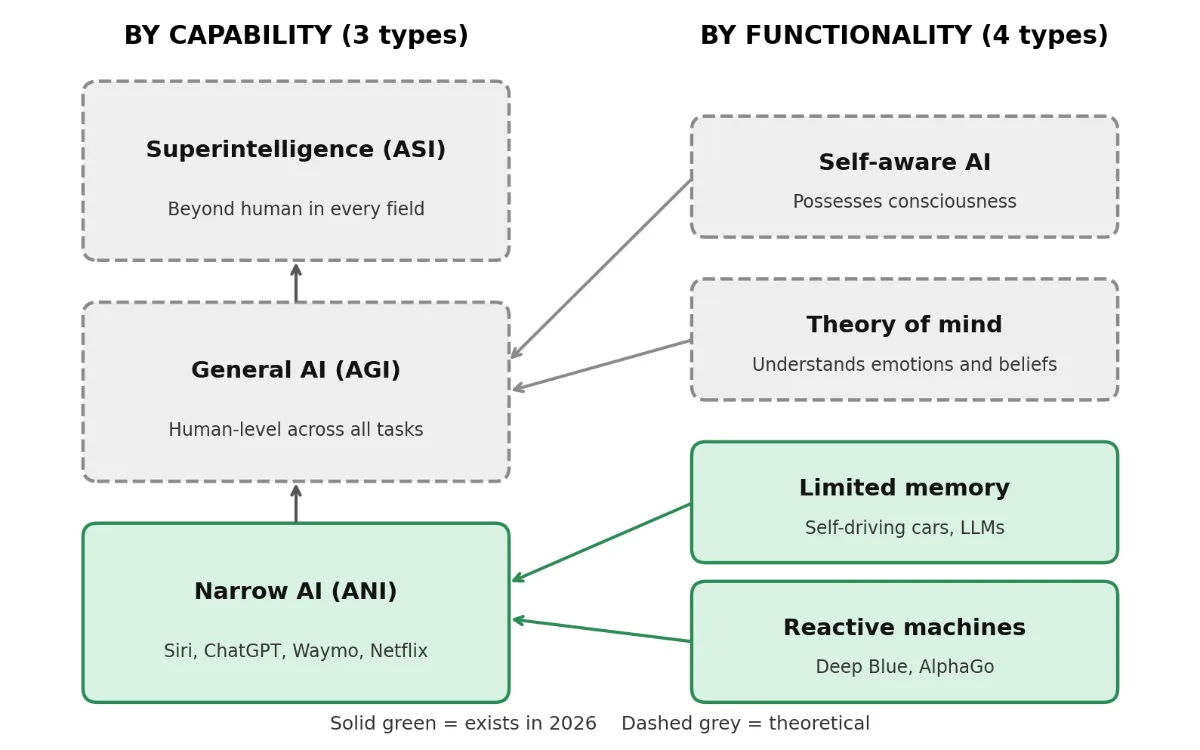
Reading the diagram from bottom to top follows the history of AI research. Reactive programs such as Deep Blue came first, followed by systems that learn from data. The top rungs of both ladders are still open research questions rather than products.
What Other Types of AI Should You Know?
Beyond the two main frameworks, people also group AI by the technology behind it. These types of AI technology cover the main artificial intelligence fields. Each field produces narrow AI, and most modern products combine several of them.
You will meet these technology-based categories when you compare AI tools.
- Machine learning (ML): Machine Learning algorithms learn patterns from training data instead of following hand-written rules. Its three main approaches are supervised, unsupervised and reinforcement learning.
- Deep learning: a branch of machine learning built on neural networks with multiple hidden layers. Convolutional networks handle images, LSTMs handle sequences, while transformers handle language.
- Natural language processing (NLP): AI that reads, understands and writes human language. Typical tasks include translation, text summaries and sentiment analysis, using models such as BERT, RoBERTa and T5.
- Computer vision: AI that makes sense of images and video. It powers image recognition, object detection and object tracking, often through Vision Transformers.
- Predictive AI: models that forecast outcomes from past data. Factories use it for predictive maintenance, while banks use it to catch card fraud.
- Expert systems: rule-based programs that store specialist knowledge as if-then rules. Stanford’s MYCIN, built in the 1970s to suggest antibiotics, is a well-known early example.
- Multimodal AI: models that handle text, images, audio and video together. Google built Gemini to process these formats natively. OpenAI’s CLIP, released in 2021, links images with their text descriptions.
- Robotics and physical AI: machines that sense, plan and move to act in the physical world.
Two of these categories, generative AI and agentic AI, get a lot of attention right now. The next two sections look at each one more closely.
Generative AI
Generative AI creates new text, images, audio, video or code in response to a prompt. It learns these skills from patterns in large training datasets. Even when its output looks remarkably human, a generative AI tool is still narrow AI with limited memory.
Four model architectures power most generative AI products.
- Transformers: Google researchers introduced this design in 2017. It now powers large language models such as GPT, Claude, Gemini, Llama, Grok, DeepSeek and Qwen.
- Diffusion models: they build an image by cleaning up random noise step by step. Tools such as FLUX and later DALL-E versions use this approach.
- GANs (generative adversarial networks): a generator network competes with a discriminator network until its samples look realistic.
- VAEs (variational autoencoders): they squeeze data into a compact form, then decode new samples from it.
Generative output now spans every major media format. ElevenLabs produces synthetic voices, and Suno creates songs. For video, Runway, Google’s Veo and Kling turn text prompts into clips. The main weakness is hallucination, where a model states false information with full confidence.
Agentic AI
Agentic AI uses AI models to plan multi-step work, call external tools and act toward a goal with little human input. A typical agentic system has five parts. These are a planning module, an execution engine, tool connectors, a memory layer and an orchestrator that coordinates the rest.
Businesses are adopting AI agents at a fast pace. Gartner predicts that 40% of enterprise apps will include task-specific AI agents by the end of 2026. In 2025, that share was under 5%.
Shared standards help agents from different vendors work together. Anthropic released the Model Context Protocol (MCP) in November 2024 to connect models with tools and data. Google, for its part, created the Agent-to-Agent (A2A) protocol so separate agents can talk to each other.
Both standards now share one neutral home. In December 2025, the Linux Foundation formed the Agentic AI Foundation (AAIF), with MCP as a founding project. Axios reported in August 2026 that A2A was joining the same foundation.
Worked Example: One Support Ticket, Four AI Types
The clearest way to see how AI types differ is to give each one the same job. The scenario below is a hypothetical example, not a documented case study.
A customer emails an online store: “Order 4821 arrived with a cracked screen, and I need a replacement before Friday.”
Four different kinds of AI could handle that message in four different ways.
| AI type | Input used | Process | Output | Main limitation |
|---|---|---|---|---|
| Reactive rule filter | Keywords in the email | Matches “cracked” to a fixed rule | Routes ticket to the returns queue | Misses the Friday deadline entirely |
| Limited memory classifier | Email text plus past labeled tickets | Predicts category and urgency from learned patterns | Tags ticket as “damaged item, high priority” | Takes no action on its own |
| Generative AI (LLM) | Email text plus store policy | Reads context, then writes a response | Drafts a polite reply offering a replacement | Can state a wrong policy if poorly grounded |
| Agentic AI | Email, order system, shipping tools | Plans steps, checks the order, calls tools | Creates a replacement order with Friday delivery, then confirms by email | Needs permission limits and audit logs |
Theory of mind AI and general AI would add something none of these systems offer today. A theory of mind system would sense that the customer probably needs the device for an important event. A general AI could go further by redesigning the store’s packaging so the next screen arrives intact.
Where Do Modern AI Systems Blur the Categories?
Modern AI systems often combine more than one type, so the categories work best as lenses rather than strict boxes. Real types of artificial intelligence systems rarely fit one label.
Take a single customer service agent. It can combine different kinds of artificial intelligence in one workflow. It runs a generative model and pulls documents from a knowledge base. It also follows fixed guardrail rules while it calls tools as an agent.
Capability labels blur in the same way. Stanford’s AI Index describes a “jagged frontier.” In other words, frontier models solve very hard problems yet still fail at some surprisingly simple ones.
That uneven performance explains why experts disagree about frontier models. Some see broad skills in coding, math and writing as early general intelligence. Others see brittle reasoning and weak skill transfer as signs of advanced narrow AI.
The debate went public in September 2026 when OpenAI launched GPT-6 Astra. According to Axios, OpenAI president Greg Brockman said he believes the model might mark AGI. OpenAI left that judgment to users, and no shared test exists to settle the question.
What Are Other Ways to Classify AI?
Besides capability and functionality, people also classify AI as weak or strong, by risk level and by learning method. Each artificial intelligence classification serves a different audience, from philosophers to compliance teams. The right classification of AI depends on the question you need to answer.
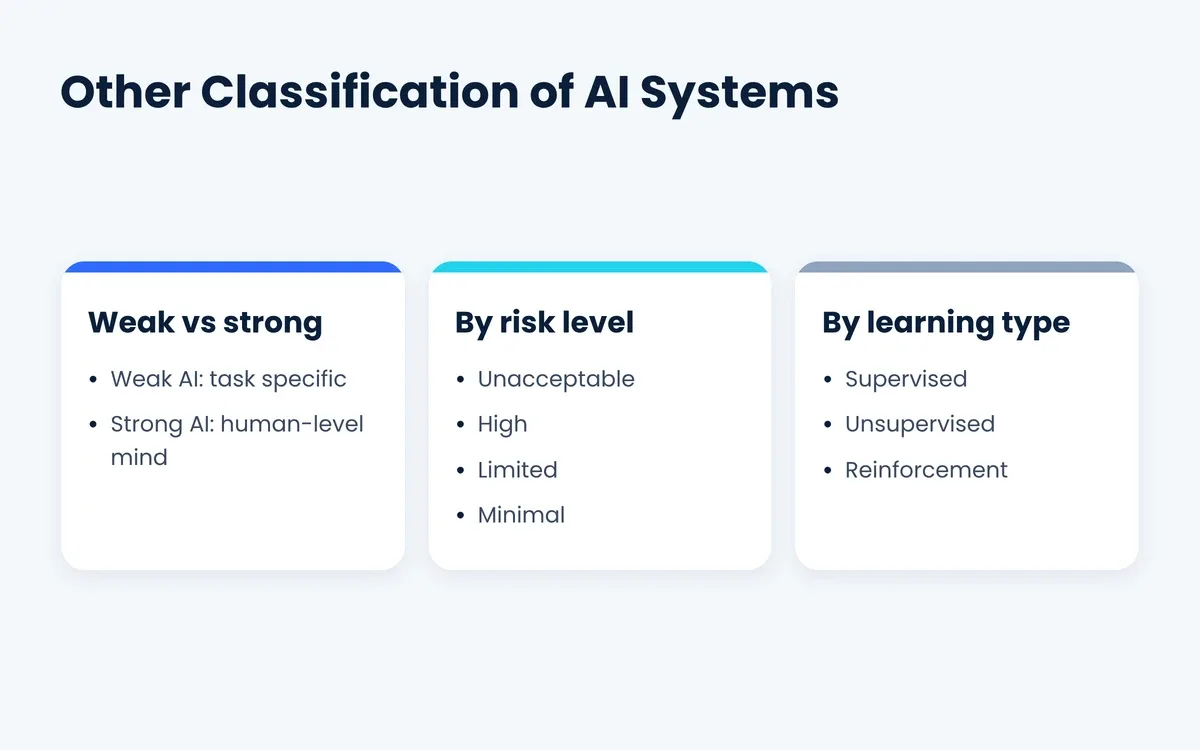
- Weak AI vs strong AI: philosopher John Searle drew this line in 1980 through his Chinese Room argument. The Stanford Encyclopedia of Philosophy covers the argument in detail.
- Risk-based classification: the AI Act from the European Commission sorts AI into four risk tiers. The tiers are unacceptable, high, limited and minimal, with stricter rules at each higher level.
- Learning method: supervised, unsupervised, self-supervised or reinforcement learning describes how a model gains its skills.
- Deployment model: large cloud-hosted models differ from small language models that run on a phone or laptop offline.
- Business purpose: companies often group AI tools by the job they do, since that is how most buyers think.
The business-purpose lens has five common categories.
- Generative AI: creates content, such as a marketing draft written in ChatGPT.
- Predictive AI: forecasts outcomes, such as a bank model that scores a card payment for fraud.
- Assistive AI: supports human work without taking over. GitHub Copilot, for example, suggests code that a developer accepts or rejects.
- Conversational AI: talks with people, such as a customer service chatbot or a voice assistant.
- Agentic AI: plans and carries out multi-step tasks, such as an agent that books a replacement order.
What Is the Most Advanced AI Today?
Today’s most capable general-purpose AI systems are frontier foundation models. Under most definitions, they still count as narrow AI. Major AI labs such as OpenAI, Anthropic, Google DeepMind, Meta, xAI, DeepSeek and Alibaba build them.
New versions arrive almost every month, so any “best model” ranking dates quickly. September 2026 shows that pace. OpenAI released the GPT-6 Astra on September 3. TechCrunch then reported that Anthropic released Claude Opus 5.5 on September 22.
Comparing different AI models on benchmarks shows how fast they are improving. Stanford’s AI Index reports results on SWE-bench Verified, a coding benchmark. In a single year, scores rose from 60% to near 100% of the human baseline.
Open models are advancing alongside closed ones. Meta’s Llama, DeepSeek, Alibaba’s Qwen and Ai2’s Olmo let developers download model weights. Teams can then run these models on their own hardware.
What Are the Limits and Risks of Today’s AI Types?
Today’s narrow AI systems carry four main risks: hallucination, bias, brittleness and agent security gaps. Some of these risks grow more serious as organizations give AI more autonomy and more access to tools.
- Hallucination risk: generative models can state false facts with confidence, so high-stakes output needs human review.
- AI bias: models trained on skewed data repeat that skew in hiring, lending or medical decisions.
- Brittleness: performance drops when real-world inputs differ from training data.
- Agent security: an agent with tool access can follow harmful instructions hidden in web pages or documents.
Reported problems are rising along with adoption. The Stanford AI Index counted 362 documented AI incidents in 2025, up from 233 in 2024. In response, AI governance frameworks now focus on five controls: data lineage, auditability, bias detection, explainability and access controls.
How Do You Pick the Right Type of AI?
Start with the job, not the technology. Match each task to the simplest type of AI that does it reliably, then add human review where mistakes cost the most.
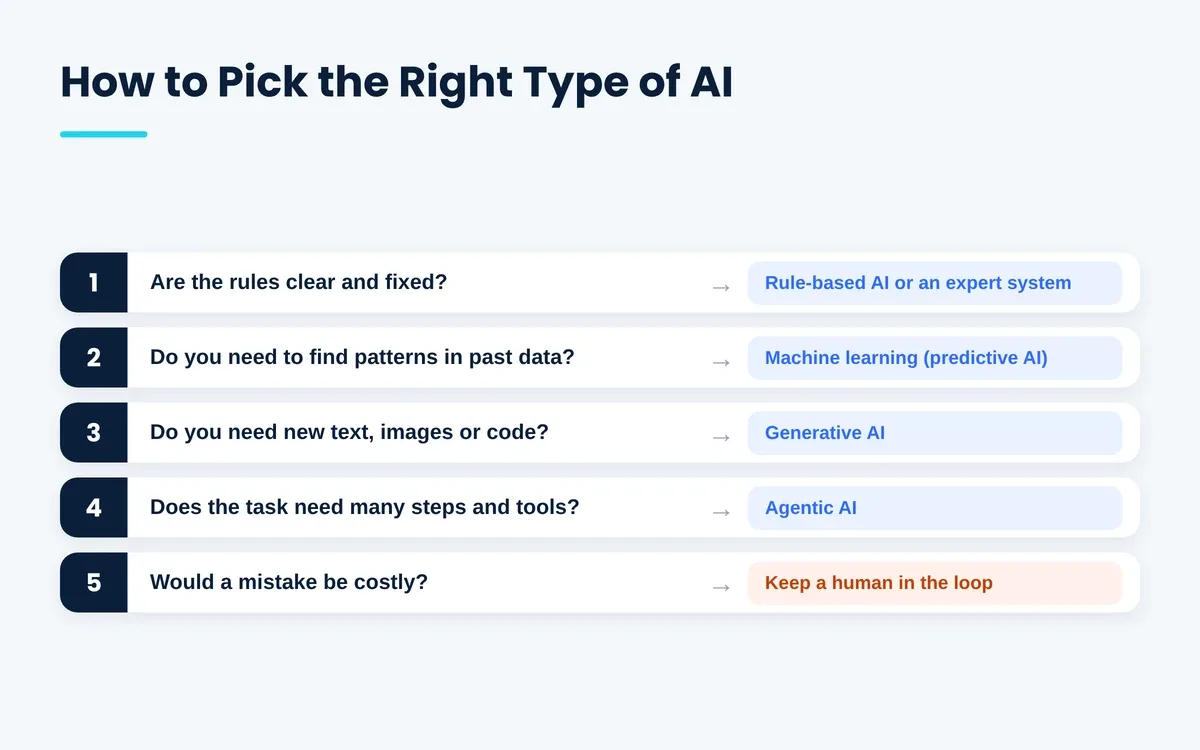
Comparing artificial intelligence options by brand name alone often leads to the wrong tool. Five questions give a better starting point.
- Does the task follow fixed rules? A reactive rule system is often enough, and it gives the same answer every time.
- Does the task depend on past patterns? Predictive, limited memory AI fits forecasting, fraud checks and demand planning.
- Does the task create content? Generative AI suits drafts, summaries and images, but a person should check facts before anything goes out.
- Does the task need several steps across tools? Agentic AI can handle it, as long as you set clear permission limits and keep audit logs.
- What happens if the AI is wrong? High-stakes work such as hiring, lending or medical advice needs strong human oversight, whatever type you choose.
Every one of these types of AI tools is still narrow AI, so no single tool handles every job well. Combining two or three types often works better, as the support ticket example above shows.
Conclusion
The types of AI make the most sense as answers to two questions. Capability asks how broad a system’s intelligence is. Its answer gives three types: narrow AI, general AI and superintelligence.
Functionality asks how a system uses memory and understands others. Its answer gives four types: reactive machines, limited memory, theory of mind and self-aware AI.
Across all types of AI, most systems you can use in 2026 are narrow AI. That includes ChatGPT, Waymo’s robotaxis and enterprise AI agents. Many of them also fit the limited memory category, because they learn from training data and use recent context.
General AI, theory of mind, self-aware AI and superintelligence remain research goals. Credible experts still disagree on how close any of them are.
With the types of AI explained on both scales, classify any new AI tool before you trust its marketing. Once you know a product is narrow, limited memory AI, you know where it will do well. You also know where it will need human oversight.
Frequently Asked Questions
What are the different types of AI?
The different types of artificial intelligence fall into three capability types and four functionality types. The capability types are narrow AI, general AI and superintelligence. The functionality types are reactive machines, limited memory, theory of mind and self-aware AI.
What are the 4 types of AI?
The 4 types of artificial intelligence are reactive machines, limited memory, theory of mind and self-aware AI. Arend Hintze proposed this model in 2016. Only the first two types exist today.
What are the 3 types of AI?
The 3 types of artificial intelligence are narrow AI, general AI and superintelligence. This model ranks AI by how broadly it can think. Deployed systems count as narrow AI, while AGI claims remain disputed.
Is ChatGPT a narrow AI or general AI?
Most researchers classify ChatGPT as a narrow AI with limited memory. Some frameworks, however, call frontier chatbots “emerging AGI.” ChatGPT has broad skills, yet its reliability varies from task to task, and it struggles to transfer skills to unfamiliar problems.
What is an example of general AI?
No real example of general AI exists yet. A hypothetical example would be one system that diagnoses illness, writes software and negotiates a contract. The same system would also learn a new game from its rules, without any task-specific training.
What are the 2 types of AI?
The two types of AI in philosophy are weak AI and strong AI. Weak AI imitates intelligence for specific tasks, which describes today’s products. Strong AI would truly understand and reason like a human.
What are the 5 main types of artificial intelligence?
No single standard list of five AI types exists. Popular guides often use five technology fields instead. These are machine learning, deep learning, natural language processing, computer vision and robotics.
What are the levels of artificial intelligence?
The 3 levels of artificial intelligence are narrow AI, general AI and superintelligence. They run from task-specific skill to ability beyond any human. Google DeepMind’s framework adds finer AGI levels: emerging, competent, expert, virtuoso and superhuman.
What are examples of artificial intelligence?
Common examples of artificial intelligence include ChatGPT, Siri, Netflix recommendations, Waymo robotaxis and bank fraud detection. Every one of these examples counts as narrow AI. Non-artificial intelligence examples include a basic calculator, a simple thermostat and a spreadsheet formula. These tools follow fixed instructions and never learn from data.
Which type of AI is most common today?
Limited memory narrow AI is the most common type of artificial intelligence today. Recommendation engines, fraud detection, voice assistants and chatbots all belong here. Each one learns from past data within a specific scope.
When will AGI or superintelligence arrive?
Nobody knows when AGI or superintelligence will arrive. Expert forecasts range from a few years to never. Researchers do not even share one definition of AGI, which makes any arrival date hard to verify.