


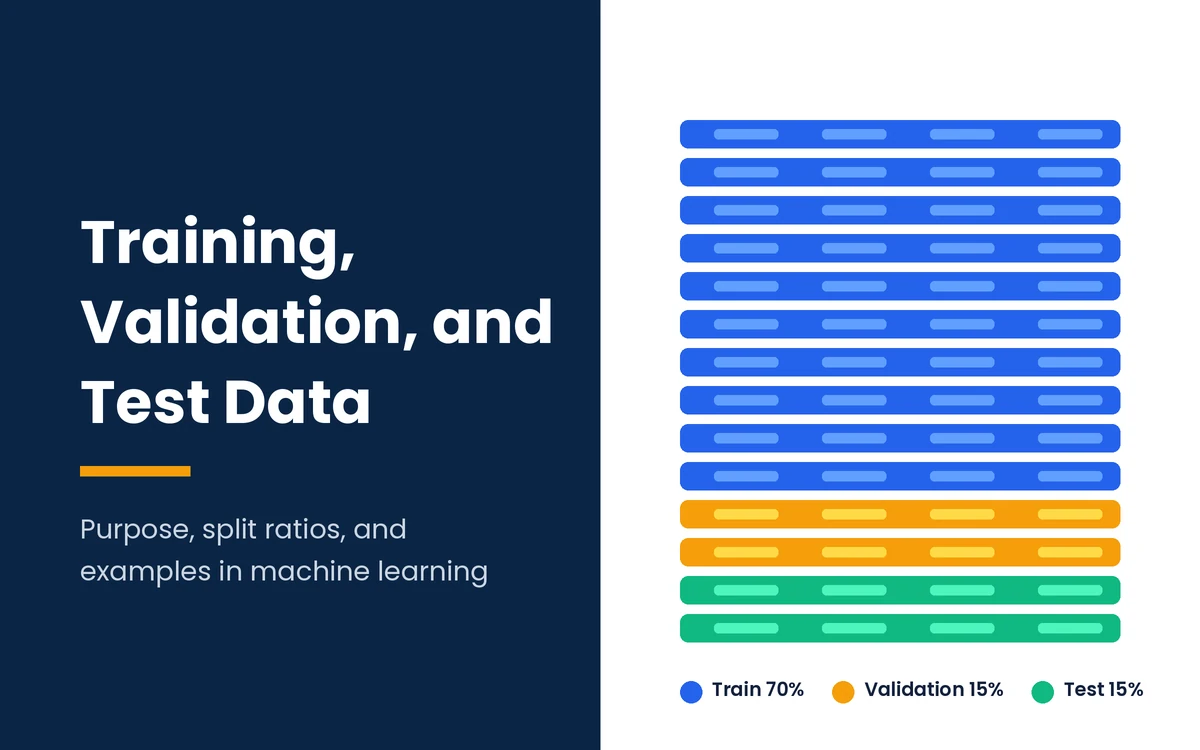
Training, validation, and test data are the three separate subsets of one dataset that a machine learning (ML) model uses to learn, to get tuned, then to get graded. The training set fits the model's parameters, the validation set compares candidate models during tuning, while the test set gives one final, unbiased score on examples the model has never seen.
Splitting data this way gives a team an honest estimate of generalization error, an early warning for overfitting or underfitting, plus a fair basis for comparing models such as logistic regression against a random forest. A model graded on the same rows it learned from reports inflated accuracy, so the split turns a hopeful number into a measurable one.
The same three-way partition runs through supervised learning, clustering, and the fine-tuning of large language models (LLMs). Public benchmarks like MNIST, CIFAR-10, and ImageNet ship with fixed splits of their own. This guide covers the role of each subset, the recommended train test validation split, benchmark split sizes, and splitting strategies. Later sections explain cross-validation, modern use beyond supervised learning, the mistakes that break the separation, plus a worked example.
What Are Training, Validation, and Test Data in Machine Learning?
Training data teaches a model its patterns, validation data tunes the model's settings during development, while test data measures final performance on unseen examples. All three subsets come from the same source population, yet no single example belongs to more than one of them.
In supervised learning, every record in each subset pairs input features with a target label. A spam filter dataset stores the email text as features, with "spam" or "not spam" as the label. Our training data guide explains where these examples come from, so this article focuses on how they get divided between subsets.
Training Set
The training set is the largest subset, the only one the learning algorithm sees while it adjusts model parameters. Linear regression learns its coefficients from these rows, while artificial neural networks learn their weights through gradient descent. Decision trees, naive Bayes classifiers, and support vector machines (SVMs) follow the same rule, with every parameter value coming from training examples alone.
Validation Set (Development Set)
The validation set, often called the development set or dev set, is a held-out subset for choosing hyperparameters, the settings an engineer fixes before training starts. Typical hyperparameters include the number of neighbors in k-nearest neighbors (k-NN), the maximum depth of a decision tree, the number of trees in a random forest, and the learning rate of a neural network. Validation scores drive early stopping as well, which halts training once validation loss starts to rise.
Test Set (Holdout Set)
The test set, known as the holdout set when it never touches training, stays locked until every modeling decision is final. Test examples carry true labels, so the model's predictions can be scored against ground truth. One evaluation on this subset produces the number a team reports as expected real-world performance.
What Is the Purpose of Training, Validation, and Test Datasets?
Training, validation, and test datasets serve 3 distinct purposes: fitting model parameters, selecting the best model, and estimating generalization error on new data. Keeping the jobs apart stops any subset from grading its own work.
The four main benefits of separating the data are:
- Honest accuracy estimates, since the test score reflects data the model never influenced, directly or through an engineer's choices.
- Overfitting detection, where a training accuracy far above validation accuracy exposes memorization. Our overfitting guide covers the fixes in depth.
- Fair model comparison, with logistic regression, gradient boosting, and a neural network all ranked on identical validation examples.
- Reproducible evaluation, since a fixed, documented split lets another engineer rerun the experiment to get the same numbers.
How Training and Validation Data Work Together
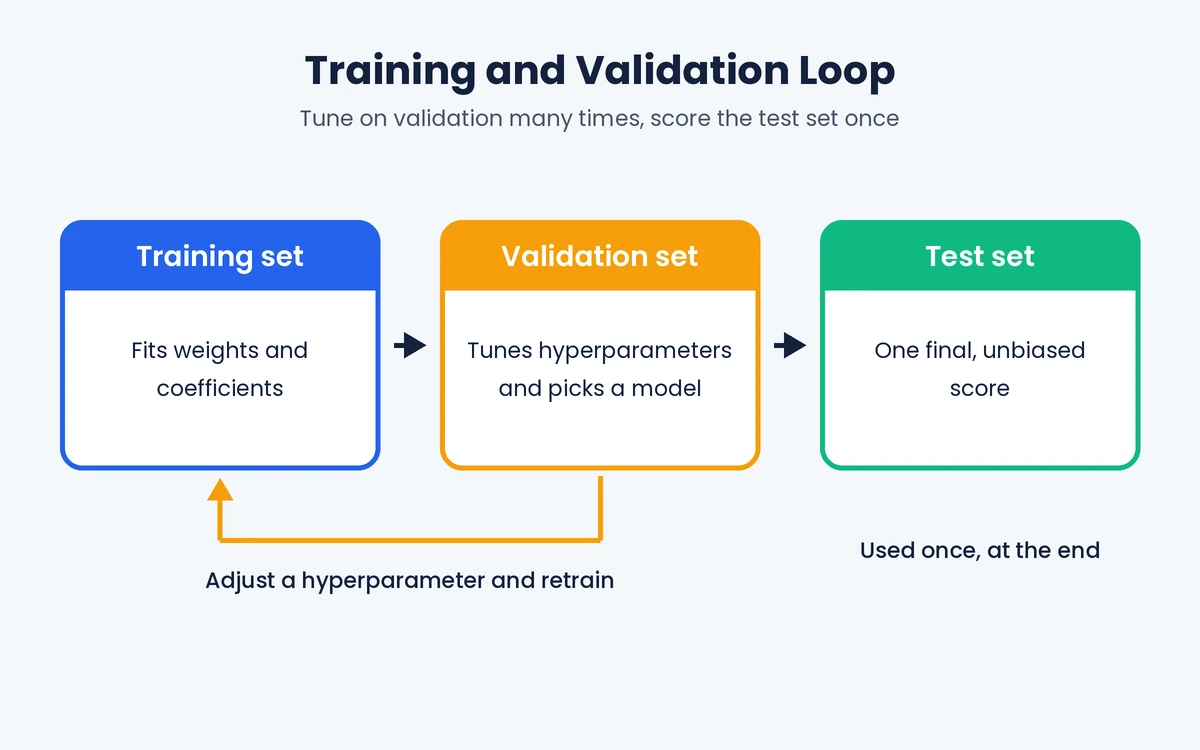
Training and validation data run in a loop during development. The model trains on the training set, then gets scored on the validation set. The engineer then adjusts a hyperparameter before repeating the cycle. Each round of that loop leaks a little information about the validation examples into the engineer's decisions. Stanford lecture notes on prediction point out that the winning model's error on a finite validation set typically underestimates its true prediction error. A separate test set exists to correct that optimism.
What Is the Difference Between Training, Validation, and Test Data?
The difference comes down to exposure: the model learns from training data, engineers make decisions with validation data, while nobody touches test data until the final evaluation. Exposure decides how often each subset gets used, as well as the damage misuse causes.
| Attribute | Training Set | Validation Set | Test Set |
|---|---|---|---|
| Main job | Fit model parameters | Tune hyperparameters, select a model | Estimate final performance |
| Seen by the learning algorithm | Yes | No | No |
| Influences engineering decisions | Yes | Yes | No |
| How often it is used | Every training step | Many times during development | Once, at the end |
| Typical share of data | 60 to 80% | 10 to 20% | 10 to 20% |
| Needs labels in supervised learning | Yes | Yes | Yes |
| Other names | Fitting set | Development set, dev set | Holdout set, evaluation set |
| Risk when misused | Memorization goes unnoticed | Optimistic model choice | Inflated final score |
Training vs Testing Data in a Two-Way Split
A two-way split drops the validation set, leaving only training vs testing data. This holdout setup works for a single model with fixed settings, such as a baseline logistic regression with default hyperparameters. Once tuning begins, every test score starts to steer decisions, so the project needs a third subset to keep the final evaluation clean.
Why Do People Confuse Validation Sets With Test Sets?
Validation sets get confused with test sets since textbooks from different fields swap the two labels, while some workflows skip one subset entirely. The concepts stay fixed even when the names change.
Searchers type the trio in every order, such as "test validation training" or "train test validation", yet each phrase describes the same three-way partition. The Stanford prediction notes describe a common shortcut in which teams use only training and validation, then call the validation stage "testing", a habit the notes themselves flag as confusing.
Benchmark downloads add to the confusion, as few public benchmarks ship a complete training test validation set. MNIST and CIFAR-10 ship without a validation split, so engineers carve one out of the training portion themselves. Whatever name a team uses, one rule settles the debate: the final subset gets used once, in the final experiment.
What Is the Recommended Train Test Validation Split?
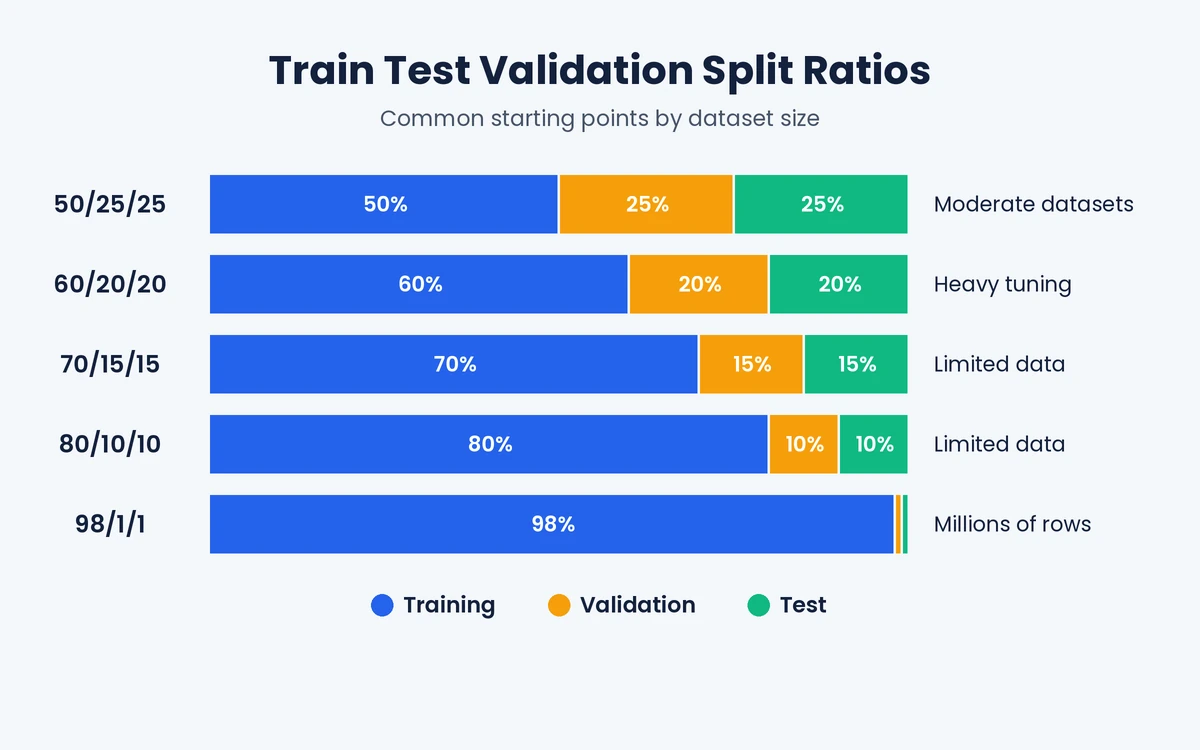
No single ratio fits every project, yet 70/15/15, 80/10/10, and 60/20/20 cover most datasets with a few thousand to a few hundred thousand rows. The right choice depends on dataset size as well as the number of decisions the validation set needs to support.
Common starting points include:
- 50/25/25: a classic split for moderate datasets, cited in Penn State STAT 857 course notes.
- 60/20/20: a balanced option for projects that tune many hyperparameters.
- 70/15/15 or 80/10/10: a good fit for limited labeled data, since the model needs most of it for learning.
- 98/1/1: workable for datasets with millions of rows, where 1% of 5 million rows still equals 50,000 evaluation examples.
The scikit-learn train_test_split function holds out 25% of the data for testing when no size is set, which makes it a two-way default rather than a three-way one.
How Large Does a Test Set Need to Be?
Size the test set by the precision you need, not by a fixed percentage. A test accuracy score behaves like a sample proportion, so its 95% margin of error equals 1.96 × √(p(1 − p) / n), the normal approximation formula taught in Penn State STAT 200. At 90% accuracy, the margin shrinks as the test set grows:
- 500 test examples: about ±2.6 percentage points
- 2,000 test examples: about ±1.3 percentage points
- 10,000 test examples: about ±0.6 percentage points
Two models scoring 90% and 91% on a 500-example test set sit inside each other's margin of error, so the comparison proves nothing. Pick a test size where the margin falls below the smallest accuracy difference your project needs to detect.
How Do Benchmark Datasets Split Their Data?
Public benchmarks fix their splits in advance, so every research team evaluates models on identical test examples, which keeps results comparable across papers. Fixed splits vary widely in size, with the ImageNet training set about 39 times larger than the UCI Adult training set.
| Dataset | Data type | Training | Validation | Test | Split detail |
|---|---|---|---|---|---|
| MNIST | Handwritten digits | 60,000 | Not provided | 10,000 | No writer appears in both sets |
| CIFAR-10 | 32×32 color images, 10 classes | 50,000 | Not provided | 10,000 | Exactly 1,000 test images per class |
| ImageNet (ILSVRC 2012) | Photos, 1,000 classes | About 1.2 million | 50,000 | 100,000 | Test labels never publicly released |
| UCI Adult | Census income records | 32,561 | Not provided | 16,281 | Random two-thirds to one-third split |
MNIST counts come from the MNIST database page, with CIFAR-10 counts taken from the CIFAR-10 dataset page. ImageNet counts come from the ImageNet generalization study by Recht et al., while the Adult counts come from the UCI Adult notes. The Modified National Institute of Standards and Technology (MNIST) authors kept the roughly 250 training writers separate from the test writers, so the model gets graded on handwriting styles it never saw. The ImageNet organizers withheld test labels to limit adaptive overfitting, the slow drift that happens when thousands of papers tune against one public test set.
How Do You Split a Dataset Into Training, Validation, and Test Sets?
To split a dataset correctly, hold out the test set first, choose a splitting strategy that matches how the data was collected, then divide the remaining rows into training and validation sets. Six steps keep the process clean:
- Define the unit of independence. Decide whether rows, customers, patients, devices, or days count as independent, since that unit decides how the split works.
- Remove exact duplicates. Deduplicate before splitting, so one record cannot land in two subsets.
- Hold out the test set first. Store it separately with a fixed random seed before any analysis begins.
- Split the remainder. Carve the validation set out of the remaining rows with the same strategy.
- Fit preprocessing on training data only. Learn scaling, imputation, and encoding statistics from the training rows, as the scikit-learn pitfalls guide recommends.
- Lock the split. Record the ratios, seed, date range, and strategy, then leave the test set alone until the final evaluation.
A stratified three-way split in Python takes two calls to the same function:
from sklearn.model_selection import train_test_split

  # Step 1: hold out 15% of all rows as the final test set
  X_temp, X_test, y_temp, y_test = train_test_split(
      X, y, test_size=0.15, stratify=y, random_state=42
  )

  # Step 2: split the remaining 85% into training (70%) and validation (15%)
  X_train, X_val, y_train, y_val = train_test_split(
      X_temp, y_temp, test_size=0.15 / 0.85, stratify=y_temp, random_state=42
  )
Which Splitting Strategy Fits Your Data?
Five splitting strategies cover nearly every project:
- Random splitting shuffles rows before cutting them by percentage, which suits independent, identically distributed records.
- Stratified sampling keeps class proportions equal across subsets, the standard choice for imbalanced problems such as fraud detection with 1% positive cases.
- Group splitting keeps every record from one patient, user, or device inside a single subset. Scikit-learn's GroupKFold enforces this rule automatically.
- Temporal splitting trains on older records, validates on newer ones, and tests on the newest window, which forecasting models require to avoid seeing future values.
- Cross-site external test sets hold out an entire hospital, region, or store chain to measure performance under distribution shift before deployment.
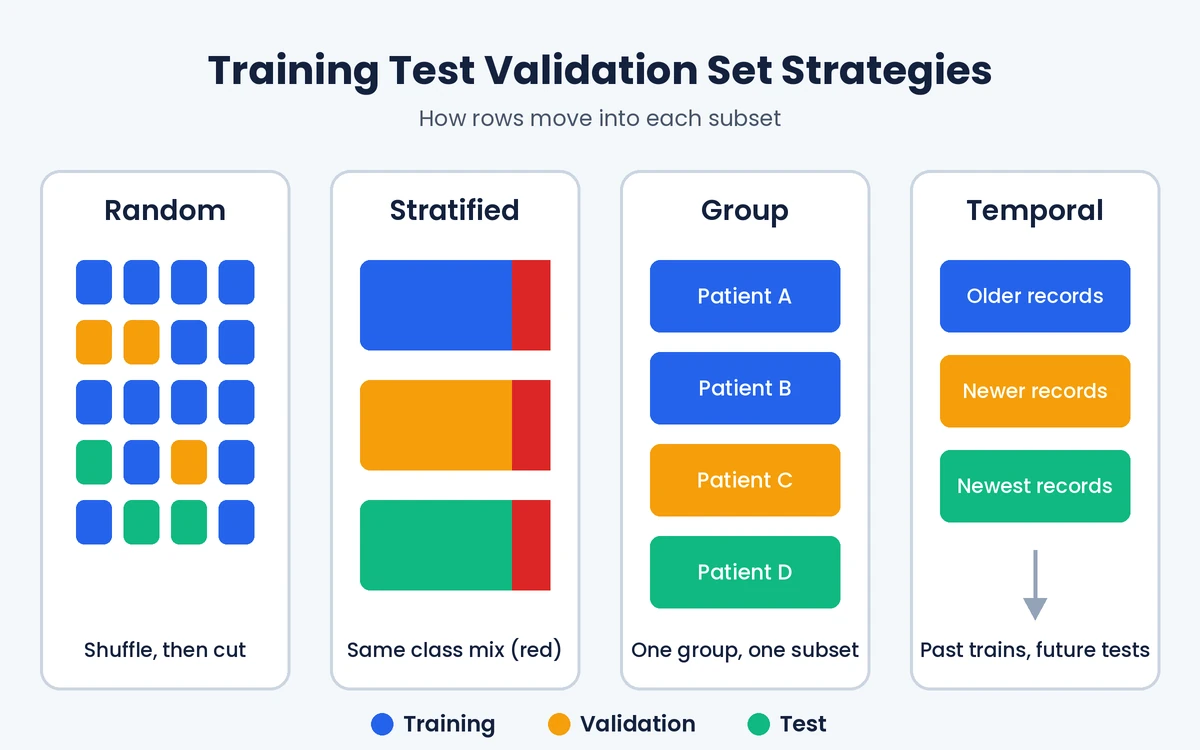
Good split design pairs naturally with feature engineering, since any feature built from future or cross-group information breaks the separation the split was meant to protect.
When Is Cross-Validation Better Than a Fixed Validation Set?
Cross-validation beats a fixed validation set when your dataset is too small to spare one, which typically means a few thousand labeled rows or fewer. Cross-validation reuses the training data for validation, so no example sits idle.
K-fold cross-validation splits the training data into k equal folds, trains on k − 1 folds, validates on the remaining fold, then rotates until every fold has served as validation once. A study of over half a million runs by Ron Kohavi at IJCAI found ten-fold stratified cross-validation to be the best method for model selection on real-world datasets, even when more folds were affordable. The scikit-learn cross-validation guide adds the rule that matters most: keep a separate test set for final evaluation, since cross-validation replaces only the validation set.
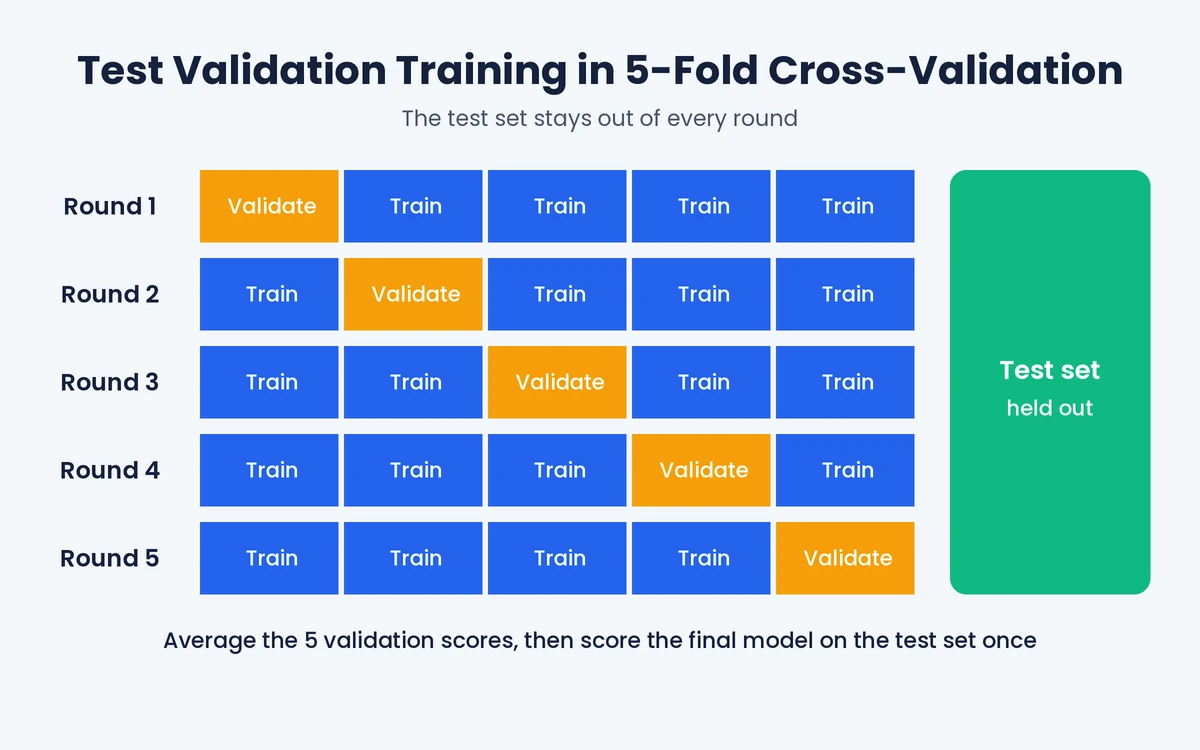
The four main evaluation methods trade speed for stability:
- Holdout method: one fixed validation split, the fastest option, with noisy estimates on small data.
- K-fold cross-validation: k training runs per model, a steadier estimate, at k times the compute cost.
- Nested cross-validation: an inner loop tunes hyperparameters while an outer loop evaluates, a fit for small datasets with heavy tuning.
- Bootstrap: resampling with replacement, with out-of-sample rows used for evaluation, compared directly against cross-validation in Kohavi's study.
Deep learning projects with millions of examples rarely run k-fold cross-validation, since a single training run can take days of GPU time. A fixed validation set is the practical default in that setting, a trade-off explained further in our guide to AI vs deep learning.
How Do Data Splits Work Beyond Supervised Learning?
Data splits extend to unsupervised, self-supervised, transfer, and reinforcement learning, with each paradigm redefining what the two held-out subsets measure. The core rule of keeping evaluation data unseen stays the same.
Unsupervised Learning and Anomaly Detection
Clustering has no labels, so the validation set compares settings such as the number of clusters in k-means, scored with an internal metric like the silhouette coefficient on held-out rows. Anomaly detection teams keep a small labeled test set of known anomalies, since an unsupervised model still needs ground truth for its final grade.
Self-Supervised Learning, Transfer Learning, and LLMs
Self-supervised pretraining consumes huge unlabeled corpora, while the downstream evaluation subsets stay small, fully labeled, sharing no text with the pretraining corpus. Fine-tuning a pretrained generative AI model works the same way: the pretraining corpus acts as one giant training set, while the fine-tuning dataset receives its own three-way split.
Web-scale pretraining creates a new failure called benchmark contamination, where public test questions end up inside training text. A NAACL 2024 study found that ChatGPT and GPT-4 guessed masked answer options from the Massive Multitask Language Understanding (MMLU) test set with exact match rates of 52% and 57%. A separate open contamination report measured accuracy boosts of up to 14% on contaminated C-Eval questions, with a smaller 7% gain on HellaSwag. Teams evaluating AI agent development projects apply the same lesson with a frozen set of private test conversations that never feed prompt tuning.
Reinforcement Learning and Online Learning
Reinforcement learning has no fixed dataset, so agents get tested on environment seeds, levels, or scenarios kept out of training. Online learning systems that update continuously evaluate on rolling temporal windows, which expose concept drift as recent performance falls below older performance.
What Mistakes Break the Separation Between Data Splits?
Four mistakes break the separation most often: reusing the test set, duplicating records across subsets, mismatching distributions, and leaking preprocessing statistics. Each one inflates reported accuracy without any warning sign in the training logs.
- Test set reuse turns the test set into a second validation set, since every look at test accuracy followed by a change leaks information into the model. Recht et al. collected fresh test sets for two benchmarks from scratch. The evaluated models lost 3% to 15% accuracy on the new CIFAR-10 test set, while ImageNet models lost 11% to 14%, with the authors tracing the drops to slightly harder images.
- Duplicate or near-duplicate records break the split when the same customer, a resized image copy, or a forwarded email thread appears in two subsets. The model then succeeds through recognition instead of learning.
- Mismatched distributions hide real errors. The same ImageNet study notes that its validation images came from different collection sources than its training images, a reminder that held-out data needs to mirror production inputs.
- Preprocessing leakage happens when scalers, imputers, and feature selectors fitted on the full dataset pass test statistics into training, a failure our overfitting prevention guide breaks down step by step.
Worked Example: Splitting 10,000 Support Tickets
The following hypothetical example compares a holdout split with 5-fold cross-validation on the same task: routing 10,000 labeled customer support tickets into 5 categories, where the smallest category holds 6% of all tickets. Both approaches run training testing and validation in the same order, with the test set scored last.
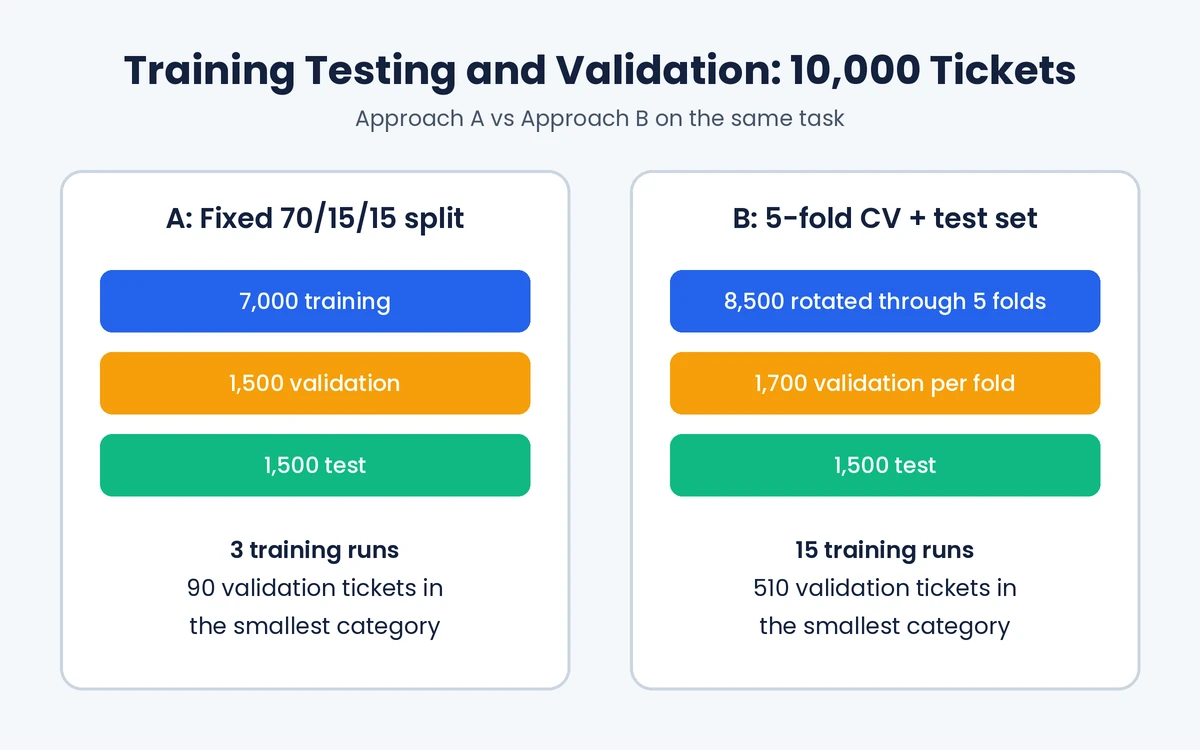
Approach A, fixed stratified 70/15/15 split:
- Input: 7,000 training tickets, 1,500 validation tickets, and 1,500 test tickets.
- Process: train naive Bayes, logistic regression, and gradient boosting, pick the best validation score, then score that model once on the test set.
- Output: one test accuracy with a margin of about ±1.5 percentage points at 90% accuracy.
- Strength: 3 training runs plus one final evaluation keep compute low.
- Limitation: the smallest category contributes only 90 validation tickets, so its recall estimate swings from one random split to the next.
Approach B, stratified 5-fold cross-validation plus the same test set:
- Input: the same 1,500 test tickets held out, with 8,500 tickets rotated through 5 folds, each fold training on 6,800 tickets while validating on 1,700.
- Process: 3 candidate models × 5 folds = 15 training runs, followed by one test evaluation of the winner.
- Output: a mean and standard deviation of 5 validation scores per model, plus one final test score.
- Strength: every one of the 8,500 tickets validates once, so the smallest category contributes 510 validation tickets instead of 90.
- Limitation: 5 times the training compute of Approach A.
Approach B gives a steadier model choice for a dataset this size, while Approach A becomes the better option once the dataset grows past a few hundred thousand tickets. Tickets from the same customer thread would need group splitting in either approach. A team turning a classifier like this into a product feature can validate the idea through proof of concept builds before committing to a full rollout.
Conclusion
Training, validation, and test data give every machine learning project three separate jobs: the training set fits parameters, the validation set guides hyperparameter tuning plus model selection, while the test set delivers one honest estimate of generalization error. A sound train test validation split starts with the test set, follows the structure of the data through stratified, group, or temporal splitting, and sizes each subset by the precision the project needs.
Cross-validation stretches small datasets further, while benchmark datasets show the value of fixed splits. The same discipline carries into clustering, fine-tuning, and LLM evaluation. Teams planning a model that has to perform on real users can explore AI development services or the wider custom software development work at O2SOFT.
Frequently Asked Questions
What is the difference between training data and test data?
Training data is the subset a model learns its parameters from, while test data is a separate subset the model never sees during training. Test data measures how well the finished model performs on new examples, so it gives the final accuracy figure a team reports.
Can you use validation data for training?
Yes, many teams retrain the chosen model on the combined training and validation data once hyperparameters are fixed. The validation set stops acting as an evaluation set at that point, so the untouched test set provides the only unbiased score.
Is the validation set the same as the test set?
No, the validation set guides decisions during development, while the test set grades the final model once. Some textbooks swap the two names, yet the subset used for the final, one-time evaluation always plays the test role.
Does test data need labels?
Yes, test data in supervised learning needs true labels, since accuracy, precision, and recall all compare predictions against ground truth. A model in production receives unlabeled inputs, yet its offline test set still requires labels for scoring.
What happens if you skip the test set?
Skipping the test set leaves the validation score as the only performance estimate, a score that runs optimistic since it shaped the model selection. The reported accuracy then overstates how the model performs after deployment.
How many examples does a validation set need?
A validation set needs enough examples for its margin of error to fall below the accuracy gaps between candidate models. At 90% accuracy, 1,000 validation examples give a margin of about ±1.9 percentage points, while 2,000 examples narrow it to about ±1.3 points.