


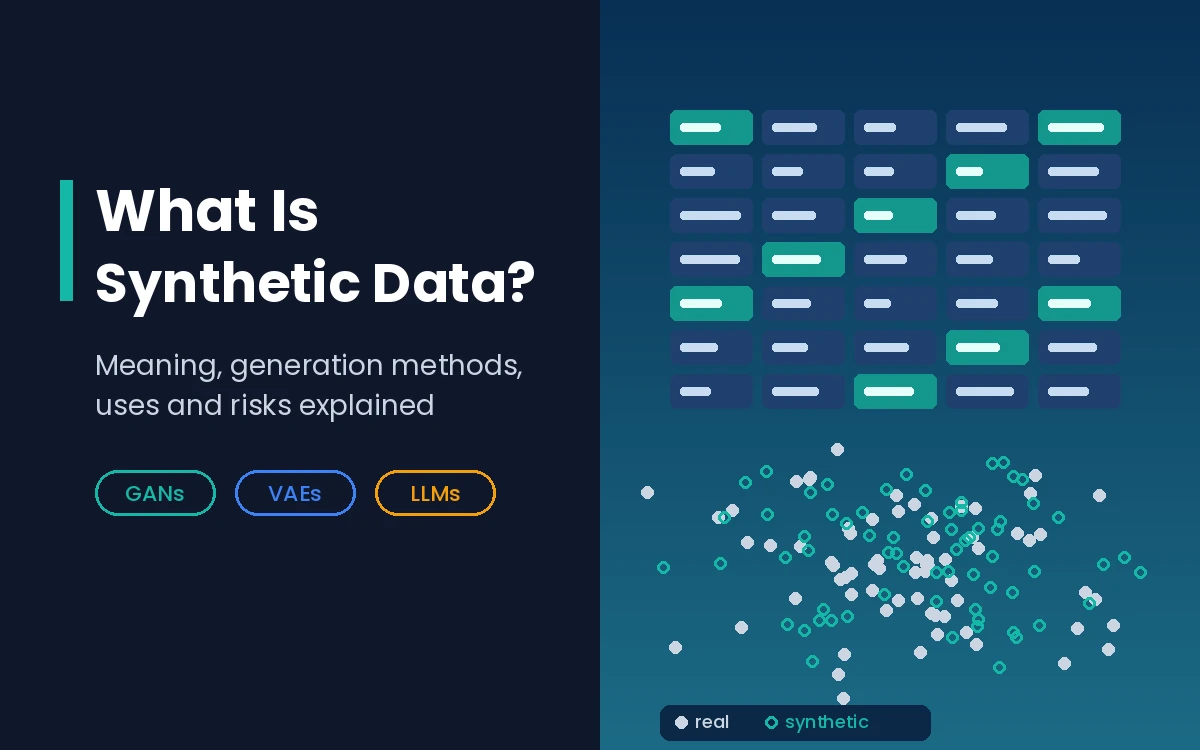
Synthetic data is fake data that a computer makes to copy the patterns of real data, without copying any real person or event. A program studies a real dataset, learns how its values relate, then creates new rows, images or text that follow the same rules.
Teams use it when real data is rare, costly to label or blocked by privacy laws. Good synthetic records come with labels already attached, hold no personal details and can be made in any amount a project needs.
The main uses are training machine learning models, testing software safely and sharing private data with outside researchers. Teams also use it to model events that rarely happen, such as fraud, machine failure or car crashes.
Each synthetic dataset has four parts, starting with a source of real data or rules. Next comes a method that makes new records, then a check for quality and privacy, then the final records. Used with care, synthetic data fills the gaps in real data. Used without checks, it passes old bias and errors into every model trained on it.
Key Takeaways
- Synthetic data copies patterns, not real people or events.
- Statistical models, GANs, VAEs and transformers can create it.
- Fake data protects privacy and supplies rare cases on demand.
- Copied bias and model collapse are the biggest risks.
- Always test synthetic data against real data you held back.
What Does Synthetic Data Mean?
Synthetic data means data made by an algorithm or a simulation instead of being measured in the real world. The word "synthetic" tells you how the data was made, not how good it is.
The synthetic data meaning covers several words people use for the same idea. Depending on the team, you may hear artificial data, generated data, simulated data, mock data or fake data.
Random numbers have no shape, while synthetic data keeps the shape of its source. A good generator keeps the averages, the spread and the links between columns. For example, if older customers spend more in the real table, they spend more in the synthetic table too.
The single records are new, yet each one behaves the way an analyst would expect. Fake data now helps almost every part of artificial intelligence, from fraud scoring to chatbots.
What Is a Synthetic Dataset?
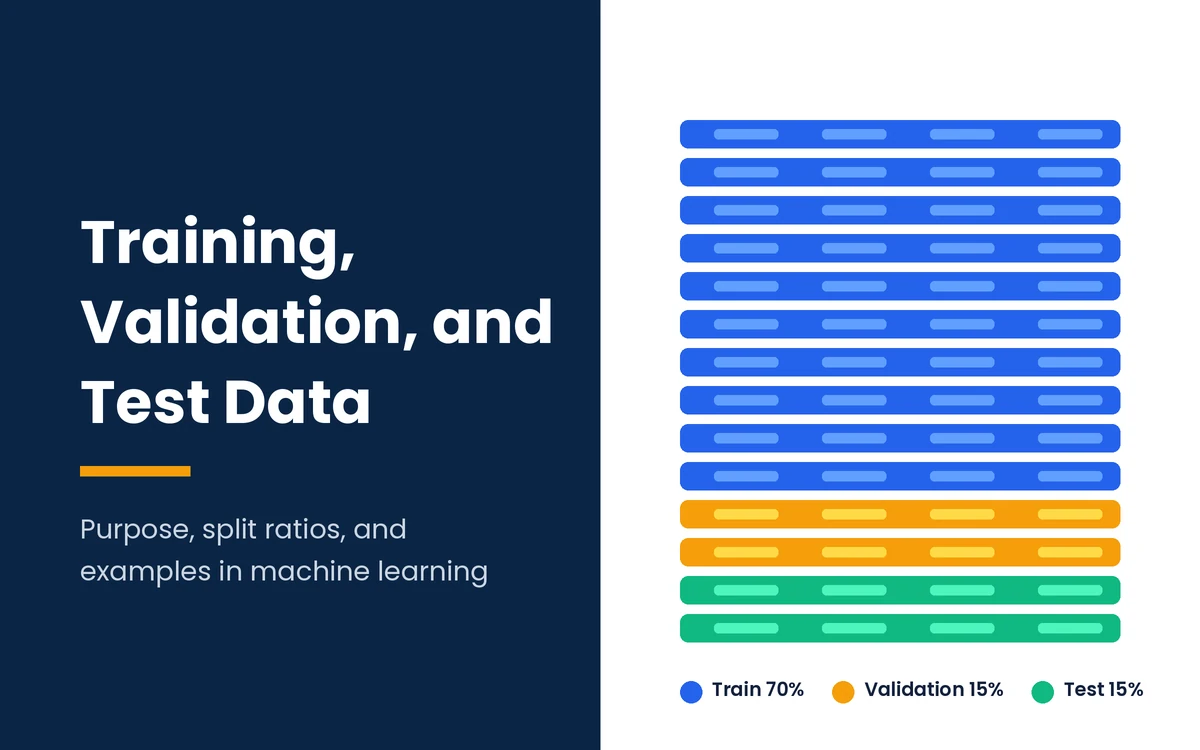
A synthetic dataset is a full set of generated records, laid out like any real dataset with rows, columns and labels. You can load one into Python, split it into training, validation and test sets, then feed it to a model the usual way.
The same rules that make good training data apply here. A synthetic dataset needs wide coverage, correct labels and enough examples of every class the model must learn.
What Are the Types of Synthetic Data?
Synthetic data is grouped by format, such as tables, text, images, audio, video or time series. A second grouping looks at how much of the data is fake: fully synthetic, partially synthetic or hybrid.
Types by Data Format
- Tabular data fills rows and columns with records such as customers, insurance claims or bank payments.
- Text data includes made-up chats, emails and documents used for natural language processing (NLP).
- Image and video data gives vision models rendered frames for image classification, image recognition and object detection.
- Time series data copies sensor readings, stock prices or heart-rate traces in the right order.
- Audio data provides speech and sound clips for voice assistants and noise monitoring.
Types by Level of Synthesis
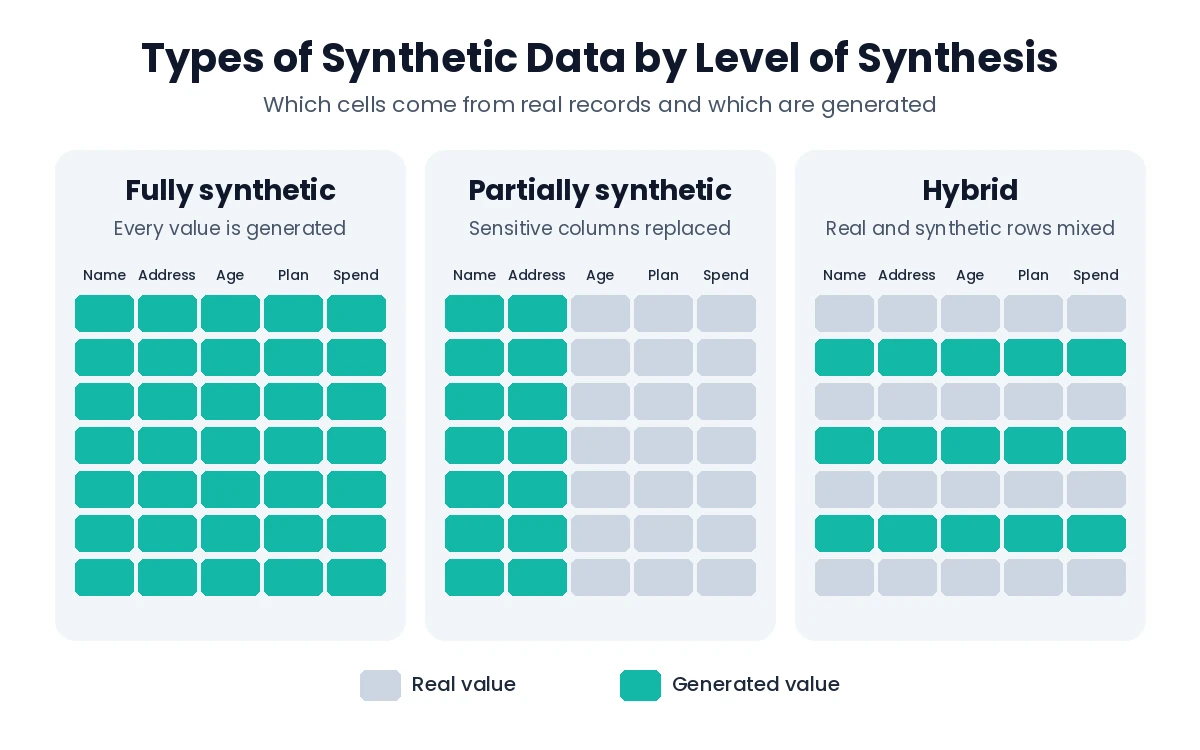
Fully synthetic data holds no real record at all. The generator learns the patterns of the source, then builds every row from scratch. A bank with few fraud cases can create thousands of fake fraud payments this way to train its fraud model.
Partially synthetic data keeps most of the real table but replaces private columns, such as names, addresses or diagnosis codes. Medical researchers like this approach because real outcomes stay in place while patient names disappear.
Hybrid synthetic data mixes real records with fully synthetic ones, often pairing each real row with a fake partner. Analysts get realistic numbers, yet no single row points back to one customer.
The three levels sit on a scale between privacy and detail. Fully synthetic data gives the most privacy of the three levels. Partially synthetic data keeps more real detail, but someone is more likely to be identified.
What Is Synthetic Data Generation and How Does It Work?
Synthetic data generation means training a model on real data or on known rules, then asking that model for new records. A synthetic data generator is the software that runs this train-then-sample loop.
Most generators follow four steps: they study the source data, learn its patterns, create new records, then compare those records with the original. The synthetic data generation techniques below differ mainly in how they learn the patterns.
Some rely on simple statistics, while others use the deep learning models that power modern AI. Each one learns from examples in much the same way that most AI systems learn.
Statistical Methods
Statistical methods work best when you already know how the data is spread out. Analysts fit a common curve, such as a bell curve, to each column. They then draw random values from that curve to make new data points.
Other statistical methods keep the links between columns in place. With time series data, linear interpolation adds new points between two real readings. Linear extrapolation extends the line past the last reading. Statistical methods run fast on a normal laptop, but they struggle with images, free text and complex patterns.
Generative Adversarial Networks (GANs)
Generative adversarial networks set two neural networks against each other. The generator turns random noise into fake records, while the discriminator tries to spot which records are fake.
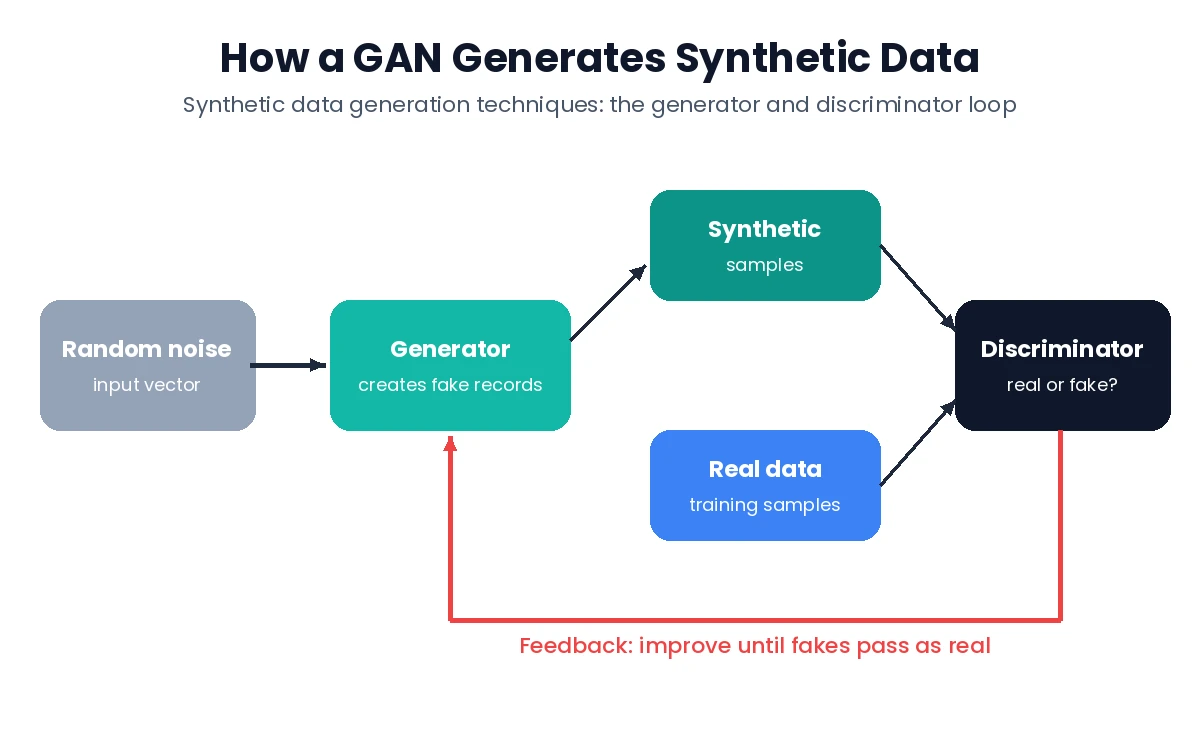
Each round of feedback helps the generator make more realistic output. Training stops when the discriminator can no longer tell real from fake. GANs became the top choice for fake images, faces and product photos. A version called CTGAN does the same job for tables.
Variational Autoencoders (VAEs)
Variational autoencoders learn to make small changes to the data they study. An encoder squeezes each input into a short summary of its main features. A decoder then builds new samples from those summaries.
VAEs train more steadily than GANs, so teams often pick them for fake images, sensor signals and rare-event data.
Transformer Models and Large Language Models
Transformer models, including OpenAI's generative pretrained transformers (GPTs), sit behind both small language models (SLMs) and large language models (LLMs). An encoder turns each word piece into embeddings, which are lists of numbers that store meaning and position.
A self-attention mechanism lets the model focus on the most useful words in a sentence. A decoder then uses those signals to predict the next word, one step at a time. Teams use transformers to write synthetic text, code, chats and even table rows written out as text.
Agent-Based Modeling and Simulation
Agent-based modeling builds a virtual world full of agents, such as drivers, shoppers or patients, who each follow simple rules. The simulation records how the agents act, and those records become synthetic data.
Health researchers run these models to estimate how fast a disease spreads. Carmakers use physics simulators to create crash, weather and traffic scenes that would be unsafe to stage on a real road.
Rule-Based and Privacy-Preserving Generators
Rule-based generators follow written rules, such as "an order always comes after the account sign-up date." Privacy-preserving generators add a little random noise while they learn from the source.
The noise lets the output meet differential privacy, a math-based promise that limits how much any one person's record can change the result. In 2018, NIST ran a public challenge built around this idea. Teams had to prove their generators kept the promise while keeping public safety data useful.
What Is Synthetic Data in Generative AI?
In generative AI, synthetic data is text, images or code that one model creates to train, tune or test another model. Synthetic data generation with generative AI now helps train chatbots, test safety rules and build small "student" models.
A clear example comes from a Microsoft Research team that built a coding model called phi-1. The model learned from about 6 billion tokens, or word pieces, of filtered web text plus 1 billion tokens of textbooks written by GPT-3.5. Even with only 1.3 billion parameters, phi-1 passed 50.6% of the tasks on the HumanEval coding test.
Teams use the same approach to create question-and-answer pairs, chat logs and test prompts for niche topics with little human-written data. Security teams make fake phishing emails and attack logs to train their alert tools, one of many uses of generative AI in cybersecurity.
Synthetic data also links the two sides of generative vs predictive AI. A generative AI model writes the examples, then a predictive model learns from them. The student can only learn what the teacher knew, so quality checks decide whether the plan works.
Synthetic Data vs Real Data: How Do They Compare?
Real data shows what actually happened, including surprises no model saw coming. Synthetic data gives you control, scale and privacy, yet it only knows the patterns its generator learned.
| Factor | Real data | Synthetic data |
|---|---|---|
| Source | Collected from people, sensors or payments | Made by a model, rules or a simulation |
| Cost | High cost to collect and label | Mostly computing cost after setup |
| Labels | Added by hand | Created with each record |
| Privacy risk | Holds personal details unless masked | Low when made and tested properly |
| Rare events | Few or missing examples | Made on demand |
| Accuracy | True by definition | Depends on the generator and checks |
| Bias | Shows past bias | Copies source bias unless fixed |
In practice, the synthetic data vs real data question usually ends with a mix of both. Teams train on the mix, then test the final model on real data they kept aside. Only real records can show how a model will behave after launch.
When Should a Business Use Synthetic Data?
Use synthetic data when real data is too private to share, too rare to learn from or too slow to collect. Skip it when you need exact facts about real people.
Synthetic data is a good fit in these cases:
- You need test data for a new app before any real users exist.
- Privacy rules stop you from sharing records with a vendor or offshore team.
- Your model must learn a rare event, such as fraud or a machine fault.
- Labeling your real images by hand would take months of work.
Synthetic data is a poor fit in these cases:
- You need to report real sales, real patient results or real audit numbers.
- Your source data is tiny, so the generator has little to learn from.
- No one on the team can check the output against real data.
What Are the Main Uses of Synthetic Data?
Synthetic data trains machine learning models, tests software and lets teams share private records. Teams also use it to model rare events and build computer vision systems. Banks, hospitals, factories, carmakers, statistics offices and market researchers all use it.
Generate Synthetic Data for Machine Learning
Teams generate synthetic data for machine learning when one class is much rarer than the others. Fraud, machine failure and rare diseases show up in a tiny share of real records. Models trained on raw data therefore learn to ignore them.
Adding fake examples of the rare class balances the training set. The same idea drives data augmentation, where small changes such as flips, crops or reworded sentences grow a small dataset.
Watch for overfitting when fake samples look too much alike. Clean feature engineering on the source data matters too. A generator copies every column it gets, flaws and all.
Computer Vision Synthetic Data
Computer vision synthetic data comes from 3D scenes or image tools, and each pixel gets its label as the image is drawn. Drawing boxes around objects by hand takes minutes per image, while a renderer does it instantly and without mistakes.
An ICCV 2021 paper showed that face models trained only on synthetic faces could match models trained on real photos. Factories use rendered images of scratched or dented parts to train inspection cameras. Self-driving teams create fog, glare and night scenes that are hard to film on demand. Search apps rely on similar images to improve visual image search.
Synthetic Training Data: Scientific Diagrams, Flowcharts and Charts
Models that read charts, flowcharts and scientific figures need huge numbers of labeled examples, yet real papers rarely include answer keys. Researchers solve this with synthetic training data: scientific diagrams, flowcharts and plots drawn by code from known numbers. Each answer is then known and correct from the start.
The FigureQA dataset, shared on arXiv in 2017, holds over 100,000 synthetic figures with more than one million question-and-answer pairs. Its images cover line plots, bar graphs and pie charts. The same draw-by-code idea works for the boxes, arrows and labels in flowcharts.
Synthetic Test Data Generation for Software
Synthetic test data generation fills test servers with lifelike records that hold no customer details. Testers need odd cases, such as expired cards, very long names, empty fields and huge orders. Live data rarely supplies these cases at the moment you need them.
A rule-based generator can create thousands of these cases in minutes. You can then rerun the same tests after every code change without touching a single real account.
Synthetic Data in Healthcare, Finance and Public Statistics
Hospitals and drug makers test their analytics on fake patient records, so no medical file leaves the building. Banks use fake payments for risk models, credit card fraud detection and money laundering tests.
Government statistics offices use synthetic data too, including the U.S. Census Bureau with its SIPP Synthetic Beta. The product links survey answers with tax and Social Security records, then replaces every value with a modeled one. Researchers can study income patterns without seeing any real person's file.
Synthetic Data in Market Research
In market research, synthetic data means fake survey answers or made-up customer profiles built from past studies. Brands test ideas, prices or messages on these fake respondents before paying for a full survey.
The results work best as an early filter before real fieldwork starts. A model can only repeat opinions found in its training data, so it will miss trends that have not happened yet.
What Are the Benefits of Synthetic Data?
The main benefits of synthetic data are privacy, endless volume, free labels, lower cost and rare cases that real data misses.
- Privacy: fake records hold no real personal details, so sharing them with partners is simpler.
- Speed: a generator can create millions of rows in hours instead of months.
- Free labels: every record carries its label from the moment it is made.
- Edge cases: teams can create the rare and risky events that real data lacks.
- Control: you can set the class balance, age mix or noise level to fit a test plan.
- Fairer data: teams can add records for groups that real data underrepresents, then measure fairness.
What Are the Risks of Synthetic Data?
The main risks of synthetic data are copied bias, weak accuracy, privacy leaks, model collapse and extra time spent on checks.
Bias Carried Over From the Source
A generator learns from real data, so it repeats any bias hidden in that data. A loan dataset that rejects one neighborhood too often will produce synthetic records with the same pattern. Running fairness checks on both the source and the output catches the problem before training starts.
Accuracy vs Privacy Trade-Off
Stronger privacy usually costs some accuracy in the fake records. Privacy noise protects people, yet the same noise blurs patterns that analysts need.
A generator that memorizes its training rows can leak real records outright. Teams run simple distance tests to confirm that no fake record sits too close to a real person.
Model Collapse and the Dangers of Using Synthetic Prompt Data in AI
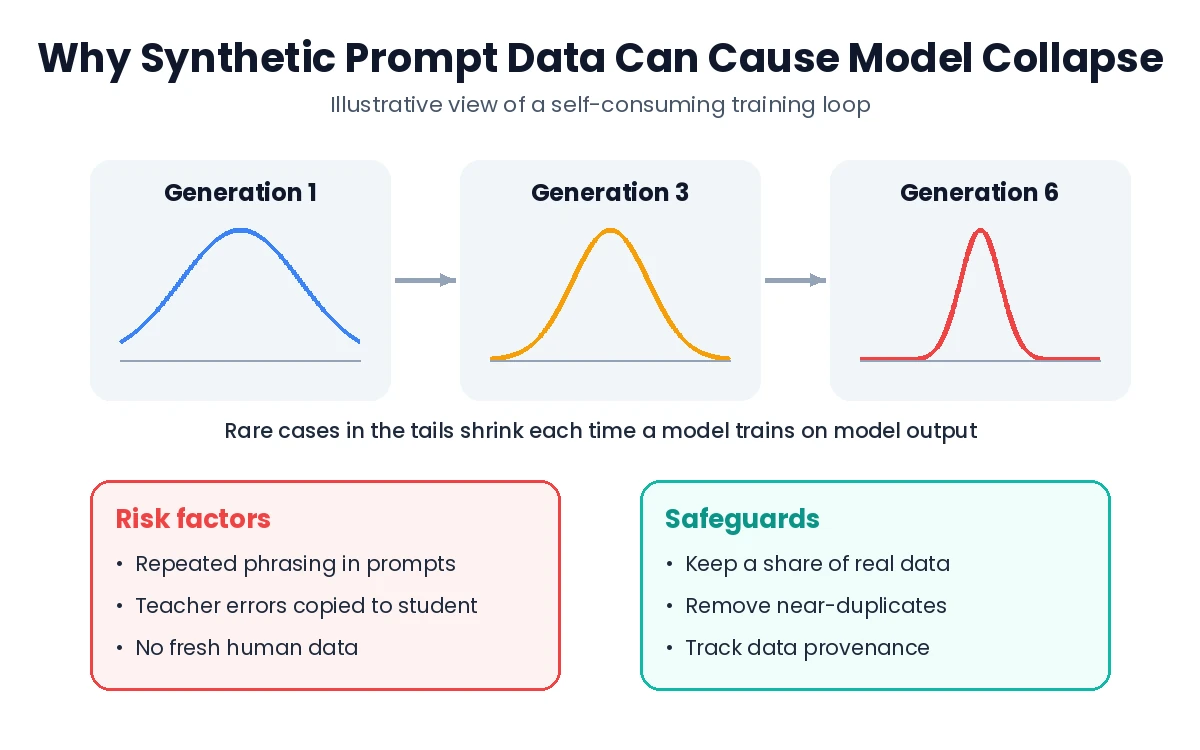
The dangers of using synthetic prompt data in AI grow when models keep training on the output of other models. A 2024 study in Nature, shared through a University of Oxford archive, found that careless training on AI-made content does lasting harm. The rare cases at the edges of the data slowly disappear, an effect the authors call model collapse.
An ICLR 2024 paper found the same pattern in image models. Without enough fresh real data in each round, image quality or variety dropped within a few rounds.
Synthetic prompts bring two more problems on top of collapse. Generated prompts tend to repeat the same wording, while any mistakes in the teacher model pass straight into the student. To lower the risk, keep a steady share of human-written data, remove near-copies and record where each sample came from.
Quality Checks Add Work
Every synthetic dataset needs testing before use, which adds a step to the project. Skipping that step risks shipping a model that fails on real patterns the generator never learned.
How Do You Measure Synthetic Data Quality?
Teams judge synthetic data on three things: fidelity, utility and privacy. Fidelity asks whether the fake data matches the real numbers closely. Utility asks whether a model trained on it works on real data. Privacy asks whether anyone can pull a real record back out.
- Fidelity checks compare averages, spreads and column links between the real and synthetic sets.
- Utility checks use a test called train on synthetic, test on real. One model trains on fake data, a second trains on real data, then both face the same real test set.
- Privacy checks measure how close each fake record sits to its nearest real record. Attack tests then see whether someone could tell which people were in the source.
In practice, start with the cheapest check by plotting a few key columns from both sets side by side. A gap in the plots can save hours of training on bad data.
Fake data can pass the fidelity check and still fail the real task. Track all three scores against the AI model you plan to train. Keep these scores in your wider AI governance records, next to notes on where the data came from and regular bias reviews.
How to Create Synthetic Data: A Step-by-Step Workflow
To create synthetic data, set a goal, clean the source data, pick a method, train the generator, check the output and record what you did.
- Set the goal. Decide whether the data will train a model, test software or support sharing. Each goal needs its own level of detail and privacy.
- Clean the source data. Fix errors, correct data types, remove names and IDs, then flag every column that holds private values.
- Choose among the synthetic data generation methods. Use statistics for simple tables, GANs or VAEs for images and complex tables, LLMs for text and simulation for physical scenes.
- Train the synthetic data generator. Fit the model on the source data, then tune settings such as training rounds, privacy level or class balance.
- Check the output. Score fidelity, utility and privacy against real data you held back, then remake any weak parts.
- Record and monitor. Write down the source, method, settings and scores so anyone can see how the dataset was made.
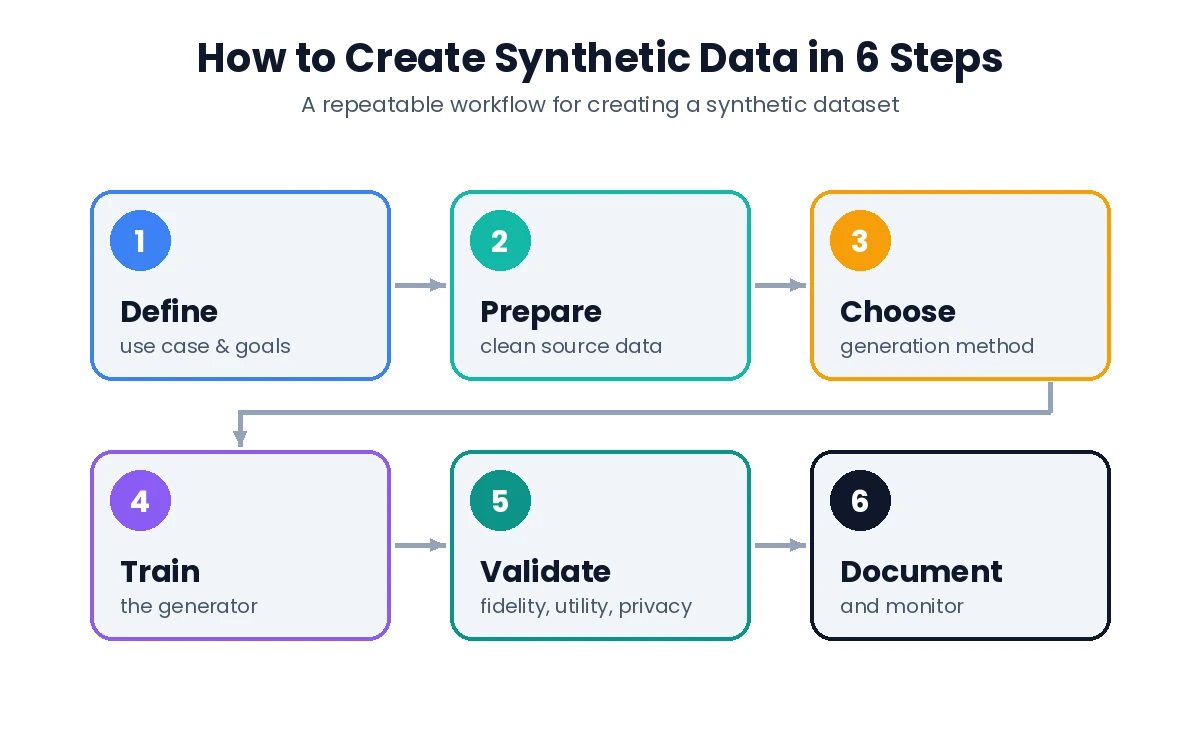
Creating a synthetic dataset follows these steps whether you write the code in Python or use a hosted tool. Many companies plan this pipeline with an AI development partner when they lack in-house data science staff.
Practical Tips Before You Generate
- Keep a slice of real data locked away before you start, because a test set the generator has seen proves nothing.
- Start small with a few thousand rows, check them, then scale up.
- Compare rare categories first, since generators drop small groups before they drop large ones.
- Save the random seed and settings, so you can recreate the same dataset during an audit.
Worked Example: Balancing a Fraud Dataset (Hypothetical)
Take a made-up card company with 200,000 payments, of which only 400 are fraud, a rate of 0.2%. A model trained on this raw data can score 99.8% accuracy by calling every payment safe. Even with that score, it catches no fraud at all.
The team trains a CTGAN model on the 400 fraud rows to create 9,600 fake fraud cases. A new model then trains on the combined set. Testing uses real payments only, comparing how much fraud each model catches against the first model. The fake rows teach the fraud patterns, while the real test set proves whether those patterns hold.
Which Synthetic Data Generation Tools Can You Use?
Synthetic data generation tools fall into three groups: free Python libraries, paid platforms and simulation engines. Ready-made synthetic datasets offer a fourth route when you only need sample data.
- Free libraries: the Synthetic Data Vault (SDV), first built at MIT's Data to AI Lab, offers Python models such as GaussianCopula and CTGAN. Faker, a separate Python library, creates fake names, addresses and emails for test databases.
- Paid platforms: hosted tools add privacy reports, data links and access controls for banks, hospitals and other strict fields.
- Simulation engines: game engines and physics tools render labeled images, video and sensor data for robots and self-driving cars.
- Ready-made datasets: vendors and public agencies publish synthetic sets for fraud, banking and health research.
The right synthetic data generator depends on your data type, your privacy rules and your team's skills. Teams with strict security rules often build this step into their own pipeline. With AI agent development, the create, check and retrain loop can then run on its own.
How Big Is the Synthetic Data Generation Market?
The synthetic data generation market was worth about USD 218 million in 2023, according to Grand View Research. The firm expects USD 1,788.1 million by 2030, a yearly growth rate of 35.3%.
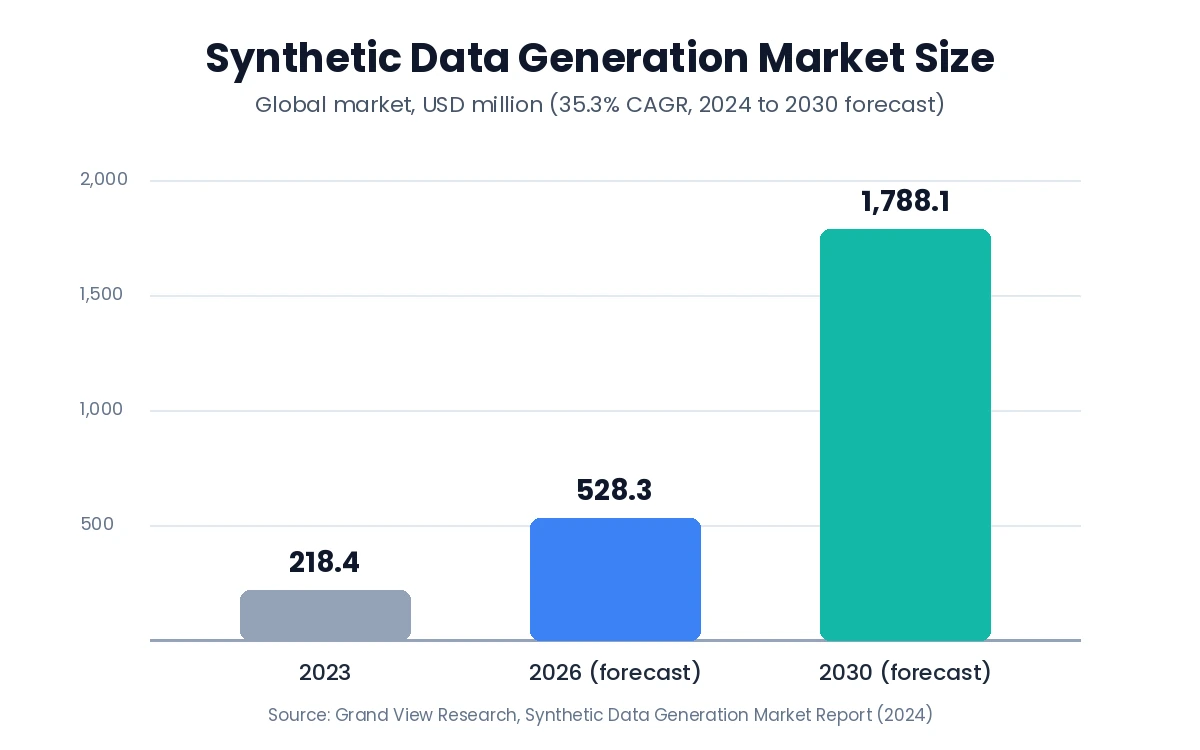
The same report expects USD 528.3 million in 2026, with North America as the largest region and Asia Pacific growing fastest. Fully synthetic data was expected to hold the largest share in 2023.
Other analysts see the same trend: in 2022, Gartner said synthetic data would fully overshadow real data in AI models by 2030. In 2024, the firm predicted that 75% of businesses would use generative AI to create synthetic customer data by 2026.
Market estimates vary a lot from firm to firm, so treat any single number as a rough guide.
Conclusion
Synthetic data gives teams new records that keep the patterns of real data while leaving real people out. Statistical models, GANs, VAEs, transformers and simulations each create it in their own way. The best choice depends on your data type and how much privacy you need.
Generated data brings privacy, scale, free labels and rare cases on demand. Careless use, though, copies bias or leads to model collapse. Before any fake data trains a model, test how close it is to real data, how useful it is and how safe it is.
Teams planning a first pipeline can look at a proven development process or ask an AI software partner to help build one.
Frequently Asked Questions
How is synthetic data used in AI?
Synthetic data trains, tunes and tests AI models when real data is scarce, private or missing rare cases. Common examples include fake fraud payments, rendered street scenes for self-driving cars and model-written questions for chatbots.
How does synthetic data help machine learning?
Synthetic data gives machine learning models more examples, balanced classes and perfect labels at low cost. Models still need testing on real data, since fake samples can miss patterns that only appear after launch.
Is synthetic artificial intelligence the same as synthetic data?
The two terms often get searched together, yet synthetic artificial intelligence is not the same as synthetic data. Synthetic data is the generated training material, while the AI that learns from it is a normal model.
What is the Synthetic Data Vault?
The Synthetic Data Vault (SDV) is a free Python library for creating synthetic tables, linked tables and time series. Researchers at MIT's Data to AI Lab first built it, with models such as GaussianCopula and CTGAN.
Is synthetic data the same as anonymized data?
Anonymized data is real data with names and IDs removed, so each row still describes a real person. Synthetic data contains newly made rows, although a poorly trained generator can still leak real records.
Can synthetic data replace real data completely?
Synthetic data can replace real data for some jobs, such as software testing or early prototypes. For live models, most teams combine both sources and keep a real test set. Only real data shows how a model will behave after launch.