



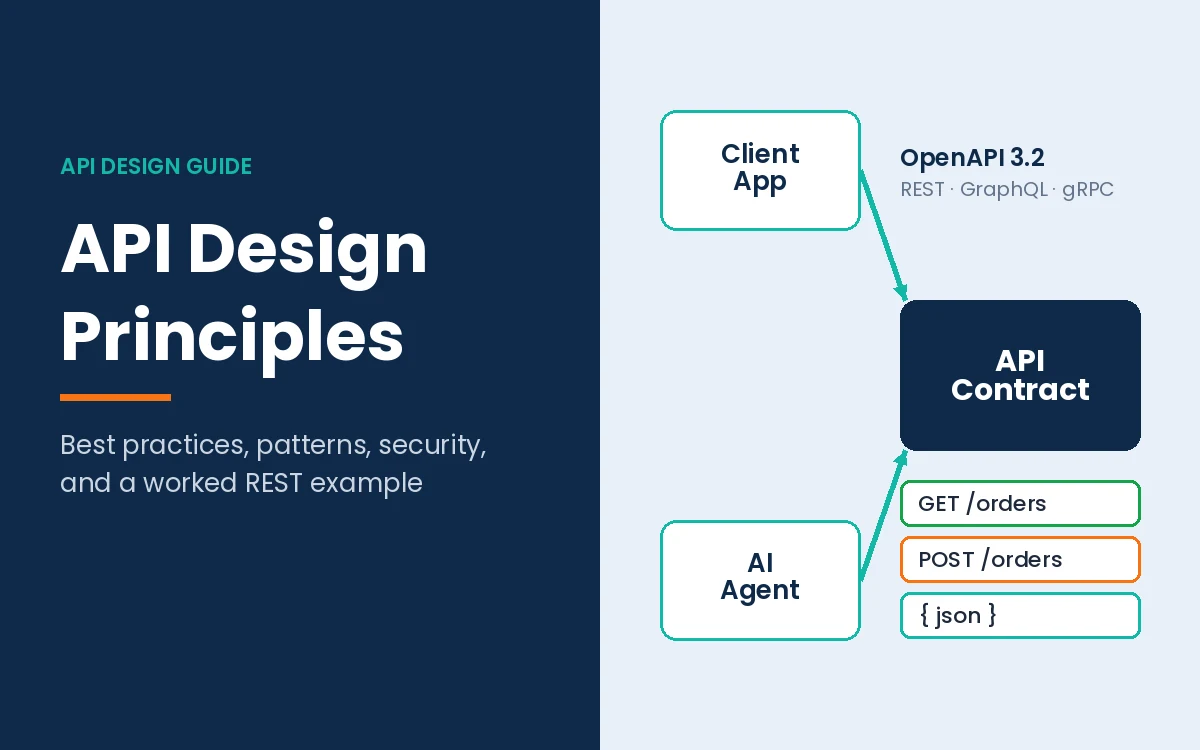
API design principles are the rules a team follows when deciding how an API exposes data and actions to the people and systems that call it. They cover endpoint names, HTTP methods, error formats, versioning, and access control. Good design starts with a written contract, usually an OpenAPI file, that producers and consumers agree on before anyone writes backend code.
Teams that apply these rules ship interfaces a developer can learn in an afternoon and change without breaking the mobile apps already sitting on users' phones. The same thinking covers public APIs sold as products, partner integrations, internal microservices, and platform APIs that other teams build features on.
The practice breaks down into nine parts: resource modeling, HTTP semantics, request and response formats, error handling, pagination, versioning, authentication, rate limiting, and documentation. Protocol choice sits over all of them, since REST, GraphQL, gRPC, SOAP, and WebSocket each pull the design in a different direction.
Most API problems that reach production, from leaked customer records to apps broken by one renamed field, start with a design decision made badly or skipped.
Table of Contents
- What Is API Design?
- What Is API Design First?
- What Are the Core API Design Principles?
- What Are REST API Design Principles?
- How Do REST, GraphQL, gRPC, SOAP, and WebSocket Compare?
- Which API Design Approaches Do Teams Use?
- How to Design an API in 6 Steps
- API Design Example: Building an Orders API
- What Are the Most Useful API Design Patterns?
- How Do You Secure an API by Design?
- How Do You Design AI-Ready APIs for Agents?
- What API Design Principles Skills Does a Developer Need?
- API Design Best Practices Checklist
- Conclusion
What Is API Design?
API design is the process of deciding how an application programming interface (API) exposes data and functions, recorded in a machine-readable contract of endpoints, methods, and resources. Most teams write that contract in OpenAPI for HTTP APIs or AsyncAPI for event-driven systems.
The OpenAPI Initiative released version 3.2.0 of its specification in September 2025, adding hierarchical tags and proper support for streaming responses. AsyncAPI plays the same role for message-driven systems built on Kafka, MQTT, or WebSocket channels.
Every design decision eventually lands on a developer somewhere downstream. A field name picked in a hurry gets typed hundreds of times, while a vague error message turns into a support ticket nobody wanted.
Why does API design matter so much now?
API design matters since most software now runs on APIs, and a flawed contract costs far more to fix after release than during a design review. Four reasons carry most of the weight for teams today:
- Adoption depends on how quickly developers reach a first successful call, and they drop interfaces that surprise them.
- Cost of change jumps after launch, and a late contract change can delay mobile app timelines since shipped app versions keep calling the old contract.
- Governance at scale gets easier when shared conventions let dozens of teams reuse the same linting rules, mock servers, and test suites.
- Security holes appear when authorization checks, input limits, and rate limits get bolted onto a live API instead of designed in.
What Is API Design First?
API design first means agreeing on the API contract before building anything, so the specification becomes the single source of truth for code, mocks, tests, and docs. Code-first works the other way round and pulls a contract out of whatever the backend already exposes.
Design-first pays off whenever someone outside your own team will call the API. Stakeholders review the contract while changes still cost nothing, and frontend developers build against mock servers from day one. Contract tests running in CI/CD pipelines then flag any drift between the spec and the live service.
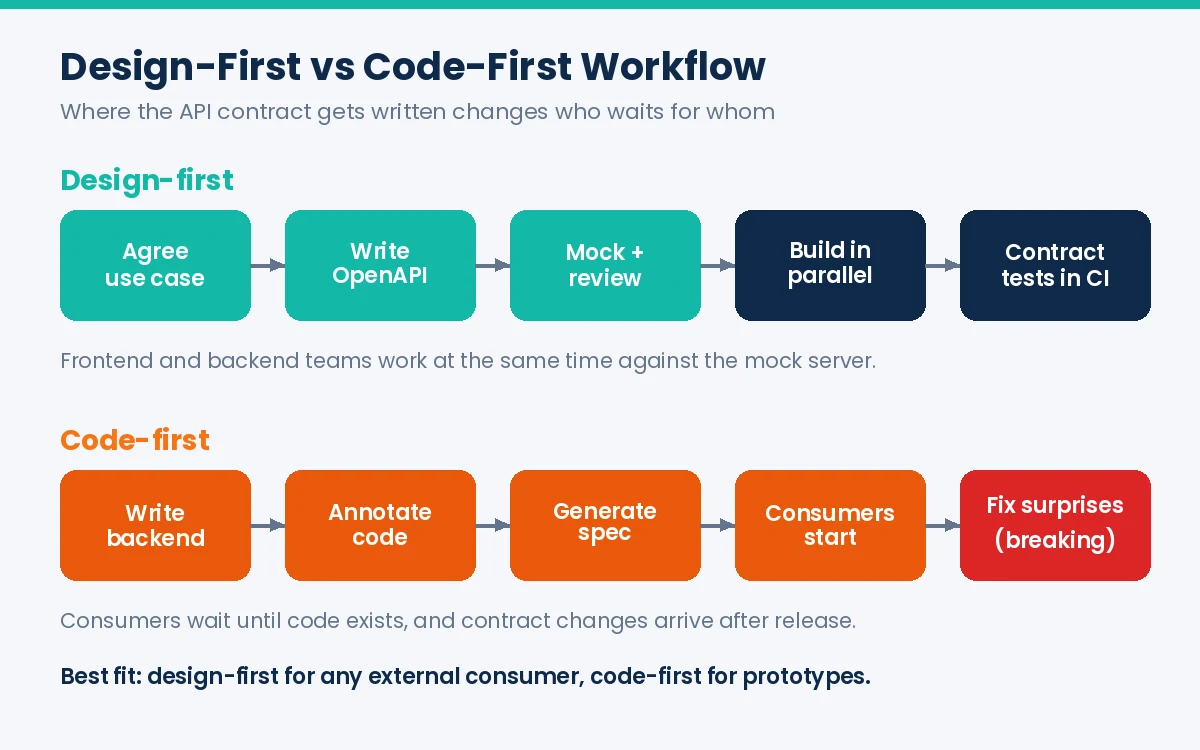
Code-first still makes sense for throwaway prototypes or internal scripts with one caller, where generating the spec from annotations later is quicker.
API first design principles teams actually follow
The API first design principles that survive real projects are few and practical:
- Treat the contract as a product with an owner, a changelog, and named reviewers.
- Keep the spec in a shared repository so changes go through pull requests like code.
- Generate mock servers from the spec and let consumers test against them early.
- Run contract tests in CI so the build fails when code and spec disagree.
- Get feedback from at least one real consumer before the first release.
Mocking does more work here than most people expect. A mock server returns sample responses straight from the definition, so a mobile team can finish its screens while the backend team is still writing database migrations. Reviews go smoother when the spec lives close to the team collaboration tools your developers already open every morning.
What Are the Core API Design Principles?
The core principles are consistency, resource orientation, statelessness, security by default, evolvability, efficiency, and discoverability, with documentation treated as part of the contract. Each one turns into concrete rules inside the spec.
Good API design principles are less about elegance and more about predictability. A developer who has used one of your endpoints should be able to guess how the next one behaves without opening the docs.
Consistency
Consistency means the same naming, casing, pagination parameters, status codes, and error shape appear on every endpoint across your whole portfolio.
API design consistency best practices are mostly small, boring rules that nobody notices until they break. Pick snake_case or camelCase for JSON fields and never mix the two inside one API. Use the same limit and cursor parameter names everywhere, and stick to a single date format such as ISO 8601. Publish the rules as a style guide, then enforce them with a linter in CI so a machine catches drift before a reviewer has to.
Resource orientation
Resource orientation means modeling the nouns of your domain, such as orders, customers, and invoices, while HTTP methods supply the verbs. Google's API Improvement Proposals build an entire style guide on this idea, with standard List, Get, Create, Update, and Delete methods applied to each resource.
Statelessness
Statelessness means every request carries everything the server needs, including the auth token, so any server instance can answer any call. Stateless APIs scale out without sticky sessions, and a crashed node does not lose anyone's place.
Security by default
Security by default treats every endpoint as reachable by an attacker until proven otherwise. Authentication, object-level authorization, input validation, and rate limits belong in the first version of the contract, where they cost a few lines of YAML.
Evolvability
Evolvability means the API can grow without breaking the clients already using it. Additive changes like a new optional field ship freely, while removals and renames wait for a new major version with a published sunset date.
Efficiency
Efficiency means moving the least data in the fewest round trips. Sparse fieldsets, compression, caching headers, and pagination keep payloads lean, and one compound endpoint can replace a workflow that used to need ten sequential calls.
Discoverability and documentation
Discoverability means a developer can work out what the API does without emailing the people who built it. Descriptive resource names, error messages that explain the fix, and reference docs generated from the spec all serve that goal. Error text deserves the same care a UI/UX design team gives to the copy on a checkout screen.
What Are REST API Design Principles?
REST principles come from six constraints Roy Fielding defined in 2000: client-server separation, statelessness, cacheability, a uniform interface, a layered system, and optional code on demand.
Roy Fielding's dissertation at the University of California, Irvine described Representational State Transfer (REST) as an architectural style rather than a protocol. Most modern web APIs borrow its ideas without following every single rule.
Leonard Richardson's maturity model gives a handy way to judge how RESTful an API really is. Level 0 sends everything to one endpoint, Level 1 introduces resources, and Level 2 uses HTTP methods and status codes properly. Level 3 adds hypermedia links, but most public APIs you will meet sit at Level 2, which is a fine target for nearly every team.
API design principles REST structure: resources, URIs, and nesting
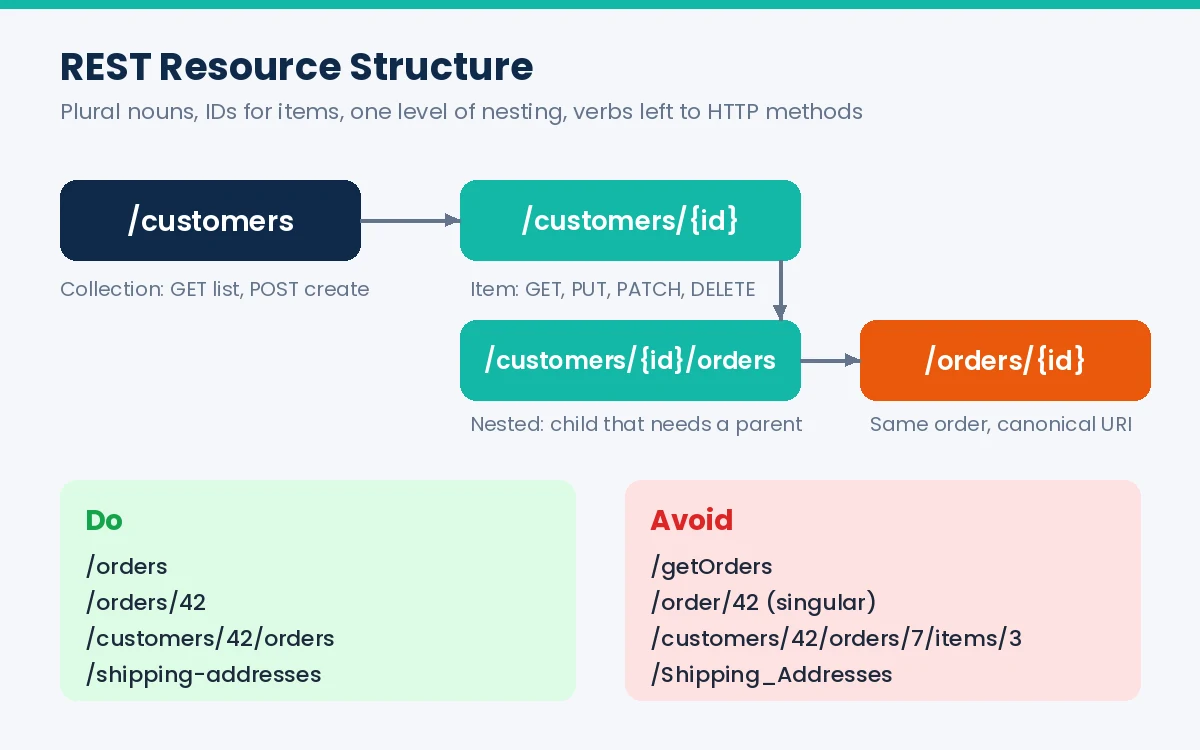
A clean REST structure exposes collections and items as URIs, nests only where ownership is real, and keeps verbs out of the path:
- Use plural nouns for collections, like /customers, /orders, and /invoices.
- Address a single item by its ID, as in /orders/{orderId}.
- Nest one level when a child cannot exist without its parent, as in /customers/{id}/orders.
- Stop at two levels, since a path like /customers/42/orders/7/items/3/variants is painful to read and route.
- Keep paths lowercase and separate words with hyphens, as in /shipping-addresses.
- Save action paths like /orders/{id}/cancel for operations that do not map cleanly to CRUD.
HTTP methods, safety, and idempotency
Each HTTP method carries a defined meaning, and clients rely on that meaning whenever they retry, cache, or prefetch a request. RFC 9110 defines which methods are safe, meaning read-only, and which are idempotent, meaning repeat calls leave the same end state.
| Method | What it does | Safe | Idempotent | Typical success code |
|---|---|---|---|---|
| GET | Reads a resource or collection | Yes | Yes | 200 |
| POST | Creates a resource or runs an action | No | No | 201 |
| PUT | Replaces a resource completely | No | Yes | 200 or 204 |
| PATCH | Updates part of a resource | No | Not guaranteed | 200 |
| DELETE | Removes a resource | No | Yes | 204 |
Idempotency decides what happens on a flaky mobile network. A client that retries a timed-out PUT or DELETE ends up in the same state. A retried POST, on the other hand, can create a second order unless the API supports idempotency keys.
HTTP status codes clients depend on
Return the status code that matches the outcome, and never send 200 OK with an error hidden inside the body. Client libraries, gateways, and monitoring tools all branch on the code before anyone reads the payload.
| Code | Meaning | When to return it |
|---|---|---|
| 200 OK | Success with a body | Successful GET, PUT, or PATCH |
| 201 Created | A new resource exists | POST that created something, plus a Location header |
| 204 No Content | Success with an empty body | DELETE, or an update with nothing to return |
| 304 Not Modified | The cached copy is still valid | Conditional GET with a matching ETag |
| 400 Bad Request | Malformed request | Broken JSON or an unsupported query parameter |
| 401 Unauthorized | Missing or invalid credentials | No token, or an expired token |
| 403 Forbidden | Authenticated but not allowed | Caller lacks the required role or scope |
| 404 Not Found | Resource does not exist | Unknown ID, or an object the caller may not see |
| 409 Conflict | State conflict | Duplicate email or a reused idempotency key |
| 422 Unprocessable Content | Valid JSON with invalid values | Field validation failures |
| 429 Too Many Requests | Rate limit exceeded | Always send with a Retry-After header |
| 503 Service Unavailable | Temporary outage | Maintenance or overload, with Retry-After |
Request and response design
Each piece of data belongs in a specific part of the HTTP message:
- Path parameters identify one resource, as in /orders/{orderId}.
- Query parameters filter, sort, and paginate, as in ?status=shipped&limit=20.
- Headers carry metadata such as tokens, content type, and trace IDs.
- The JSON body carries the payload for POST, PUT, and PATCH requests.
Responses follow the same split, with the representation in the body, the outcome in the status code, and metadata in headers. Validate payloads against a JSON Schema definition on both sides of the wire. Send ETag headers too, so clients can make conditional requests that return a cheap 304 instead of the full payload again.
How Do REST, GraphQL, gRPC, SOAP, and WebSocket Compare?
REST suits public resource APIs, GraphQL suits flexible frontend queries, gRPC suits fast internal calls, SOAP suits formal enterprise contracts, and WebSocket suits real-time messaging.
| Style | Data format | Transport | Best fit | Main trade-off |
|---|---|---|---|---|
| REST | JSON in most cases | HTTP/1.1 or HTTP/2 | Public and partner APIs | Over-fetching on complex screens |
| GraphQL | JSON | HTTP, single endpoint | Frontends pulling from many sources | Harder caching and query cost control |
| gRPC | Protocol Buffers (binary) | HTTP/2 | Internal microservices | Limited direct browser support |
| SOAP | XML described by WSDL | HTTP, SMTP, and others | Banking, insurance, government | Verbose with a steep learning curve |
| WebSocket | Any, often JSON | Long-lived TCP connection | Chat, live feeds, collaboration | Connection state and reconnect logic |
Real production systems mix these styles all the time, and no single one wins everywhere. A common setup puts REST on the public edge and gRPC between internal services. A GraphQL layer then sits in front of the web and mobile apps as a backend for frontend, with webhooks or WebSocket channels handling live updates.
GraphQL schema design principles
Facebook built GraphQL internally in 2012 and released it publicly in 2015, and the GraphQL specification now lives under the Linux Foundation. Schema design follows a short list of practical rules:
- Model what consumers care about, not how database tables are laid out.
- Mark a field non-null only when the server can always return it.
- Name mutations after business actions, such as placeOrder or cancelSubscription.
- Add fields freely, deprecate with @deprecated, and remove only after usage drops.
- Limit query depth and cost, or one nested query can exhaust the server.
gRPC and Protocol Buffers
Google developed gRPC and open-sourced it in 2015, and the gRPC project is now hosted by the Cloud Native Computing Foundation (CNCF). Services are defined in .proto files, and code generation produces typed clients in many languages, so type mismatches show up at compile time. Field numbers identify data on the wire, which lets teams add fields safely as long as they never reuse a retired number.
Which API Design Approaches Do Teams Use?
Teams usually pick one of three approaches: inside-out starts from the existing backend, outside-in starts from consumer needs, and agile refines the contract in short cycles.
- Inside-out design exposes what the backend already does, which gives fine-grained control but ties clients to internal structures. The approach fits internal APIs where the producer and the consumer sit on the same team.
- Outside-in design begins with consumer workflows and hides backend details, which produces loosely coupled APIs that are easier to evolve. Public APIs, partner APIs, and any API sold as a product benefit most from it.
- Agile design starts before the spec is finished and refines it with consumers sprint by sprint. Without contract tests and a versioning policy, agile iteration quickly turns into a stream of breaking changes.
How to Design an API in 6 Steps
To design an API, agree on the use case, model the resources, write an OpenAPI contract, validate it with mocks, document it, and plan for change.
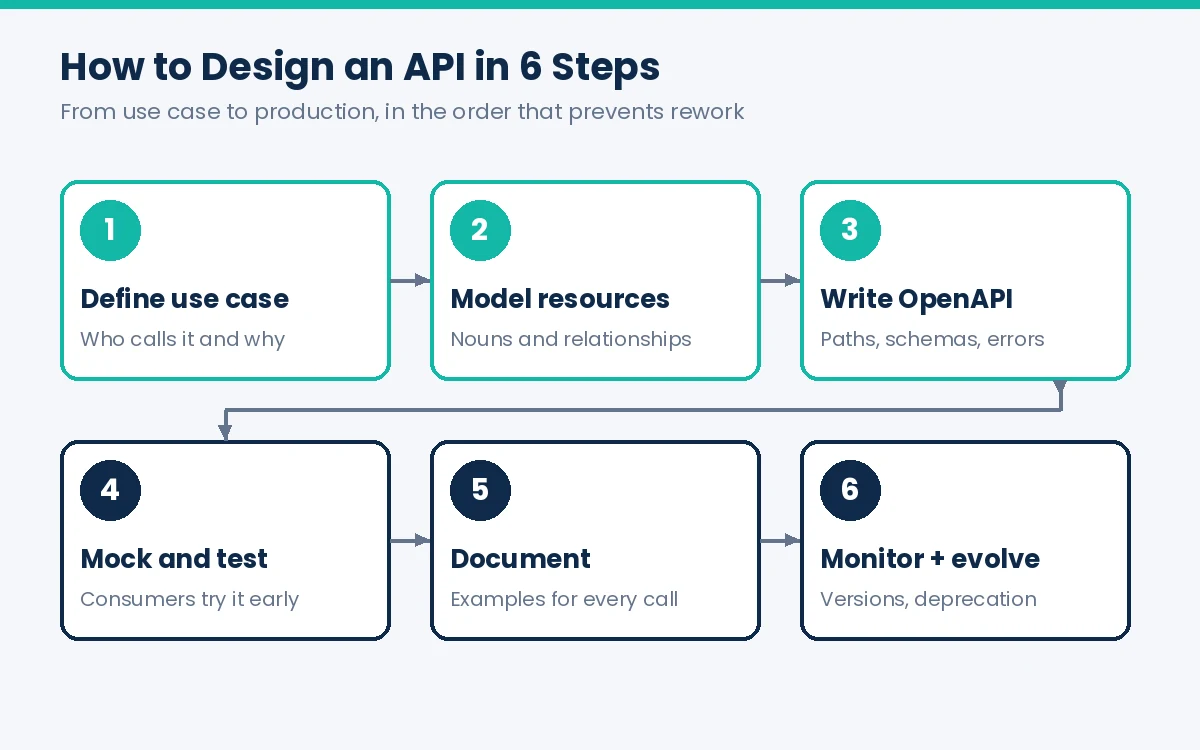
- Define the use case in plain language: who calls the API, what they need to get done, and how success gets measured. An authentication API and a product catalog API differ in traffic, latency targets, and security needs, so this choice shapes everything after it.
- Model the core resources and the relationships between them. List the nouns, decide which ones clients address directly, and sketch how they connect before naming a single endpoint.
- Write the contract in OpenAPI or AsyncAPI, covering paths, methods, schemas, error formats, auth schemes, and examples. Lint it against your style guide before anyone spends time reviewing it.
- Validate the contract with mock servers and automated tests. Consumers integrate against the mock filled with realistic synthetic test data, while contract tests run manually, on a schedule, and inside CI/CD pipelines.
- Document every resource, parameter, and error with working request and response examples. Generate reference docs from the spec, and add a short getting-started guide that ends in a successful first call.
- Plan for production traffic and future change before launch. Set latency targets and track error rates per endpoint, then settle a versioning and deprecation policy.
Anyone wondering how to design API contracts for a small internal tool can squeeze steps 3 to 5 into one day, but the order stays. You can compare these steps with our delivery process to see where design fits inside a full software build.
API Design Example: Building an Orders API
A hypothetical coffee ordering app makes a good API design example, since one small contract touches resource modeling, methods, status codes, idempotency, and error handling.
The app needs three resources: customers, menu items, and orders. Orders belong to customers and each order holds line items, so the API endpoint design looks like this:
| Method | Endpoint | Purpose | Success code |
|---|---|---|---|
| GET | /v1/menu-items | List menu items with cursor pagination | 200 |
| GET | /v1/customers/{customerId}/orders | List one customer's orders | 200 |
| POST | /v1/orders | Place an order, with an Idempotency-Key header | 201 |
| GET | /v1/orders/{orderId} | Fetch a single order | 200 |
| PATCH | /v1/orders/{orderId} | Change the pickup time | 200 |
| POST | /v1/orders/{orderId}/cancel | Cancel an order before preparation starts | 200 |
Placing an order sends a POST with an idempotency key, so a double tap on a slow connection never charges the customer twice:
POST /v1/orders
Idempotency-Key: 7f3c2a9e-1b4d-4c8e-9f21-5a6b7c8d9e0f
Content-Type: application/json

{
"customer_id": "cus_1042",
"pickup_time": "2026-11-26T09:15:00Z",
"items": [
{ "menu_item_id": "itm_latte", "quantity": 2, "size": "large" }
]
}
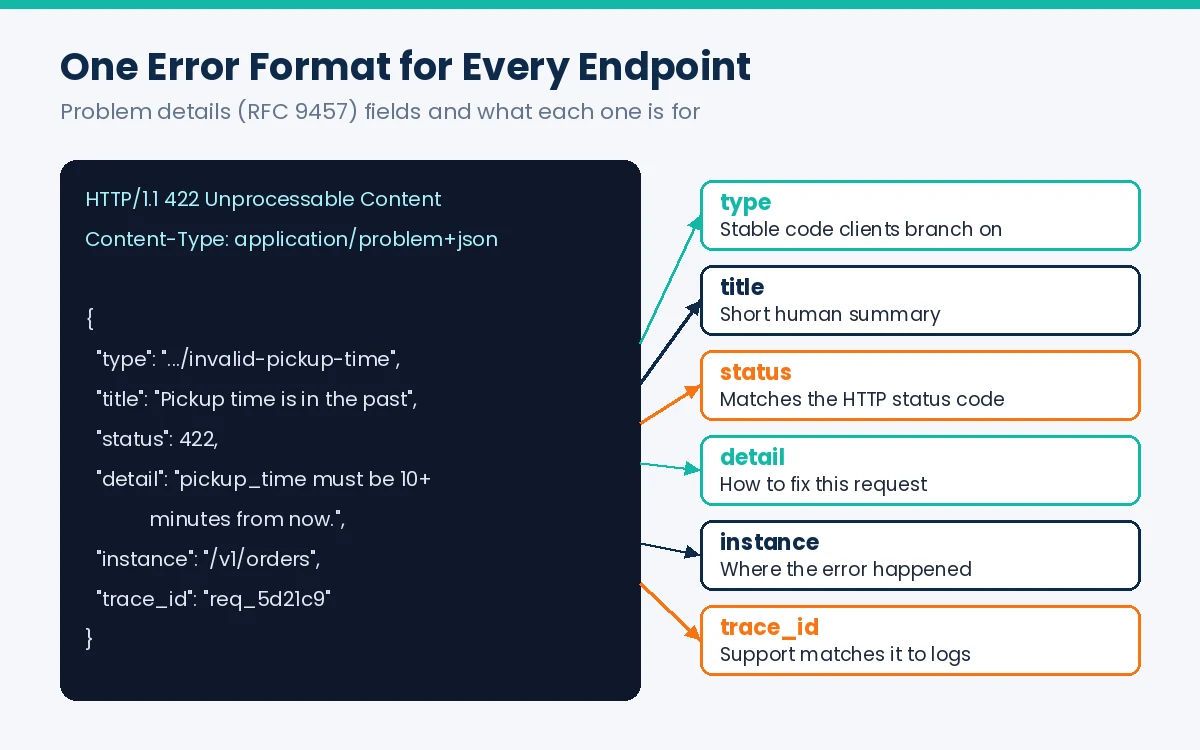
The server answers with 201 Created, a Location: /v1/orders/ord_88213 header, and the full order in the body. When a field fails validation, the response uses the problem details format from RFC 9457:
HTTP/1.1 422 Unprocessable Content
Content-Type: application/problem+json

{
"type": "https://api.example.com/problems/invalid-pickup-time",
"title": "Pickup time is in the past",
"status": 422,
"detail": "pickup_time must be at least 10 minutes from now.",
"instance": "/v1/orders",
"trace_id": "req_5d21c9"
}
Every endpoint in the app returns errors in this one shape, so the mobile team writes a single error handler instead of six slightly different ones.
What Are the Most Useful API Design Patterns?
The API design patterns with the biggest payoff are cursor pagination, consistent filtering, idempotency keys, standard error responses, versioning with deprecation headers, and webhooks.
Pagination: offset vs cursor
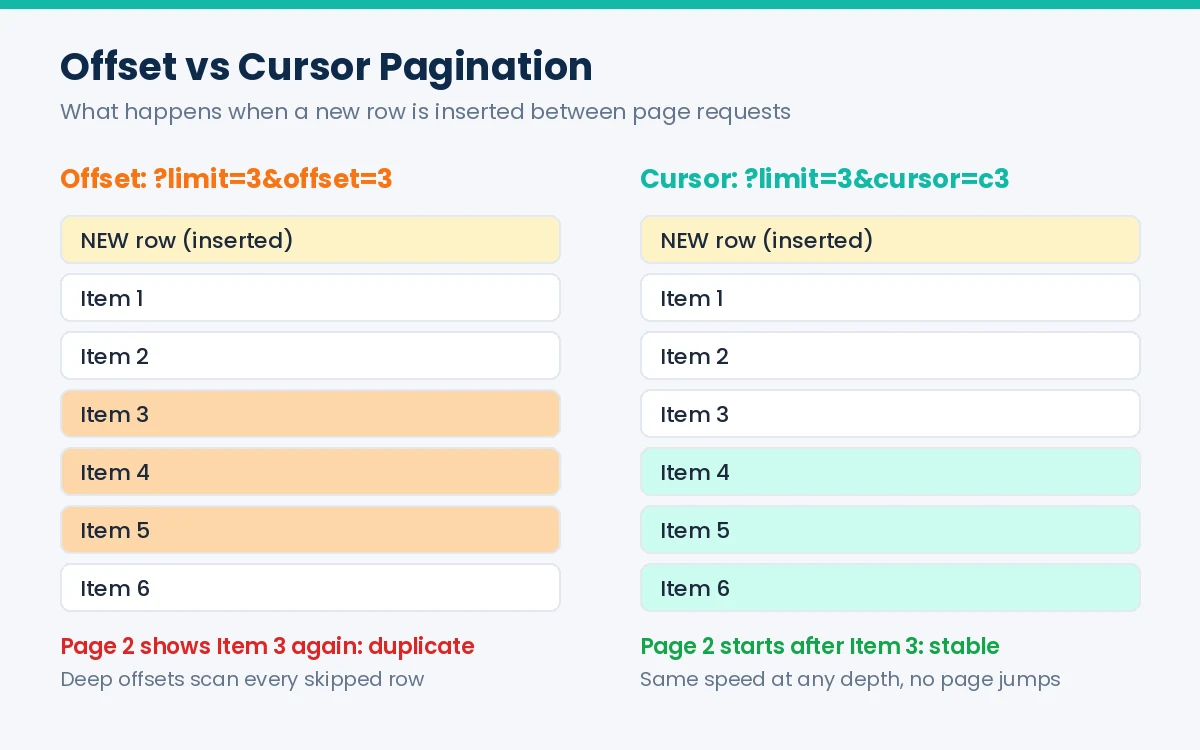
Offset pagination uses limit and offset, so ?limit=20&offset=40 returns items 41 to 60. Clients can jump to any page, but inserts between requests cause duplicates or gaps. Deep offsets get slow as well, since the database scans past every skipped row.
Cursor pagination returns an opaque cursor marking a position, like ?limit=20&cursor=eyJpZCI6MTIzfQ. Results stay stable when data changes and speed stays flat at any depth, which makes cursors the better default for feeds, timelines, and big tables. The trade-off is losing the ability to jump straight to page 37.
Filtering and sorting
Put filters in query parameters with one consistent grammar, such as ?status=active&created_after=2026-01-01, plus ?sort=-created_at for descending order. Document which fields are filterable, validate values against an allowlist, and return 400 with a clear message for unsupported fields.
Idempotency keys
An idempotency key is a unique value the client sends in an Idempotency-Key header on POST requests, a pattern an IETF draft is working to standardize. The server stores the key with the first response and replays that response on any retry carrying the same key. Keys typically expire after 24 hours, stay scoped to one client, and trigger an error when reused with a different payload.
Consistent error responses
Use one error schema across every endpoint, ideally the problem details format defined in RFC 9457. A useful error body carries a stable machine-readable type, a human-readable title, the field at fault, and a trace ID support staff can match against server logs. Clients branch on the type and never on the message text, so you can reword messages without breaking anyone.
Versioning and deprecation
URI versioning such as /v1/orders is the most visible option and the easiest to route, cache, and document. Header versioning keeps URLs clean but hides the version from anyone reading logs, while query parameter versioning like ?version=1 is simple but easy to forget. Whichever you pick, apply semantic versioning discipline to the contract and publish a written deprecation policy.
RFC 9745, published by the Internet Engineering Task Force (IETF) in March 2025, standardized the Deprecation response header. The older Sunset header from RFC 8594 tells clients the date an endpoint stops working, and its date may not come before the deprecation date. Send both headers, link to a migration guide, and watch traffic on the old version before switching it off.
Webhooks and event-driven APIs
Webhooks push events to a URL the client registers, which saves clients from polling an endpoint every few seconds. Sign each payload with an HMAC secret, include an event ID so receivers can drop duplicates, and retry failed deliveries with exponential backoff. Describe event schemas in AsyncAPI next to your OpenAPI file, since those payloads often feed ETL pipelines further downstream.
How Do You Secure an API by Design?
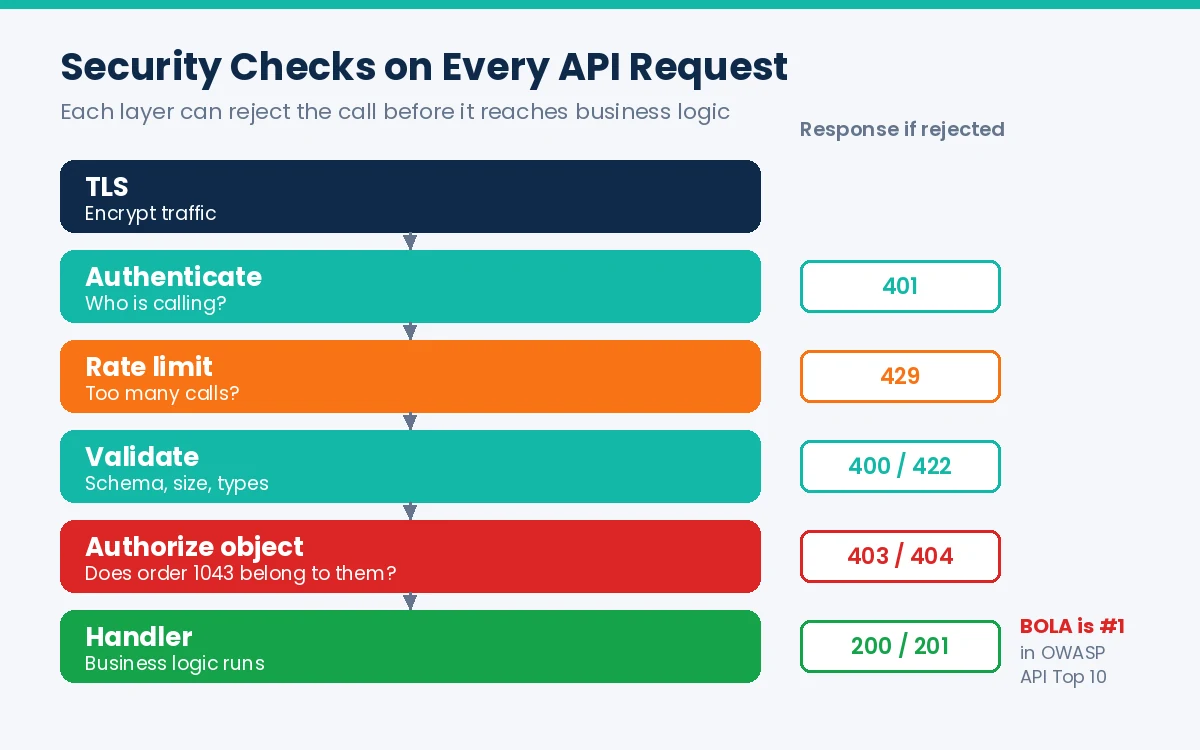
Secure an API by authenticating every caller, authorizing every object, validating input against a schema, limiting request rates, and encrypting traffic with TLS before launch.
The 2023 edition of the OWASP API Security Top 10 ranks Broken Object Level Authorization (BOLA) as the number one risk. BOLA happens when an API checks that a user is logged in but never checks whether order 1043 actually belongs to them. Changing one number in the URL then exposes somebody else's data.
API keys, JWTs, and OAuth 2.0
API keys are static strings that identify an application, which suits server-to-server integrations. Anyone can pull them out of a browser bundle or mobile app, though, so keep them off the client side. A JSON Web Token (JWT) is a signed token carrying claims such as user ID, scopes, and expiry, so the server verifies it without a database lookup.
Delegated user access belongs to OAuth 2.0, which issues short-lived access tokens and refresh tokens with narrow scopes. Rotate API keys on a schedule and keep JWT lifetimes short, since revoking a token before it expires is hard.
Authorization and RBAC
Role-based access control (RBAC) maps identities to roles and roles to permissions, so a support_agent can read customer records while only an admin can issue refunds. Check permissions at the object level inside each handler and return 403 when a caller lacks a scope. Return 404 instead when even admitting the object exists would leak information.
Rate limiting and input validation
Rate limits protect availability and stop one noisy tenant from starving everyone else on the platform. Use a token bucket or sliding window algorithm, layer limits per key, per account, and per endpoint, and return 429 with a Retry-After header. Many APIs send RateLimit-Limit, RateLimit-Remaining, and RateLimit-Reset headers too, a format drawn from IETF working drafts.
Validate every payload against its schema, cap request body sizes, and strip response headers that reveal server versions or framework names. Security teams looking at automated defenses can read our piece on generative AI in cybersecurity for the wider threat picture.
How Do You Design AI-Ready APIs for Agents?
AI-ready APIs give agents clear operation names, detailed descriptions, strict schemas, predictable errors, and idempotent writes, so a model picks the right call and recovers from failures.
Large language models read your OpenAPI descriptions the way a new developer reads docs, only faster and far more literally. A summary like "Gets data" leaves an agent guessing, while "Returns a customer's unpaid invoices, newest first" tells it exactly when to call the endpoint.
The Model Context Protocol (MCP), an open standard Anthropic introduced in November 2024, wraps existing APIs as tools that assistants can discover and call. MCP servers sit on top of your API, so its design quality passes straight through to every agent using it. Agent-friendly design comes down to a few simple habits:
- Write operation descriptions that state purpose, inputs, side effects, and limits.
- Use enums for fixed values so agents cannot invent invalid options.
- Make write operations idempotent, since agents retry more often than people do.
- Return errors that explain how to fix the request.
- Scope agent credentials narrowly and log every tool call with a trace ID.
Whether the caller is a person or an AI model, the contract is the only thing it sees. Teams building agents on company data can pair a well-described API with an AI agent knowledge base. Our AI agent development team works on exactly that kind of integration. Broader AI development services cover model features that sit behind the same APIs.
What API Design Principles Skills Does a Developer Need?
The skills that matter most are HTTP fluency, data modeling, specification writing, security thinking, clear technical writing, and judgment about managing change.
- HTTP fluency covers method semantics, caching, conditional requests, and status codes you can recall without searching.
- Data modeling turns a messy business domain into clean resources with sensible relationships.
- Specification writing means reading and editing OpenAPI, AsyncAPI, or Protocol Buffers files by hand.
- Security thinking spots object-level authorization gaps and abuse paths during review, before code exists.
- Technical writing produces descriptions, examples, and error messages a stranger understands on first read.
- Change management covers versioning, deprecation timelines, and checking usage data before removing anything.
Developers coming from mobile app development often have a head start on the consumer side, since they have lived with badly designed APIs from the client end.
API Design Best Practices Checklist
API design best practices come down to a short pre-release checklist that any reviewer can walk through before the first external release. Treat it as your team's own version of application programming interface standards, and add rules every time an incident teaches you something.
- Confirm the contract exists in OpenAPI or AsyncAPI and passes linting.
- Check that every resource name is a plural noun with no verbs in paths.
- Verify each method and status code matches RFC 9110 semantics.
- Return the same error schema from every endpoint.
- Paginate every collection, preferably with cursors.
- Require idempotency keys on POST endpoints that move money or create orders.
- Authorize access at the object level as well as the route level.
- Set rate limits and document the Retry-After behavior.
- Version the API and publish a deprecation policy.
- Generate docs from the spec with a working example for each endpoint.
- Track latency, error rate, and usage per endpoint from day one.
- Write descriptions clear enough for an AI agent to choose the right call.
The checklist works the same way on web development services projects, and our web app guidelines pick up the front-end side of the same contract.
Conclusion
API design principles and best practices turn dozens of small interface decisions into a practice a whole team can repeat. Write the contract first, model resources carefully, and use HTTP methods and status codes as the specification defines them. Return one error format, paginate and version from day one, and check authorization on every object a caller touches.
Teams planning an API as part of a larger custom software development build can talk to our engineers at O2SOFT about a contract review. Our client case studies show the web and mobile products those APIs end up running.
Frequently Asked Questions
How long does it take to design an API?
A small internal API takes a few days to design, while a public or partner API usually needs several weeks of contract review, mocking, and consumer testing. Large platform APIs with many consumers can take months, mostly spent on review rounds and migration planning.
What makes a well-designed API?
A well-designed API is predictable, consistent, secure, documented, and easy to change without breaking existing clients. Developers can guess how the next endpoint behaves after using one, and every error explains what to fix.
Is REST better than GraphQL?
Neither one is better overall, since REST fits resource-based public APIs with HTTP caching while GraphQL fits frontends combining data from many sources on one screen. Plenty of companies run REST for external partners and GraphQL internally for their own apps.
Should you version an API from the first release?
Yes, version from the first release, since adding a version scheme later forces every existing client to change its URLs or headers. URI versioning such as /v1/ is the simplest choice for most teams.
What is the difference between API design and API development?
API design decides what the interface looks like and how it behaves, while API development builds the code, infrastructure, and tests that implement that design. Design produces the contract, and development produces the running service behind it.
Do internal APIs need an OpenAPI specification?
Internal APIs gain as much from an OpenAPI file as public ones, since the file drives mocks, contract tests, generated clients, and docs. Internal teams change often, and the spec saves each newcomer from reading backend code to learn the interface.