


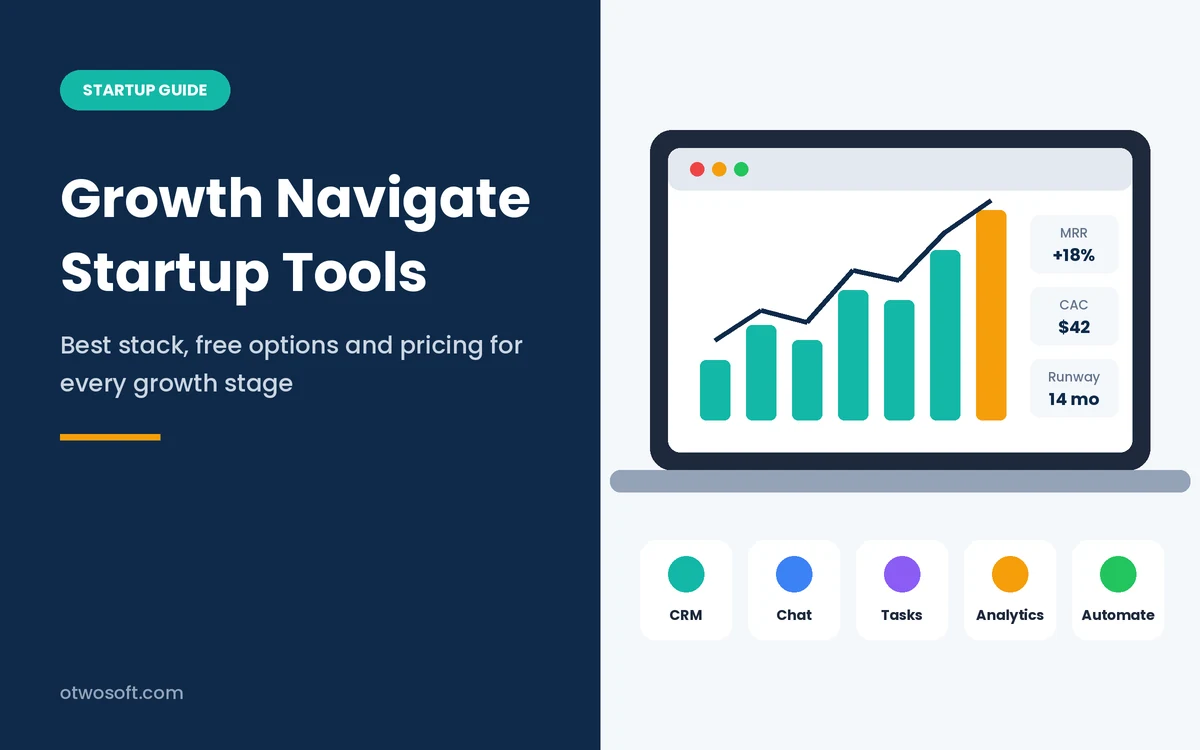
Growth navigate startup tools are the software platforms a young company uses to find customers, run its team, measure traction and control cash without hiring a separate department for each job. A working stack covers six areas: customer relationship management (CRM), team communication, project management, analytics, automation and finance. Founders who match these tools to their stage spend less money and get cleaner data for every decision that follows.
The main benefits are speed, visibility and a lower cost per task. A five-person team with a free CRM, a shared workspace and Google Analytics 4 (GA4) can track leads, assign work and read user behavior after a single afternoon of setup. Most of these platforms run as cloud-based solutions, so nothing needs installing on a server and seats grow with headcount.
Startups rely on these platforms for four recurring jobs: winning customers, coordinating people, measuring product use and protecting runway. The sections below explain what each tool category does, which free plans hold up under real work and what a stack costs at each stage. Later sections cover the metrics worth weekly attention, plus a five-step method for building the stack. You will find the accelerator credits and export resources that most tool lists skip as well.
What Are Growth Navigate Startup Tools?
They are cloud software products that help an early-stage company acquire customers, organize work, read data and manage money from one connected setup. Each tool handles a single job, while integrations pass data between them so founders stop copying numbers from one spreadsheet into another.
The category reaches wider than any single app. A typical early stack pairs a startup CRM such as HubSpot with Slack for chat, Notion as the shared workspace, GA4 for analytics and Zapier as the automation layer. Venturz takes a different route by bundling a CRM, website builder, email marketing, payments and an AI co-founder assistant into one startup platform.
What Does Growth Navigate Mean for Startups?
Growth navigate describes the practice of steering a startup’s growth with data from its tools instead of guesswork. The phrase joins two ideas: growth, measured through revenue, users and retention, plus navigation, meaning the weekly decisions about where to spend time and money next.
A founder searching for growth navigator solutions usually wants answers to three questions. Which channel brings the cheapest customers? Which features keep users coming back? How many months of cash remain in the bank? Each question maps to one tool category, so the tool stack and the growth plan develop side by side.
How Business Growth Technology Replaces Manual Tracking
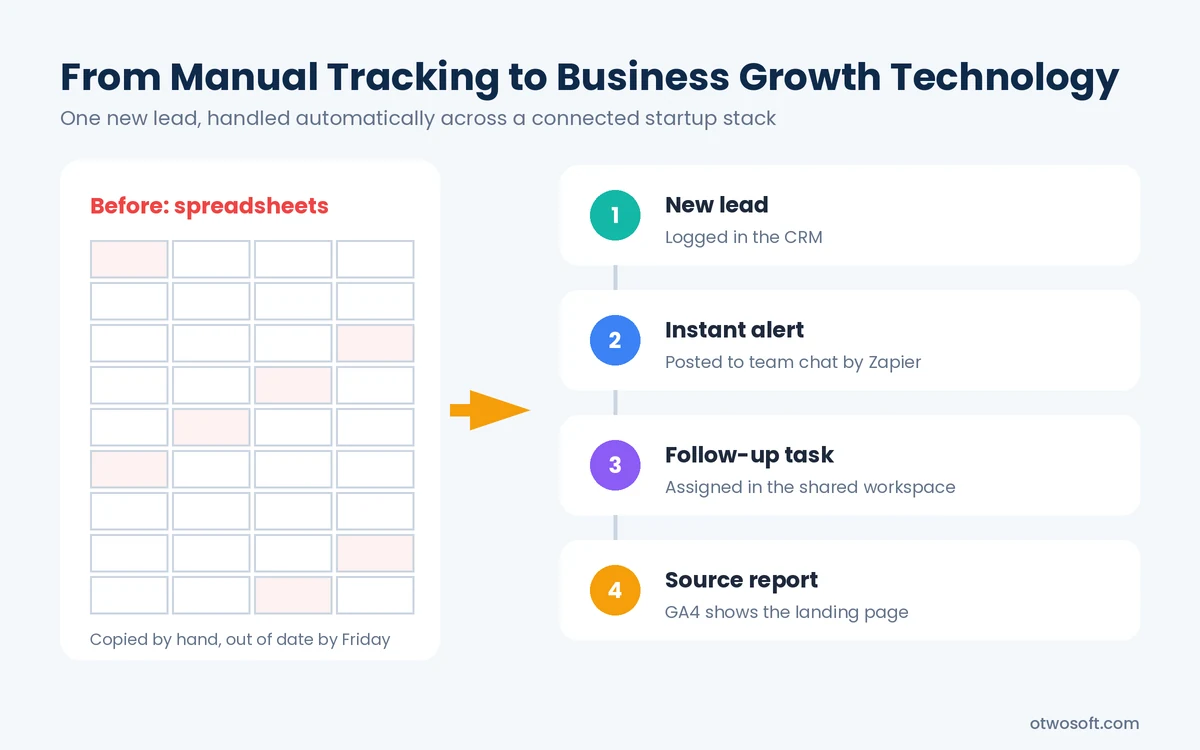
Business growth technology replaces scattered spreadsheets, inboxes and memory with live dashboards and automated records. A spreadsheet shows whatever someone typed last Friday, while a connected CRM shows every lead, email and deal stage the moment it changes.
The gain shows up in small daily moments. A new lead logged in HubSpot triggers a Slack alert through Zapier, the founder assigns a follow-up task in Notion, then GA4 later reports which landing page brought that lead in. Nobody rebuilds a report by hand, and nobody waits for a teammate to send the latest numbers.
Why Startup Business Tools Matter for Growth
Startup business tools matter since most young companies fail on execution and cash rather than on ideas, and a well-chosen stack makes both visible early. Survival data shows how narrow the margin is. The Bureau of Labor Statistics reports that 79.7% of private-sector establishments opened in 2014 survived their first year, 50.8% reached year five and only 34.9% were still operating in year ten.
Growth for startups depends on three outcomes that good tools support directly:
- Faster customer acquisition, with channel data showing which campaigns bring paying users
- Fewer internal delays, with tasks, owners and deadlines visible to the whole team
- Better cash decisions, with burn rate and runway reported monthly instead of quarterly
A weak product stays weak with any software. Good tools expose the problem months earlier, while the founder still has cash to change direction.
Core Categories of Business Growth Tools
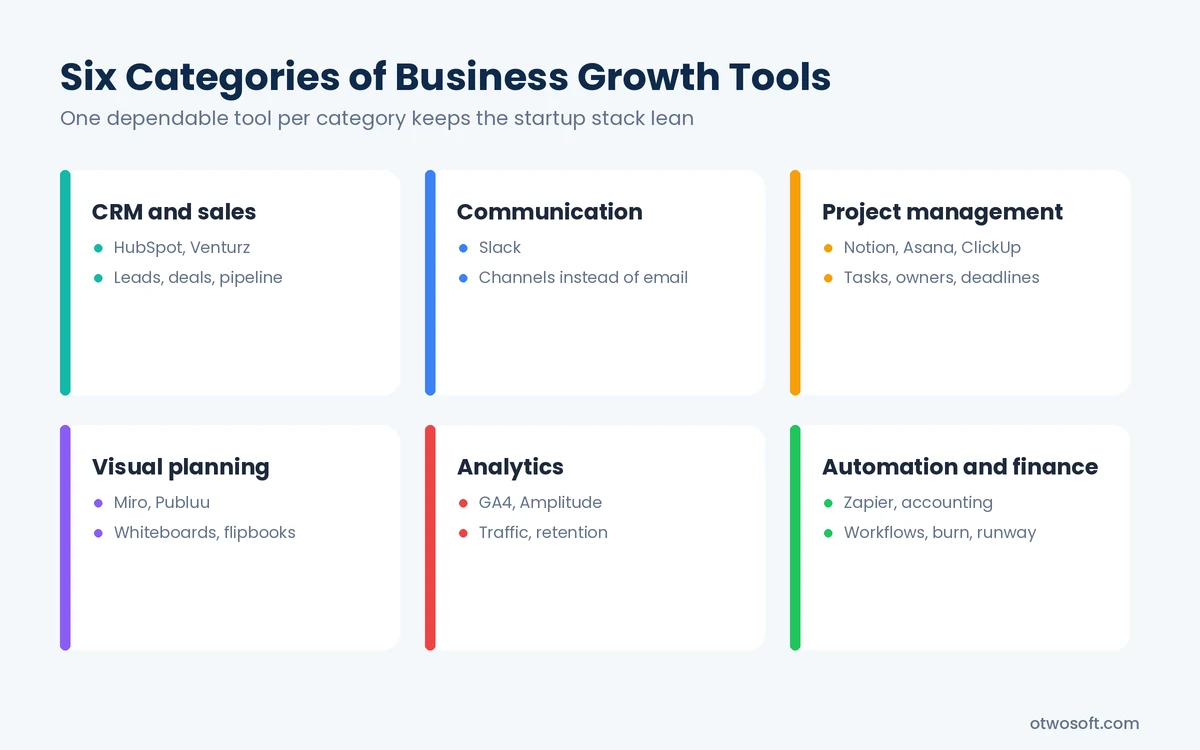
Business growth tools fall into six categories: CRM, team communication, visual planning, analytics, automation and finance. Each category answers one operational question, so a startup needs only one dependable tool per category.
CRM and Sales Tools
A CRM stores every lead, deal and customer conversation in one record, so sales and marketing work from the same facts. HubSpot offers a free CRM for up to two users, and its Starter plan lists at $20 per seat per month, with lower promotional rates for new customers. HubSpot for Startups adds discounts of up to 90% in year one for eligible seed and Series A companies.
Venturz suits founders who want CRM, website, email and payments under one login during the idea stage. B2B startups with longer sales cycles tend to move to a dedicated CRM once more than one person sells, since shared pipelines need clear deal ownership.
Team Communication and Project Management Tools
Slack handles team conversation, while Notion, Asana, ClickUp and Airtable handle the work those conversations produce. Slack’s free plan keeps 90 days of message history, and the Pro plan costs $7.25 per user per month on annual billing.
Notion combines notes, wikis, databases and project boards, with its AI assistant included on the Business plan at $20 per member per month. Asana and ClickUp focus on tasks, dependencies and timelines, whereas Airtable works as a relational database with a spreadsheet interface. Our guide to team collaboration tools compares 15 platforms feature by feature, and the roundup of best productivity tools covers personal task and focus apps.
Visual Planning and Digital Publication Tools
Miro gives teams an infinite online whiteboard for brainstorming, user journeys, wireframes and sprint planning. The free plan keeps three boards editable at a time, and the Starter plan costs $8 per member per month billed yearly.
Publuu covers a different need: sales material. The platform converts a PDF to flipbook format with page-turn animation, branding, password protection and reader analytics. Startups use it as a brochure maker for pitch decks, product catalogs and partner one-pagers, then check which pages each prospect read before the follow-up call, often alongside a structured research dossier for target companies to personalize the outreach.
Analytics and Product Intelligence Tools
GA4 tracks where visitors come from and what they do on a website or app, while Amplitude explains how users behave inside the product. Google Analytics is free to use, with Analytics 360 available as the paid enterprise tier.
Amplitude’s free plan covers up to 2 million events per month, enough for most startups until well after launch. Product analytics answers questions GA4 handles poorly: which feature predicts retention, where new users drop out of onboarding and which customer cohort upgrades fastest. Together, the two platforms feed a startup KPI dashboard that founders can review in ten minutes each Monday.
Marketing and Workflow Automation Tools
Marketing automation sends campaigns and follow-ups on schedule, while workflow automation moves data between your other tools without manual copying. Passing messy data between apps can break segmentation, which is why applying data cleaning and normalization transformation rules keeps lead and product names consistent across platforms. Zapier is the common choice for the second job, with a free plan of 100 tasks per month and a Professional plan starting at $19.99 per month.
A typical first automation sends every new HubSpot form submission to a Slack channel and a Notion lead tracker. Teams adding AI to these workflows can see where AI agent development fits once a workflow outgrows simple triggers, backed by a structured enterprise knowledge base for AI agents so models answer from verified internal data.
Finance and Accounting Tools
Finance tools track cash in, cash out, burn rate and runway, the numbers that decide how long a startup survives. An accounting platform connected to the business bank account keeps the books current, while a simple runway model shows how a new hire or a pricing change affects the months of cash left.
The Small Business Administration advises founders to separate one-time launch costs from ongoing monthly costs, budget ongoing costs for at least one year and add roughly 10% for unexpected expenses. Software subscriptions belong in the monthly column, so every new tool shortens runway by a figure you can calculate in advance.
Best Free Tools for Startups and Growing Teams
The best free tools for startups and growing teams are HubSpot CRM, Slack, Notion, GA4, Miro, Amplitude, Zapier and ClickUp, each offering a free plan that supports real work. Free plans come with limits, and knowing those limits in advance prevents a forced upgrade at an awkward moment.
- HubSpot CRM, free for up to 2 users
- Slack, with 90 days of searchable message history
- Notion, with a free workspace and a trial of Notion AI
- GA4, with free web and app analytics
- Miro, with 3 editable boards
- Amplitude, with up to 2 million events per month
- Zapier, with 100 automated tasks per month
- ClickUp and Asana, with free plans for small teams (Asana caps its free plan at 2 users)
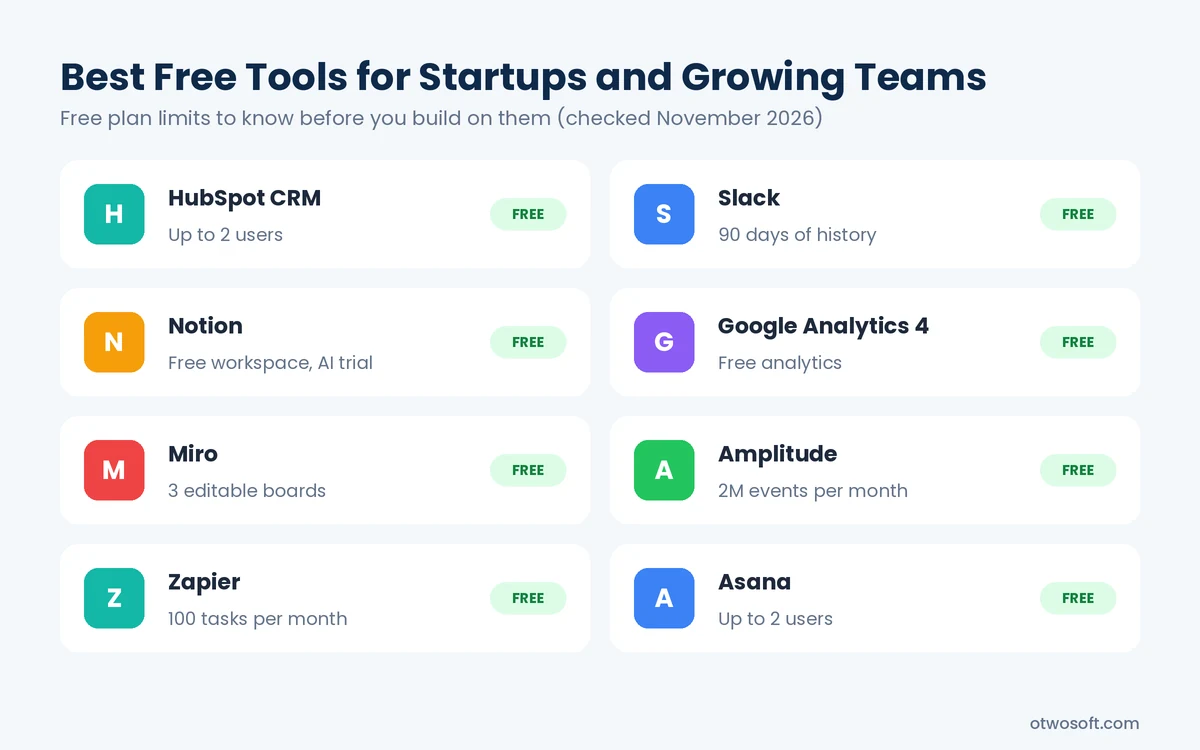
A free stack covers most idea-stage needs. Upgrade a tool when its limit blocks work every week, not when a sales email offers a discount.
Startup Planning Tools Comparison
HubSpot, Slack, Notion, GA4 and eight other platforms make up this startup planning tools comparison, sorted by main job, best stage, free plan and entry price. Prices are US dollar list prices from each vendor’s pricing page, checked in November 2026, with annual billing where noted.
| Tool | Main job | Best stage | Free plan | Entry paid price |
|---|---|---|---|---|
| HubSpot CRM | CRM and sales | Early traction | Up to 2 users | $20 per seat per month (Starter) |
| Venturz | All-in-one startup platform | Idea | Not listed on homepage | See vendor pricing page |
| Slack | Team communication | Idea | 90-day message history | $7.25 per user per month, annual |
| Notion | Docs, wiki, projects, AI assistant | Idea | Yes, with AI trial | $10 per member per month (Plus) |
| Asana | Project management | Early traction | Up to 2 users | $10.99 per user per month, annual |
| ClickUp | Tasks and projects | Early traction | Free Forever plan | $9 per user per month, annual |
| Airtable | Spreadsheet-style database | Early traction | Yes | $20 per seat per month, annual |
| Miro | Infinite online whiteboard | Idea | 3 editable boards | $8 per member per month, annual |
| Publuu | PDF to flipbook publishing | Early traction | Free start, no card | Paid plans on pricing page |
| Google Analytics 4 | Web and app analytics | Idea | Free | Analytics 360 (enterprise) |
| Amplitude | Product analytics and retention | Growth | Up to 2M events per month | Usage-based Plus plan |
| Zapier | Workflow automation | Early traction | 100 tasks per month | From $19.99 per month |
Overlap is the main risk in any comparison like this one. Notion, Asana, ClickUp and Airtable all manage projects, so pick one as the home for tasks and add another only when a specific gap appears.
Growth Tools Pricing: What a Startup Stack Costs Per Month
A lean startup stack costs $0 per month at the idea stage and about $146 at early traction for 5 people. At growth stage, a 15-person team pays about $569 at current list prices. The table below uses annual billing wherever the vendor offers it.
| Stage | Team size | Tools in the stack | Monthly cost |
|---|---|---|---|
| Idea | 1 to 3 | HubSpot CRM Free, Slack Free, Notion Free, GA4, Miro Free | $0 |
| Early traction | 5 | Slack Pro ($36.25), Notion Plus ($50), HubSpot Starter for 2 seats ($40), Zapier Professional ($19.99), GA4 ($0) | About $146 |
| Growth | 15 | Slack Pro ($108.75), Notion Business ($300), HubSpot Starter for 5 seats ($100), Miro Starter for 5 members ($40), Zapier Professional ($19.99), Amplitude Free ($0) | About $569 |
Growth tools pricing changes often, and promotional rates hide the standard price that arrives at renewal. Build the budget on standard list prices, then treat any discount as extra runway. HubSpot’s $20 Starter seat, for example, drops to a promotional rate for new customers only.
Per-seat pricing scales with headcount, so a stack costing $146 for 5 people roughly quadruples by 15 people. Usage-based tools such as Zapier and Amplitude scale with activity instead, which makes task and event limits worth a quarterly check. Teams whose subscription costs climb past the value delivered can compare that spend against custom software development for the one workflow that matters most.
Choosing a Business Growth Platform by Startup Stage
Choose a business growth platform by matching it to your current stage: lean tools before product-market fit, CRM and analytics at early traction, automation and product analytics at scale. The startup vs growth stage question decides almost every purchase, since a tool that saves hours at 50 customers only adds friction at 5.
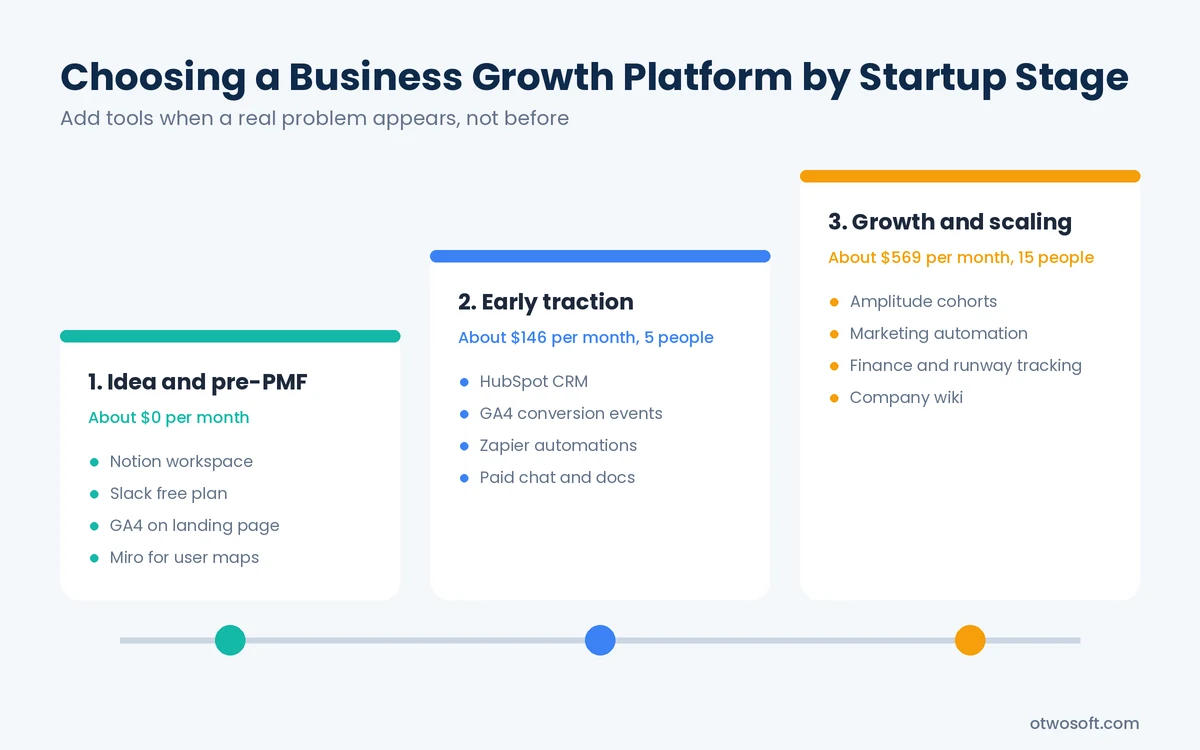
Idea and Pre-Product-Market-Fit Stage
Keep the stack to a workspace, a chat tool and free analytics until users prove they want the product. Notion for notes and customer interviews, Slack for team talk, GA4 for the landing page and Miro for mapping user problems cover this stage at no cost.
Premature scaling is the specific risk here. Research from Startup Genome found that 70% of the startups in its dataset scaled prematurely, and 93% of those never passed $100,000 in monthly revenue. Paying for heavy software before demand exists is a smaller version of the same mistake.
Early Traction Stage
Add a CRM and proper event tracking once paying customers arrive. HubSpot’s free or Starter CRM tracks leads and deals, GA4 conversion events show which channels convert, and Zapier removes the first round of repeated copy-paste work.
The growth trajectory of a startup becomes measurable at this point. Weekly figures for new leads, conversion rate and customer acquisition cost (CAC) replace gut feeling, so the founder can see whether growth comes from one channel or several.
Growth and Scaling Stage
Layer in product analytics, marketing automation and stronger finance tracking once revenue repeats month after month. Amplitude shows retention by cohort, automation handles onboarding emails, and finance tools watch burn closely as headcount rises.
Faster hiring creates new tool needs at this stage, including permissions, onboarding checklists, a company wiki and documented processes. A shared habit for recording decisions, such as written meeting minutes after every planning call, keeps a 15-person team aligned without extra meetings.
Startup Metrics Your Tools Should Track
Your tools should report six numbers every week or month: CAC, lifetime value (LTV), burn rate, runway, monthly recurring revenue (MRR) and retention. Each number comes from a specific tool, so plan the stack and the metrics together.
- Customer acquisition cost (CAC) equals total sales and marketing spend divided by new customers won, with HubSpot and GA4 supplying the inputs.
- Lifetime value (LTV) estimates the gross profit one customer brings over the full relationship, using billing data.
- Burn rate shows net cash spent per month, taken from the accounting platform.
- Runway equals cash in the bank divided by monthly net burn, expressed in months.
- MRR adds up all active subscription revenue for the month, split into new, expansion and churned revenue.
- Retention measures the share of users or customers still active after a set period, which Amplitude reports by cohort.
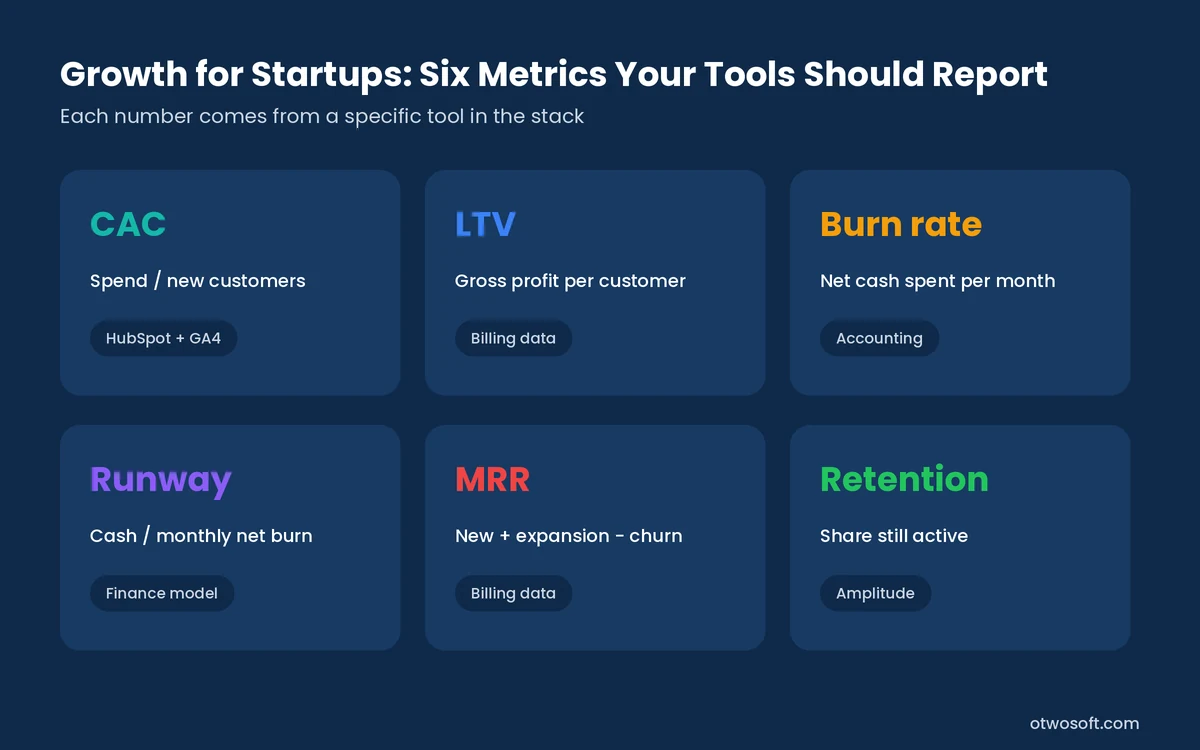
MRR deserves extra attention, since a single total hides movement underneath. A month with $2,000 in new MRR and $1,800 in churned MRR looks flat on the headline figure, yet the churn signals a retention problem that needs a fix before more marketing spend. Our list of KPI examples includes worked calculations for CAC, LTV and runway.
Business Acceleration Tools and Startup Programs
Business acceleration tools include accelerator programs and cloud credit offers that cut early costs by thousands of dollars. Tool lists rarely mention these programs, yet the credits change the real cost of a stack more than any discount code.
- AWS Activate gives self-funded startups $1,000 in credits, with up to $5,000 for selected founders, and up to $200,000 for Portfolio startups referred by an approved accelerator or investor.
- Google for Startups Cloud Program offers up to $200,000 in cloud credits over two years, rising to $350,000 for AI startups.
- Microsoft for Startups advertises up to $150,000 in credits for eligible Azure services.
- HubSpot for Startups offers up to 90% off in year one for eligible seed and Series A companies.
- Stripe Atlas incorporates a Delaware C corporation or LLC for a one-time $500 fee, followed by $100 per year for registered agent service.
- Y Combinator invests $500,000 in every accepted company, with $125,000 on a post-money SAFE for 7% plus $375,000 on an uncapped MFN SAFE.
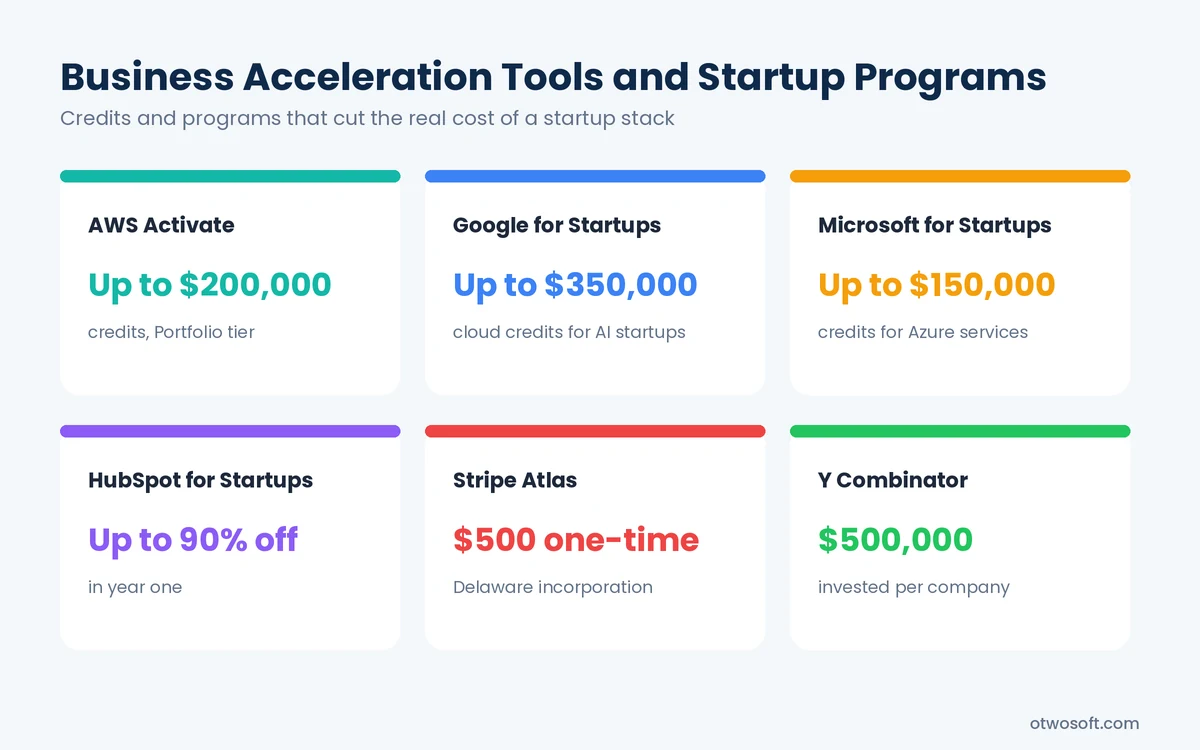
Techstars and 500 Global (formerly 500 Startups) run accelerator programs with their own investment terms. Carta manages cap tables, AngelList connects founders with angel investors, while Product Hunt and Indie Hackers serve as launch and community channels for early user acquisition.
International Growth Tools for Expanding Startups
International growth tools help a startup research foreign markets, accept payments across borders and register a company that overseas investors and customers trust. Expansion makes sense once the home market shows repeatable sales.
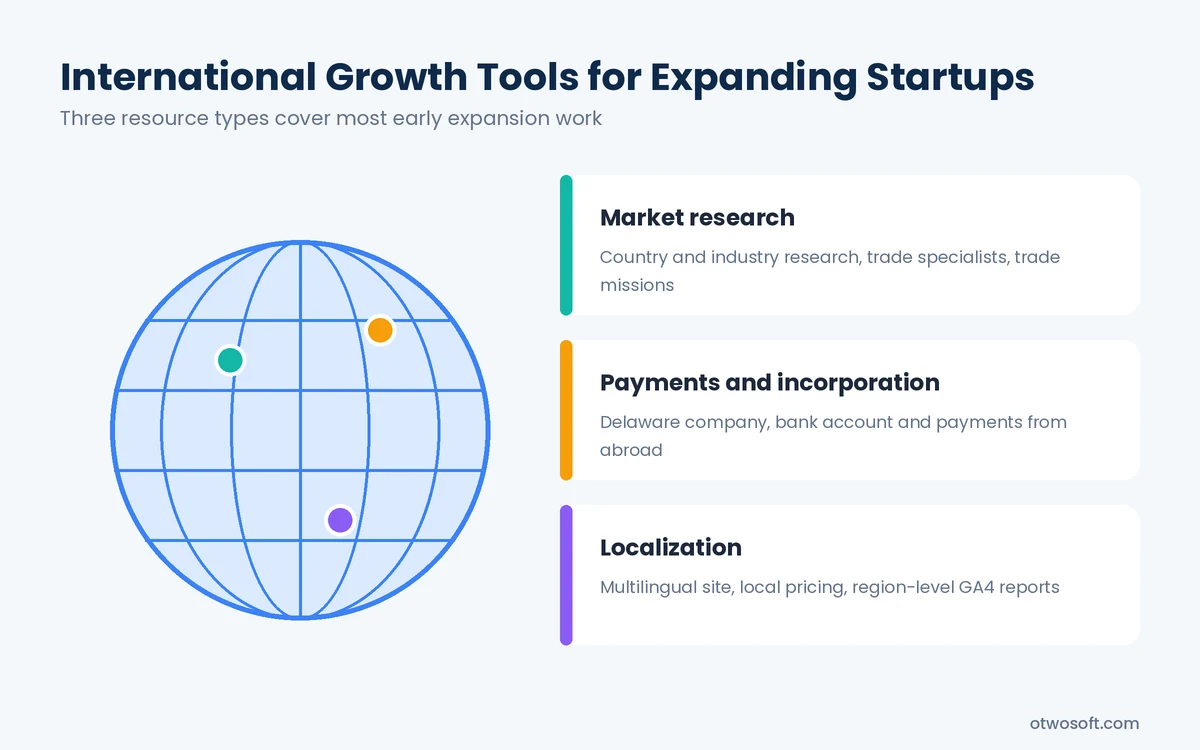
Three resource types cover most early expansion work:
- Market research, where the International Trade Administration publishes country and industry research for U.S. companies, connects exporters with trade specialists and organizes trade missions
- Payments and incorporation, where Stripe Atlas lets founders apply from almost anywhere in the world to form a Delaware company, open a bank account and accept payments
- Localization, where a multilingual website, local currency pricing and region-specific GA4 reports show whether a new market responds before any office or local hire
Localization costs far less when it is planned in the first build. Founders scoping a product for several regions can start with web development services or mobile app development and plan language support from the first sprint.
Startup Tools Mistakes That Drain Your Budget
Five startup tools mistakes drain budgets most often: buying before product-market fit, paying for overlap, ignoring integrations, keeping unused seats and budgeting on promotional rates.
- Buying before product-market fit. Heavy CRM and automation setups built for a five-person team take setup hours that belong to customer interviews.
- Paying for overlapping tools. Notion, ClickUp and Asana running side by side split tasks across three places, and nobody trusts any of them.
- Ignoring integrations. Tools that cannot exchange data create silos and double entry, so confirm native integrations or Zapier support before you subscribe.
- Keeping unused seats. Former contractors and inactive users stay on per-seat plans for months unless someone runs a quarterly seat audit.
- Budgeting on promotional rates. Discounted first-year prices expire, and the standard price arrives with the renewal invoice.
Startup tooling stack consolidation protects runway better than any single tool choice. Review every subscription each quarter, cancel anything nobody opened in 30 days and record the saving as added runway.
How to Build Your Startup Tools Stack Step by Step
To build a startup tools stack, start from your problems, map each one to a category, pick one tool per category, connect the tools and measure the results every quarter.
- List your three biggest operational problems, such as lost leads, missed deadlines or an unclear cash position.
- Match each problem to one tool category: CRM for lost leads, project management for missed deadlines and finance tracking for cash.
- Pick one tool per category and run its free plan with real work for two to four weeks.
- Connect the tools through native integrations or Zapier so new data flows without manual copying.
- Measure whether each tool saves time or moves a metric such as CAC, conversion rate or runway, then keep, replace or cancel it.
Repeat the cycle each quarter as the team and revenue grow. Startups that need software built around a unique workflow, such as a client portal or an internal dashboard, often get better value from one focused build than from several overlapping subscriptions. Our AI development services cover AI features for products that already have users, including setting up proper training, validation, and test data splits before deploying proprietary models.
Conclusion
Growth navigate startup tools give a small team the reach of a much larger one when the stack stays lean, connected and matched to the company’s stage. Free plans for customer relationship management (CRM), team communication, analytics and automation cover the idea stage at no cost. Paid CRM seats, product analytics and finance tracking earn their place once revenue starts repeating.
Track CAC, LTV, burn rate, runway, MRR and retention from the start. Claim the accelerator and cloud credits your company qualifies for, then audit every subscription each quarter so cloud-based solutions keep adding runway instead of draining it. If your startup needs software that off-the-shelf tools cannot cover, contact O2SOFT to scope a custom build or visit the O2SOFT homepage for the full list of services.
Frequently Asked Questions
What tools does an early-stage startup need first?
An early-stage startup needs a workspace, a chat tool, a free CRM and web analytics first. Notion, Slack, HubSpot CRM and GA4 cover those four jobs on free plans, leaving the budget for product work until paying customers arrive.
How many startup tools does a small team need?
A small team needs five to seven tools, one for each core job. A typical set covers CRM, communication, projects, analytics, automation and finance, with a whiteboard such as Miro as an optional seventh. More tools than jobs points to overlap.
Are free startup tools enough for a new business?
Free plans cover most needs for a new business until the team passes two users on some tools or hits a usage cap. HubSpot CRM and Asana limit free plans to 2 users, Slack keeps 90 days of history and Zapier allows 100 tasks per month, so growing teams usually upgrade one tool at a time.
What is the difference between startup and growth stage tools?
Startup stage tools focus on learning what customers want, while growth stage tools focus on repeating and scaling what already works. Idea-stage stacks rely on free workspaces and basic analytics, whereas growth-stage stacks add paid CRM seats, product analytics, automation and tighter finance tracking.
What growth opportunities do startup tools create?
Startup tools create growth opportunities by showing which channels, features and customer segments produce revenue. GA4 reveals the best traffic sources, Amplitude identifies the features tied to retention and a CRM shows which deal types close fastest, so founders can put money where results already appear.
How much do startup tools cost per month?
A startup stack costs $0 per month at the idea stage, about $146 for a 5-person team at early traction and about $569 for 15 people at growth stage. Each figure uses current list prices with annual billing, so promotional discounts lower the first-year bill.
Which CRM works well for a new startup?
HubSpot CRM works well for most new startups, with a free plan for up to 2 users and a Starter plan at $20 per seat per month. Venturz fits founders who want CRM, website, email and payments in one platform during the idea stage.
Can startups get free credits for cloud and software tools?
Startups can claim six-figure cloud credits through programs such as AWS Activate (up to $200,000), Google for Startups Cloud Program (up to $350,000 for AI startups) and Microsoft for Startups (up to $150,000). HubSpot for Startups adds up to 90% off its software in year one.
What is premature scaling in a startup?
Premature scaling means spending on growth before the product has proven demand, such as hiring, heavy marketing or expensive software ahead of product-market fit. Startup Genome found that 70% of startups in its dataset scaled prematurely.
How often should a startup review its tool stack?
A startup should review its tool stack every quarter. Each review should cancel tools nobody opened in 30 days, remove unused seats and check whether promotional prices are about to renew at standard rates.
Which tools help a startup expand internationally?
Market research, incorporation and localization tools cover most early expansion work. The International Trade Administration provides country and industry research for U.S. companies, Stripe Atlas forms a Delaware company for founders abroad, and GA4 region reports show which markets respond.