


A research dossier for target company work is one sourced file that explains who a business is, how it earns money, plus who makes its decisions. Each fact links to a dated source, so a reader can check any claim instead of trusting a homepage pitch.
Verification is the main benefit. Checking every figure against a filing or registry record helps a team spot outdated revenue numbers, leadership exits or open lawsuits while there is still time to change course.
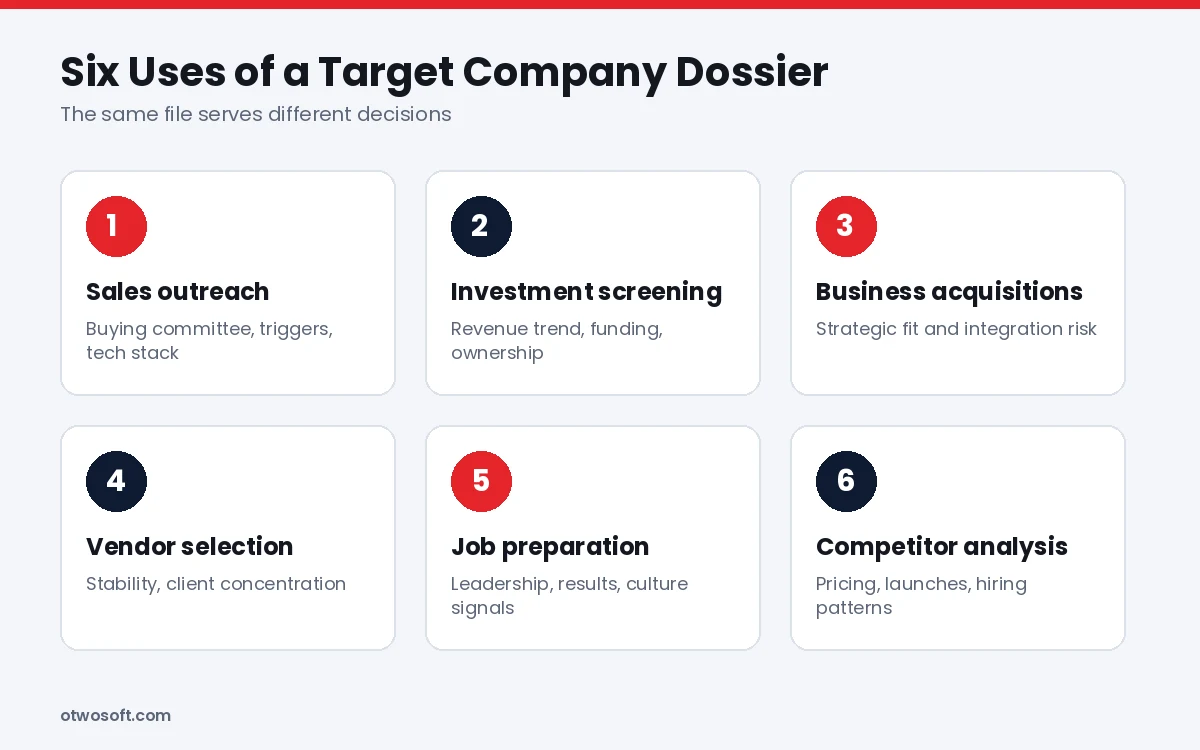
Teams use these files for six jobs: sales outreach, investment screening, business acquisitions, vendor selection, job preparation, plus competitor analysis. An investor usually reads financial performance first, while a sales rep starts with leadership changes or recent buying triggers.
The core parts are company identification, business model, leadership, financial performance, market position, digital presence, risks or opportunities, closed by an evidence log recording where each fact came from. The sections below cover each part, target company URL research, ownership checks, source tiers, AI-driven research dossier generation, a copy-ready template, plus common mistakes.
What Is a Target Company Research Dossier?
A target company research dossier is a structured report that combines verified facts about one organization with analysis, plus a recommended next step. The "target" is whichever company sits on the other side of your decision, whether a prospect, an acquisition candidate, a supplier, an employer or a rival.
Most dossiers follow a five-link chain of fact, evidence, analysis, implication, then action. A new warehouse announcement is the fact, while 40 forklift job postings in the same county serve as supporting evidence. The analysis reads both signals as possible fulfillment expansion, which could point to a systems budget for a logistics software vendor.
What Does a Target Dossier Mean?
A target dossier is a research file on the specific company you plan to sell to, buy, partner with or study. The phrase comes from mergers & acquisitions (M&A), where the "target" is the company being considered for purchase. Searchers sometimes confuse the term with Target Corporation, the Minneapolis retailer, though a target dossier covers that retailer only when Target Corporation is the account under review.
How Does a Research Dossier Differ from a Company Profile or a Due Diligence Report?
A company profile describes who a business is, while a research dossier recommends what to do about it. A due diligence report then tests whether an agreed deal is safe to close. The page ranges below are practical estimates from common practice rather than fixed standards.
The two processes differ by access, not length. A dossier relies on public or licensed information. Due diligence starts after both sides agree to proceed, usually under a letter of intent, when the buyer gains access to private records.
| Document | Depth | Typical length (estimate) | Main question | Main readers |
|---|---|---|---|---|
| Company profile | Basic facts | 1 page | Who is this company? | Marketing teams, sales development reps |
| Research dossier | Facts plus analysis | 3 to 20 pages, scaled to the decision | What should we do about this company? | Sales leaders, partners, executives |
| Due diligence report | Legal, financial, plus operational audit | Often 50 pages or more | Is this deal safe to close? | Investors, lawyers, acquirers |
What Are the Main Uses of a Company Research Dossier?
A company research dossier supports six main decisions, including sales outreach, investment screening, plus business acquisitions.
- Sales outreach: A rep who knows the buying committee, recent funding, plus current tech stack can open with a relevant problem instead of a generic pitch.
- Investment screening: Investors review revenue trends, funding history, debt levels, plus ownership structure before committing capital.
- Business acquisitions: Corporate development teams test strategic fit, then decide whether the target deserves formal due diligence.
- Vendor selection: Procurement teams review financial stability, client concentration, plus delivery record before a multi-year contract. For software vendors, the same checks appear in our guide to choosing a technical partner.
- Job preparation: Candidates study leadership, recent results, plus culture signals so interview answers connect to real company priorities.
- Competitor analysis: Strategy teams track a rival's pricing, product launches, hiring patterns, plus market position across several quarters.
What Sections Should a Research Dossier Include?
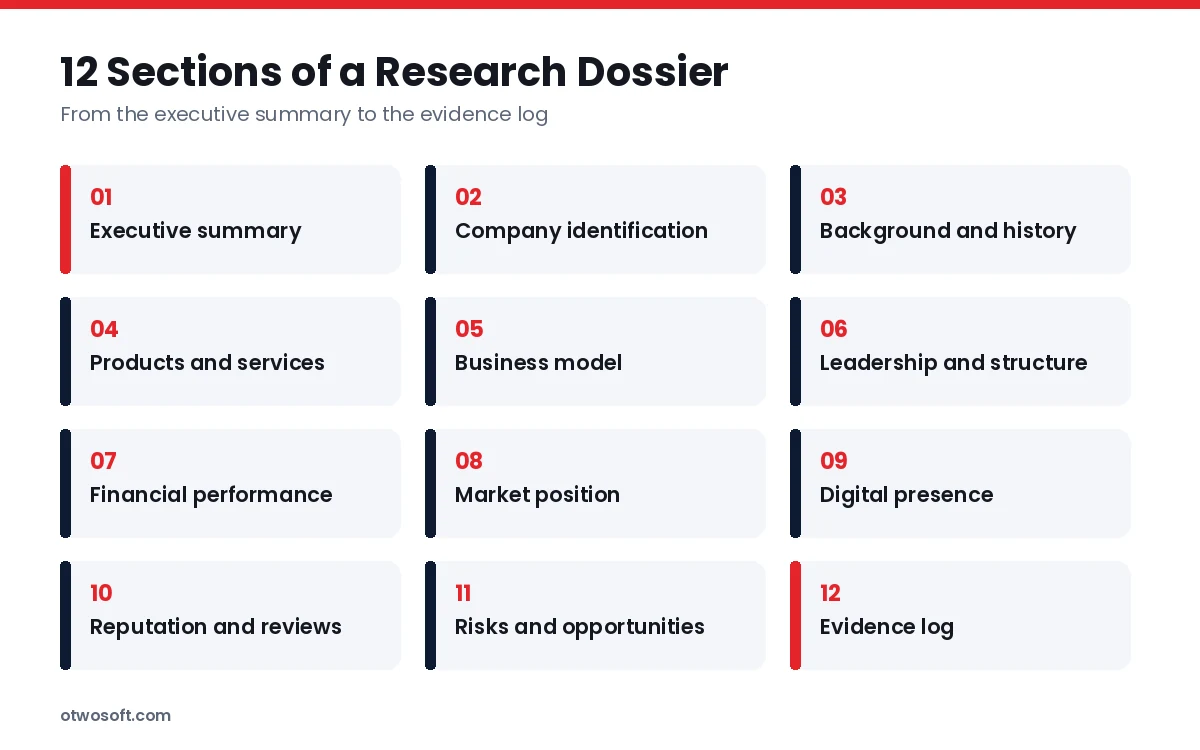
A complete research dossier includes 12 sections, starting with an executive summary through to an evidence log.
- Executive summary: Three findings, the top two risks, plus one recommended action, kept to a single page.
- Company identification: Official name, website URL, headquarters, founding year, industry, ownership structure, plus registration details such as the state of incorporation.
- Background and history: Founders, milestones, acquisitions, name changes, plus ownership shifts since founding.
- Products and services: Core offerings, pricing model, target customers, plus distribution channels.
- Business model: Revenue streams, customer segments, partners, suppliers, with a note on which stream drives most income.
- Leadership and organizational structure: Executives, board members, reporting lines, workforce size, plus office locations.
- Financial performance: Revenue, profit, funding, assets, liabilities, plus growth rate, each labeled with its reporting period. Use the KPI examples that fit the target's industry so the numbers carry meaning.
- Market position and competitors: Market share estimates, direct or indirect rivals, plus the target's competitive advantage.
- Digital presence: Website quality, search visibility, social channels, app ratings, plus technology stack signals.
- Reputation and reviews: Customer reviews, employee feedback, plus press coverage.
- Risks and opportunities: A SWOT analysis with notes on legal, regulatory, financial, operational risk.
- Evidence log: Source title, URL, publication date, access date, plus the finding taken from each source.
Smaller decisions rarely need every section. A pre-call sales brief usually needs sections 1, 2, 6, 9, 10, while an acquisition screening file uses all twelve at full depth.
How Do You Research a Target Company Step by Step?
To research a target company, follow eight steps that move from the decision you need to make to a dated report you can share.
- Write the decision in one sentence, for example "Decide by March 31 whether to shortlist this vendor."
- Confirm the legal entity through a business registry to avoid researching a similarly named company.
- Run target company URL research to confirm the official domain with its linked pages.
- Collect primary sources first, including filings, registry records, annual reports, plus investor relations pages.
- Add secondary sources such as industry publications, news coverage, job postings.
- Fill each section, labeling every claim as a confirmed fact, a company claim, a third-party estimate or unverified.
- Write the target company analysis, covering the SWOT, open risks, unanswered questions, plus the recommended action.
- Date the file, give it a version number, then set a refresh reminder.
Skipping steps 2 & 3 causes the most expensive errors. Two firms named "Apex Logistics" can operate in different states, so a dossier built on the wrong one wastes every hour that follows. Software teams apply the same logic in a discovery process, where the problem gets defined before anyone estimates the work.
How Does Target Company URL Research Work?
Target company URL research confirms that a website belongs to the company you are studying before any data is pulled from it. Lookalike domains, expired domains bought by strangers or regional subsidiaries with separate sites can all produce a dossier that describes the wrong business.
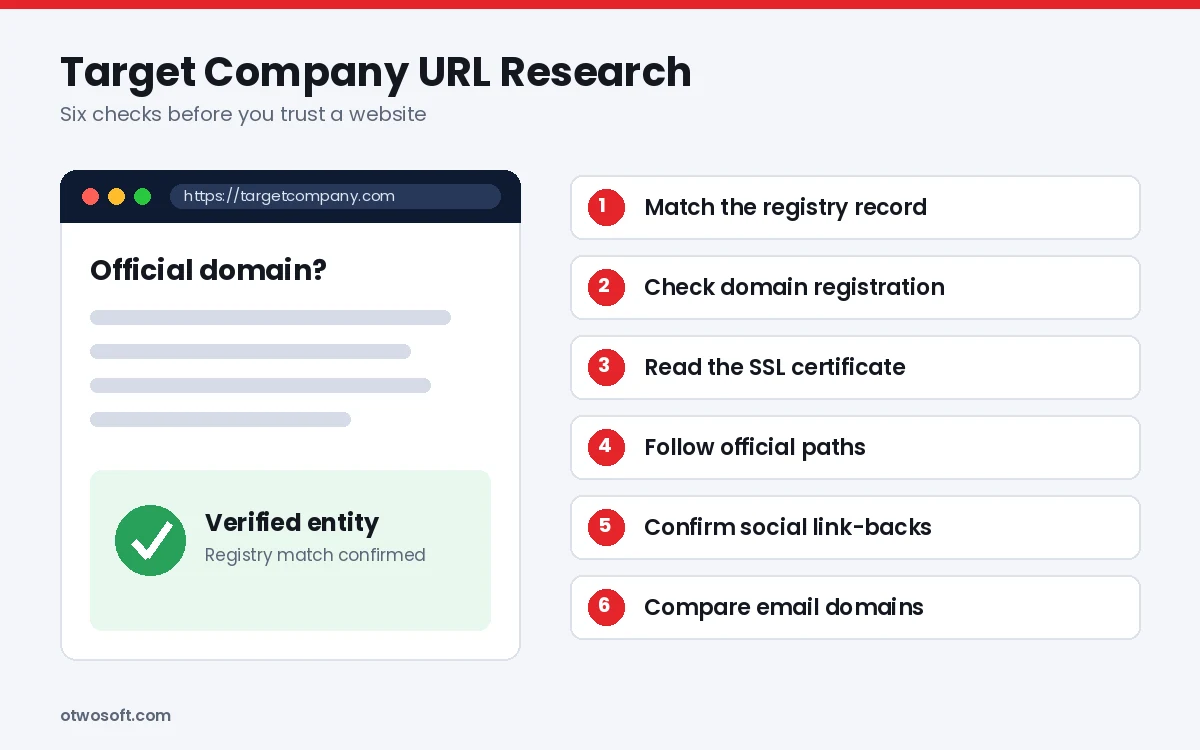
Run these six checks in order:
- Match the registry record. The company name, plus address on the site should match the state business registry or, for UK firms, the Companies House record.
- Check the domain registration. An ICANN Lookup query usually shows the registration date, plus registrar details, though some registrant fields are redacted for privacy. A company claiming 20 years of history on a domain created last month deserves a closer look.
- Read the SSL certificate. Organization-validated (OV) or extended-validation (EV) certificates list the verified legal entity name under the CA/Browser Forum requirements. Domain-validated (DV) certificates only prove control of the domain, so they say nothing about the organization.
- Follow the official paths. Genuine company sites link consistently to Careers, Investor Relations, Newsroom, plus legal pages like the privacy policy.
- Confirm social link-backs. The LinkedIn company page, along with other official profiles, should point to the same domain the website lists.
- Compare email domains. Press contacts, job postings, plus filings should use the same domain as the website.
Teams with a list of several hundred accounts automate these checks in bulk, which turns URL research into the first working stage of research dossier generation.
How Do You Verify Who Owns a Target Company?
To verify who owns a target company, separate six roles that research often blurs together: legal entity, parent company, subsidiaries, beneficial owners, shareholders, directors versus executives.
- The legal entity is the registered company that signs contracts, shown in the state registry.
- A parent company controls the entity, while subsidiaries are separate legal entities the parent controls.
- Beneficial owners are the people who ultimately own or control the business, even when shares sit in a holding company.
- Shareholders hold equity, though a small stake rarely brings control.
- Directors sit on the board to oversee strategy, whereas executives run daily operations.
Public companies disclose much of this structure. The annual 10-K lists significant subsidiaries in Exhibit 21, while investors who acquire more than 5% of a voting class file Schedules 13D or 13G. Private ownership is harder to confirm; record it as "claimed" unless a filing or signed document supports it.
Which Sources Are Most Reliable for Company Research?
The most reliable sources for company research are government records with regulatory filings, followed by the company's own official documents.
Public companies file three report types on SEC EDGAR: the annual 10-K, the quarterly 10-Q, plus the 8-K for material events between reports. Patent activity sits in USPTO records. Federal case indexes can be searched through PACER, which requires a registered account, charging per-page fees for most documents.
Paid databases such as Dun & Bradstreet or PitchBook help with private firms, though their revenue figures are usually modeled estimates rather than reported numbers.
| Tier | Source types | Best for | Trust note |
|---|---|---|---|
| Tier 1: Government & regulatory | SEC filings, state business registries, patent records, court records | Financials, ownership, legal status, patents | Highest trust; still check the filing date |
| Tier 2: Company official | Annual reports, investor relations decks, newsroom, careers pages | Strategy, products, leadership, hiring | The company's own view; verify claims |
| Tier 3: Independent publications | Industry publications, trade associations, reputable news, paid business databases | Market position, deals, competitors | Strong; check methodology, plus date |
| Tier 4: Crowd signals | Customer reviews, employee reviews, forums, social media | Sentiment, culture, recurring complaints | Leads only; never a sole source |
How Do Customer and Employee Reviews Support Company Research?
Reviews support company research as evidence of patterns, not as standalone facts. Research dossier target company reviews come from two places. Customer review platforms show how buyers experience the product, while employee review sites hint at culture, management quality, plus turnover risk.
The four screening rules below are editorial guidelines we suggest for consistency, not industry standards:
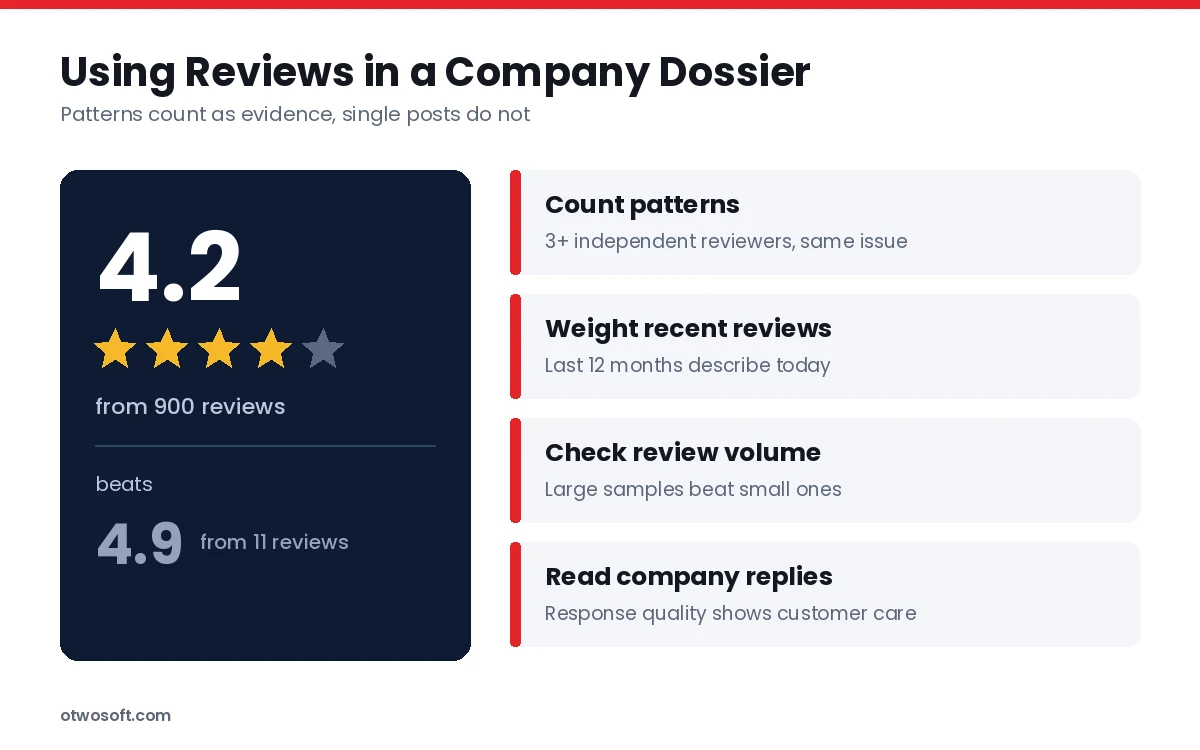
- Count patterns rather than single posts, treating a complaint as a finding once several independent reviewers raise the same issue. Three is a practical starting threshold.
- Weight recent reviews more heavily. A 12-month window is a reasonable default, since older posts may describe a previous product version or management team.
- Check review volume, as a 4.9 rating from 11 reviews says far less than a 4.2 rating from 900.
- Read the company's replies, since specific responses to negative reviews show how the business handles complaints.
User reviews of dossier tools help a team judge accuracy, plus support quality. A test run on a company you already know well still gives a more reliable verdict.
How Often Should Each Data Point Be Rechecked?
Each data point has its own suggested review interval, ranging from weekly checks on legal news during an active deal to yearly checks on market sizing. Adjust these intervals to the stakes of your decision.
Write the access date next to every figure. A revenue number without a reporting period is a frequent reason two analysts reach opposite conclusions from the same dossier.
| Data point | Suggested review interval | Refresh trigger |
|---|---|---|
| Leadership & board | Every 30 days | Press release, LinkedIn update, 8-K filing |
| Funding & ownership | Every 90 days | New funding round, acquisition, Form D filing |
| Revenue & profit | Each new reporting period | Quarterly or annual filing |
| Headcount & locations | Every 90 days | Hiring surge, layoff news |
| Products & pricing | Every 60 days | Pricing page change, launch announcement |
| News & legal events | Weekly during an active deal | News alert, court docket update |
| Market size & share | Every 12 months | New industry report |
How Does AI Automate Research Dossier Generation?
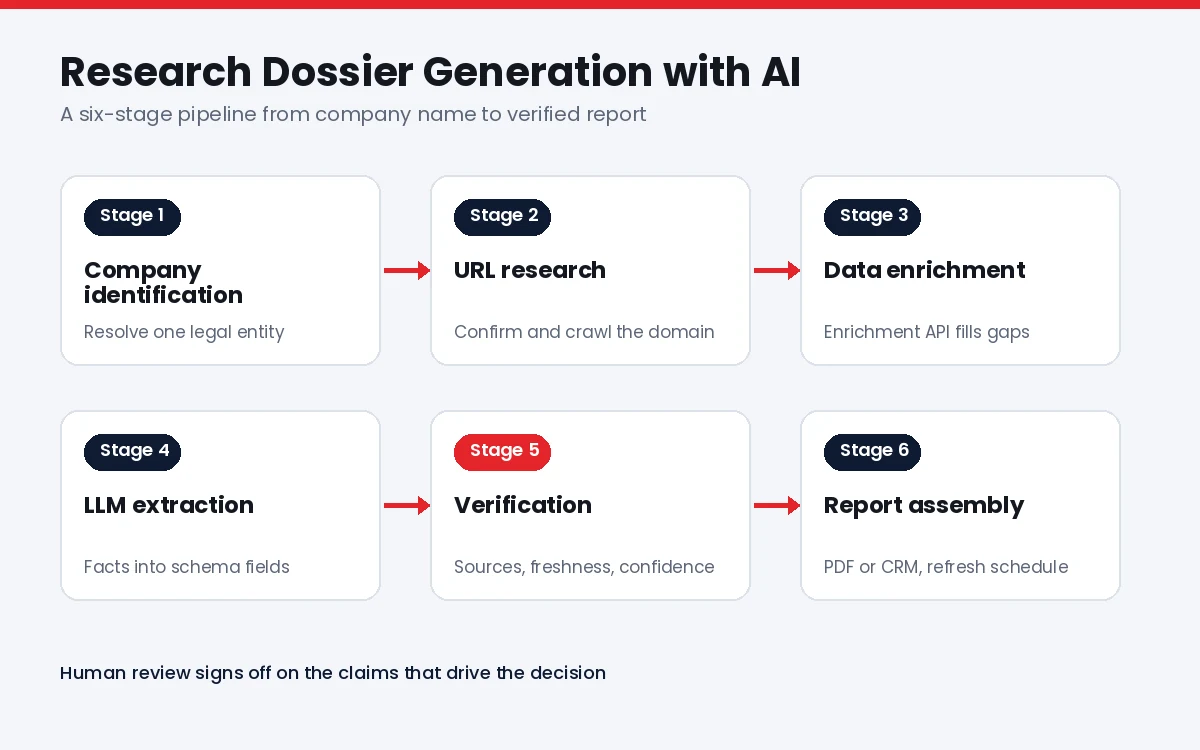
AI automates research dossier generation through a six-stage pipeline: company identification, URL research, data enrichment, extraction, verification, report assembly. A well-built system produces a first draft in minutes, so analysts spend their time checking the claims that drive the decision.
- Company identification: The system resolves the input name or domain to one legal entity, using registry data to separate subsidiaries from similarly named firms.
- URL research: Automated checks confirm the official domain, then crawl the About, Careers, Investor Relations, plus Newsroom pages.
- Data enrichment: An enrichment API, a service that returns attributes such as industry, headcount, plus funding for a given domain, fills fields the website does not publish.
- Extraction: A large language model (LLM), the engine behind most generative AI systems, reads the collected pages, then writes each finding into a fixed schema field with its source URL.
- Verification: Rules flag any figure without a source, any claim resting on a single Tier 4 source or any date past its review interval.
- Report assembly: The system builds the final dossier, exports it to PDF or a CRM record, then schedules the next refresh.
Summarizing supplied documents into a fixed format is one of the clearer appropriate tasks for generative AI, since the model works from evidence you provide rather than from memory.
What Fields Should an Automated Dossier Store?
Every field in an automated dossier should carry four attributes: the value, the source URL, the access date, plus a confidence label of confirmed, claimed, estimated or unverified.
Here is one verified record in that format:
- Finding: Company headquarters
- Value: Austin, Texas
- Source: State business registry entry
- Access date: The date the analyst checked the record
- Confidence: Confirmed
- Verification note: Matches the legal entity name on the official website
Storing records this way lets the system refresh one field without rebuilding the whole file, while auditors get a clean evidence log.
How Do You Check That a Source Supports the Claim?
An analyst checks a citation by confirming the source says what the dossier claims, not merely that the link works. Use four checks on every figure, date or name that drives the decision:
- Open the cited page, then find the exact passage behind the claim.
- Match the number, the date or the entity name word for word, including the reporting period.
- Confirm the page describes the same legal entity, not a subsidiary or a similarly named firm.
- Record the passage location, such as a filing section or page number, in the evidence log.
Automated systems fail in predictable ways when these checks are skipped. A model may fill an empty field with a plausible number or merge two similarly named companies. Other common errors include an outdated executive pulled from a cached page, or a real link attached to a claim the page never makes. Registry-based entity matching, cache expiry rules, automated passage matching reduce these errors, though a human reviewer should still sign off.
How Can Teams Build This Pipeline?
Most teams start with a spreadsheet template, then automate the slowest steps once the research volume grows. O2SOFT builds this kind of pipeline for sales, investment, procurement teams. Our AI agent development work covers the agents that crawl, extract, verify. Our AI development services handle model selection, retrieval design, plus evaluation.
How Is Private Company Research Different from Public Company Research?
Private company research relies on indirect evidence, since private firms do not file the annual or quarterly reports public companies submit to the SEC.
Five indirect sources help fill the gap for private firms:
- State registry records show the legal name, registered agent, officers, plus current status, such as active or dissolved.
- Form D filings on SEC EDGAR disclose issuer-reported offering amounts, plus securities sold under Regulation D exemptions, though they do not show a company's total funding history.
- Uniform Commercial Code (UCC) filings at the state level show which lenders claim a security interest in company assets, which signals a financing relationship rather than financial distress.
- Court dockets show contract disputes, vendor claims, plus employment lawsuits.
- Hiring data, such as open roles or headcount trends on LinkedIn, offers an indirect signal of growth or contraction that needs confirmation from other sources.
Label every private company revenue figure as an estimate unless the number comes from audited statements shared under a nondisclosure agreement (NDA).
| Research area | Public company | Private company |
|---|---|---|
| Financial records | 10-K, 10-Q, 8-K filings | Estimates, Form D notices, audited statements under NDA |
| Ownership disclosure | Exhibit 21, Schedules 13D & 13G | State registry, press releases, investor announcements |
| Leadership | Proxy statements, filings | Company website, LinkedIn, registry officer lists |
| Verification method | Filing cross-checks | Multiple indirect sources pointing to the same conclusion |
What Legal and Ethical Limits Apply to Company Research?
Company research stays on safe ground when it uses lawfully accessible or licensed data, avoids deception, keeping personal information to what the decision needs. Public availability alone does not remove privacy, licensing or contract restrictions.
- Access rules: Registry records, filings or published pages are normal research sources, while hacking, borrowed passwords, or scraping behind logins are not.
- Pretexting: Posing as someone else to extract information creates legal exposure. The Federal Trade Commission enforces the Gramm-Leach-Bliley Act (GLBA), which governs how covered financial institutions protect customer financial information.
- Personal data: Executive names or titles fit a business dossier, while home addresses or family details do not. The California Attorney General explains which businesses fall under the California Consumer Privacy Act (CCPA), plus the specific rights granted to residents.
- Automated collection: Respecting robots.txt is good practice, but RFC 9309 states that robots.txt rules are not a form of access authorization. Site terms, licensing or privacy law still apply.
Teams running AI research at scale need written rules on retention, access, plus model use. Our article on why AI transformation is a problem of governance covers those rules in more depth. The points above are general information, not legal advice.
Target Dossier Template You Can Copy
The research dossier template below lists each section, the fields to fill, the best source, plus the confidence label to record.
| Section | Fields to fill | Best source | Confidence label |
|---|---|---|---|
| Executive summary | 3 findings, 2 risks, 1 action, owner, deadline | Your analysis | Not applicable |
| Company identification | Official name, website URL, headquarters, founding year, industry, ownership type, registration details | State registry, official website | Confirmed |
| Ownership | Parent company, subsidiaries, major shareholders | Filings, registry, press releases | Confirmed or claimed |
| Leadership | Founders, executives, board members, workforce size | Company site, filings, LinkedIn | Confirmed or claimed |
| Business model | Revenue streams, customer segments, pricing, partners | Annual report, pricing page | Claimed |
| Financial performance | Revenue, profit, funding, assets, liabilities | SEC filings, Form D, audited statements | Confirmed or estimated |
| Market position | Competitors, market share, competitive advantage | Industry publications, trade associations | Estimated |
| Digital presence | Search visibility, social channels, app ratings | Public pages, review sites | Estimated |
| Risks & opportunities | SWOT, legal, regulatory, operational risks | Court records, news, filings | Mixed |
| Evidence log | Title, URL, publish date, access date, finding | All sources | Not applicable |
Add two short logs under the template: an unknowns log for questions you could not answer, with a contradiction log for sources that disagree. Both logs show the reader where the evidence is thin. Teams that outgrow a document template often move it into an internal tool built with custom software development or a web development company, with dashboards shaped through UI/UX design.
What Does a Finished One-Page Summary Look Like?
A finished one-page summary states the decision, the strongest findings, the main risks, a confidence level, plus the next action with a named owner. The research dossier example below uses a fictional vendor to show the format.
Company: Northline Freight Systems, a privately held logistics software vendor founded in 2014 with headquarters in Columbus, Ohio.
Decision: Shortlist Northline for a three-year warehouse software contract by March 31.
Findings: Two independent databases estimate revenue between $18 million to $24 million, while 62 open engineering roles suggest product investment.
Client proof: Three enterprise clients listed on the website were confirmed through public case studies.
Risks: One client appears to supply about 40% of revenue. A 2025 contract dispute remains open in federal court.
Confidence: Medium, since every financial figure is an estimate.
Next action: The procurement lead requests audited statements under NDA by February 15.
Common Mistakes in Target Company Research
Eight mistakes cause most unreliable dossiers:
- Wrong entity selection from a similar company name or a regional subsidiary.
- Company claims presented as verified facts.
- Revenue figures compared across different reporting periods.
- Single-source findings on revenue, ownership or legal status.
- AI output accepted without anyone opening the cited pages.
- Missing access dates that hide how old a figure is.
- Negative findings left out to make a recommendation look stronger.
- No refresh schedule once the file has been shared.
Final Thoughts
A research dossier for target company decisions works when every fact carries a source, a date, plus a confidence label. The 12 sections, from company identification to the evidence log, give sales, investment, procurement teams one verified picture of an account.
Start with the decision, then confirm the entity through target company URL research before collecting Tier 1 sources. Treat reviews as patterns rather than proof, keep financial performance figures tied to their reporting periods, then refresh the file on a schedule.
Automated research dossier generation shortens the work considerably, provided the pipeline stores a source with every field, while a person approves the final call. Teams that want this built into their workflow can talk to the O2SOFT team or visit the O2SOFT homepage to see recent client work.
Frequently Asked Questions
How long should a research dossier be?
Length should follow the decision. As a practical estimate, a sales brief runs 1 to 3 pages, while a vendor or acquisition screening dossier runs 5 to 20 pages. Formal due diligence is a separate process with its own, usually longer, reports.
How often should a company research dossier be updated?
Update the dossier after every major event, such as a funding round, leadership change, acquisition, or quarterly filing. During an active deal, check news, plus court records every week.
Can AI create a complete research dossier?
AI can draft most sections within minutes, but a person must verify the figures, dates, plus names that drive the decision. Automated research dossier generation works best with source rules, confidence labels, plus a human sign-off step.
Is a research dossier the same as due diligence?
A dossier uses public or licensed data to decide whether a company deserves deeper attention. Due diligence uses private records after both sides agree to proceed, often starting from an existing dossier.
Where should research on a target company start?
Research on a target company starts at the state business registry with the official website, using target company URL research to confirm the domain before any third-party source is opened.
Do customer and employee reviews count as evidence?
Research dossier target company reviews count as supporting evidence once several recent, independent reviewers describe the same issue. A single review, positive or negative, stays in the unverified column.
Does a target company dossier cover Target Corporation?
A research dossier target company file covers Target Corporation only when the retailer is the account under review. "Target company" means whichever business you are researching.